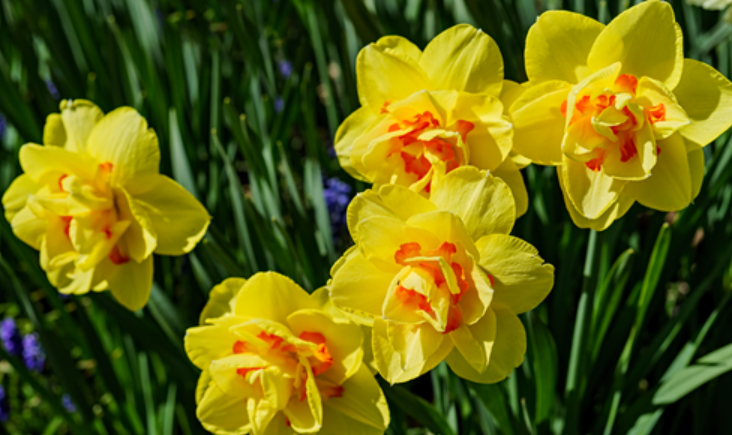
The daffodil is one of the most universally recognized flowers in the world. With its distinctive combination of a ring of outer petals — technically called the perianth — surrounding a central tubular or trumpet-shaped corona, the daffodil has a silhouette unlike almost any other flower. This two-part structure, simple yet elegant, has made it a symbol of spring, renewal, and hope across cultures and centuries.
Daffodils belong to the genus Narcissus, which contains between 50 and 100 wild species native primarily to the Iberian Peninsula and the Mediterranean region. From these wild origins, plant breeders have developed over 32,000 registered cultivars — one of the largest collections of named varieties within any single bulb genus. Yet the daffodil’s distinctive flower form is not unique to Narcissus alone. Dozens of other plants produce blooms with the same essential architecture of a corona surrounded by spreading perianth segments, or capture the same overall impression through similar proportions, coloring, and posture.
The daffodil’s characteristic form evolved as a highly efficient pollination mechanism. The central corona acts as a landing platform and nectar guide for long-tongued bees and other pollinators, while the spreading outer petals serve as visual signals visible from a considerable distance. Plants that have independently evolved similar structures have often done so for the same functional reasons, arriving at the same elegant solution through different evolutionary paths.
Globally, daffodils are among the most economically important ornamental bulbs, with the Netherlands alone exporting over 1.5 billion daffodil bulbs annually. Their cultural significance spans ancient Greece — where the narcissus featured prominently in mythology — to modern Wales, where the daffodil serves as the national flower, worn proudly on St. David’s Day each March 1st.
Whether you are a gardener seeking to extend the daffodil season, a florist looking for year-round alternatives, or simply someone captivated by this distinctive flower form, the plant world offers a rich and varied collection of daffodil-like blooms to discover.
Also Read: Flowers That Look Like Daisies
Narcissus Paperwhite (Narcissus papyraceus)
Paperwhite Narcissus is the closest relative to the classic daffodil, producing clusters of small, pure white flowers with a shallow, flat corona surrounded by six spreading perianth segments on stems 12 to 18 inches tall. Unlike most daffodils, it requires no cold period to bloom and can be forced into flower indoors in just 3 to 5 weeks from planting, making it one of the most popular winter-blooming bulbs worldwide. Its intensely sweet fragrance is one of the most powerful of any daffodil-form flower.
Jonquil (Narcissus jonquilla)
Jonquil is a delicate, rush-leaved species narcissus producing clusters of 2 to 6 small, golden-yellow flowers per stem with a short, cup-shaped corona and sweetly fragrant perianth segments on plants 10 to 14 inches tall. It is native to Spain and Portugal, growing on rocky hillsides and in open scrubland, and has been cultivated in gardens for over 400 years. Its clustered, multi-flowered arrangement distinguishes it clearly from single-flowered trumpet daffodils, giving it a lighter, airier quality.
Snowflake (Leucojum vernum)
Spring Snowflake produces nodding, bell-shaped flowers of pure white with distinctive green or yellow tips on each petal segment, carried on stems 6 to 12 inches tall in early spring. While the individual flower form differs from a classic daffodil, the overall presentation — a solitary or paired bloom nodding atop a clean, leafless stem above strap-like foliage — is strongly reminiscent of a daffodil in posture and proportion. It naturalizes freely in damp, humus-rich soils beneath deciduous trees.
Also Read: Tallest Perennial Flowers For Pots And Containers
Hymenocallis (Hymenocallis littoralis)
Spider Lily, or Peruvian Daffodil, is one of the most convincingly daffodil-like of all tropical bulbs, producing flowers with a distinct central corona — resembling a daffodil’s trumpet — surrounded by six long, narrow, spidery white perianth segments on stems 18 to 24 inches tall. The structural similarity to a daffodil is so strong that it is commonly sold under the name Peruvian Daffodil in the bulb trade. It is native to coastal regions of tropical America and thrives in warm, humid conditions.
Pancratium (Pancratium maritimum)
Sea Daffodil is a striking Mediterranean bulb that produces pure white flowers with a prominent central cup surrounded by six spreading, strap-like perianth segments that closely mirror the classic daffodil silhouette. It grows 12 to 18 inches tall and blooms in late summer on sandy coastal dunes and beaches from Portugal to the Middle East. It is one of the few daffodil-like flowers adapted to grow in pure sand just meters from the sea, and it carries a powerful, sweet evening fragrance.
Sternbergia (Sternbergia lutea)
Winter Daffodil produces bright, glossy, golden-yellow flowers with six smooth, overlapping perianth segments forming a deep, goblet-like shape on stems just 4 to 6 inches tall. While it lacks a distinct separate corona, the deep, cup-shaped form of the whole flower closely mimics the overall impression of a small daffodil, and it blooms in autumn — precisely when true daffodils are dormant — filling an important seasonal gap. It is native to the Mediterranean and Middle East, where it blooms after the first autumn rains.
Eucharis (Eucharis amazonica)
Amazon Lily produces elegant white flowers with a distinct green-flushed central cup surrounded by six broad, flat, snow-white perianth segments on stems 18 to 24 inches tall, creating a flower form that is strikingly similar to a white daffodil. It grows from bulbs native to the Andean foothills of Colombia and Peru and blooms two to three times per year in warm conditions, making it one of the most reliable tropical daffodil-like flowers for indoor and sheltered garden cultivation.
Also Read: Flowers That Look Like Peonies
Zephyranthes (Zephyranthes candida)
White Rain Lily produces solitary, upright, funnel-shaped flowers of pure white with six clean perianth segments and a central mass of yellow stamens on stems 8 to 12 inches tall, blooming in flushes triggered by rainfall. The overall proportions — a single white flower with spreading segments held upright on a clean, leafless stem above grassy foliage — are unmistakably daffodil-like, though without a distinct separate corona. It naturalizes freely in warm climates, spreading to form dense, grassy clumps.
Crinum (Crinum x powellii)
Powell’s Swamp Lily produces clusters of large, funnel-shaped flowers in shades of white and soft pink with prominent, spreading perianth segments and a long, curved floral tube on stems 2 to 3 feet tall. The individual flowers share the daffodil’s essential structure of a corona-like tube and spreading outer segments, scaled up to a considerably larger size. Established clumps can carry 6 to 8 flower stems simultaneously and produce blooms with a light, pleasant fragrance in late summer.
Narcissus Tazetta (Narcissus tazetta)
Bunch-flowered Narcissus produces clusters of 4 to 8 small flowers per stem, each with a shallow, orange or yellow corona surrounded by white or cream perianth segments, creating a cloud of miniature daffodil-form blooms on plants 12 to 18 inches tall. It is one of the most ancient of all cultivated narcissus, with records of its cultivation in China dating back over 1,000 years and in the Mediterranean region for much longer. It is forced by the millions for Chinese New Year celebrations across East Asia.
Also Read: Flowers That Look Like Bells
Amaryllis (Hippeastrum x hybridum)
Hippeastrum, commonly sold as amaryllis, produces enormous, trumpet-shaped flowers up to 8 inches across in shades of red, pink, white, orange, and bicolor with six broad, overlapping perianth segments surrounding a prominent, tube-like center — a form that is essentially a dramatically enlarged daffodil structure. Each bulb produces one to two stems carrying 2 to 6 flowers each, and the global hippeastrum market is valued at several hundred million dollars annually, with billions of bulbs sold for winter indoor flowering.
Brodaea (Brodiaea elegans)
Harvest Brodaea produces clusters of funnel-shaped, violet-blue to lavender flowers with a distinct inner tube surrounded by six spreading perianth segments on slender stems 10 to 16 inches tall. The structural similarity to a small daffodil is enhanced by its leafless stem and the way individual flowers face outward and upward from the cluster. It is native to California and Oregon, growing in dry, grassy hillsides and oak woodlands, and blooms in late spring and early summer when true daffodils have finished.
Habranthus (Habranthus robustus)
Rain Lily produces solitary, funnel-shaped flowers in shades of soft pink with yellow throats, held at a characteristic 45-degree angle on stems 8 to 12 inches tall — a posture that distinguishes it from the upright Zephyranthes but retains the same essential daffodil-like proportions of a clean stem topped with a single, outward-facing bloom. It blooms in waves triggered by summer rainfall and is native to South America, where it grows in grassy fields and rocky hillsides in Brazil and Argentina.
Alstroemeria (Alstroemeria aurea)
Peruvian Lily produces clusters of trumpet-like flowers in shades of yellow, orange, pink, red, white, and bicolor with distinctive inner petals marked by streaks and spots, carried on stems 2 to 3 feet tall. The individual flowers share the daffodil’s characteristic shape of a prominent floral tube opening into spreading perianth segments, and the plant’s upright, leafy stem topped with a cluster of outward-facing blooms echoes the daffodil’s overall posture. Alstroemeria is one of the top five most important cut flowers commercially, with billions of stems sold worldwide annually.
Also Read: Flowers That Look Like Butterflies
Neomarica (Neomarica caerulea)
Walking Iris produces flattened, iris-like flowers with three large, sky-blue outer falls and three smaller, banded inner petals, carried on flat, fan-like stems 2 to 3 feet tall. While the flower structure leans toward iris, the overall proportions and presentation of a single bloom nodding above flat, sword-like foliage strongly recall the daffodil’s character. It gets its common name from its habit of producing plantlets where the flowering stem bends to the ground, effectively walking across the garden bed over time.
Tulbaghia (Tulbaghia violacea)
Society Garlic produces rounded clusters of small, tubular, lilac-purple flowers, each with a distinct inner corona-like tube and spreading perianth lobes, on upright stems 18 to 24 inches tall — a miniaturized daffodil structure reproduced in soft lavender tones. It blooms almost continuously in warm climates and is exceptionally drought-tolerant once established. Despite its common name, its garlic-like fragrance is mild enough to make it perfectly acceptable as an ornamental border plant.
Narcissus Bulbocodium (Narcissus bulbocodium)
Hoop Petticoat Daffodil is a wild species narcissus with a dramatically enlarged, flared, funnel-shaped corona dominating six tiny, narrow, rush-like perianth segments, creating the impression of a tiny golden crinoline or hoop petticoat. It grows just 4 to 6 inches tall and naturalizes freely in short grass and meadow conditions, producing sheets of golden-yellow blooms in early spring. In optimum conditions, it can produce over 50 bulbs per square foot within a few years of initial planting.
Ipheion (Ipheion uniflorum)
Spring Starflower produces solitary, upright, star-shaped flowers in pale lavender-blue to white with a faint, honey-like fragrance on stems just 6 to 8 inches tall, with a central cluster of stamens that creates a subtle corona-like focal point within the six spreading segments. While lacking a distinct separate corona, the single flower on a clean, leafless stem above strap-like foliage presents the same essential visual language as a small daffodil. It naturalizes with exceptional enthusiasm, forming dense carpets within just a few seasons.
Also Read: Types of Elephant Ear Plants
Ornithogalum (Ornithogalum thyrsoides)
Chincherinchee produces dense, pyramidal clusters of star-shaped white flowers with a greenish central stripe on each petal on stems 12 to 20 inches tall. Individual flowers have six spreading segments surrounding a central mass of stamens that creates a subtle corona-like impression, and the overall upright stem topped with an outward-facing flower cluster echoes the daffodil’s posture. It is an outstanding cut flower with a remarkable vase life of up to four weeks.
Calostemma (Calostemma purpureum)
Garland Lily is a rare Australian bulb that produces clusters of small, tubular, pink to lilac flowers with a distinct fringed corona — genuinely daffodil-like in its two-part structure of inner cup and outer perianth — on leafless stems 12 to 18 inches tall. It blooms in late summer and autumn, long after the spring daffodil season has ended, and is native to the floodplains and river banks of inland southeastern Australia. Its fringed corona is among the most structurally similar to a true narcissus corona of any non-Narcissus bulb.
Calochortus (Calochortus albus)
White Globe Lily produces nodding, globe-shaped flowers of pure white with a distinctive interior of finely fringed, nectary-bearing petals creating a central focal structure surrounded by broader outer segments — an arrangement that captures the daffodil’s essential two-zone flower architecture. It grows 12 to 24 inches tall and is native to the chaparral and woodland slopes of California. There are approximately 70 species of Calochortus, many with this same inner-and-outer petal differentiation that mirrors the daffodil’s corona-and-perianth structure.
Lycoris (Lycoris radiata)
Red Spider Lily produces clusters of vivid scarlet flowers with dramatically recurved, wavy perianth segments and extremely long, arching stamens on leafless stems 12 to 18 inches tall, blooming in late summer and autumn without any foliage present. While more dramatic and spidery than a classic daffodil, the basic structure of a funnel-shaped floral center with spreading outer segments on a clean, leafless stem is fundamentally daffodil-like. In Japan, it is deeply embedded in cultural and spiritual symbolism, associated with the autumn equinox.
Nerine (Nerine bowdenii)
Bowden Lily produces clusters of funnel-shaped flowers with six glistening, wavy, rose-pink perianth segments reflexing gracefully backward on leafless stems 18 to 24 inches tall in autumn. The cluster of outward-facing, funnel-form flowers on a clean, leafless stem strongly echoes the daffodil’s overall presentation, and the shimmering, crystalline texture of the petals gives nerine flowers a unique, jewel-like quality. It is native to the foothills of the Drakensberg mountains in South Africa.
Also Read: Perennials With Deep and Strong Roots
Agapanthus (Agapanthus praecox)
Common Agapanthus produces globe-like clusters of 50 to 100 individual tubular, funnel-shaped flowers in shades of blue, lavender, and white, each one structurally similar to a small, tubeless daffodil, carried in a dramatic spherical head on stems 2 to 4 feet tall. While the massed, globular flower head is quite different from a single daffodil bloom, individual florets within the cluster share the same funnel-and-segment architecture. It is one of the most widely grown garden perennials in temperate and subtropical climates worldwide.
Eustoma (Eustoma grandiflorum)
Prairie Gentian produces upright, funnel-shaped flowers in shades of purple, lavender, white, and pink with a prominent, trumpet-like floral tube opening into five or six broad, overlapping segments — a form that strongly echoes the daffodil’s corona-and-perianth structure in a non-bulbous, annual plant. It grows 18 to 36 inches tall and is one of the most important cut flowers in the world, with a vase life of up to 21 days. It is native to the warm grasslands of the American Southwest and northern Mexico.
Galanthus (Galanthus elwesii)
Giant Snowdrop produces pendant white bells with three large outer perianth segments spreading outward and three shorter inner segments marked with green — a two-tier flower structure that, while smaller and nodding rather than upright, shares the daffodil’s fundamental architecture of differentiated inner and outer floral zones. It grows 4 to 8 inches tall and is one of the earliest flowering bulbs of the year, blooming in January and February. The snowdrop collecting community rivals the daffodil world in enthusiasm, with rare varieties selling for hundreds of pounds each.
Clivia (Clivia miniata)
Kaffir Lily produces dense clusters of funnel-shaped, orange-red to yellow flowers with six broad, overlapping perianth segments surrounding a prominent central opening on stems 18 to 24 inches tall. The individual flower structure — a funnel of spreading segments with a distinct inner tube — is fundamentally daffodil-like, and the overall upright cluster on a strong, leafless stem above broad, strap-like foliage echoes the daffodil’s characteristic presentation. It is one of the most shade-tolerant of all bulbous plants, thriving in positions far too dark for true daffodils.
Sprekelia (Sprekelia formosissima)
Jacobean Lily produces one of the most exotic and dramatic of all daffodil-like flowers, with three upright, velvety scarlet upper petals and three lower petals that curve downward and inward to form a prominent central channel — a unique arrangement that shares the daffodil’s essential two-part structure of inner structure and outer spreading segments, expressed in a completely distinctive way. It grows on bulbs producing single stems 12 to 18 inches tall and is native to Mexico and Guatemala, where it grows on rocky hillsides in dry, scrubby conditions.
Also Read: Best Decorative Grasses for Shady Areas
Daffodil Garlic (Allium neapolitanum)
Neapolitan Garlic produces loose, rounded clusters of pure white, star-shaped flowers with six spreading segments surrounding a small, greenish central corona on stems 12 to 18 inches tall in spring. The central corona, while small, is genuinely present and gives the flower a subtle but recognizable daffodil-like quality beyond its overall white, spring-flowering, bulbous character. It naturalizes freely in well-drained soils and is native to the Mediterranean region, where it carpets olive groves and roadsides in spring.
Cooperia (Cooperia drummondii)
Evening Rain Lily produces solitary, pure white, funnel-shaped flowers with six long, slender perianth segments surrounding a central tube on leafless stems 6 to 10 inches tall, opening in the evening and releasing a sweet fragrance. The single white flower on a clean stem with its distinct inner tube and spreading outer segments is structurally and visually very close to a small white daffodil. It is native to Texas and Mexico, where it blooms in flushes after summer rain, sometimes producing thousands of flowers per meadow simultaneously.
Amaryllis Belladonna (Amaryllis belladonna)
Belladonna Lily, or Naked Lady, produces clusters of large, funnel-shaped flowers in shades of soft pink, rose, and white with six broad, spreading perianth segments and a prominent, curved floral tube on leafless stems 18 to 24 inches tall, blooming in late summer without any foliage. The structural similarity to a large daffodil is considerable — a clean, leafless stem topped with a cluster of funnel-form flowers with spreading outer segments — and the leafless “naked” stem echoes the daffodil’s own leafless flower scape. It is native to the Western Cape of South Africa.
Sparaxis (Sparaxis elegans)
Wandflower produces small, upright, cup-shaped flowers in shades of orange, pink, red, and white with a contrasting dark-centered yellow throat, on wiry stems 12 to 18 inches tall in spring. The central throat marking creates a subtle corona-like focal point within the spreading perianth segments, mimicking the daffodil’s two-zone flower architecture on a miniature scale. It is native to the Western Cape of South Africa, a region that produces a disproportionate share of the world’s bulbous plant diversity.
Also Read: Best Drought Tolerant Lawn Grasses
Babiana (Babiana stricta)
Baboon Flower produces clusters of cup-shaped flowers in shades of blue, purple, pink, red, and white with a distinct lighter or darker central zone creating a corona-like focal point on plants 6 to 12 inches tall. The central contrast zone within the flower effectively replicates the visual impact of a daffodil’s corona against its perianth, making babiana one of the most convincingly daffodil-inspired of all small South African bulbs. It is pollinated primarily by long-proboscid flies in its native Western Cape habitat.
Fritillaria (Fritillaria meleagris)
Snake’s Head Fritillary produces solitary, nodding, bell-shaped flowers in a remarkable purple-and-white checkerboard pattern on slender stems 8 to 12 inches tall. While the nodding posture differs from the upright daffodil, the single bloom on a clean, leafless stem above sparse, grass-like foliage presents the same essential visual language. The exquisite tessellated pattern of its petals makes it one of the most intricately beautiful of all daffodil-like bulb flowers in the spring garden.
Rhodophiala (Rhodophiala bifida)
Oxblood Lily produces clusters of small, funnel-shaped flowers in deep blood-red with six spreading perianth segments and a distinct inner floral tube on leafless stems 10 to 14 inches tall, blooming in late summer and autumn. The funnel-and-segment structure is closely daffodil-like, and the leafless stem and strap-like foliage that appears separately after flowering add to the daffodil parallel. It is native to Argentina and Uruguay and is exceptionally cold-hardy for a South American bulb, tolerating temperatures well below freezing.
Albuca (Albuca canadensis)
Sentry-in-a-Box produces racemes of nodding, yellow-striped white flowers, each with six perianth segments surrounding a central cluster of fused inner segments that create a distinct inner structure within the flower — a daffodil-like two-zone architecture expressed in pale, nodding bells on stems 18 to 24 inches tall. Some species, including the popular Albuca spiralis, produce attractively coiled, spiral foliage that is ornamental in its own right even outside of flowering season. It is native to South Africa and thrives in dry, well-drained conditions.
Also Read: Types of Grass Used on Golf Courses
Urginea (Drimia maritima)
Sea Squill produces tall, dramatic spikes of small, star-shaped white flowers with six spreading perianth segments on leafless stems that can reach an impressive 4 to 5 feet in height, blooming in late summer and autumn from enormous bulbs that can weigh up to 6 pounds — among the largest of any Mediterranean bulb. The leafless, soaring stem topped with outward-facing white flowers shares the daffodil’s characteristic naked-stem, clean-bloom presentation, scaled up to an architectural level of drama rarely seen in bulbous plants.
Nothoscordum (Nothoscordum gracile)
Graceful Onion produces loose, rounded umbels of small, cream-white flowers with six perianth segments and a faint central striping that creates a delicate inner marking echoing the daffodil’s corona on stems 12 to 18 inches tall. It blooms in spring and again in autumn in mild climates and naturalizes freely, sometimes too freely, in warm garden conditions. Despite belonging to the onion family, it produces no garlic or onion scent, making it a more garden-friendly ornamental than many of its relatives.
Triteleia (Triteleia laxa)
Ithuriel’s Spear produces loose, rounded clusters of funnel-shaped, blue-violet to white flowers with a distinct inner tube and six spreading perianth lobes on wiry stems 12 to 24 inches tall in late spring and early summer. The funnel-and-lobe flower structure is fundamentally daffodil-like, and the way individual flowers face outward from a clean stem above sparse, grassy foliage presents a strong daffodil-inspired overall impression. It is native to the grasslands and open woodlands of California and Oregon, blooming as the spring bulb season reaches its peak.
Also Read: Succulents that Grow Tall