Nature has a remarkable habit of mimicry, and nowhere is this more enchanting than in the world of flowers that have evolved to resemble butterflies. Whether through the spreading, wing-like arrangement of their petals, their delicate veining, their hovering posture above slender stems, or their vibrant, patterned coloring, these flowers create an almost magical impression of flight frozen in botanical form. Some have developed this resemblance as a genuine evolutionary strategy, while others simply arrive at the same graceful shape through independent paths of development.
The relationship between butterflies and flowers is one of the oldest and most important partnerships in the natural world. Flowering plants and butterflies co-evolved over approximately 130 million years, and today an estimated 20,000 butterfly species worldwide depend on flowering plants for nectar and larval food. It is perhaps no surprise, then, that some flowers have come to so closely resemble the very creatures they depend upon for pollination.
Butterfly-like flowers are found across an extraordinary range of plant families and habitats. The Orchidaceae family alone contains over 28,000 species, many of which produce flowers of breathtaking butterfly-like intricacy. The legume family, Fabaceae, produces hundreds of species with the characteristic winged, papilionaceous flower form — the word papilionaceous itself comes from the Latin papilio, meaning butterfly. Beyond these two families, butterfly-like blooms appear in irises, salvias, and wildflowers spanning every continent except Antarctica.
These flowers bring a double delight to the garden — they resemble butterflies in form while simultaneously attracting the real insects in abundance. Many butterfly-shaped flowers are rich in nectar and structure their blooms to guide pollinators with precision, making them some of the most ecologically valuable plants a gardener can choose.
Also Read: Flowers That Look Like Bells
Butterfly Orchid (Anacamptis papilionacea)
The Butterfly Orchid is perhaps the most literally named of all butterfly-like flowers, producing blooms with broad, spreading, wing-like petals in shades of deep pink, rose, and white with intricate veining that creates an unmistakable butterfly silhouette. It grows 8 to 16 inches tall and is native to the Mediterranean region and Middle East, where it blooms in spring on rocky hillsides and open scrubland. It is a protected species across much of its range due to habitat loss from agricultural intensification.
Sweet Pea (Lathyrus odoratus)
Sweet Pea produces the quintessential butterfly-shaped flower, with a broad upper petal called the standard, two spreading wing petals, and a lower keel — a structure botanists call papilionaceous, from the Latin for butterfly. It climbs to 6 feet or more and produces its delicately winged, intensely fragrant blooms in shades of white, cream, pink, red, purple, lavender, and bicolor throughout spring and early summer. There are over 1,000 named sweet pea cultivars, making it one of the most extensively bred annual climbers in cultivation.
Bauhinia (Bauhinia purpurea)
Butterfly Tree produces large, orchid-like flowers with five spreading petals in shades of purple, pink, and white that are elegantly arranged in a pattern strikingly reminiscent of a butterfly in flight. It grows as a small to medium tree reaching 15 to 25 feet tall and blooms prolifically in autumn and winter in tropical and subtropical climates. The Bauhinia is the emblem of Hong Kong, appearing on its flag and coins, and is one of the most widely planted ornamental trees across tropical Asia.
Iris (Iris germanica)
Bearded Iris produces some of the most elaborately structured flowers in the plant kingdom, with three upright inner petals called standards and three downward-curving outer petals called falls — a combination that creates a strong impression of butterfly wings caught in mid-flight. They grow 2 to 4 feet tall and bloom in late spring in a color range wider than almost any other perennial, including blue, purple, yellow, white, orange, pink, brown, and near-black. There are over 300 species of iris and tens of thousands of registered cultivars worldwide.
Also Read: Flowers That Look Like Tulips
Schizanthus (Schizanthus pinnatus)
Poor Man’s Orchid, also called Butterfly Flower, produces masses of small, intricately patterned blooms with spreading, wing-like petals in shades of pink, purple, red, white, and yellow, each marked with contrasting veins, streaks, and blotches that give them an astonishing resemblance to a resting butterfly. Plants grow 12 to 18 inches tall and can carry hundreds of blooms simultaneously at peak season. Despite their exotic appearance, they are straightforward to grow from seed and thrive in cool conditions.
Lupine (Lupinus polyphyllus)
Lupine produces tall, densely packed spires of papilionaceous flowers — each one a perfect miniature butterfly form — in shades of blue, purple, pink, red, yellow, white, and bicolor, stacked along stems 3 to 5 feet tall. The individual flowers have a distinctly winged appearance, with the broad standard petal spreading above two lateral wings. Russell Lupine hybrids, developed in the early 20th century, remain among the most popular and colorful of all cottage garden perennials.
Gladiolus (Gladiolus papilio)
Butterfly Gladiolus lives up to its species name, producing elegantly flared, hooded flowers in soft shades of creamy yellow, green, and purple with intricate veining and markings that give each bloom a haunting butterfly-like quality. Unlike the stiff, formal spikes of standard hybrid gladioli, Gladiolus papilio has a graceful, arching habit and nodding flowers that genuinely suggest hovering wings. It grows 2 to 3 feet tall and naturalizes freely in mild climates.
Salvia (Salvia x jamensis)
Many salvia species produce two-lipped flowers with a distinctly butterfly-like arrangement, with the upper lip forming a hood and the lower lip spreading open like wings. Salvia x jamensis grows 18 to 24 inches tall and produces its butterfly-form blooms in shades of red, pink, orange, yellow, and bicolor from midsummer through autumn. There are approximately 1,000 species of salvia worldwide, making it one of the largest genera in the mint family, and a significant number produce this characteristic winged flower structure.
Psychopsis Orchid (Psychopsis papilio)
The Butterfly Orchid of the genus Psychopsis is one of the most spectacularly butterfly-like flowers in existence, with a dramatically elongated, spreading flower featuring two narrow, upswept upper petals that mimic antennae and broad, wing-like lower petals in rich shades of brown, yellow, and orange with intricate spotting. Individual flowers are carried one at a time on tall, wiry stems that can reach 2 to 3 feet, and a single stem can continue producing new flowers sequentially for years. It is native to Trinidad, Venezuela, Colombia, Ecuador, and Peru.
Pea Flower (Pisum sativum)
The common garden pea produces one of the purest expressions of the papilionaceous butterfly form, with a broad, rounded standard petal arching back above two spreading wing petals and a lower keel — a structure so consistently butterfly-like that the entire subfamily Papilionoideae is named for it. Pea flowers are typically white or purple and are followed by the familiar edible pods. The garden pea has been cultivated for at least 10,000 years, making it one of the oldest food crops in human history.
Also Read: Flowers That Look Like Peonies
Moth Orchid (Phalaenopsis amabilis)
Moth Orchid produces broad, flat, spreading flowers with rounded petals in shades of white, pink, purple, and patterned combinations that are widely compared to hovering moths and butterflies. It is the world’s most commercially important orchid, with hundreds of millions of plants sold annually as houseplants worldwide. A single well-grown Phalaenopsis spike can carry 10 to 30 individual butterfly-like flowers and remain in bloom for three to six months continuously.
Polygala (Polygala x dalmaisiana)
Sweet Pea Shrub produces small but exquisitely formed papilionaceous flowers in rich magenta-purple that are essentially identical in butterfly-wing structure to sweet pea flowers, carried on a compact evergreen shrub 3 to 5 feet tall. It blooms almost continuously throughout the year in mild climates, producing its butterfly-like flowers with remarkable generosity. It is widely grown in Mediterranean gardens and warm-temperate regions worldwide for its extraordinary length of flower season.
Clitoria (Clitoria ternatea)
Butterfly Pea produces striking, vivid blue flowers with a uniquely inverted papilionaceous structure — the broad standard petal faces downward rather than upward, creating a distinctly different butterfly pose from most legume flowers. It grows as a twining climber to 10 to 15 feet and blooms prolifically in warm climates. The flowers contain anthocyanin pigments that change color dramatically from blue to purple and then pink when exposed to acidic or alkaline conditions, making them a popular natural food and drink colorant across Southeast Asia.
Oncidium Orchid (Oncidium sphacelatum)
Dancing Lady Orchid produces branching sprays carrying dozens to hundreds of small, vivid yellow and brown flowers with broad, skirt-like lips and smaller upper petals — a combination that creates an irresistible impression of tiny, dancing butterfly figures. Sprays can carry up to 150 individual flowers and measure 3 to 4 feet in length when fully extended. They are among the most popular and widely grown of all orchid genera, valued for their prolific, long-lasting flower displays.
Wisteria (Wisteria sinensis)
Wisteria produces cascading clusters of papilionaceous flowers, each one a perfectly formed butterfly in miniature, in shades of lavender, lilac, white, and pink, hanging in racemes that can measure up to 18 inches long. An established wisteria in full bloom can carry thousands of individual butterfly-form flowers simultaneously, creating one of the most spectacular displays of any climbing plant. The longest recorded wisteria vine in the world, located in Sierra Madre, California, covers over an acre and dates to 1894.
Oxalis (Oxalis purpurea)
Large Purple Wood Sorrel produces upward-facing, five-petaled flowers in deep rose-purple with a pale green and yellow throat, with petals that spread symmetrically to create the impression of a butterfly with wings open flat. It grows just 4 to 6 inches tall and blooms in autumn and winter in mild climates, providing butterfly-like color during a season when few other plants are flowering. It forms attractive, clover-like clumps of foliage that are ornamental even when the plant is not in bloom.
Also Read: Grasses With Purple Flowers
Vanda Orchid (Vanda coerulea)
Blue Vanda Orchid produces flat, spreading flowers with broad, rounded petals in shades of sky-blue to deep violet, intricately tessellated with a darker checkered pattern, on stems carrying 6 to 12 blooms simultaneously. The broad, flat flower face with its symmetrical spreading petals is unmistakably butterfly-like, and the tessellated coloring adds to the resemblance of a patterned butterfly wing. It is one of the rarest blue flowers in the orchid family and is protected under CITES Appendix I due to over-collection from the wild.
Broom (Cytisus scoparius)
Common Broom produces bright golden-yellow, papilionaceous flowers along arching, leafless-looking green stems, covering the entire shrub in butterfly-form blooms from spring through early summer. It grows 4 to 8 feet tall and blooms with such extraordinary profusion that individual branches can be almost entirely concealed by flowers. Each flower has a spring-loaded mechanism that catapults pollen onto visiting bees with a force estimated at several hundred times the force of gravity.
Strelitzia (Strelitzia reginae)
Bird of Paradise, while more commonly compared to a tropical bird, also produces a striking butterfly-like impression with its arrangement of brilliant orange and deep blue petals emerging from a horizontal green and red bract — the spread of colors and forms evoking a vivid, exotic butterfly in mid-flight. It grows 3 to 5 feet tall and blooms over a very long season in warm climates. It is the official flower of the City of Los Angeles and one of South Africa’s most recognized plant emblems.
Also Read: Best Soil Erosion Control Plants
Dicentra (Lamprocapnos spectabilis)
Bleeding Heart produces arching stems hung with pendant, heart-shaped flowers, but when viewed from the side or below, the protruding inner petals create a strong impression of a butterfly emerging from the outer heart-shaped wings. It grows 2 to 3 feet tall and blooms in spring in shades of rose-pink, red, and white. Despite the sad implications of its common name, the intricate dual structure of its flowers — part heart, part butterfly — makes it one of the most structurally fascinating of all spring perennials.
Limonium (Limonium sinuatum)
Statice, or Sea Lavender, produces dense, papery clusters of tiny funnel-shaped flowers in shades of purple, blue, pink, yellow, and white that collectively create a cloud-like, butterfly-wing effect across the whole plant. It grows 18 to 24 inches tall and is one of the best flowers for retaining its color and form after drying — a dried Statice arrangement can maintain its butterfly-wing colors for years. It is among the top ten most important dried flower crops commercially, produced in large quantities in the Netherlands, Israel, and Colombia.
Pansies (Viola x wittrockiana)
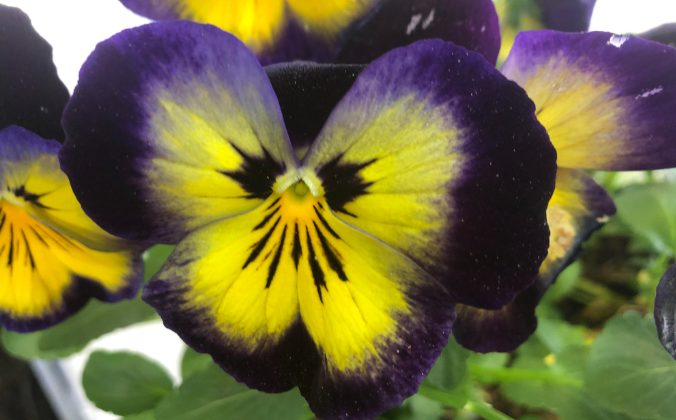
Pansy flowers are famous for their velvety, face-like markings, but the overall form — five broad, overlapping petals spread symmetrically in two lateral pairs above a lower single petal — creates a perfect butterfly silhouette, enhanced by the distinctive dark lines that radiate inward from the center like the veining on a butterfly wing. They grow just 6 to 9 inches tall and are among the most widely planted bedding flowers in the world, with billions of plants sold annually across Europe and North America.
Crotalaria (Crotalaria agatiflora)
Canary Bird Bush produces large, bright yellow, papilionaceous flowers with an unusually elongated keel petal that curves dramatically downward, giving each bloom a distinctly bird-and-butterfly hybrid appearance on a shrub that grows 6 to 10 feet tall. It blooms almost continuously in warm climates and is exceptionally attractive to sunbirds in Africa and hummingbirds in cultivation outside its native range. Its common name refers to the resemblance of the flowers to small, hovering canaries with wings outstretched.
Thunbergia (Thunbergia mysorensis)
Mysore Clockvine produces spectacular, pendant racemes of large, two-toned flowers with reflexed yellow petals and a deep burgundy-red tube that hang in long, swaying chains from a vigorous climber. The reflexed, spreading petals of each individual flower create a strong butterfly impression, particularly when the flowers sway in a breeze. Native to southern India, it can climb 20 to 30 feet in warm climates and produces its extraordinary hanging flower chains almost continuously throughout the warm season.
Viola (Viola tricolor)
Wild Pansy, or Heartsease, is the wild ancestor of the modern pansy and produces small but exquisitely formed five-petaled flowers in combinations of purple, yellow, and white with dark radiating lines that create a compelling butterfly-wing pattern. It grows just 4 to 8 inches tall and self-seeds freely, naturalizing in garden beds, lawns, and paving cracks with cheerful persistence. It has been used in herbal medicine across Europe for centuries and features extensively in the literature and folklore of Shakespeare’s England.
Also Read: Plants for Hillsides and Steep Slope Planting
Kenedia (Kenedia coccinea)
Coral Vine is an Australian native climber that produces small, vivid scarlet-red papilionaceous flowers with a contrasting yellow blotch on the standard petal, spread in perfect butterfly-wing formation along twining stems that can reach 10 to 15 feet. It blooms in spring and early summer and is exceptionally attractive to honeyeaters in its native Australia. It is one of the most brilliantly colored of all butterfly-form flowers, with a scarlet intensity that stands out dramatically against its dark green foliage.
Impatiens (Impatiens psittacina)
Parrot Flower is one of the rarest and most extraordinary butterfly-like flowers in existence, producing blooms in shades of lilac and carmine red whose petals are arranged in a configuration so convincingly like a cockatoo or butterfly in flight that early botanical illustrations were dismissed as fabrications. It grows 18 to 24 inches tall and is native to Thailand, Burma, and northeastern India. It is a legally protected species in Thailand, where collection or export of the plant is prohibited by law.
Epidendrum Orchid (Epidendrum secundum)
Reed-stem Epidendrum produces clusters of small, star-like flowers in shades of orange, red, pink, purple, and white with a finely fringed lip that creates the impression of a butterfly with intricately edged wings. It grows on reed-like stems 18 to 36 inches tall and blooms in repeated flushes throughout the year in warm climates. It is one of the most adaptable and easy-to-grow of all orchid genera, tolerating outdoor conditions in frost-free climates that would challenge more sensitive orchid species.
Also Read: Tall Grasses With Feathery Tops
Columbine (Aquilegia vulgaris)
Columbine produces uniquely structured flowers with five spreading, petal-like sepals and five inner petals each extended into backward-projecting spurs — a combination that, when viewed from the front, presents a radiating, butterfly-wing arrangement of color in shades of blue, purple, pink, red, yellow, and white. It grows 18 to 30 inches tall and is native to European meadows and open woodland, where it has been a beloved garden plant for over 500 years. Over 70 species of aquilegia exist worldwide, and hundreds of garden hybrids have been developed from them.