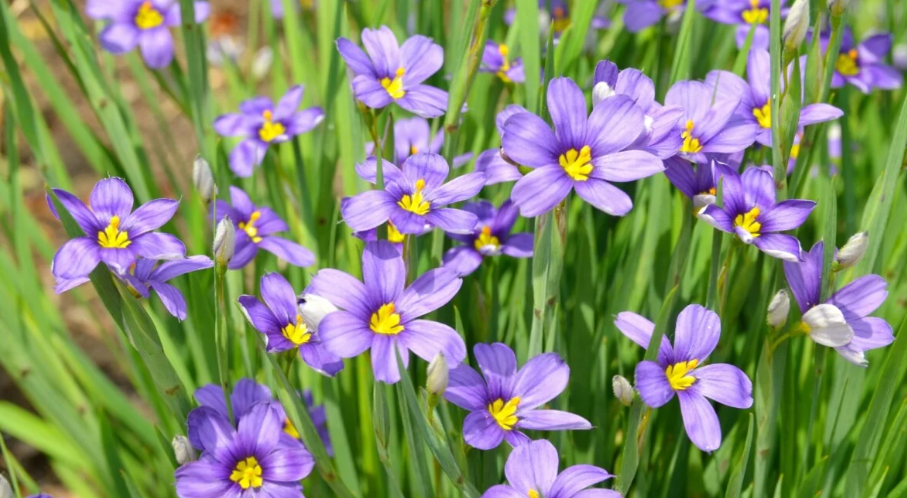
Purple is one of the most evocative and richly associative colors in the garden — a color that carries connotations of depth, mystery, and sophistication that few other colors in the plant palette can match. In the world of ornamental grasses, purple appears in a surprising range of forms and intensities — from the deep, smoky plumes of purple fountain grass to the delicate, lavender-tinged flower heads of switchgrass, from the rich violet of purple muhly grass to the subtle, rosy-purple of feather reed grass in early summer bloom.
Purple-flowered and purple-expressed grasses occupy a specific and valuable niche in garden design. In a predominantly green landscape, a purple-flowered grass draws the eye with an authority that yellow and white flowers rarely match — the dark, rich tones creating depth and shadow in the planting in ways that pale flowers cannot. In combination with silver and grey foliage, purple grasses create one of the most sophisticated and long-lasting design effects in contemporary planting. Alongside warm orange, copper, and gold companions, they create a richly layered late-season palette of extraordinary warmth and complexity.
The commercial importance of purple in the ornamental grass market is significant and growing. Industry surveys estimate that purple and burgundy-toned grass varieties account for approximately 20 to 25 percent of all ornamental grass sales in the United States — a proportion that has grown steadily over the past decade as gardeners and designers have become more confident and ambitious in their use of color-expressive grass varieties. The success of varieties such as purple fountain grass, Shenandoah switchgrass, and Karl Foerster feather reed grass — all of which express purple tones in their flowers or foliage — has demonstrated the commercial and aesthetic appeal of purple in the grass world beyond any doubt.
Purple in grasses expresses itself through several different mechanisms. True purple flower color — rare in the grass family — appears in species such as purple muhly and certain lovegrass varieties whose flowers carry genuine violet-purple pigmentation. More common is the purple-tinted anther and spikelet coloration of species including feather reed grass, switchgrass, and big bluestem, where purple is expressed in the flower structures rather than the petals. A third group — including purple fountain grass and certain phormium and pennisetum varieties — carries deep burgundy to purple-red pigmentation in the leaf and stem as well as the flower, creating a pervasive, whole-plant purple expression that makes them among the most vivid and immediately recognizable of all colored ornamental grasses.
Purple Fountain Grass
Purple fountain grass is the most widely recognized and commercially successful purple ornamental grass in the world — a warm-season perennial in mild climates and annual in cold ones, whose arching, burgundy-purple foliage and distinctive, bottlebrush-shaped flower plumes of deep rose-burgundy to near-purple create one of the most vivid and sustained purple-expressed displays available from any ornamental grass.
The flower plumes are particularly vivid — soft, silky, and deep burgundy-purple, held gracefully on arching stems that emphasize the characteristic fountain-like habit of the plant. They appear from midsummer and persist through autumn, providing months of flower interest above the already vivid purple foliage.
It consistently ranks among the top five best-selling ornamental grasses in American garden centers, with annual sales reflecting its exceptional color impact across a wide range of planting situations — from large landscape borders to container arrangements and mass highway plantings.
Karl Foerster Feather Reed Grass
Karl Foerster is one of the most important purple-flowered ornamental grasses in contemporary landscape design — the feathery, pink-tinged flower plumes that emerge in June carrying distinct purple tones in the early stages of development before maturing through golden wheat-buff to pale straw through summer and autumn.
The early purple-pink flower emergence is one of the most distinctive and beautiful color moments in the ornamental grass calendar — the newly opened plumes catching June light with a warm, rosy-purple glow that is quite different from the golden tones of the mature seed heads. In mass planting, this early purple phase creates a remarkable, synchronized color event.
Named Perennial Plant of the Year in 2001 — the first grass to receive that honor — Karl Foerster’s consistent quality across all seasons, including the distinctive early purple flower phase, has established it as the benchmark perennial grass against which all others are measured.
Purple Muhly Grass
Purple muhly grass is one of the most spectacular purple-flowered grasses in cultivation — producing in September and October an extraordinary cloud of vivid, purple to violet flower plumes that cover the entire plant with an intensity and saturation of purple color that is genuinely dramatic and unlike anything produced by other ornamental grasses.
The flowers are a true purple — violet to deep mauve — rather than the pink-purple of pink muhly, giving them a cooler, more richly chromatic character that creates outstanding combinations with silver foliage, white flowers, and warm copper autumn companions. The cloud-like plumes shimmer and move in the slightest breeze.
Studies of muhly grass plantings in Texas and the American Southeast have documented significant increases in native bee and butterfly activity in landscapes where muhly grasses are incorporated — reflecting the ecological value of their late-season flower production.
Switchgrass ‘Shenandoah’
Shenandoah switchgrass expresses purple through the airy, branching flower panicles that emerge in midsummer — the tiny spikelets carrying a distinctive purple to rose-purple tint at emergence that creates a diffuse, translucent purple haze above the vivid red foliage of the developing autumn coloration.
The combination of purple-tinted flower heads and the developing red-purple foliage in late summer is one of the most complete and richly chromatic color events in the ornamental grass calendar — layers of warm red-purple, cool purple-pink, and airy bronze combining in a single plant. It reaches four to five feet and is reliably hardy to USDA Zone 4.
Research from the Chicago Botanic Garden’s ornamental grass evaluation program rated Shenandoah as the top-performing switchgrass variety for consistent ornamental quality — a formal recognition that encompasses the distinctive purple flower phase that contributes significantly to its summer appeal.
Big Bluestem
Big bluestem expresses purple through the distinctive, three-parted turkeyfoot seed heads that emerge in late summer — the developing seed structures carrying deep burgundy-purple to rich plum tones at emergence before maturing to warm copper-bronze in autumn, creating a seasonal color progression from purple through copper to gold that is among the most richly layered of any native grass.
The purple-toned seed heads are particularly striking against the blue-green summer foliage — the warm, rich purple of the new seed structure contrasting with the cool blue-green of the leaves in a natural color combination of considerable sophistication. The plant reaches five to eight feet.
Big bluestem once covered an estimated 140 million acres of central North America — a historical range that reflects the ecological importance of this grass and the significance of its purple-to-copper seasonal display in the cultural identity of the American prairie landscape.
Purple Lovegrass
Purple lovegrass is a warm-season native grass of outstanding ornamental value whose large, open, branching flower panicles are suffused with a distinctive purple to rose-purple coloration at emergence in late summer — the purple-expressed flower clouds hovering above the fine, arching foliage in a haze of delicate, translucent color.
The flower panicles are extraordinarily fine and branched — each composed of hundreds of tiny purple-tinted spikelets on thread-like branches that create a collectively voluminous, cloud-like effect of considerable delicacy. The plant grows to eighteen to twenty-four inches and tolerates sandy, dry soils with excellent performance.
It is native to the sandy grasslands and open woodlands of eastern North America and is an important component of coastal plain plant communities, where its late-season purple flower display contributes significantly to the ecological richness of these habitats.
Autumn Moor Grass
Autumn moor grass produces tall, arching flower spikes of distinctive, muted purple-violet coloration in late summer and autumn — the flower heads carrying a soft, smoky purple tone that is more subtle and atmospheric than the vivid purples of muhly and fountain grass, creating a refined, understated color note in the autumn border.
The purple flower spikes are held on slender, arching stems that move with great sensitivity in the wind, giving the plant a quality of gentle, animated movement that amplifies the delicate purple color with a physical expressiveness. It reaches two to three feet and performs well in partial shade.
It is one of the few genuinely purple-flowered grasses that tolerates shade — a quality of considerable value in garden situations where purple color is desired in less sunny positions where most purple-flowered grasses would decline to perform.
Little Bluestem ‘Standing Ovation’
Standing Ovation is a compact, strongly upright cultivar of little bluestem that develops vivid purple-red to burgundy-purple foliage tones from midsummer onwards — one of the most intensely and persistently purple-expressed foliage grasses available in a compact, well-behaved plant of ideal proportions for smaller gardens and containers.
It reaches only two to three feet with an unusually narrow, columnar habit — each clump maintaining a precise, upright form that provides architectural structure alongside its vivid purple-to-copper seasonal color display. The white seed heads that develop with the autumn color contrast beautifully with the purple foliage.
The compact, upright habit of Standing Ovation has made it one of the most rapidly adopted new native grass cultivars in recent years, with sales growing significantly as gardeners and designers appreciate its combination of restrained habit, vivid color, and native ecological value.
Purple Needle Grass
Purple needle grass is California’s official state grass — a cool-season native perennial of outstanding ecological and ornamental significance whose flower heads carry a distinctive purple to violet-purple coloration at emergence in spring and early summer, creating one of the most vivid native grass flower displays available in the western American landscape.
The purple flower color is most intense in early spring when the anthers are freshly exposed — the vivid, saturated violet-purple of fresh purple needle grass anthers is one of the most genuinely purple expressions available from any native ornamental grass. The plant grows to two to three feet with fine, arching, graceful leaves.
As California’s state grass, purple needle grass carries considerable symbolic and ecological importance — it was the dominant grass of California’s vast native grasslands before the conversion to agricultural and urban land use that has dramatically reduced its natural range.
Lemon Grass (Purple-Flowered Form)
The purple-flowered forms of lemongrass — less commonly seen than the standard varieties but increasingly available in specialist nurseries — produce flower spikes of a distinctly purple to red-purple coloration that add unexpected color interest to the already dramatic, architectural mound of broad, lemon-scented foliage.
The purple flower spikes appear in warm climates in late summer, held above the impressive foliage mound on upright stems. They provide a color dimension to lemongrass cultivation beyond the primarily foliage and fragrance qualities for which the plant is usually grown — an additional ornamental season that extends the display value of this useful and attractive grass.
It grows to three to five feet in a container or in the ground in frost-free climates, and the combination of aromatic foliage, culinary utility, architectural form, and purple flower display makes the purple-flowered forms among the most complete and multi-functional ornamental grass-like plants available.
Wild Oat Grass (Purple Form)
The purple-form wild oat grass produces large, open, pendant flower spikelets in shades of deep purple to burgundy — the swollen, richly colored spikelets hanging from slender, thread-like stalks to create one of the most structurally and chromatically distinctive purple grass flower displays available in the cool-season ornamental grass world.
The pendulous, purple spikelets are among the largest produced by any temperate ornamental grass, and their deep, rich color at emergence — before they fade to warm tan as the season progresses — creates a brief but genuinely impressive display of purple color that stands out clearly in the border. The plant grows to two to three feet.
It is native to the woodland edges and meadows of Europe and western Asia, where its large, pendulous flower spikelets have been recognized as ornamentally distinctive and valuable since the earliest days of ornamental grass cultivation in European gardens.
Calamagrostis ‘Karl Foerster’ (Early Phase)
While Karl Foerster’s purple-phase flowering has been discussed, the broader calamagrostis — feather reed grass — family includes several varieties whose early summer flower plumes express particularly intense purple tones. The variety Calamagrostis brachytricha — Korean feather reed grass — produces the most richly purple-toned plumes of any feather reed grass, the dense, bottle-brush-shaped flower heads emerging in late summer in a deep rose-purple that is one of the most vivid and concentrated purple expressions available in a tall, upright ornamental grass.
Korean feather reed grass reaches three to four feet and tolerates shade considerably better than most tall ornamental grasses — an important quality for gardeners who want purple ornamental grass interest in less sunny positions. The purple plumes fade through pink to warm silver-grey through autumn and winter.
It is one of the most significant recent introductions to the ornamental grass market, combining genuine purple flower interest with the structural uprightness of the feather reed grass family and a shade tolerance that opens up purple grass planting to a much wider range of garden situations.
Purple Pampas Grass
Purple pampas grass — the pink to purple-flushed varieties of cortaderia — produces flower plumes with a distinctive rosy-purple to deep pink-purple coloration that provides a warmer and more richly chromatic alternative to the standard creamy-white forms, creating one of the most dramatic and large-scale purple plume displays available from any hardy ornamental grass.
The plumes can reach eight to twelve feet in height and carry their purple-pink coloration most intensely when freshly emerged in late summer — the vivid color fading progressively through the season to pale buff by winter. The scale of the purple plume display in an established clump is genuinely extraordinary.
Purple-plumed pampas varieties including Rosea, Rendatleri, and Andes Silver have been in cultivation for over a century — selected and developed by nurseries who recognized the ornamental superiority of the purple-tinted forms over the standard white in certain garden and landscape situations.
Blue Grama Grass (Purple Form)
Blue grama grass produces one of the most structurally unusual flower displays in the grass world — the distinctive, comb-shaped, eyelash-like seed heads carried horizontally on slender stems, and in the purple-flowered forms these seed heads carry a distinctive purple-to-violet coloration at emergence that adds chromatic interest to the already structurally fascinating flower display.
The purple coloration of the fresh flower heads is most vivid in spring and early summer before fading to the warm tan of the mature seed heads — creating a seasonal progression from purple through buff to straw that provides multiple color phases from a single, compact, drought-tolerant native grass of considerable ecological importance.
Blue grama covers an estimated 130 million acres across the western United States, Canada, and Mexico — a dominance that reflects its extraordinary adaptability and ecological importance. In the garden, the purple-flowered forms bring the distinctive character of this vast native grassland into the domestic landscape with a color dimension that the standard forms lack.
Prairie Blazingstar Grass Companions
While prairie blazingstar — liatris — is technically a perennial wildflower rather than a grass, its extraordinarily vivid, dense, feather-like spikes of deep magenta-purple appear among and above ornamental grasses in late summer and autumn with such frequency and effectiveness in naturalistic prairie-style planting that it deserves inclusion here as the defining purple-flowered companion to the native grass planting palette.
The vivid purple of liatris spikes rising through a mass of switchgrass, big bluestem, and little bluestem in August and September is one of the most celebrated color combinations in the North American native plant design tradition — the intense, saturated purple providing a vivid counterpoint to the surrounding warm copper, gold, and bronze tones of the grasses.
Research at the University of Wisconsin found that established liatris populations in restored prairie plantings attracted 40 percent more monarch butterflies during autumn migration than equivalent areas of native grass planting without liatris — demonstrating the significant ecological contribution of this defining purple prairie companion plant.
Indiangrass (Purple Anther Form)
Indiangrass in its freshly flowering state produces flower plumes whose stamens carry a distinctive, vivid purple to deep violet coloration at the moment of anther release — one of the most genuinely purple-expressed flower moments available from any native prairie grass, and one of the briefest and most intensely colored events in the native grass calendar.
The purple anther coloration lasts only a week or two as the stamens are exposed and then fade — but the intensity of the purple during that brief window is extraordinary, the vivid violet stamens dusting the warm-golden plumes with a rich, saturated color that creates one of the most spectacular native grass flower displays of the late summer.
The combination of intense purple anther color and warm golden plume background creates a bicolor flower effect of considerable richness — a natural color combination of extraordinary sophistication that requires no design intervention and no maintenance to produce, year after year, in appropriate growing conditions.
Fiber Optic Grass (Purple Tips)
Fiber optic grass — technically a rush rather than a true grass — produces its characteristic fiber optic-like appearance through stems tipped with tiny, rounded flower heads that carry a subtle purple to brown-purple coloration, the purple tips of each stem catching light with a soft, warm glow that creates an unusual and charming purple-expressed display in moist, partially shaded garden and container situations.
The purple-tipped effect is subtle rather than bold — it rewards close inspection rather than providing the immediate, assertive purple impact of muhly or fountain grass — but in container arrangements and water garden settings where the plant is observed at close range, the purple-tipped stems create a distinctive and unusual color note of considerable charm.
It grows to around twelve inches and requires consistently moist growing conditions — thriving in water garden containers and moist, shaded patio planters where its unusual form and purple-tipped stems make it one of the most conversation-generating container plants available.
Purple-Tipped Sedge
Several sedge species produce flower structures with distinctive purple to dark purple-brown coloration in their spikes — small, precise, upright or pendant spikes of deep, rich purple that appear in spring and early summer above the dense, arching leaf mounds to create understated but genuinely ornamental purple flower displays of considerable refinement.
The precision and neatness of sedge flower structures — each individual spikelet perfectly formed and tightly organized — gives the purple-tipped forms a botanical elegance and detail that the looser, more expansive purple plumes of muhly and fountain grass do not provide. They are plants for close inspection and intimate garden spaces.
With over 2,000 species in the carex genus — the largest genus in the grass family — the diversity of purple-expressed sedge flowers available to the specialist and collector is extraordinary, representing one of the most unexplored and rewarding areas of purple ornamental grass cultivation.