When most people picture a succulent, they imagine something small and compact — a neat rosette sitting in a terracotta pot on a sunny windowsill, or a cluster of low-growing plants spreading across a dry garden border. And while that image captures a large part of the succulent world, it misses an equally fascinating group entirely: the tall, architectural, sometimes truly towering succulents that grow to heights that challenge and redefine what we expect from these remarkable plants.
Tall succulents are among the most dramatic and architecturally powerful plants in horticulture. Some grow as slowly as a few inches per year and take decades to reach their full height. Others are surprisingly fast, adding a foot or more of growth in a single season under ideal conditions. The tallest species in the world — the giant saguaro cactus of the American Southwest — can reach over 40 feet in height and live for more than 150 years, making it one of the longest-lived and most iconic plants on the planet.
The appeal of tall succulents in garden design is considerable. They provide instant structure and vertical drama in a way that few other plant groups can match, and their ability to thrive with minimal water makes them particularly valuable in arid, Mediterranean, and drought-prone garden settings. Many are also surprisingly cold-hardy, and the growing global interest in low-water gardening has brought tall succulents into mainstream garden design in regions where they would once have been considered purely exotic novelties.
Globally, the succulent plant family encompasses over 10,000 known species across more than 60 plant families — a number that continues to grow as new species are discovered, particularly in the biodiversity hotspots of South Africa, the Canary Islands, and the Americas. Among these, the tall-growing forms represent some of the most extraordinary and visually commanding members of the group.
1. Saguaro Cactus
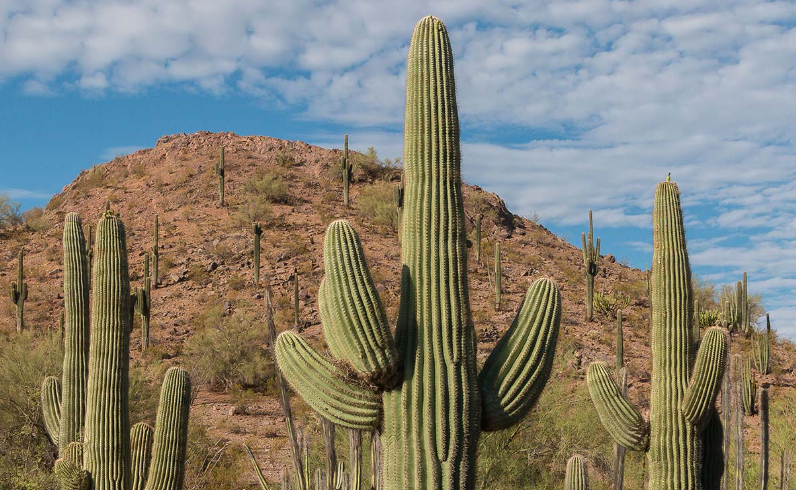
The saguaro is the giant of the succulent world and one of the most recognizable plants on earth — the multi-armed, towering cactus that defines the visual identity of the American Southwest desert landscape and has become a global symbol of desert life.
It grows slowly and majestically, typically not developing its characteristic side arms until it is 75 years old, and reaching its full height of 40 to 60 feet only after 150 years or more of growth. A mature saguaro can weigh up to 4,800 pounds when fully hydrated after heavy rain — the pleated trunk expanding like an accordion to store enormous quantities of water.
It flowers in May and June with large, creamy white blooms that are pollinated by bats, birds, and insects, producing red fruits of importance to both wildlife and the native Tohono O’odham people who have harvested them for food and ceremonial use for centuries.
2. Golden Barrel Cactus (Large Colony Forms)
While individual golden barrel cacti are typically compact and spherical when young, mature specimens — and particularly the large colony-forming groups found in their native Mexican habitat — develop impressive columnar or elongated forms that can reach four to five feet in height over their long lives.
The vivid golden-yellow spines that cover the deeply ribbed, bright green body are one of the most ornamental features of any cactus, glowing brilliantly in sunlight and maintaining their color throughout the year. The plant flowers in summer, producing a ring of small yellow flowers at the crown.
Golden barrel cactus is one of the most widely grown ornamental cacti in the world and is considered vulnerable in its native Mexican habitat, where wild populations have declined significantly due to collection and habitat loss.
3. Blue Agave
The blue agave is one of the most commercially important succulent plants in the world — the species from which tequila is produced, cultivated across hundreds of thousands of acres in the Jalisco region of Mexico in one of the most geographically specific and culturally significant agricultural traditions anywhere on earth.
The plant forms a large, striking rosette of stiff, blue-grey, sharply tipped leaves that can reach five to six feet in height and six to eight feet across at maturity. After a growing period of seven to ten years in cultivation — and potentially twenty years or more in the wild — it produces a single, towering flower spike that can reach twenty feet in height, bearing thousands of yellow-green flowers.
After flowering, the plant dies — a characteristic of most agave species known as monocarpic flowering — but offsets produced at the base ensure the continuation of the colony.
4. Century Plant
The century plant is one of the most dramatically architectural of all garden succulents — a massive agave that forms an imposing rosette of blue-grey to grey-green leaves edged with dark spines, reaching four to eight feet in height and spread in mature specimens.
Despite its common name suggesting a hundred-year wait, the flower spike typically appears after ten to thirty years of growth — though the wait feels long enough. When it does flower, the spike is extraordinary — shooting upward at a rate that can be visible to the naked eye, ultimately reaching twenty to forty feet and bearing masses of yellow-green flowers along its upper branches.
It is a plant of significant hardiness for a succulent, tolerating temperatures down to 15°F (-9°C) in well-drained conditions, which makes it suitable for gardens across a wide range of climates including much of the Mediterranean, California, the American Southwest, and parts of the British Isles.
5. Dragon Tree
The dragon tree is one of the most ancient and mythologically resonant of all tall succulents — a slow-growing tree of the Canary Islands that develops its distinctive, upswept, umbrella-shaped crown of stiff, sword-like leaves on a stout, grey, ringed trunk over centuries of growth.
The oldest known specimen — the famous Drago Milenario in Icod de los Vinos, Tenerife — is estimated to be between 650 and 1,000 years old and reaches 65 feet in height, making it one of the most venerable living plants in the world. The tree produces a distinctive dark red sap when cut — the legendary “dragon’s blood” that has been traded as a dye, resin, and medicine since antiquity.
In gardens, young dragon trees develop slowly but create an architectural statement that is unique among succulent plants, eventually reaching fifteen to twenty feet or more in favorable conditions.
6. Joshua Tree
The Joshua tree is the emblematic plant of the Mojave Desert and one of the most distinctive and architecturally extraordinary trees in the succulent world — its irregular, outstretched branches ending in dense rosettes of stiff, sharp-pointed leaves creating a silhouette of unmistakable character against the desert sky.
It grows to heights of twenty to forty feet over a lifespan of 150 years or more, and its presence in a landscape is often used as an indicator of the specific elevation and climate zone of the Mojave. The flowers, which appear in spring, are large and creamy white, and are pollinated exclusively by the yucca moth — one of the most well-known examples of an obligate mutualism in the plant kingdom.
The Joshua tree is currently listed as threatened under the California Endangered Species Act, primarily due to the effects of climate change on its native habitat.
7. Candelabra Cactus (African)
The African candelabra cactus is a magnificent, fast-growing succulent tree native to tropical and southern Africa that develops a thick, ridged, grey-green trunk topped with multiple upright, candelabra-like branches — each one deeply ribbed and armed with pairs of short spines — creating one of the most dramatic and instantly recognizable plant silhouettes in the succulent world.
It grows remarkably quickly for a succulent — potentially adding several feet per year in warm, favorable conditions — and can reach thirty to forty feet in height at maturity. In its native African savanna habitat, it forms large groves that provide shelter and food for a wide range of wildlife.
All parts of the plant contain a highly caustic, toxic white latex sap that causes severe skin and eye irritation, and it should be handled with great care.
8. Aloe Vera (Tree Forms)
While the familiar Aloe vera is a low-growing, stemless succulent, the tree-forming aloe species — particularly those native to South Africa and East Africa — grow to impressive heights and are among the most ornamentally spectacular of all succulent plants.
Tree aloe can reach ten to twenty feet in height, forming single or branching trunks topped with rosettes of grey-green, serrated leaves. The flower spikes that appear in winter and early spring are extraordinary — tall, branching candelabras of vivid orange, red, or yellow tubular flowers that provide one of the most important winter nectar sources for birds in their native habitat.
South Africa alone is home to over 130 aloe species, many of them tree-forming, and the country’s aloe forests — particularly those on the Sneeuberg mountains — are botanical wonders of global significance.
9. Ponytail Palm
Despite its common name and palm-like appearance, the ponytail palm is a true succulent — a member of the agave family that stores water in its dramatically swollen, bottle-shaped base and produces a fountain of long, narrow, grass-like leaves that cascade from the top of a tall, slender trunk.
In its native Mexican habitat, the ponytail palm grows slowly to heights of fifteen to thirty feet over many decades. In garden cultivation, established specimens can reach impressive heights and become genuinely tree-like in character. The trunk base — which can reach several feet in diameter in old specimens — is the plant’s water storage organ and gives mature plants an immediately distinctive, sculptural quality.
It is one of the most widely grown ornamental succulent trees in warm-climate gardens worldwide and is valued for its unusual form, extreme drought tolerance, and the soft, flowing texture of its cascading leaves.
10. Organ Pipe Cactus
The organ pipe cactus is a magnificent column-forming cactus of the Sonoran Desert that produces multiple tall, upright stems — typically fifteen to twenty of them in mature specimens — rising from a common base to heights of fifteen to twenty-three feet, creating the dense, organ-pipe cluster that gives the plant its name.
It grows slowly, with individual stems adding about one inch per year in the wild, and mature specimens can be 150 years old or more. It flowers at night in May and June, producing large, white to pale pink funnel-shaped blooms that are pollinated primarily by bats, and the resulting red fruits are an important food source for wildlife and were traditionally eaten by the Tohono O’odham people.
The Organ Pipe Cactus National Monument in Arizona protects the largest population of this species in the United States across 330,000 acres of desert wilderness.
11. Queen of the Night Cactus
The queen of the night is a tall, sprawling, epiphytic cactus with flattened, leaf-like stems that grows naturally on trees and rocks in tropical forests from Mexico to South America, eventually building into large, impressive clumps that can reach six to ten feet in height and considerably greater width.
Its fame rests almost entirely on its flowers — enormous, breathtakingly beautiful white blooms up to twelve inches across that open only after dark on a single night of the year, releasing an intense and intoxicating vanilla-like fragrance through the warm night air, and then closing and dying before dawn. The event of a queen of the night in bloom is so extraordinary that it attracts gatherings of observers who wait through the night for the annual spectacle.
In warm climates it can be grown outdoors and eventually reaches considerable size, becoming a dramatic garden specimen that rewards patience with one of the most spectacular flowering events in the plant world.
12. Foxtail Agave
The foxtail agave is one of the most ornamentally refined and widely grown of the taller agave species — a medium to large succulent that forms an impressive, full, globe-shaped rosette of arching, bright green leaves with distinctive reddish-brown terminal spines, reaching three to five feet in height and four to six feet in spread.
It is considered one of the most beautiful agaves in cultivation, and its symmetrical, sculptural form is valued as a focal point in contemporary garden design, particularly in dry, Mediterranean, and gravel garden settings. After a growing period of around ten years, it produces a tall flower spike reaching fifteen to twenty feet, bearing masses of reddish-orange flowers that are a magnet for hummingbirds and insects.
Unlike many agaves, it produces relatively few offsets, which means each plant maintains a clean, uncluttered individual form without the spreading colony habit of some other species.
13. Silver Torch Cactus
The silver torch cactus is one of the most beautiful of all the columnar cacti — a tall, clustering South American species whose multiple upright columns are densely clothed in long, soft, silvery-white spines that give the entire plant a luminous, frosted appearance quite unlike the harsher, more defensive spination of many other cacti.
Individual columns can reach six to ten feet in height, growing from a shared base to form an impressive, torch-like cluster. In late spring and early summer, mature columns produce deep red, tubular flowers near their tips — flowers that are pollinated by hummingbirds in their native habitat and that provide a vivid color contrast to the silver-white spines.
It is a moderately frost-hardy species, tolerating temperatures down to around 15°F (-9°C) in dry conditions, and is increasingly popular as a garden plant in warm, sheltered positions in temperate climates.
14. Euphorbia Candelabra Tree
The euphorbia candelabra tree — native to Ethiopia and widely distributed across the highlands of eastern Africa — is one of the most architecturally impressive of all succulent trees, developing a thick, corky, light grey trunk topped with multiple ascending, deeply ridged, succulent branches arranged in the classic candelabra formation that gives the plant its name.
It can reach thirty to forty feet in height in its native habitat, and the trunks of ancient specimens become massive and deeply textured, developing the character of ancient olive trees combined with the structural drama of a cactus. It is a prominent feature of the Ethiopian highland landscape and is traditionally planted around villages as a living boundary and windbreak.
Like all euphorbias, it produces a highly caustic white latex sap that causes serious skin and eye irritation and must be handled with extreme caution. In cultivation it grows well in frost-free gardens with full sun and excellent drainage.
15. Yucca (Giant Forms)
The giant yuccas — particularly the species native to the American Southwest and Mexico — are among the most architectural and garden-worthy of all tall succulent plants, developing thick, fibrous trunks topped with dramatic rosettes of sword-like leaves and producing, when they flower, some of the most impressive flower spikes in the plant kingdom.
Giant yucca species can reach fifteen to thirty feet in height at maturity, with the trunk developing over decades of slow growth to a girth and character that gives older specimens a genuinely tree-like presence and dignity. The flower spikes — produced in summer on well-established plants — are enormous, sometimes reaching ten to twelve feet in height and carrying hundreds of creamy white, bell-shaped, mildly fragrant flowers.
Yuccas are among the most cold-hardy of all large succulent plants, with some species tolerating temperatures down to -20°F (-29°C) — a cold tolerance that makes them usable across a far wider range of climates than almost any other tall succulent, from the warm deserts of the Southwest to the gardens of northern Europe and the Great Plains.
16. Mexican Fence Post Cactus
The Mexican fence post cactus is a tall, slender, columnar cactus native to the arid regions of Oaxaca and Puebla in Mexico, named for its traditional use as living fencing — rows of closely planted columns forming impenetrable, long-lasting natural barriers around fields and homesteads that have been in use for centuries.
Individual columns grow upright and unbranched, reaching ten to fifteen feet in height with a relatively narrow diameter of three to four inches, giving the plant an elegant, vertical character that is distinct from the more heavily branched columnar cacti. The columns are pale grey-green with prominent ribs lined with short, reddish-brown spines, and in late spring mature plants produce small, pink to red funnel-shaped flowers near the crown.
It is one of the faster-growing columnar cacti in cultivation, adding up to twelve inches of height per year in warm conditions, and it is valued in gardens for providing a strong vertical accent in a compact footprint. It tolerates temperatures down to around 25°F (-4°C) in dry conditions.
17. Cardón Cactus
The cardón cactus of Baja California is the tallest cactus species in the world — surpassing even the famous saguaro — with the largest recorded specimens reaching over 63 feet in height and weighing up to 25 tons. It is a truly awe-inspiring plant of majestic scale that defines the desert landscapes of the Baja California Peninsula.
Like the saguaro, it grows slowly — adding just one to three inches of height per year in the wild — and the most massive specimens are estimated to be several hundred years old. It develops a stout central trunk with multiple upright branches and produces large, white, night-blooming flowers in spring that are pollinated by bats and provide an important food source for desert wildlife.
The cardón is not as widely grown in cultivation as the saguaro due to its sheer eventual size, but young plants are occasionally grown as specimen succulents in large, warm gardens and botanical collections where their impressive growth potential is appreciated over the long term.
18. Ocotillo
Ocotillo is one of the most distinctive and recognizable plants of the Chihuahuan and Sonoran deserts — a tall, fountain-like succulent shrub producing dozens of long, whip-like, spiny canes that rise from a central crown to heights of ten to twenty feet, remaining bare and grey through dry periods before leafing out rapidly after rain.
The transformation after rainfall is one of the most dramatic in the plant world — within 72 hours of significant rain, the bare canes are covered in small, bright green leaves that photosynthesize rapidly during the brief moist period before dropping again as conditions dry out. At the tips of the canes in spring, vivid scarlet flower clusters provide one of the desert’s most brilliant and important nectar sources for migrating hummingbirds.
Though not a true succulent in the strictest botanical sense, ocotillo stores water in its stems and is universally grouped with desert succulents in horticultural practice. It is a striking and fast-growing plant for hot, dry gardens, adding several feet of height per season.
19. Candelabra Aloe
The candelabra aloe is one of South Africa’s most magnificent native plants — a tall, multi-branched tree aloe that develops a stout, rough-barked trunk and a spreading crown of upward-pointing branches, each one tipped with a rosette of thick, grey-green, toothed leaves and, in winter, a spectacular candelabra of vivid orange-red flower spikes.
It reaches heights of twenty to thirty feet at maturity, developing over decades into a genuinely tree-like specimen of commanding presence. The winter flowering season is particularly valuable — the tall, branching spikes of tubular orange-red flowers appearing from June through August in the southern hemisphere and providing a critical nectar source for sunbirds, weavers, and other birds during the cold months.
The candelabra aloe is one of the most widely planted ornamental aloes worldwide and its dramatic flowering display has earned it a place in gardens across South Africa, Australia, California, and the Mediterranean, where it thrives in full sun with excellent drainage and minimal summer water.
20. Totem Pole Cactus
The totem pole cactus is a striking and unusual spineless columnar cactus with a smooth, undulating surface covered in irregular bumps, knobs, and swellings that give it a distinctly sculptural, almost carved quality quite unlike the ribbed, spined forms of most columnar cacti.
It grows slowly and steadily to heights of ten to twelve feet, developing a single or lightly branched column of pale grey-green flesh whose mottled, lumpy surface creates fascinating patterns of light and shadow throughout the day. Despite being a naturally occurring form — not a hybrid or cultivar — the totem pole cactus has an almost artificially designed appearance that makes it one of the most visually unusual large succulents in cultivation.
It is thornless, which makes it more practical in garden settings where people or animals may come close, and its slow growth and manageable ultimate height make it a popular choice for desert garden design in California, Arizona, and similar climates.
21. Blue Chalk Fingers (Tall Form)
While many blue chalk succulent forms are low and spreading, the tall-growing blue chalk fingers — a South African native — develops elongated, cylindrical, waxy, pale blue-grey finger-like leaves on upright, branching stems that gradually build to heights of three to four feet, forming an impressive, silvery-blue mound of architectural character.
The striking powdery blue coloration of the leaves — caused by a natural waxy coating that protects the plant from intense sun and moisture loss — is one of the most vivid and unusual foliage colors available in any succulent, and it provides year-round color interest that is genuinely outstanding in the garden. Small, daisy-like yellow flowers appear in summer, though the foliage is the primary ornamental feature.
It is tolerant of drought, poor soil, and coastal conditions, and is increasingly valued in contemporary low-water garden design for the cool, architectural quality its glaucous blue foliage brings to a planting scheme.
22. Boojum Tree
The boojum tree is one of the most surreal and extraordinary plants in the world — a tall, tapering succulent tree endemic to Baja California that resembles nothing so much as a giant inverted parsnip, with a pale, yellow-grey trunk that tapers from a broad, swollen base to a slender tip, studded with small, stubby side branches and topped with a sparse crown of foliage.
It grows with deceptive slowness — adding only one to three inches of height per year — but the most ancient specimens reach heights of fifty to sixty feet and are estimated to be over 700 years old, making them among the most long-lived plants in North America. In autumn, it produces small clusters of creamy yellow flowers at the branch tips that attract pollinators across the surrounding desert.
The boojum tree is named after an imaginary creature from Lewis Carroll’s poem “The Hunting of the Snark” — a name bestowed by the botanist who discovered it, who felt that no conventional name could do justice to such a bizarre and otherworldly plant.
23. Madagascar Palm
Despite its common name, the Madagascar palm is not a true palm but a tall, spiny succulent from the dry regions of southwestern Madagascar — a single-stemmed, columnar plant with a stout trunk densely covered in long, grey spines and topped with a crown of long, narrow, glossy green leaves.
It grows to heights of fifteen to twenty feet in its native habitat over several decades, creating a striking, architectural silhouette that is entirely its own. In summer, it produces clusters of white flowers from the leaf crown that are pleasantly fragrant, and on mature plants these may be followed by small fruits.
It is a popular ornamental plant in tropical and subtropical gardens worldwide and is also widely grown as a large houseplant or conservatory specimen in cooler climates where its dramatic form and tropical character make it one of the most eye-catching architectural plants available for indoor cultivation.
24. Aloe Marlothii (Mountain Aloe)
The mountain aloe is one of the most robust and cold-tolerant of all the tree aloes — a South African native that develops a single, stout trunk covered in the persistent brown remains of old leaves and topped with a large, spreading rosette of broad, grey-green, heavily toothed leaves that can reach five to six feet across in mature specimens.
It grows to heights of ten to fifteen feet and flowers in winter — typically June through August in the southern hemisphere — producing an impressive candelabra of upright flower spikes in vivid shades of orange, yellow, and red that provide one of the most important wildlife food sources in its native South African grassland habitat. Up to 30 different bird species have been recorded visiting a single flowering mountain aloe.
It is notably frost-hardy for a large aloe, tolerating brief dips to 25°F (-4°C) in dry conditions, which makes it usable in a wider range of garden climates than many other tree aloes.
25. Senita Cactus
The senita cactus is a tall, columnar cactus of the Sonoran Desert with a particularly distinctive and ornamental character — the mature sections of its multiple upright columns develop long, grey, hair-like spines near their tips that give the plant a distinctly whiskered, old-man appearance and set it apart visually from other columnar cacti growing in the same desert habitat.
It grows to heights of thirteen to twenty feet and forms multi-stemmed clusters of considerable presence in the landscape. It flowers at night in spring and summer, producing small, pink flowers near the bristled tips of mature columns, and it has one of the most specialized pollination relationships in the cactus world — the senita moth pollinates it exclusively while using the cactus flowers as a site for laying its eggs, in a mutualistic relationship remarkably similar to that of the Joshua tree and yucca moth.
26. Halfmens
The halfmens is one of the most extraordinary and culturally significant succulent plants in southern Africa — a tall, slow-growing species of the arid Richtersveld region of South Africa and southern Namibia that develops a slender, unbranched or lightly branched succulent trunk reaching ten to fifteen feet in height, topped with a small, dense crown of leaves that gives the plant an uncanny resemblance to a person standing on the horizon.
This human-like appearance is deeply embedded in the mythology of the indigenous Nama people, who believe the halfmens are the petrified remains of ancestors who were driven from their northern homeland but could not bear to stop looking back — forever frozen facing north, as every halfmens does, its crown always tilted toward the direction of the sun.
It is one of the most slow-growing of all succulent plants — adding barely an inch of height per year — and mature specimens in the wild are estimated to be several hundred years old. It is a protected species in South Africa and extremely rare in cultivation outside of specialist botanical collections, making any encounter with a living halfmens a genuinely remarkable and moving botanical experience.