Succulents are celebrated first and foremost for their extraordinary foliage — the jewel-toned rosettes, the plump geometric forms, the silvery, dusty, and vividly colored leaves that make them among the most visually diverse plant groups in the world. But the flowers that many succulents produce are equally worthy of attention, and among the full spectrum of succulent flower colors, pink is one of the most common, most varied, and most beloved.
Pink appears across the succulent world in an extraordinary range of shades and forms — from the palest, barely-there blush of a ghostly echeveria flower to the vivid, almost neon magenta of a delosperma covering a sunny bank in midsummer. It appears in tiny, star-shaped blooms less than a quarter of an inch across and in large, showy flowers several inches in diameter. It flowers in spring, summer, autumn, and in some species even through the winter months, making pink-flowered succulents a year-round presence in the garden.
The global succulent community has grown dramatically in recent decades. Surveys estimate that the number of people growing succulents as a hobby has increased by over 60 percent in the past ten years alone, driven partly by their low-maintenance nature and partly by the explosion of interest in drought-tolerant and water-wise gardening. In the United States alone, succulents account for more than 15 percent of all houseplant sales annually, and pink-flowered varieties consistently rank among the most popular and sought-after selections.
From the tiny, windowsill-friendly crassula to the sprawling, ground-covering ice plant, and from the architectural elegance of a pink-flowering aloe to the romantic trailing stems of a chain of hearts — the 35 succulents in this guide demonstrate the extraordinary breadth of pink that the succulent world has to offer.
1. Pink Ice Plant
The pink ice plant is one of the most spectacularly flowering of all ground-covering succulents — a fast-spreading, mat-forming plant that covers itself in vivid, bright pink to magenta daisy-like flowers from late spring through summer, creating a carpet of color so intense it can be seen from considerable distances.
Each flower is one to two inches across with dozens of narrow, glistening petals that catch sunlight with an almost metallic shimmer — the source of the “ice” in the common name. A single plant can spread three to four feet in a season, making it one of the most effective and low-maintenance flowering ground covers available for sunny, dry slopes, banks, and rockeries.
It is exceptionally drought-tolerant once established and thrives in coastal conditions, tolerating salt spray and sandy soils that challenge most other flowering perennials.
2. Living Stones (Pink-Flowering)
Living stones are among the most extraordinary plants in the succulent world — tiny, pebble-mimicking plants from the stone deserts of southern Africa that produce flowers of remarkable size relative to the plant body, with pink to magenta blooms that can exceed the diameter of the plant itself.
The camouflage these plants develop is so convincing that they were largely undiscovered by Western botanists until the 20th century — even experienced field researchers frequently walked past them without noticing. Around 37 species of living stones are recognized, and several produce flowers in shades of pink ranging from pale blush to vivid rose.
The flowers appear in autumn, emerging from the split between the two fleshy leaf lobes, and their brief, brilliant appearance after months of modest presence is one of the most surprising and delightful events in the succulent grower’s calendar.
3. Pink Echeveria
Echeverias are among the most widely grown of all rosette-forming succulents, and many of the most popular species and cultivars produce flower spikes in shades of pink — from soft coral-pink to deep rose-red — that arch elegantly above the tightly packed leaf rosettes on slender, graceful stems.
A single echeveria rosette can produce multiple flower spikes simultaneously in spring and summer, each one carrying a succession of small, urn-shaped flowers that open progressively from base to tip over several weeks. The contrast between the cool-toned, glaucous leaves of many varieties and the warm pink of the flowers is one of the most pleasing color combinations in succulent cultivation.
Over 150 Echeveria species are recognized, with hundreds of cultivars available, and pink-toned flower spikes appear in the majority of commonly grown varieties.
4. Pink Crassula (Jade Plant Flowers)
The jade plant and its many relatives in the crassula family produce clusters of tiny, star-shaped flowers in pale pink to white that appear in late autumn and winter — a time of year when flowering interest in the garden and on the windowsill is particularly welcome and relatively rare.
A mature, well-established jade plant in full bloom is a genuinely impressive sight — the dense, rounded canopy of thick, glossy, jade-green leaves studded with hundreds of delicate flower clusters that collectively create a frothy, soft-pink haze across the entire plant. Plants typically need to be several years old before they flower reliably, and the onset of cooler temperatures and slightly reduced watering in autumn often triggers the best flowering response.
In warm, frost-free climates, jade plants can grow into large, multi-stemmed shrubs reaching six feet or more in height.
5. Hens and Chicks (Pink-Flowering)
The sempervivum family — commonly known as hens and chicks — are among the most cold-hardy and adaptable of all rosette-forming succulents, and many species and varieties produce tall, succulent flower stems topped with clusters of small, starry flowers in shades of pink and rose from June through August.
The flowering stems can reach twelve to fifteen inches in height — remarkably tall for a plant whose rosettes measure only one to three inches across — and the open, star-shaped flowers are produced in dense, attractive clusters. After flowering, the parent rosette dies, but the numerous offsets clustered around it — the “chicks” — carry on, ensuring the colony’s continuity.
Sempervivums are among the toughest plants in cultivation, surviving temperatures as low as -30°F (-34°C) and thriving in wall crevices, rock gardens, and green roofs where almost nothing else will grow.
6. Pink Sedum
The sedum family contains dozens of species that produce flowers in shades of pink, and several of the most popular and widely grown garden sedums are celebrated specifically for their pink-to-rose flower heads that appear in late summer and autumn.
Sedum Autumn Joy — technically now classified as Hylotelephium — produces large, flat-topped flower heads that open in a soft, dusty pink in August and deepen progressively through rose-pink to copper-red and finally to deep rust-brown as autumn advances, providing months of changing color from a single planting. The flat flower heads are outstanding for pollinators — a single established clump can attract hundreds of bees, butterflies, and hoverflies on a warm September day.
Sedums are remarkably self-sufficient and thrive in poor, dry soils where more demanding perennials would struggle.
7. Pink Aloe
Several aloe species produce flowers in shades of pink — ranging from soft blush to deep coral-pink — that provide spectacular color during their winter and spring flowering seasons and make them among the most ornamental of all the aloe genus in flower.
Pink aloe forms a compact to medium rosette of grey-green, fleshy leaves edged with soft teeth, and produces tall flower spikes of bright pink tubular flowers in late winter and early spring that are magnets for hummingbirds in warm climates. A single mature clump can support multiple flower spikes simultaneously, creating a vivid and long-lasting display when many other garden plants are still dormant.
Pink-flowering aloes are among the most important winter nectar sources for birds in South Africa, where they grow natively, and transplanting them to gardens worldwide has extended their ecological value far beyond their native range.
8. Trailing Jade (Pink Flowers)
Trailing jade is a vigorous, sprawling succulent with small, round, fleshy leaves on trailing stems that eventually produces masses of tiny, bright pink, star-shaped flowers in winter and spring — one of the most prolific-flowering succulents available for hanging baskets and cascading over walls.
The contrast between the deep, glossy green leaves and the vivid pink flowers is one of the most cheerful color combinations in the succulent world, and the plant produces these flowers in such abundance that the stems can be almost completely hidden beneath bloom during the peak flowering period. It is a fast-growing plant that can extend its trailing stems by several feet in a single season.
In warm, frost-free climates it makes an excellent ground cover for large areas, rooting as it spreads and forming a dense, weed-suppressing mat of attractive foliage and seasonal flowers.
9. Pink Kalanchoe
Kalanchoe is one of the most widely sold flowering houseplants in the world — global sales of kalanchoe as a potted plant exceed 50 million units annually, making it one of the top five most commercially important flowering houseplants worldwide — and pink is consistently among the most popular colors in which it is sold.
The flowers are small, four-petalled, and produced in dense, rounded clusters above the thick, glossy, scallop-edged leaves. In standard cultivation, a single flush of bloom lasts four to six weeks, but with careful management of light exposure to manipulate the plant’s day-length response, flowering can be triggered at any time of year.
Modern breeding has produced pink kalanchoe varieties in an enormous range of tones, from the palest porcelain pink to vivid cerise, with both single and double-flowered forms available in the trade.
10. Pink Haworthia
Haworthias are compact, shade-tolerant succulents that are among the most popular windowsill plants in the world, and while they are grown primarily for their architecturally fascinating foliage — transparent-windowed leaves, geometric rosettes, pearlescent warts — many species produce delicate flower spikes with small, tubular flowers in soft shades of pink and white.
The flower spikes are slender and upright, reaching six to twelve inches, and the individual flowers are small but daintily attractive, with soft pink outer petals and paler inner surfaces. Haworthia flowers are produced reliably on healthy, well-established plants and appear most commonly in spring and summer, though some species flower in other seasons.
With over 80 recognized species and hundreds of cultivars, haworthias are among the most avidly collected of all succulent genera.
11. Pink Delosperma
Delosperma — the ice plant family — provides some of the most vivid and long-lasting pink flower displays of any succulent, with certain species producing brilliant magenta-pink flowers from late spring through to first frost in a nearly continuous bloom that makes them among the most persistently colorful of all ground-covering perennials.
The flowers are daisy-like in form, glistening and iridescent in the manner of all ice plant flowers, and produced in such abundance that the grey-green, succulent foliage is entirely concealed during peak bloom. Unlike many other flowering succulents, delospermas are surprisingly cold-hardy — some species surviving temperatures as low as -10°F (-23°C) — which makes them valuable pink-flowering ground covers for gardens well outside the typical succulent growing range.
They thrive in full sun with excellent drainage and are particularly effective on sunny slopes, in rock gardens, and at the edge of raised beds.
12. Pink Gasteria
Gasteria is a close relative of aloe and haworthia that produces long, arching flower stems bearing rows of small, tubular flowers in coral-pink to salmon-pink tones — a color that sits beautifully between the deeper pinks of many aloes and the pale blush of haworthia flowers.
The flowers have a distinctive, slightly inflated shape that is characteristic of the genus — often described as resembling a small stomach, which is the origin of the gasteria name (from the Greek for stomach). They appear in spring and summer on established plants and are produced reliably even on plants growing in quite shaded conditions, making gasteria one of the most flowering-reliable succulents for lower-light situations.
The bold, tongue-shaped, often white-spotted leaves are highly ornamental throughout the year, giving gasteria a year-round garden value that extends well beyond its flowering season.
13. Pink Crown Cactus
The crown cactus is a small, clustering cactus with a rounded, low-growing body densely covered in white to golden spines, celebrated primarily for its flowering performance — producing a crown of large, vivid pink to magenta funnel-shaped flowers in spring and summer that are disproportionately large and showy relative to the modest size of the plant body.
The flowers can reach two to three inches across and are produced in a ring around the top of the cactus body — the “crown” of the common name — creating a remarkably vivid and eye-catching display from a plant that typically measures only three to five inches in diameter. Pink-flowering forms are among the most popular and widely grown cacti for windowsill cultivation.
With minimal water, good drainage, and a bright, sunny position, crown cacti flower reliably every spring for many years.
14. Pink Prickly Pear
Several prickly pear species and varieties produce flowers in shades of pink and rosy-pink — a color that is far less common in the prickly pear family than the dominant yellows and oranges, making the pink-flowering forms particularly sought-after by succulent enthusiasts and garden designers.
The flowers are large and cup-shaped — typically two to three inches across — with silky, crepe-paper-textured petals in soft to vivid pink surrounding a prominent boss of yellow stamens. They appear in late spring and early summer on the flat, paddle-shaped pads and last for only one to two days individually, though the succession of blooms on an established plant can continue for several weeks.
After flowering, the ornamental fruits — typically red-purple or deep rose in color — provide a further season of interest through summer and into autumn.
15. Pink Portulacaria
Portulacaria — known as elephant bush or dwarf jade — is a tough, fast-growing succulent shrub native to South Africa where it forms a significant part of the diet of African elephants, who consume up to 10 percent of their daily dry-matter intake from these plants in some areas.
The standard species produces small, star-shaped pink flowers in spring and summer that are produced in clusters along the branches, though the plant does not flower reliably in every situation and is grown primarily for its ornamental foliage in cultivation. The tiny, bright pink flowers are charming when they appear, scattered like confetti among the small, round, bright green leaves.
It is one of the fastest-growing and most forgiving of all succulents in cultivation and is widely used in bonsai practice due to its rapid growth, fine-textured foliage, and attractive branching structure.
16. Pink Aeonium
Several aeonium species and hybrids produce flower spikes in shades of soft yellow-pink to warm rose-pink, and the dramatic, cone-shaped flower heads — composed of hundreds of tiny individual flowers packed into a perfectly pyramidal structure — are among the most architecturally striking flowering structures in the succulent world.
The flower heads can reach six to twelve inches in length and are held above the characteristic flat, glossy rosettes of aeonium foliage on tall, upright stems. Like all aeoniums, the flowering rosette dies after blooming — a sacrifice that is more than compensated for by the extraordinary flower head and the offsets that grow to replace the spent rosette.
Aeoniums are native to the Canary Islands and Madeira, where they grow on cliff faces and rocky slopes in the mild, maritime climate — a habitat that has shaped their preference for cool, humid conditions rather than the hot, dry summers that suit most other succulents.
17. Pink Anacampseros
Anacampseros is a small, slowly growing succulent genus from southern Africa that produces flowers of remarkable beauty relative to the plant’s modest appearance — vivid, silky, open-faced flowers in brilliant shades of pink to magenta that open in the afternoon sun and close again in the evening, each lasting only a few hours.
The flowers are produced over an extended period through summer and measure about half an inch to an inch across — small in absolute terms but luminously vivid and beautifully formed. The plant is covered in fine, hair-like structures between the small, fleshy leaves that give it a soft, slightly fuzzy appearance quite different from most other succulents.
It is a slow-growing but long-lived plant that rewards patient cultivation with years of reliable, if brief, afternoon flowering performances.
18. Pink Oscularia
Oscularia is a small, shrubby South African succulent with distinctive three-angled, blue-grey, serrated leaves that produce masses of small, bright pink, daisy-like flowers in spring — one of the most floriferous and cheerful of all the small succulent shrubs available for container or rockery growing.
The flowers are produced in such abundance that they can completely hide the foliage beneath them during peak bloom, and the vivid pink color against the silver-blue of the leaves creates an extraordinarily effective color contrast. The flowers carry a light, sweet fragrance — unusual in succulent flowers — that adds a further sensory dimension to the spring display.
It is an easy and reliable plant in a sunny, well-drained position and a consistently popular choice for pot culture on terraces, balconies, and patios.
19. Pink Graptoveria
Graptoveria hybrids — crosses between graptopetalum and echeveria — include several beautiful varieties that produce arching flower stems of pink to salmon-coral flowers above compact, jewel-toned rosettes, combining the flowering reliability of echeveria with the slightly more robust constitution of graptopetalum.
The flowers are small, star-shaped, and typically in shades of warm pink, coral, or peachy-pink, produced in generous clusters on the arching flower stems that extend gracefully above and beyond the rosette. The combination of ornamental foliage — often in tones of lavender, grey, or pink-flushed green — with the warm-toned flowers makes graptoveria one of the most complete and ornamental of all rosette succulents.
They are easy to propagate from leaf cuttings, and a single leaf placed on the surface of gritty compost will typically produce a rooted plantlet within four to six weeks.
20. Pink Lampranthus
Lampranthus is a South African succulent shrub that produces one of the most spectacular spring flower displays of any plant in the succulent world — the entire plant covered in brilliant, vivid flowers in shades of pink, magenta, orange, and red that open fully in sunshine and close in dull weather and at night, creating a display that seems to switch on and off with the movement of the sun.
Pink varieties produce flowers of intense, clear pink that can be seen from considerable distances when a well-established plant is in full bloom, and the iridescent, glistening quality of the petals — shared with all ice plant family members — amplifies the color with a brilliance that photographs rarely fully capture.
It flowers most prolifically in late winter and spring and is one of the earliest and most vivid flowering succulents of the season, providing color when winter is barely over and the garden is still largely dormant.
21. Pink Chain of Hearts
Chain of hearts is a beloved trailing succulent with small, heart-shaped, marbled leaves on long, wiry, purple-tinted stems that produces tiny, distinctive tubular flowers in soft pink-purple tones — the flowers having an unusual, almost insect-like appearance with a swollen base and narrow, fused upper petals that form a delicate pink cage at the tip.
The flowers appear through summer and autumn and are small but charming — most of the plant’s ornamental appeal lies in the extraordinary trailing habit and the heart-shaped foliage, but the flowers add a further dimension of seasonal interest. In warm conditions the stems can reach several feet in length, making it one of the most effective and visually appealing of all trailing succulents for hanging baskets.
It is a remarkably easy plant to grow and propagate, and small tubers that develop along the stems can be removed and potted individually to produce new plants.
22. Pink Cotyledon
Cotyledon — a genus of fleshy-leaved succulents from South Africa and the Arabian Peninsula — includes several species that produce pendant, tubular flowers in shades of soft pink, coral, and salmon-pink on tall, upright stems in late summer and autumn.
The pendant, bell-shaped flowers are typically half an inch to an inch long and hang in clusters from the branched flower stems, moving gently in the breeze with an elegant, nodding quality that suits the soft flower color. The silver-white, powdery coating on the leaves of many cotyledon species provides a beautiful foliage contrast to the warm-toned flowers.
Cotyledon orbiculata — the pig’s ear plant — is one of the most widely grown species and produces particularly attractive flower spikes of orange-pink to coral-red in late summer that are a reliable food source for sunbirds in their native habitat.
23. Pink Dudleya
Dudleyas are rosette succulents native to the coastal cliffs and rocky slopes of California and Baja California, and several species produce tall, branched flower stalks of pale pink to coral-pink flowers that rise dramatically above the chalk-white or silver-green rosettes in spring and early summer.
They are plants of remarkable beauty in flower — the pale, powdery rosettes contrasting with the branched, coral-pink flower stems to create an effect of ethereal, coastal elegance that perfectly reflects their clifftop native habitat. The most spectacular species, the Santa Barbara Island liveforever, is critically endangered in the wild with fewer than 1,200 plants remaining in its native range.
Dudleyas are increasingly valued in dry garden design in California and other Mediterranean climates, where their drought tolerance and native status make them important and ecologically appropriate planting choices.
24. Pink Epiphyllum (Orchid Cactus)
The orchid cactus is a forest-dwelling epiphytic cactus with broad, flattened, leaf-like stems that produces some of the most spectacular flowers in the entire cactus family — enormous, silky, open-faced blooms in shades of pink ranging from the palest blush to vivid, saturated cerise, often measuring six to eight inches across on mature plants.
The flowers are produced in spring and occasionally again in autumn, and their brief but extraordinary appearance — lasting only a few days before fading — is one of the most eagerly anticipated events in the cactus grower’s year. Unlike many cactus flowers, orchid cactus blooms are produced in daylight rather than at night, allowing their full beauty to be appreciated.
Modern breeding has produced hundreds of named orchid cactus cultivars, with pink-toned varieties among the most popular and widely grown.
25. Pink Mammillaria
Mammillaria is one of the largest cactus genera with over 200 recognized species, and many of them produce rings of small, vivid pink to deep magenta flowers that encircle the crown of the plant like a floral halo — one of the most charming and reliable flowering performances of any cactus in cultivation.
The flowers are small — typically half an inch to three quarters of an inch across — but the ring of a dozen or more blooms surrounding the crown of the plant simultaneously creates a collectively impressive display that is distinctive and immediately recognizable. Many mammillaria species flower reliably every year from late winter through spring.
They are among the easiest cacti to grow and flower successfully indoors, needing only bright light, minimal watering, and a cool, dry winter rest period to perform reliably.
26. Pink Torch Cactus
The pink torch cactus is a tall, columnar cactus with deeply ribbed, upright stems that produces large, vivid pink to hot-pink funnel-shaped flowers near the crown in late spring and early summer — flowers of considerable size and beauty that are among the most showy produced by any columnar cactus in cultivation.
The flowers can reach three to four inches across and open in the morning, remaining open through the day before closing in the evening — giving them excellent garden display value compared to the many night-blooming cactus species. The plant grows to four to six feet in height over several years and is suitable for both container growing in cool climates and permanent outdoor planting in frost-free and Mediterranean gardens.
The vivid pink flower color is particularly effective against white walls and gravel in contemporary garden design.
27. Pink Sedeveria
Sedeveria is a hybrid genus produced by crossing sedum with echeveria, and several varieties produce flower stems in shades of pink that combine the flower quality of echeveria with the compact, robust constitution of sedum — resulting in reliably flowering plants of considerable ornamental merit.
The pink flowers are small and star-shaped, produced in clusters on slender, upright or arching stems above the fleshy leaf rosettes in spring and early summer. Several sedeveria varieties develop pink or red tints in the foliage when grown in strong sunlight, which creates an attractive coordination between leaf and flower color that is particularly effective in container arrangements and dish gardens.
They are easy, fast-growing, and adaptable plants that tolerate a wider range of conditions than pure echeveria hybrids, making them excellent choices for beginning succulent growers.
28. Pink Rock Purslane
Rock purslane is a small, shrubby succulent from Chile with small, paddle-shaped, succulent leaves on wiry stems that produces large, silky, pink to magenta flowers of surprising size and beauty throughout the warmer months — flowers that resemble a single rose or camellia bloom and are entirely out of proportion to the modest scale of the plant.
The flowers can reach two to three inches across and are produced prolifically over a very long season from late spring through autumn, making rock purslane one of the longest-blooming pink-flowering succulents available for garden use. The flowers close at night and on dull days, opening fully only in sunshine, which gives the plant a responsive, animated quality.
It is a relatively frost-hardy succulent for its family, tolerating temperatures down to around 25°F (-4°C) in well-drained conditions.
29. Pink Aptenia
Aptenia — sometimes called baby sun rose — is a fast-spreading, low-growing succulent ground cover with small, bright green, heart-shaped leaves and vivid, bright pink to magenta flowers that appear in profusion from spring through summer on a plant that spreads rapidly to cover large areas of dry, sunny ground.
The flowers are small but produced in such quantities and with such regularity that the plant is in near-constant flower during the warm months, creating a persistent carpet of pink color that makes it one of the most effective and low-maintenance flowering ground covers available for warm, sunny gardens. It is widely used in Mediterranean landscaping, on motorway banks, and in drought-tolerant garden designs.
In warm, frost-free climates it can spread several feet in a single season and effectively suppresses weeds across large areas.
30. Pink Ceropegia (Rosary Vine)
The rosary vine — a close relative of chain of hearts — is a slender, trailing succulent with small, tubular flowers in a distinctive and unusual form: the pink to purplish petals fuse at their tips to form a delicate cage structure that traps small insects temporarily as part of its pollination strategy — one of the most extraordinary and specialized flower structures in the succulent world.
The flowers appear through summer and autumn along the trailing stems, which can reach several feet in length in established plants. While the individual flowers are small and require close inspection to appreciate their remarkable structure, they reward that attention with a complexity and ingenuity of design that is genuinely fascinating.
The plant is easy to grow in a warm, bright position with minimal watering and is an outstanding choice for hanging baskets where its trailing habit can be displayed to best effect.
31. Pink Orostachys
Orostachys is a small, compact rosette succulent from the mountainous regions of Central Asia and China that produces tall, narrow flower spikes crowded with small, pink to rose-colored flowers in late summer and autumn — one of the few truly cold-hardy rosette succulents available to gardeners in cool-temperate climates.
Several orostachys species survive temperatures well below 0°F (-18°C), making them among the hardiest of all flowering succulents and valuable for rock garden and alpine planting schemes in climates where echeveria and most other rosette succulents cannot overwinter outdoors. The flower spikes appear in autumn just before the rosette dies — monocarpic in habit — but offsets ensure the colony persists.
The compact, tightly packed rosettes have an architectural precision and geometric regularity that makes them ornamental throughout the growing season regardless of their flowering performance.
32. Pink Graptopetalum
Graptopetalum — ghost plant — is a popular and easy rosette succulent with lavender-grey to pinkish leaves that produces star-shaped flowers in soft pink with distinctive pink spotting or striping on the petals in spring and early summer, creating a charming, delicately patterned flower of considerable appeal.
The flowers are about half an inch across and are held on arching, branched stems above the flat rosettes, and the spotting pattern on the petals is one of the most distinctive and recognizable in the succulent family. Graptopetalum is one of the easiest succulents to propagate — a single leaf dropped on dry soil will root and produce a new rosette without any further intervention.
It is a highly adaptable plant that tolerates more shade, more water, and more cold than many other rosette succulents, making it an excellent beginner’s plant as well as a collector’s favorite.
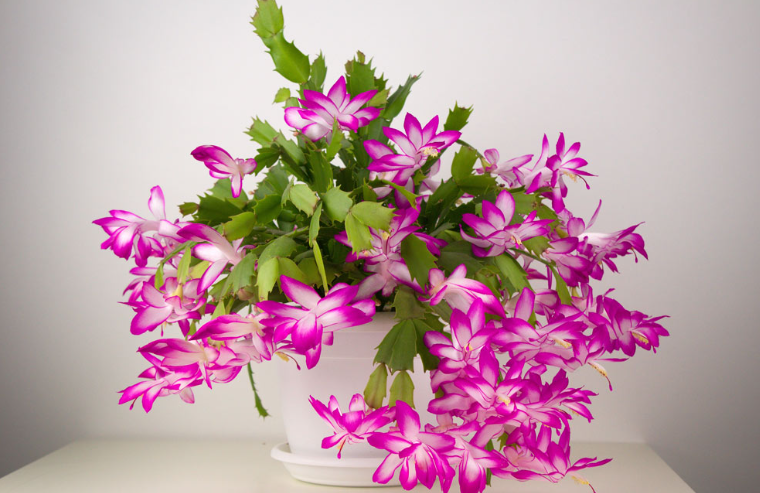
33. Pink Schlumbergera (Christmas Cactus)
The Christmas cactus and its close relatives — including the Thanksgiving cactus and Easter cactus — are among the most widely grown of all flowering houseplants, with global sales estimated at over 30 million plants annually, and pink is consistently the most popular flower color across all three closely related species.
The flowers are large, tubular, and produced at the tips of the flat, segmented, pendant stems in vivid shades of pink ranging from soft blush to deep rose — a spectacular display that appears in winter and early spring when flowering interest indoors is most needed. A well-grown, mature Christmas cactus can carry dozens of blooms simultaneously, creating a curtain of pink flowers that makes it one of the most impressive of all winter-flowering houseplants.
With good care, a Christmas cactus can live for over 20 years and become a multi-generational family heirloom, passed down through households along with the flowering traditions it represents.
34. Pink Pereskia
Pereskia is one of the most ancient and primitive of all cactus genera — plants that retain true leaves rather than the spines and modified stems of most cacti — and several species produce beautiful, open-faced, single flowers in shades of warm pink and rose that look more like a wild rose or a camellia than anything most people associate with the word “cactus.”
The flowers are typically one to two inches across, with delicate, silky petals and a prominent cluster of yellow stamens at the center, and they appear in autumn and winter. They are a vivid reminder of the evolutionary origins of the cactus family from leafy, rose-like ancestors, and their gentle beauty is a striking contrast to the dramatic spined forms that dominate the modern cactus world.
In warm climates, pereskia grows into a large, scrambling shrub or small tree reaching ten to fifteen feet, creating a substantial and unusual garden specimen.
35. Pink Melocactus (Turk’s Cap Cactus)
The Turk’s cap cactus is one of the most unusual and fascinating of all flowering succulents — a spherical cactus that, upon reaching sexual maturity, develops a dense, cylindrical structure of bristles and spines at its crown called a cephalium, from which small, vivid pink to cerise tubular flowers emerge in succession over many years.
The cephalium can reach several inches or even a foot or more in height on very old specimens, growing slowly upward as new flowers are produced from its top. The individual flowers are small but vivid — a brilliant, saturated pink that contrasts dramatically with the pale grey-green, prominently ribbed cactus body below.
It is a plant of the Caribbean and tropical Americas, found growing natively on dry, rocky hillsides and coastal scrublands, and it has been widely collected and planted in botanical gardens worldwide where the extraordinary cephalium and its persistent pink flowers make it one of the most memorable and talked-about plants in any succulent collection.