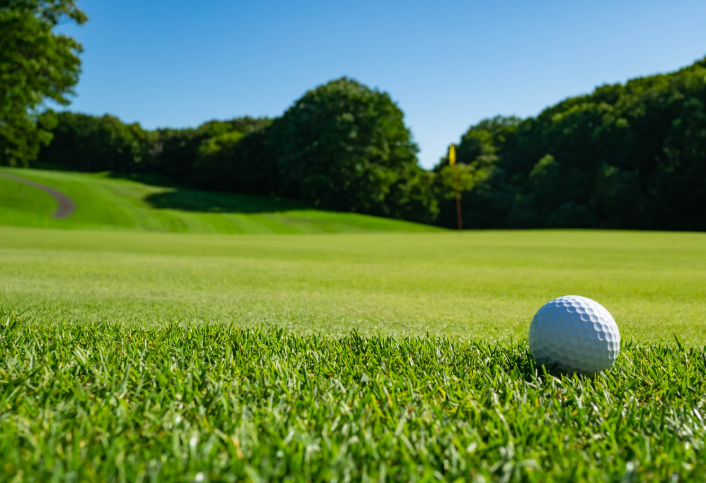
Golf course turf management is one of the most demanding and technically sophisticated branches of horticulture. Across the world’s estimated 38,000 golf courses — which collectively cover an area roughly the size of Belgium — the selection of the right grass for each playing surface is among the most consequential decisions a course superintendent can make. The wrong grass in the wrong climate can mean slow greens, uneven fairways, and unsightly bare patches. The right grass, properly managed, produces the smooth, consistent, beautifully presented playing surfaces that golfers expect and that define the character of a great course.
No single grass species suits every part of a golf course. Greens, where the grass is mown to heights as low as one-eighth of an inch, demand species with exceptional density, fine texture, and the ability to tolerate extreme cutting. Tees and fairways require durability, wear tolerance, and the capacity to recover quickly from the divot damage that thousands of daily shots inflict. Roughs are managed at greater heights and need grasses that provide visual contrast and a genuine penalty for wayward shots without creating unplayable conditions.
Climate is the primary driver of grass selection. The turfgrass world is broadly divided into cool-season grasses — which thrive in temperatures between 60°F and 75°F and are favored in the northern United States, northern Europe, and similar climates — and warm-season grasses, which perform best between 80°F and 95°F and dominate in the American South, the Caribbean, Australia, southern Europe, and tropical regions. Many courses in transition climates use both types in different parts of the course, or overseed warm-season turf with cool-season grasses in winter to maintain playable green surfaces year-round.
The science of golf course grasses has advanced dramatically in the past half century. Modern breeding programs have produced cultivars with dramatically improved disease resistance, drought tolerance, salt tolerance, and playing quality compared to the varieties available even twenty years ago. Annual investment in turfgrass research by the golf industry and its supporting institutions runs into the tens of millions of dollars globally, reflecting the enormous economic and aesthetic importance of getting the grass right.
1. Creeping Bentgrass
Creeping bentgrass is the dominant putting green grass in the cool-season world — the variety of choice on the majority of premium golf courses across the northern United States, Canada, northern Europe, and Japan, where its exceptionally fine texture, dense growth, and ability to be mown to extreme low heights make it the benchmark against which all other putting surface grasses are measured.
It can be maintained at heights as low as 0.100 inches — barely a fraction above bare soil — producing putting surfaces of extraordinary smoothness and consistency. Major championships including the US Open and The Masters are contested on creeping bentgrass greens that have been meticulously prepared to stimpmeter readings of twelve feet or more.
The most widely used modern cultivars include Penn A-4, Declaration, and Tyee, each bred to improve on the disease resistance and performance limitations of older varieties.
2. Bermuda Grass
Bermuda grass is the most widely used warm-season turfgrass on golf courses worldwide — a tough, aggressive, heat-loving grass that dominates course construction across the American South, the Caribbean, the Middle East, Australia, Africa, and the warmer parts of Asia and Europe.
It produces dense, fine-textured turf that withstands heavy traffic and recovers rapidly from damage — a critical quality on courses with high round volumes. Hybrid bermuda cultivars developed specifically for golf course use have transformed the quality of warm-season playing surfaces, with varieties such as TifEagle and Champion Bermuda producing putting green turf that rivals the best bentgrass surfaces in smoothness and consistency.
Over 8,000 golf courses in the United States alone use bermuda grass on their fairways and greens, making it the single most planted golf course grass in the country.
3. Poa Annua (Annual Bluegrass)
Poa annua is the most controversial and yet most widespread of all golf course grasses — a weed species that has colonized putting greens worldwide almost entirely without human assistance, and which is now deliberately maintained as the primary putting surface at some of the most famous and prestigious courses in the world, including Augusta National and Pebble Beach.
It produces exceptionally smooth putting surfaces with a fine texture and a soft, responsive playing character that many golfers prefer to bentgrass. However, it is highly susceptible to heat stress in summer — leading to brown patches and surface inconsistency — and its natural tendency to produce seed heads from spring through autumn creates a bumpy, grainy putting surface that requires intensive management to control.
The coexistence of Poa annua and creeping bentgrass on the same green is one of the most common and challenging management situations in golf course agronomy.
4. Kentucky Bluegrass
Kentucky bluegrass is one of the most widely recognized cool-season grasses in the world, forming the basis of countless lawns, sports fields, and golf course fairways and roughs across the northern United States and similar cool-temperate climates. Its rich, deep blue-green color and medium-fine texture make it one of the most visually attractive of all cool-season turfgrasses.
On golf courses, it is most commonly used on fairways, tees, and roughs rather than greens, where its growth habit and texture are less suited to the ultra-low mowing heights required. It produces a dense, wear-resistant sward with good self-repair capability from its vigorous underground rhizomes, and it performs reliably in the cool springs and autumns when other grasses slow down.
It requires more water and fertilization than many other golf course grasses but rewards good management with one of the finest-quality playing surfaces available in cool climates.
5. Perennial Ryegrass
Perennial ryegrass is valued on golf courses primarily for two qualities that are unmatched in the cool-season grass world — its extraordinary speed of germination (it can produce visible seedlings within five to seven days of sowing, faster than almost any other turfgrass) and its exceptional wear tolerance under heavy traffic.
It is used extensively on tees and fairways where rapid establishment and durability are priorities, and it is the dominant overseed grass used on warm-season courses through winter to maintain green playing surfaces after bermuda and zoysia grasses go dormant. Courses in temperate climates with heavy daily play — including many Scottish links courses — rely heavily on perennial ryegrass for its ability to withstand intensive use and recover quickly.
Modern improved cultivars such as Transenze and Elka have dramatically increased the heat tolerance and disease resistance of perennial ryegrass, extending its geographic range considerably.
6. Zoysia Grass
Zoysia is a warm-season grass of East Asian origin that has become one of the most important and widely planted golf course grasses in the world — particularly in Japan, Korea, Southeast Asia, Australia, and the transition zones of the United States where summer heat and cool winters create conditions that neither pure cool-season nor warm-season grasses handle perfectly.
It is prized for its exceptionally dense, resilient turf that provides outstanding playing quality, its good tolerance of shade — superior to bermuda grass in this respect — and its ability to perform across a wider temperature range than most warm-season species. The firm, resilient playing surface it produces on fairways is considered by many golfers to provide ideal conditions for iron play.
Zoysia can be slow to establish — sometimes taking two growing seasons to fill in fully — but once established it forms one of the most durable and self-maintaining turfgrass surfaces available.
7. Fine Fescue
The fine fescues — a group that includes creeping red fescue, chewings fescue, hard fescue, and sheep’s fescue — are the dominant grasses of links golf, particularly on the celebrated Scottish and English seaside courses where the sport was born and where the combination of poor, sandy soils, exposed conditions, and salt-laden winds creates an environment that fine fescues tolerate better than any other turfgrass.
They produce a fine, slender-leaved, naturally low-growing turf that requires minimal fertilization and irrigation — fine fescue fairways on traditional links courses are often maintained with little more than mowing and aerification, their natural lean condition producing the firm, fast playing surfaces that are the hallmark of true links golf.
Courses such as the Old Course at St Andrews, Royal Birkdale, and Carnoustie are classic examples of fine fescue course agronomy, and the playing character these grasses produce has influenced the global understanding of what golf course turf should feel like.
8. Colonial Bentgrass
Colonial bentgrass is a cool-season grass closely related to creeping bentgrass but with a more upright, bunch-forming growth habit that makes it particularly well suited to fairways and approaches rather than greens. It produces a fine, dense sward of excellent playing quality and is widely used on courses in New Zealand, the Pacific Northwest of the United States, and parts of northern Europe.
It is notably drought-tolerant compared to creeping bentgrass and performs well in the cool, moist maritime conditions of the regions where it is most commonly grown. On links and heathland courses in particular, colonial bentgrass fairways produce a firm, fast playing surface with excellent ball-lying characteristics that suit traditional golf shot-making.
It tends to produce a naturally low, tight sward when maintained well, and its fine texture and dense growth give it good resistance to weed invasion.
9. Velvet Bentgrass
Velvet bentgrass is considered by many turfgrass specialists to produce the finest and densest putting surface of any grass in the world — a silky, deep green turf of extraordinary smoothness that, at its best, provides a playing experience unlike any other. It is however, significantly more demanding to grow than creeping bentgrass and far less forgiving of management errors.
It is the traditional grass of putting greens in New England, and iconic courses such as The Country Club in Brookline and Myopia Hunt Club in Massachusetts maintain velvet bentgrass greens that are celebrated for their exceptional quality and character.
The relatively narrow climatic window in which velvet bentgrass performs well — cool summers are essential — has limited its widespread adoption, but on courses where conditions suit it the results are extraordinary.
10. St. Augustine Grass
St. Augustine grass is a coarse-textured warm-season grass of the humid tropics and subtropics that is widely used on golf course roughs and secondary areas in Florida, the Gulf Coast, the Caribbean, and similar high-humidity, high-heat environments where its outstanding shade tolerance and aggressive spreading growth make it both practical and effective.
It forms a dense, vigorous ground cover that recovers rapidly from disturbance and provides an effective visual boundary between maintained and unmanaged areas of the course. While its coarse texture and relatively low visual quality make it unsuitable for greens or most fairway applications, its performance in shaded areas under trees is superior to virtually every other warm-season grass.
It requires more water than bermuda or zoysia and is sensitive to cold, limiting its use to the warmer portions of the golf course map.
11. Paspalum
Seashore paspalum is one of the most remarkable and increasingly important warm-season grasses in golf course management — a species capable of growing in conditions that would kill virtually any other turfgrass, including irrigation with highly saline water, direct coastal salt spray, and the waterlogged soils of coastal development sites.
It is the grass of choice for golf course construction in the Middle East — where fresh water for irrigation is scarce and courses must often be watered with desalination byproduct or treated wastewater with high salt content — and for seaside courses in tropical and subtropical regions worldwide. The development of improved cultivars such as SeaDwarf, Aloha, and Platinum TE has dramatically elevated the playing quality of paspalum turf to the point where premium paspalum greens can rival bermuda in smoothness and consistency.
Its salt tolerance is estimated to be five to ten times greater than that of bermuda grass, making it genuinely irreplaceable in the most challenging coastal and arid golf course environments.
12. Buffalo Grass
Buffalo grass is a native North American prairie grass that has been adapted for golf course use on courses in the Great Plains, the American Southwest, and other semi-arid regions where its extraordinary drought tolerance and low input requirements make it one of the most environmentally sustainable turfgrass options available.
It thrives in full sun with minimal water — buffalo grass fairways can be maintained on natural rainfall alone in many parts of its native range — and it requires significantly less fertilization, mowing, and chemical inputs than conventional golf course grasses. Several courses in the American Midwest and Southwest have converted areas of rough and secondary fairway to buffalo grass as part of environmental stewardship programs, reducing water use by up to 75 percent in those areas.
Its blue-green color and fine texture are attractive in the right context, though its relatively slow growth and poor shade tolerance limit its use to sun-exposed areas with appropriate climates.
13. Centipede Grass
Centipede grass is a low-maintenance warm-season grass native to China and Southeast Asia that has found a significant role on golf courses in the southeastern United States — particularly in the Carolinas, Georgia, and the Gulf states — where its preference for acidic, sandy, infertile soils and its minimal fertilization requirements make it both economically and ecologically attractive.
It is naturally slow-growing, which reduces mowing frequency, and produces a medium-textured, light apple-green turf of reasonable playing quality on roughs and secondary areas. Its tolerance of poor soils and its reduced input requirements have made it particularly popular on older, lower-budget courses where the cost savings from its naturally low-maintenance character are a genuine financial benefit.
It is however, sensitive to cold, alkaline soils, heavy foot traffic, and drought — limitations that restrict its use to particular environments where conditions align with its narrow range of tolerances.
14. Kikuyu Grass
Kikuyu grass is a vigorous, warm-season grass native to East Africa that has become one of the most widely planted golf course grasses in Australia, South Africa, and coastal California — regions where its aggressive growth, drought tolerance, and ability to produce dense, wear-resistant turf in hot conditions have made it both a management asset and, in some cases, a management challenge.
It grows with remarkable speed and aggression, recovering from divot damage on tees and fairways more rapidly than almost any other warm-season grass — a quality that makes it ideal for high-traffic areas on busy courses. On the other hand, its invasive spreading habit can make it difficult to contain, and kikuyu encroachment into areas designated for other grasses is a persistent challenge on courses where it is grown.
It produces a reasonably fine texture for a warm-season grass and is tolerant of the cool coastal conditions of southern California and the Western Cape of South Africa, where it performs well in climates that would challenge bermuda grass.
15. Bent/Poa Mixed Turf
On many of the world’s most prestigious golf courses, the putting greens are not maintained as a pure stand of any single species but rather as a managed mixture of creeping bentgrass and Poa annua — the two most competitive cool-season putting surface species — with the superintendent working to maintain a consistent playing surface from the balance between them rather than fighting the inevitable invasion of one by the other.
Courses such as Augusta National, Shinnecock Hills, and many of the classic parkland layouts of the northeastern United States and the British Isles maintain these mixed surfaces, which develop their own distinct playing character over decades — firm in certain conditions, receptive in others, with a complexity and responsiveness that pure cultivated stands sometimes lack.
Managing a mixed bentgrass/Poa surface requires considerable skill and experience, as the two grasses respond differently to temperature, disease pressure, and cultural practices throughout the year.
16. Carpetgrass
Carpetgrass is a low-growing, stoloniferous warm-season grass that thrives in the wet, acidic, infertile soils of the humid American Southeast — conditions that challenge most other turfgrasses — and is used on golf course roughs and low-maintenance areas in Florida, the Gulf Coast, and similar environments where drainage is poor and soil quality is low.
It produces a medium-coarse, light green turf that requires minimal fertilization and very little management attention, making it a practical choice for large areas of course that do not require high playing quality. Its tolerance of wet, poorly drained soils is one of its most valuable characteristics in the environments where it grows naturally.
It is not suitable for high-quality playing surfaces due to its coarse texture and tendency to produce tall, unsightly seed heads, but as a low-maintenance grass for secondary areas it performs a useful and cost-effective role.
17. Bahia Grass
Bahia grass is a coarse-textured, drought-tolerant warm-season grass widely used on golf course roughs in the southeastern United States — particularly Florida — where its deep, extensive root system, which can reach six feet or more into the soil, gives it outstanding drought and wear tolerance on sandy, infertile soils.
It is not a grass of fine playing quality, but it is one of the most reliably persistent and low-maintenance grasses available for large rough areas that receive minimal irrigation and fertilization. Its natural adaptation to the poor, sandy soils of the Florida peninsula makes it particularly appropriate for environmentally sensitive course areas where minimizing inputs is a priority.
The tall, Y-shaped seed heads it produces throughout the growing season are a characteristic and somewhat divisive visual feature that requires regular mowing to manage on well-presented courses.
18. Tall Fescue
Tall fescue has undergone a dramatic transformation in golf course use over the past thirty years — moving from a coarse, clumping grass used reluctantly on steep slopes and difficult areas to a valued, fine-textured turfgrass used deliberately on roughs, naturalized areas, and even fairways on courses that prioritize drought tolerance and low inputs.
Modern dwarf tall fescue cultivars — bred specifically for turf use — produce a fine-bladed, dense, attractive sward with exceptional drought tolerance and the ability to remain green through summer heat and dry spells that would desiccate other cool-season grasses. They are widely used on courses in the transition zone between cool and warm climates, and on drought-prone sites throughout the United States and Europe.
Tall fescue fairways irrigated with minimal water and maintained without synthetic fertilizers are increasingly common on courses pursuing environmental certification and sustainability credentials.
19. Tifdwarf Bermuda
Tifdwarf is a dwarf hybrid bermuda grass cultivar developed specifically for golf course putting greens — a variety bred to produce shorter internodes, finer texture, and greater surface density than standard bermuda grasses, enabling it to be maintained at ultra-low cutting heights to produce the smooth, fast putting surfaces demanded by modern golf.
Developed at the University of Georgia’s Coastal Plain Experiment Station in the 1960s, Tifdwarf was the dominant bermuda grass putting green variety for several decades and transformed the quality of warm-season golf course greens across the United States, the Caribbean, and internationally. It has since been succeeded by even finer and more disease-resistant cultivars such as TifEagle, Ultra Dwarf, and Champion, but it remains the genetic foundation on which most modern bermuda putting green varieties are built.
Its development was one of the most significant advances in golf course agronomy of the twentieth century.
20. Paspalum Vaginatum (Seashore Paspalum Greens Mix)
A specialized selection of seashore paspalum developed specifically for putting green use — as distinct from the broader paspalum varieties used on fairways and tees — has emerged as one of the most important developments in warm-season golf course agronomy of the past two decades.
Putting green cultivars such as SeaDwarf and Platinum TE produce a texture and density that approaches or matches the finest bermuda putting surfaces, while retaining all of the remarkable salt and waterlogging tolerance that makes the broader species so valuable in challenging environments. Courses across the Arabian Gulf, Southeast Asia, Hawaii, and coastal South America now maintain paspalum greens of genuine championship quality.
The growing pressure on freshwater resources globally — agriculture and golf together consuming an estimated 90 percent of managed freshwater in some arid regions — has made paspalum’s ability to perform with recycled and brackish water an increasingly critical environmental and economic advantage.
21. Penncross Bentgrass
Penncross is one of the most historically important and widely planted putting green grasses ever developed — a creeping bentgrass cultivar released by Pennsylvania State University in 1954 that transformed putting green quality on golf courses across the cool-season world and remained the dominant bentgrass variety for over three decades.
Before Penncross, most bentgrass greens were established from mixed, unstandardized seed of variable quality. Penncross offered for the first time a named, standardized, broadly adapted bentgrass variety that produced consistent, high-quality putting surfaces with the reliability that course superintendents and golfers demanded. Its legacy continues today in the dozens of improved bentgrass cultivars that have been developed since and that invariably acknowledge Penncross as the foundational variety against which they are measured.
Though now largely superseded for new green construction by higher-performing modern cultivars, Penncross greens established fifty or more years ago remain in excellent condition on many classic courses — a testament to the exceptional longevity and resilience of this landmark turfgrass variety.