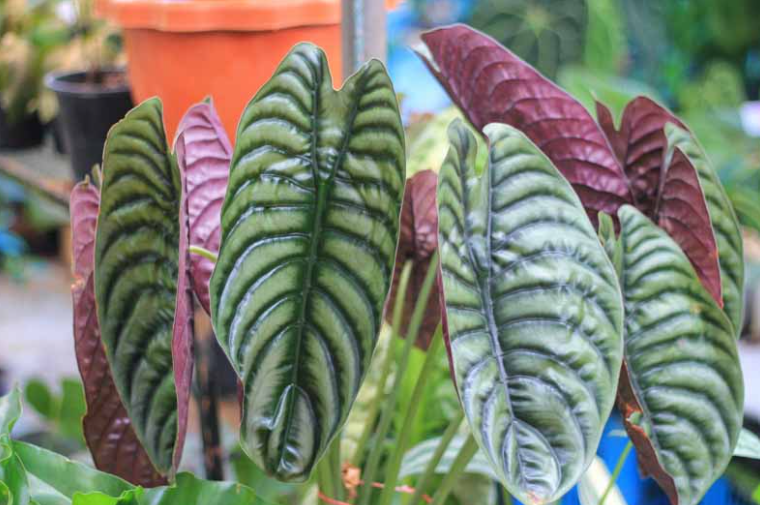
Few plants command a garden space with the immediate, visceral drama of elephant ears. Their leaves — sometimes enormous, sometimes sculptural, always architecturally powerful — create an instant tropical atmosphere wherever they grow, transforming modest garden beds into lush, exotic environments that transport the viewer mentally to far warmer, wilder places. No other group of commonly cultivated garden plants provides quite the same combination of sheer physical scale, bold texture, and tropical visual impact in a package accessible to gardeners across a wide range of climates.
The term “elephant ear” is applied somewhat loosely to several related genera within the aroid family — primarily Colocasia, Alocasia, Xanthosoma, and to a lesser extent Caladium — plants that are related but distinct in character, growing habit, and garden performance. Colocasias are the classic elephant ears of tropical water margins and humid lowland forests, with large, heart-shaped to arrow-shaped leaves that typically face downward or forward. Alocasias tend to hold their leaves upward and outward, creating a more upright, architectural presentation. Xanthosomas are similar in character to colocasias but originate primarily from tropical America. Understanding these distinctions helps in matching the right plant to the right garden situation.
The global popularity of elephant ear plants has grown dramatically in recent decades. The introduction of dramatically colored ornamental cultivars — in near-black, vivid green, chartreuse, white-veined, and metallic bronze forms — transformed elephant ears from purely foliage plants of subtropical gardens into sought-after ornamentals for temperate gardeners as well. Industry surveys estimate that elephant ear plant sales in the United States have increased by over 200 percent since 2005, driven primarily by new cultivar introductions that offer extraordinary color and form in addition to sheer leaf size.
Elephant ears are grown across an enormous range of climates — as permanent garden plants in tropical and subtropical regions, as container plants that can be moved indoors for winter in temperate climates, and as summer annuals lifted and stored in frost-free conditions through the cold months. Tubers and rhizomes store remarkably well when kept cool and dry, and the ease with which elephant ears can be carried through winter in storage has made them accessible to gardeners across much of the temperate world who cannot grow them year-round in the ground.
Also Read: Types of Perennial Ornamental Grasses
Elephant Ear Plants
1. Black Magic Colocasia
Black Magic is the elephant ear cultivar that arguably sparked the modern interest in dark-foliaged tropical plants — a Colocasia esculenta variety whose leaves are an extraordinary, deep, velvety near-black to dark purple-black that provides one of the most dramatically unusual and immediately striking foliage effects available from any garden plant.
The near-black color is rich, luminous, and consistent through the growing season, and the large, heart-shaped leaves — reaching two to three feet across on mature plants — create an imposing, moody foliage presence that is quite unlike any other commonly grown garden plant. The dark color is particularly effective when backlit by low afternoon sun, which illuminates the leaves from behind to reveal a rich, deep purple translucence.
It grows vigorously to four to five feet in height in warm conditions and is one of the most widely grown and most photographed ornamental elephant ear varieties globally — consistently appearing in award-winning container arrangements and tropical-style border plantings.
2. Colocasia Gigantea (Giant Elephant Ear)
Colocasia gigantea earns its name honestly — this is the largest-leaved elephant ear species in cultivation, capable of producing individual leaves measuring four to five feet in length and three to four feet in width on plants reaching ten to twelve feet in height under ideal tropical growing conditions.
The leaves are a rich, blue-green to grey-green on the upper surface with a paler underside, and their extraordinary size creates an immersive, jungle-like atmosphere that smaller elephant ears simply cannot achieve. The scale of a mature gigantea planting is genuinely breathtaking — plants large enough to shelter under from light rain.
In temperate climates grown as a summer annual or container plant, gigantea still achieves impressive size within a single season — individual leaves commonly reaching two to three feet even in their first year from a mature tuber.
3. Illustris Colocasia
Illustris is a classic ornamental elephant ear cultivar with a striking, naturally variegated leaf pattern — the dark green surface of each large leaf is marked with vivid, lime-green to yellowish veins and patches that create an almost stained-glass effect in bright light, combining the tropical impact of large colocasia leaves with genuine ornamental leaf patterning.
It grows to three to five feet with large, heart-shaped leaves of considerable visual complexity, and the variegated pattern is most vivid in bright, indirect light where the contrast between dark green and pale veining is most effectively displayed. In direct sun the coloring can become slightly bleached.
It is one of the most ornamentally refined of the variegated colocasia cultivars and has been in commercial cultivation for over a century — a longevity that reflects consistent demand for its exceptional leaf patterning.
4. Alocasia Macrorrhiza (Giant Taro)
Giant taro is one of the most imposing plants in the aroid family — an enormous Alocasia species whose upward-pointing, glossy, deep green leaves can reach four to six feet in length on plants growing to fifteen feet or more in tropical conditions, creating a dramatically architectural, almost prehistoric plant presence of extraordinary scale.
Unlike Colocasia, which holds its leaves at a forward or downward angle, giant taro holds its leaves conspicuously upright and outward — creating a crown of large, pointing, glossy leaves that has a boldly architectural, almost defiant quality in the landscape.
The species has been cultivated for its edible corm across Pacific Island and Asian cultures for thousands of years — it is estimated that taro in its various forms feeds approximately 400 million people worldwide as a staple food crop, making it one of the most culturally and nutritionally significant plants in the aroid family.
5. Alocasia Zebrina
Alocasia zebrina is one of the most elegant and visually distinctive of all the ornamental alocasias — a medium-sized species from the Philippines whose most remarkable feature is the extraordinary stem patterning: each leaf petiole is boldly banded and marked with deep green and pale yellow-cream in a pattern that closely resembles zebra stripes.
The leaves themselves are large, glossy, arrow-shaped, and a rich, deep green — attractive in their own right — but it is the remarkable striped stem that gives this species its common name and its outstanding ornamental distinctiveness. In a container or garden bed, the combination of the striped stems and the bold, upward-pointing leaves creates an effect of tropical refinement that is among the finest available from any alocasia species.
It grows to three to four feet in appropriate warm, humid conditions and has become one of the most popular houseplant aroids globally in recent years, with demand consistently outpacing nursery supply.
6. Alocasia ‘Portora’
Portora is a dramatic hybrid alocasia of impressive scale — a vigorous grower producing large, upright, wavy-edged, deep green leaves on tall, purplish stems that collectively create one of the most boldly architectural and structurally commanding of all ornamental elephant ear plants in garden and container use.
It grows to six to eight feet under favorable conditions — taller than most ornamental alocasias — with the characteristic upright leaf orientation of the alocasia family combined with the wavy, undulating leaf margins that give Portora a quality of restless, tropical energy. The purple-tinted stems add color contrast to the deep green foliage.
It is one of the most frequently used large tropical-style plants in professional landscape planting in warm climates, valued for the combination of scale, structure, and the distinctive wavy-edged leaf form that makes it immediately recognizable among large-leaved aroids.
7. Xanthosoma Sagittifolium (Arrowleaf Elephant Ear)
The arrowleaf elephant ear is a large, vigorous Xanthosoma species of considerable practical and ornamental value — producing large, arrowhead-shaped, blue-green to grey-green leaves on tall stems, the distinctly arrow-shaped leaf form setting it apart from the rounder, heart-shaped leaves of most Colocasia species.
It grows to five to eight feet in warm, moist conditions and is one of the most widely cultivated food plants in the Caribbean and tropical Americas, where the corms, leaves, and stems are consumed as a staple vegetable. The ornamental value of the large, boldly architectural leaves makes it equally appealing as a garden specimen.
It spreads vigorously and can colonize large areas in appropriate conditions — a quality that makes it outstanding for large-scale tropical planting effects but requires management in confined garden situations.
8. Colocasia ‘Mojito’
Mojito is one of the most visually dramatic and unusual of all the ornamental colocasia cultivars — a variety whose leaves are splashed and speckled with irregular patches of dark purple-black and bright green in a pattern that creates an almost recklessly bold, two-toned foliage display of extraordinary visual energy.
The random, non-repeating pattern of dark and light patches on each leaf means that no two leaves are ever identical — giving the plant a spontaneous, almost painted quality that is uniquely organic and alive. The splashing pattern varies in intensity depending on growing conditions and the age of individual leaves.
It grows to three to five feet and is most effective when used as a specimen or accent plant where the extraordinary leaf patterning can be appreciated individually rather than lost in a mass planting. It is among the most eagerly sought ornamental colocasia introductions of recent years.
9. Alocasia ‘Polly’ (African Mask Plant)
The African mask plant is one of the most widely grown and immediately recognizable of all ornamental alocasias — a compact, glossy-leaved cultivar with deep, wavy-edged, arrow-shaped leaves of rich, near-black green with dramatically bold, white-cream veining that creates an extraordinary, almost graphic, high-contrast leaf pattern.
The contrast between the very dark leaf surface and the vivid white vein network is so striking that the leaves resemble carved tribal masks — an association that gave rise to both its common name and its extraordinary commercial appeal. It grows to two to three feet and is one of the most widely sold houseplant aroids globally.
With annual sales estimated in the tens of millions of plants worldwide, the African mask plant is one of the most commercially significant ornamental aroids in the global houseplant market — a dominance driven entirely by the extraordinary visual impact of its leaf patterning.
Also Read: Types of Dieffenbachia Plants
10. Caladium ‘White Queen’
White Queen is a large-leaved caladium cultivar of exceptional elegance — producing broad, heart-shaped leaves primarily in vivid white with deep green margins and distinctive red veining that creates one of the most refined and sophisticated leaf color combinations in the caladium world.
While caladiums are technically distinct from the core elephant ear genera, their bold, tropical, large-leaved character places them firmly within the elephant ear design category, and White Queen represents the caladium family at its most architecturally impressive — the large, broad, predominantly white leaves creating a luminous, light-catching effect in shaded garden positions.
Caladiums as a group are particularly valued in the American South, where they have been grown as ornamental summer plants in shaded gardens for over 150 years — with Florida producing an estimated 95 percent of all caladium tubers sold commercially in the United States.
11. Colocasia ‘Jack’s Giant’
Jack’s Giant is precisely what its name promises — an extraordinarily large-leaved colocasia cultivar selected specifically for producing the biggest possible leaves, with individual leaf blades regularly exceeding four feet in length and three feet in width on well-established, well-fed plants growing in warm, humid conditions.
The leaves are a rich, glossy green with the characteristic downward-pointing orientation of the colocasia family, and their sheer size creates a jungle canopy effect in the garden that smaller elephant ears cannot achieve. A well-established Jack’s Giant planting has a genuine, immersive tropical forest quality.
It grows to six to eight feet in height and is one of the most impressive garden statement plants available for tropical-style planting in warm climates — an attention-commanding specimen that delivers more sheer scale from a single plant than virtually any other commonly available garden plant.
12. Alocasia Wentii (Hardy Elephant Ear)
Alocasia wentii is one of the most cold-tolerant of all the ornamental alocasias — a species from New Guinea and adjacent regions that has demonstrated the ability to survive brief frost events that would destroy most alocasia species, making it one of the most practically useful ornamental elephant ears for cool-temperate gardeners.
The leaves are large, bold, glossy, and a rich, deep olive-green on the upper surface with a dramatic, contrasting deep purple-bronze on the undersides — a bicolor leaf effect of considerable ornamental richness that rewards close inspection of the undersides as much as the conventional viewing of the upper surfaces.
The purple leaf undersides are particularly effective in positions where the leaves are viewed from below or where light shines through them — conditions that illuminate the purple undersurface in a way that standard above-angle viewing cannot reveal.
13. Colocasia ‘Hilo Beauty’
Hilo Beauty is one of the most exquisitely variegated of all elephant ear plants — a colocasia cultivar whose large, heart-shaped leaves are dramatically speckled and marbled in irregular patterns of deep green, light green, and cream-white that create an almost watercolor-painted quality of remarkable natural artistry.
The variegation pattern is unique on each individual leaf and varies throughout the season as the plant grows — older leaves showing more pronounced contrast between the dark and pale areas while younger leaves emerge in a fresher, more vivid arrangement. The effect of the light, cream-white patches in the leaf blade is particularly luminous.
It grows to three to four feet and is particularly effective in positions where the individual beauty of each leaf can be appreciated at close range — a specimen plant for container cultivation or as a focal point in a carefully designed tropical planting scheme.
14. Alocasia Amazonica
Alocasia amazonica — despite its name, not actually from the Amazon basin but developed as a nursery hybrid — is one of the most dramatic and widely recognized ornamental aroids in the world, producing distinctive, deeply lobed, wavy-edged, near-black green leaves with vivid, contrasting white margins and veining that create one of the most graphically striking leaf patterns of any plant.
The bold, white-outlined leaf margins and the deeply sinuate, almost scalloped leaf edges give the plant a quality of extreme precision and graphic design that appears almost impossible to have occurred naturally — though the variety was developed through conventional plant breeding rather than any genetic engineering.
It has been one of the most consistently popular houseplant and tropical garden plants globally for over 50 years, and its bold leaf pattern has influenced ornamental horticulture far beyond the aroid family.
15. Colocasia ‘Coal Miner’
Coal Miner is a deeply, richly dark-leaved colocasia cultivar that achieves a pure, intense, velvety black-purple that is among the darkest foliage colors achievable from any garden plant — the leaves absorbing light rather than reflecting it, creating a depth and density of color that is genuinely extraordinary.
Unlike some dark-leaved cultivars that lighten or bronze in summer heat, Coal Miner maintains its intense dark color through the growing season in appropriate conditions, providing a consistent, uncompromising dark foliage statement from spring planting through autumn dormancy.
It grows to four to five feet and is particularly effective in tropical-style planting schemes where the near-black foliage provides the darkest possible backdrop for vivid orange, red, and yellow flowering companions — creating color contrasts of maximum intensity.
16. Alocasia ‘Regal Shields’
Regal Shields is a large, commanding hybrid alocasia that combines an impressive scale with richly decorative foliage — the enormous, upward-pointing leaves reaching three to four feet in length in a deep, glossy green with subtle silver-green patterning between the prominent veins on established plants.
The deep purple undersides visible from below and the silvery sheen of the upper surface in appropriate light give it an air of genuine regal quality that the name captures accurately. It grows to five to six feet and has rapidly become one of the most sought-after large alocasia cultivars for warm-climate garden and container use.
Its impressive size combined with the ornamental leaf patterning make it one of the most complete large tropical accent plants available — delivering both dramatic scale and genuine leaf interest in a single specimen.
17. Xanthosoma ‘Lime Zinger’
Lime Zinger is a vivid, chartreuse-yellow to lime-green xanthosoma of extraordinary brightness — the vivid, saturated leaf color creating one of the most luminous and immediately eye-catching tropical foliage effects available from any elephant ear plant.
The vivid lime-green coloring is consistent through the growing season and reaches its most intense brilliance in bright, indirect light where the yellow-green pigments are maximally expressed without the bleaching that direct intense sun can produce. It grows to three to four feet with large, arrowhead-shaped leaves.
In tropical-style planting schemes the vivid lime-green foliage of Lime Zinger provides one of the most effective contrast plants to dark-leaved companions such as Black Magic colocasia and dark caladiums — the light and dark foliage creating combinations of maximum visual impact.
18. Alocasia Odora (Night-Scented Lily)
Alocasia odora is one of the most practically valuable ornamental alocasias for outdoor cultivation in marginal climates — a large, vigorous species with considerable cold tolerance by alocasia standards, surviving brief dips to around 25°F (-4°C) with appropriate protection, and producing large, upward-pointing, deep green leaves of bold architectural character.
The species takes its common name from the large, white, spathe-like flowers that appear on mature plants in warm climates — the flowers releasing a sweet, lily-like fragrance in the evening that is one of the most unexpected and pleasant sensory qualities of any large tropical foliage plant.
It grows to six to eight feet in appropriate warm conditions and is widely cultivated in Japanese gardens, where its bold, architectural form has been appreciated for centuries as a statement plant in traditional garden design.
Also Read: Types of Sweet Williams Flower
19. Colocasia ‘Fonoti’
Fonoti is a Polynesian cultivar of Colocasia esculenta that has been grown across the Pacific Islands for centuries as both a food plant and an ornamental — the combination of attractive foliage, edible corm, and robust constitution reflecting the practical requirements of traditional Pacific Island cultivation.
The leaves are large, bold, and a rich, deep green — impressive in scale without the unusual coloring of more modern ornamental cultivars — and the corms are edible when properly prepared, adding a utilitarian dimension to its ornamental value that few purely decorative cultivars can offer.
It is one of many traditional taro cultivars whose cultivation connects modern gardeners to centuries of Pacific Island agricultural history — a cultural heritage plant of genuine significance alongside its considerable ornamental qualities.
20. Caladium ‘Florida Sweetheart’
Florida Sweetheart is a compact caladium cultivar with smaller, more finely proportioned heart-shaped leaves than many standard varieties — producing an abundance of rose-pink to deep pink-red leaves with green margins and darker veining that creates a densely leafy, intensely colorful mound of tropical foliage ideal for containers, border fronts, and shaded landscape beds.
The compact habit — reaching only twelve to fifteen inches — and the prolific leaf production of Florida Sweetheart make it one of the most effectively dense and colorful caladium varieties for situations where maximum color impact in minimum space is the primary design requirement.
Florida produces an estimated 95 percent of all caladium tubers sold in the United States — with Highlands County, Florida producing the overwhelming majority from specialist nursery operations that supply the global caladium market.
21. Alocasia ‘Calidora’
Calidora is a large, upright hybrid alocasia selected for its impressive scale, vigorous growth, and bold, glossy, deep green leaves that create one of the most commanding and architecturally powerful tropical accent plants available for warm-climate landscaping.
It grows to six to eight feet with leaves reaching three to four feet in length — combining the upright, architectural leaf orientation of the alocasia family with a scale that approaches the dramatic size of giant taro while maintaining a more garden-manageable constitution. The broad, prominently veined leaves have a quality of bold architectural precision.
It has become one of the most widely specified large alocasia cultivars for professional tropical landscape planting in USDA Zones 9 to 11, valued particularly for its combination of reliable performance, impressive scale, and the clean, bold leaf form that suits contemporary landscape design aesthetics.
22. Colocasia ‘Pink China’
Pink China is a remarkable colocasia cultivar of genuine cold tolerance — surviving temperatures significantly below the threshold that kills standard colocasia varieties and demonstrating the ability to overwinter outdoors in USDA Zone 7 with appropriate mulching, making it one of the most cold-hardy of all ornamental colocasia selections.
The leaves are medium-sized and deep green with pinkish-purple stems and a pink tint to the leaf midrib that gives the plant an unusual, warm-toned color note quite different from the standard green or dark-leaved varieties. It grows to three to four feet with an attractive, somewhat compact habit.
The cold hardiness of Pink China has made it the subject of considerable interest among temperate gardeners who wish to grow elephant ears permanently in the ground without annual lifting and storage — its ability to naturalize and spread as a permanent ground-level presence in marginally cold climates is a genuine advancement in elephant ear cultivation for cool regions.
23. Alocasia Reginula ‘Black Velvet’
Black Velvet is one of the most exquisite and collectible of all ornamental aroids — a small, compact Alocasia species whose leaves are covered in a dense, velvety texture of the deepest, richest near-black green, with bold, contrasting silver-white veining that creates an extraordinary jewel-like quality in a plant of intimate, container-appropriate scale.
The velvety leaf texture is the result of microscopic surface hairs that absorb light rather than reflecting it — giving each leaf a depth and richness of color that glossy-leaved plants cannot replicate. The combination of velvet texture, near-black color, and silver vein network makes Black Velvet one of the most visually distinctive and collectible foliage plants in horticulture.
It grows to only twelve to fifteen inches — very small for an alocasia — making it entirely suitable for container cultivation and indoor growing where its extraordinary leaf quality can be appreciated at close range.
24. Colocasia ‘Elena’
Elena is a distinctive colocasia cultivar whose leaves display an unusual, almost iridescent blue-green to teal coloration that is quite unlike the standard deep green or dark purple of most elephant ear varieties — a cool, fresh, aquatic-toned color that adds a different dimension to the tropical foliage palette.
The teal-blue-green coloring is most pronounced on young leaves and in conditions of bright, indirect light where the unusual pigmentation is most effectively expressed. As leaves mature, the color shifts toward a more conventional deep green, but the fresh leaves always maintain a distinctive blue-toned quality.
It grows to three to four feet with large, heart-shaped leaves and is particularly effective in water garden planting and moisture-loving tropical schemes where the blue-green leaf color reinforces the aquatic character of the planting environment.
25. Alocasia Cucullata (Buddha’s Hand)
Alocasia cucullata — commonly called Buddha’s hand or Chinese taro — is a distinctive, relatively cold-tolerant alocasia species with deeply cup-shaped, hooded leaves whose unusual form is believed in some Asian traditions to resemble hands held in prayer — an association that has made it a sacred and auspicious plant in Buddhist temple gardens across Southeast Asia.
It grows to three to five feet with a compact, clumping habit and demonstrates cold tolerance to around 28 to 30°F (-2 to -1°C) — making it one of the more marginal-climate alocasias for outdoor cultivation in sheltered Zone 9 positions. The hooded, cupped leaves are distinctive and immediately recognizable.
Its cultivation in Buddhist temple gardens across Thailand, Myanmar, and Sri Lanka for centuries has given this species a cultural and spiritual significance beyond its ornamental qualities — making it one of the most historically and symbolically resonant of all the elephant ear plants.
26. Colocasia ‘Burgundy Stem’
Burgundy Stem is a striking colocasia cultivar distinguished primarily by its vivid, deep burgundy-red to purple petioles — the leaf stems being so dramatically colored that they provide as much ornamental impact as the large, deep green to purple-tinged leaves they support.
The bold, burgundy stems are particularly visible when the large leaves are slightly backlit, creating a vivid color accent at the base of each leaf blade that adds a further dimension of color interest to the standard elephant ear leaf display. It grows to four to five feet in warm, moist conditions.
It is a popular choice in container planting where the dramatic stem color is easily visible and can be incorporated into color-coordinated tropical arrangements — the burgundy stems combining effectively with similarly toned companions including purple fountain grass and dark caladiums.
Also Read: Types of Begonia Plants
27. Alocasia Brisbanensis (Cunjevoi)
Cunjevoi is a large, robust, genuinely cold-hardy alocasia native to the subtropical rainforests of eastern Australia that has demonstrated remarkable cold tolerance for the genus — surviving temperatures down to around 25 to 28°F (-4 to -2°C) in sheltered positions and returning reliably from the roots even when the above-ground portions are frost-damaged.
The leaves are large, bold, and a rich, mid to deep green with the upward-pointing orientation characteristic of the alocasia family. It grows to six to eight feet in appropriate conditions and develops into an impressively large, clumping specimen over successive growing seasons.
Its native Australian habitat in subtropical rainforest understory has shaped a tolerance of low light, high moisture, and periodic cold that makes it one of the most practically useful large alocasias for gardeners in warm-temperate climates seeking a permanently established, large-scale tropical effect.
28. Colocasia ‘Nancyana’
Nancyana is a colorful ornamental colocasia cultivar with attractively bronzed to purple-tinted green foliage and distinctive, dark-colored stems that create a rich, multi-toned effect of considerable ornamental warmth. It is a particularly vigorous and productive variety capable of developing into substantial clumps in a single growing season.
The bronzed, slightly iridescent quality of the leaf surface in appropriate light is one of its most distinctive features — a warm, metallic sheen that gives the foliage an unusual depth and richness. It grows to four to five feet with large, broadly heart-shaped leaves.
It is valued in tropical-style planting schemes for its ability to provide the large-scale, tropical leaf impact typical of colocasia combined with the warm, bronze-toned color dimension that standard green-leaved varieties lack.
29. Alocasia Sanderiana (Kris Plant)
The kris plant is one of the most dramatically beautiful and collectible of all alocasia species — a Philippine native whose deeply lobed, wavy-edged, near-black green leaves with vivid silver-white venation and margins create a leaf of extraordinary precision and graphic intensity.
The sinuate, deeply cut leaf margins create a jagged, almost serrated edge profile that gives the plant an aggressive, exotic quality quite unlike the smooth-edged leaves of most aroids. The bold white margins and veins stand out with remarkable clarity against the very dark leaf surface, creating a graphic leaf pattern of extraordinary impact.
It is considered one of the rarest and most prized of all collectible aroids, and authenticated specimens of the true species command premium prices — with wild populations in the Philippines considered vulnerable due to overcollection and habitat loss.
30. Colocasia Esculenta (Taro — Species)
The wild, unselected species of taro — one of the oldest cultivated food plants in human history, with documented cultivation stretching back over 10,000 years across tropical Asia and the Pacific Islands — deserves recognition as the foundational plant from which the entire ornamental elephant ear tradition ultimately derives.
The species produces large, heart-shaped, deep to medium green leaves of the classic elephant ear form on plants reaching three to five feet, and it is one of the most important food crops in tropical regions globally — the corm providing starchy nutrition to an estimated 400 million people worldwide as a staple food, while the leaves are consumed as a vegetable across much of Asia, Africa, and the Pacific.
The extraordinary cultural significance of taro — as food, as medicine, as ceremonial plant, and as the subject of creation myths across Polynesian cultures, where taro is considered a direct ancestor of humanity — makes this humble species one of the most historically, culturally, and nutritionally important plants in human civilization, and the ultimate ancestor of all the ornamental elephant ears that have captivated modern gardeners around the world.