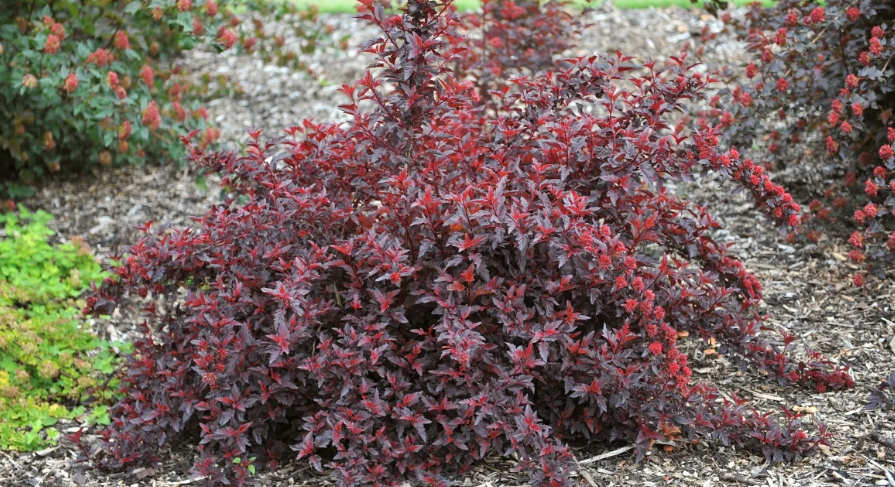
Ninebark is one of North America’s most versatile, ornamentally rewarding, and ecologically valuable native shrubs — a plant that has undergone a remarkable transformation in garden reputation over the past three decades. Once considered a workhorse of utilitarian planting, valued more for its toughness than its beauty, ninebark has been elevated by a wave of outstanding new cultivar introductions into one of the most exciting and widely planted ornamental shrubs in contemporary garden and landscape design.
The name ninebark refers to the shrub’s distinctive exfoliating bark — the outer layers peeling away in strips to reveal multiple layers of warm cinnamon, orange, and tan beneath, a feature that provides ornamental interest through the winter months when the leaves have fallen. This peeling bark effect is most pronounced on mature stems and is one of the most reliably beautiful winter features of any deciduous native shrub, creating a year-round ornamental contribution that many non-native alternatives cannot match.
The explosion of ninebark cultivar development over the past 25 years has been extraordinary. From a handful of mostly green-leaved selections available in the 1990s, the ninebark market has expanded to encompass dozens of cultivars covering a spectrum of foliage colors from vivid lime-green and golden-yellow through warm orange-copper to deep burgundy and near-black purple. Industry surveys estimate that ninebark sales in North American nurseries have increased by over 300 percent since 2000 — a growth rate that places it among the fastest-growing native shrub categories in the horticultural market.
Beyond its ornamental qualities, ninebark is one of the most ecologically valuable native shrubs available to North American gardeners. Research has documented over 60 native insect species associated with ninebark, including specialist native bees that depend on its flowers for pollen. The white to pale pink flower clusters that appear in late spring and early summer are followed by clusters of reddish seed capsules that provide food for birds through summer and autumn. Its deep, fibrous root system makes it outstanding for erosion control on slopes and stream banks, and its tolerance of wet, dry, poor, and compacted soils gives it a landscape adaptability that few other native shrubs can match.
Ninebark Shrubs
1. Diablo (Devil’s Margarita)
Diablo — trademarked as Diablo — was the cultivar that launched the modern ninebark revolution, introducing the first truly deep, rich, dark purple foliage to the genus and demonstrating that ninebark could be not just a tough native shrub but a genuinely dramatic ornamental specimen.
Introduced by Proven Winners in the early 2000s, Diablo grows vigorously to six to nine feet in height and spread — a large, arching shrub of commanding presence that produces its deep, near-black burgundy foliage from the moment the leaves emerge in spring through to autumn leaf fall. The white flower clusters in late spring contrast vividly with the dark foliage.
It remains one of the most widely sold ninebark cultivars globally, consistently appearing in landscape planting surveys as one of the top ten most planted deciduous shrubs in North American commercial and residential landscapes.
2. Summer Wine
Summer Wine is a more compact alternative to Diablo that brings the same rich, wine-red to burgundy foliage to smaller garden spaces — growing to only five to six feet in height and spread, compared to the more expansive habit of its larger relative.
The finely cut, deeply lobed leaves are a consistently attractive burgundy-wine color through the growing season, and the arching, graceful habit of the plant is more refined than the sometimes bulky appearance of larger-growing dark-leaved cultivars. The pink-tinged white flowers in late spring are particularly pretty against the dark foliage.
Summer Wine has consistently appeared on lists of the best-performing shrubs in RHS and North American horticultural society trials, reflecting its exceptional all-round ornamental quality in a size suitable for a wide range of garden situations.
3. Coppertina
Coppertina is a striking cultivar that introduces warm copper-orange tones to the ninebark palette — foliage that emerges in spring in vivid shades of orange-copper before deepening progressively through the season to rich red-orange and finally to deep burgundy by autumn, providing a continuous and evolving color display through the entire growing year.
It grows vigorously to eight to ten feet — one of the larger cultivars — with an upright, arching habit of considerable presence. The spring copper-orange coloration is particularly vivid and unusual, and the seasonal progression through multiple warm color phases gives Coppertina a year-round color narrative not available from single-toned cultivars.
It is particularly effective in autumn, when the deep burgundy foliage combines with the reddish seed capsules and the warm copper tones of aging leaves to create a richly layered late-season display.
Also Read: Different Types of Hydrangea Species
4. Little Devil
Little Devil is one of the finest and most useful dwarf ninebark cultivars — a compact, mounding shrub reaching only two to three feet in height and spread that brings the ornamental dark foliage qualities of larger ninebark cultivars to situations where standard-sized shrubs would be impractical.
The deep burgundy to purple-red foliage is richly colored and consistently attractive through the growing season, and the plant’s neat, compact mound requires minimal pruning to maintain a tidy, well-defined form. The white flower clusters produced in late spring are disproportionately generous for a plant of such modest size.
Its compact size makes it suitable for container planting, rock gardens, small urban courtyards, and border fronts where the larger ninebark cultivars would immediately overwhelm the available space — opening the ornamental qualities of dark-leaved ninebark to a much wider range of garden situations.
5. Amber Jubilee
Amber Jubilee is the most colorfully complex of all the ninebark cultivars — a multi-toned foliage variety whose leaves emerge in spring in vivid shades of orange-gold and amber before transitioning through warm copper, burgundy, and purple-red as the season advances, creating a perpetually changing, multi-phase color display of extraordinary richness.
The multiple warm tones present simultaneously on a single plant — with younger growth in bright amber and older growth in deeper burgundy — create a naturally complex, variegated effect that requires no breeding or selection for variegation, being the result of the natural color progression of individual leaves at different stages of development.
It grows to six to eight feet and was introduced as a commemorative cultivar — the name reflecting the celebratory character of its exceptional, multi-layered color performance.
6. Center Glow
Center Glow is a distinctive cultivar with an unusual and highly effective foliage color pattern — the leaves are a vivid, golden-yellow to lime-green at the center of each leaf blade, surrounded by deep purple-red at the margins, creating an almost luminous bicolor effect that is unique among ninebark varieties.
The golden center of each leaf catches available light and creates a glowing effect in the shrub that is particularly attractive in partial shade, where the yellow-gold centers illuminate the planting with warm color that most dark-foliaged shrubs lack. It grows to six to eight feet with an arching, graceful habit.
Center Glow is frequently cited by garden designers as one of the most sophisticated and refined foliage effects available from any native shrub — the natural bicolor leaf pattern providing a complexity and interest that no single-toned cultivar can approach.
7. Nugget
Nugget is a golden-foliaged ninebark of considerable ornamental value — producing vivid, bright yellow-gold to chartreuse leaves through spring and into summer that provide one of the most luminous and sustained yellow color effects available from any deciduous native shrub in cool and partially shaded garden conditions.
The yellow-gold color is most intense in spring when the fresh new growth emerges, and it remains attractively bright through summer before fading slightly in the hottest months. In partial shade the color is most sustained — a useful quality for gardens where full sun is not available.
It grows to five to six feet and provides a vivid foliage contrast to dark-leaved companions — planted alongside Diablo or Summer Wine, the combination of Nugget’s golden foliage and its neighbors’ deep burgundy creates one of the most effective native shrub color contrasts available in the landscape.
8. Dart’s Gold
Dart’s Gold is a compact, golden-foliaged cultivar that has been in commercial production longer than most modern ninebark introductions — representing one of the earliest selections for yellow-gold foliage in the genus and remaining one of the most reliable and widely available golden ninebark varieties.
It grows to four to five feet with a compact, mounding habit and produces vivid golden-yellow foliage in spring that deepens to lime-green through summer and develops warm yellow tints again in autumn. The white flower clusters are particularly attractive against the bright foliage.
Its compact size, proven reliability, and long track record of consistent performance have kept Dart’s Gold commercially relevant despite the introduction of many newer, more dramatically colored cultivars — a testament to the practical value of a well-performing, manageable shrub in the landscape.
9. Seward (Summer Wine Black)
Summer Wine Black is the darkest and most intensely colored of the Summer Wine series — a compact cultivar whose foliage achieves a near-black purple that is among the deepest and most richly saturated of any ninebark variety, creating an extraordinarily dramatic dark foliage effect in a plant of manageable size.
The near-black leaves retain their intensity of color through the entire growing season without the bronzing or fading that affects some dark-leaved cultivars in summer heat. The contrast between the very dark foliage and the pale pink to white flower clusters is one of the most visually striking combinations available from any flowering shrub.
It grows to five to six feet — slightly larger than the original Summer Wine — and maintains the refined, arching habit that has made the Summer Wine line one of the most consistently popular ninebark series in the North American and European nursery trade.
10. Midnight
Midnight is a medium to large-growing cultivar with deep, consistently dark purple-black foliage that maintains its color intensity through the hottest summer conditions — a quality of considerable practical importance in warm-climate gardens where many dark-leaved cultivars fade to a less impressive bronze-green by midsummer.
The color fastness of Midnight in heat has made it one of the most recommended dark-foliaged ninebarks for gardens in the American South and similarly warm growing regions, where the combination of summer heat and humidity tests the colorfastness of dark-leaved shrubs more severely than in cooler climates.
It grows to six to eight feet and produces the characteristic white flower clusters in late spring, followed by the attractive reddish seed capsules that extend the ornamental interest into summer and autumn and provide food for wildlife.
11. Festivus Gold
Festivus Gold is a relatively recent golden-foliaged introduction that improves on earlier yellow-foliaged ninebarks through enhanced color brightness, improved heat tolerance, and a more consistent retention of vivid gold coloration through the summer months when older yellow cultivars tend to fade to green.
The foliage is a vivid, saturated golden-yellow that is among the brightest available from any ninebark variety — maintaining its characteristic warm glow through the growing season with greater consistency than many earlier selections. The compact to medium habit of four to five feet makes it suitable for a wide range of garden situations.
It is particularly effective as a foundation planting, hedge component, or mixed border shrub where sustained, vivid yellow foliage is needed through the entire growing season — a design requirement that Festivus Gold addresses more reliably than most of its yellow-foliaged predecessors.
12. Tiny Wine
Tiny Wine is the smallest and most compact of the dark-foliaged ninebark cultivars — a dwarf variety reaching only two to three feet in height and spread that combines the rich, deep burgundy-wine foliage of larger dark cultivars with a genuinely diminutive habit suitable for small gardens, containers, and front-of-border situations.
The foliage color is richly saturated and consistently maintained through the season, and the proportionally generous flower clusters produced in late spring create a vivid contrast of pale pink-white against dark burgundy that is as ornamentally effective in this miniature form as in any of the larger cultivars.
It is one of the most commercially successful recent ninebark introductions and has been widely adopted in professional landscape design for situations where the dark foliage impact of ninebark is desired but the available space cannot accommodate a full-sized shrub.
13. Jonight (Little Joker)
Little Joker is a compact cultivar with an unusual and appealing purple foliage that is slightly warmer in tone than the cold, near-black purple of the darkest cultivars — a rich, warm burgundy-purple with visible red undertones that gives it a slightly more vibrant, less somber character than the deepest dark-leaved varieties.
It grows to four to five feet with a neat, mounding habit that requires minimal pruning to maintain, and the warm purple-red foliage provides excellent color contrast with gold and silver companions in mixed shrub and perennial planting schemes. The flower clusters are white with a warm pink flush.
The warm, red-toned purple of Little Joker’s foliage makes it one of the most versatile dark-foliaged ninebarks for combining with a wide range of companion plants — less challenging as a design partner than the coldest, darkest purple cultivars while still providing the strong foliage color impact that makes dark-leaved ninebarks so valuable.
Also Read: Different Types of Viburnums
14. First Editions Lemon Candy
Lemon Candy is a distinctive and unusual ninebark cultivar whose foliage is a soft, warm lemon-yellow to pale gold — a more delicate and refined yellow than the vivid chartreuse of Nugget or the bright gold of Dart’s Gold, providing a gentler, more nuanced yellow foliage effect of considerable elegance.
The soft lemon-yellow color works beautifully in pastel planting schemes where the more vivid golden cultivars would be too assertive, and the delicate color contrasts particularly well with soft blue and lavender perennials, pale pink roses, and the silver foliage of artemisia and stachys companions.
It grows to four to five feet with a compact, well-behaved habit and represents the more restrained, design-sophisticated end of the yellow ninebark spectrum — a cultivar for gardeners who value subtlety and color refinement over bold impact.