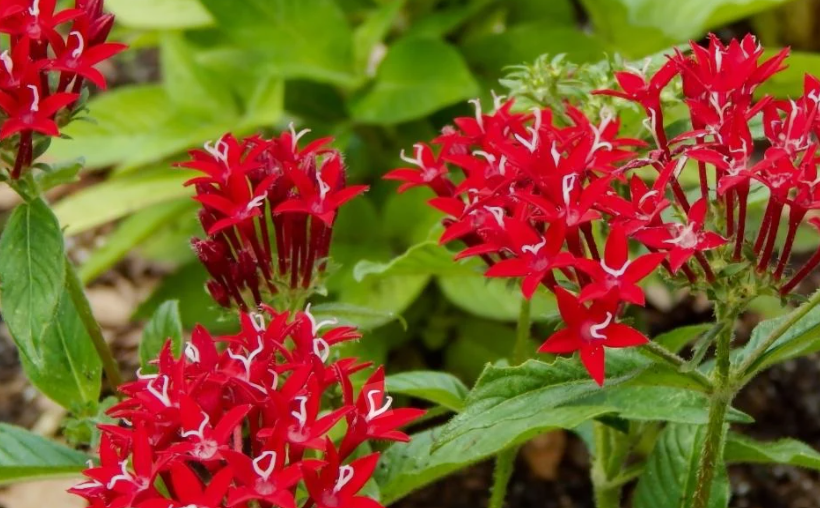
Shrubs with red flowers are the fastest way to add punch to a landscape, whether the color arrives in early spring on bare branches, in the middle of winter on an evergreen, or in waves from summer to frost. Many of the tubular red flowers below are visited by hummingbirds, so numerous entries double as pollinator plants. The 40 shrubs in this guide range from compact roses and azaleas to tall tropical hedges and Australian natives, and each one is listed with the figures that matter most when you’re choosing a plant.
The group covers a wide span of sizes and climates. Heights run from 20 to 30 inches for the smallest cape fuchsias and 2.5 feet for reblooming azaleas to 12 to 15 feet for red buckeye and red powderpuff, with oleander reaching 10 to 18 feet. Hardiness runs from zone 4 for weigela, flowering quince, red buckeye, and ‘Nova Zembla’ rhododendron to zone 12 for bat-faced cuphea, so there’s a red-flowered shrub for almost every part of the country.
Bloom time matters just as much as size. Camellias flower in winter and early spring, azaleas, weigela, and quince in spring, and roses, crape myrtles, and cape fuchsias from summer into fall. In frost-free climates, plants like firebush, ixora, and crimson bottlebrush can flower nearly all year. Choosing shrubs that bloom in different seasons lets you keep red in the garden for 12 months.
Red-flowered doesn’t always mean easy, and a few entries carry cautions worth knowing before you buy. Oleander calls for caution around children, firecracker plant spreads aggressively, and several tropical shrubs die back or fail in a hard freeze. The shrubs are grouped into spring bloomers, camellias, summer bloomers, warm-climate shrubs, and Australian natives, with a final pair of cuphea at the end.
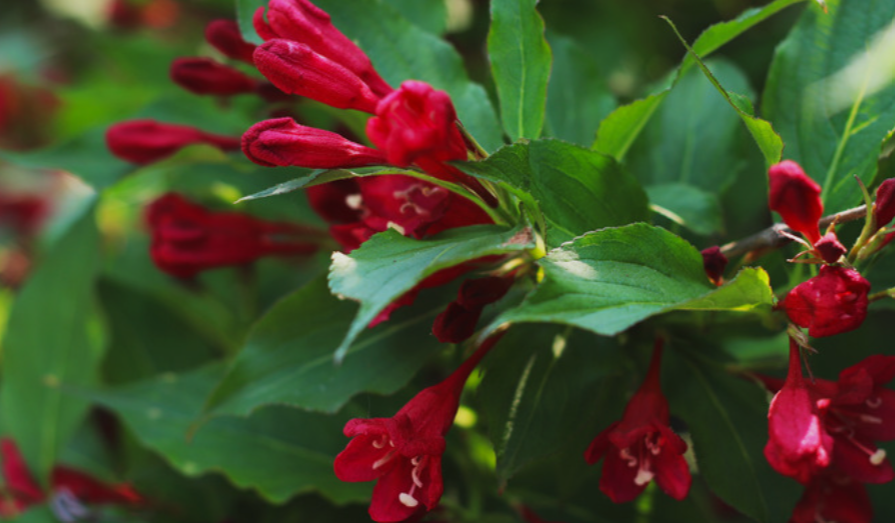
Spring-Blooming Red Shrubs
Red Buckeye
Red buckeye is a deciduous native that grows 12 to 15 feet tall and wide and is hardy in zones 4 through 8. It produces showy, upright panicles of red to orange-red tubular flowers that hummingbirds love. Clemson Extension describes it as a slow to moderate grower that does well in full sun to part shade.
Other sources describe it as a clump-forming shrub or small tree that typically reaches 10 to 20 feet. It tolerates clay soil and moist, well-drained conditions, which makes it useful in difficult sites. Its light brown seed capsules, the buckeyes, remain attractive for a long time but are generally gone before severe winter weather.
Weigela ‘Red Prince’
‘Red Prince’ is a multi-stemmed, upright weigela that grows about 6 feet tall and wide, though it can reach 9 feet in some conditions. NC State Extension describes dark red flowers that hold their color as they age and bloom from late spring into early summer. It’s hardy in zones 4 through 8 and was developed at Iowa State University, which explains its cold tolerance.
The flowers attract hummingbirds, and the plant may rebloom in late summer to early fall with fewer blooms. Because it blooms on old wood, prune it right after flowering. It has no appreciable fall color, so it works best as a background shrub the rest of the year.
Flowering Quince ‘Texas Scarlet’
‘Texas Scarlet’ is a hybrid flowering quince noted for bright red flowers and a compact shape. The single, watermelon-red blooms open in early spring before the leaves fully unfold. Flowering quince in general is hardy in zones 4 through 10.
It does best in full sun, since partial shade reduces the number of blooms. It’s a deciduous shrub that requires little maintenance but looks impressive when covered in flowers. The early bloom makes it one of the first reds of the year.
Flowering Quince ‘Scarlet Storm’
‘Scarlet Storm’ is a Japanese quince that displays very large, double, camellia-like flowers in a deep, dark red all along its branches. The double blooms look richer than the single flowers of ‘Texas Scarlet’. Like other flowering quince, it’s a deciduous shrub that blooms in early spring.
Plant it in full sun for the heaviest flowering, since shade reduces both bloom and fruit. Flowering quince is hardy across a wide range of zones, from 4 to 10. The double flowers are the main reason to choose it over the single-flowered quinces.
Red Flowering Currant
Red flowering currant is a deciduous native of the Pacific Northwest whose drooping clusters of pink to near-red flowers appear in early spring, often before the leaves. Heights are listed from 4 to 6 feet up to 6 to 12 feet, and it’s hardy in zones 5 through 9. The rufous hummingbird’s northward spring migration follows its bloom.
Dark purple, blue-black fruit follows in summer and is edible, though not very tasty, and birds enjoy it. The shrub tolerates shade and dry soil and is deer resistant. It’s a larval host for many butterfly and moth species as well.
‘Nova Zembla’ Rhododendron
‘Nova Zembla’ is a dense, upright evergreen rhododendron with large, rounded trusses of frilly, bright red flowers marked with darker spots on the upper lobes. It’s hardy in zones 4 through 8 and grows 4 to 7 feet tall and wide. Bloom comes in late spring to early summer, and the color is deeper pink in sunnier spots.
It’s deer and rabbit resistant and attracts hummingbirds and bees. It benefits from evenly moist, well-drained, slightly acidic soil and mulch, and it responds well to pruning after flowering. This cultivar is listed as having toxic components, so keep that in mind around pets.
‘Koster’s Brilliant Red’ Azalea
‘Koster’s Brilliant Red’ is a large Chinese azalea that produces an incredible, flamboyant flowering in spring. Azaleas as a group are hardy in zones 6 through 11, depending on the type. This one is prized for its saturated, fiery color.
Azaleas grow best in slightly acidic soil with a pH of 5.5 to 6.5, according to growers of the popular Encore types. Those same growers say 4 to 6 hours of sun is enough for good bloom. Pruning right after flowering avoids removing next year’s buds.
Encore Azalea ‘Autumn Fire’
‘Autumn Fire’ is a compact, evergreen azalea that matures to about 2.5 feet tall and 3 feet wide. It produces rich, velvety, semi-double red blooms about 2.5 inches across. It’s hardy in zones 6 through 9.
The Encore series reblooms, and ‘Autumn Fire’ can flower up to three times a year, in spring, summer, and fall. The foliage turns bronze-purple in winter. Prune right after the spring flush to preserve buds for later flowers.
Encore Azalea ‘Autumn Bonfire’
‘Autumn Bonfire’ is a dwarf, compact azalea with semi-double, saturated red flowers marked with darker crimson spots. It’s hardy in zones 6 through 10 and reblooms up to three times per year. In zones 8 through 10, it stays evergreen through winter.
Minimal pruning is needed, and any shaping should be done lightly right after a bloom cycle so you don’t cut off developing buds. The Encore series now has 31 varieties, and ‘Autumn Bonfire’ is one of two red selections added together with ‘Autumn Fire’. Its compact size suits foundations and containers.
Camellias
Japanese Camellia
Japanese camellia is an evergreen shrub that grows 7 to 12 feet tall and 5 to 10 feet wide and is hardy in zones 7 through 9. Florida’s fact sheet describes flowers of two to five inches in white, red, pink, or variegated forms, blooming in winter or spring. Red selections are among the most popular.
It prefers part shade to full shade and moist, well-drained, acidic soil. It’s prone to aphids, vine weevil, and scale. Prune right after flowering or during early summer.
‘Professor Sargent’ Camellia
‘Professor Sargent’ is a Japanese camellia with spectacular cherry red flowers that bring interest to the winter garden. Its lustrous dark green leaves add texture even when it isn’t in bloom. It’s best grown in zones 7 through 9.
Like other Japanese camellias, it thrives in part shade and acidic soil. The shrub is a neat, well-kept evergreen that makes a good specimen. Its cherry red blooms arrive when most of the garden has faded.
‘Black Tie’ Camellia
‘Black Tie’ is a Japanese camellia with velvety, dark red, formal double blooms. It flowers over an extended period from late winter to early spring. It’s hardy in zones 7 through 9.
Most Japanese camellias perform best in zones 7 through 9, and pushing into zone 6 requires winter protection and a sheltered spot. Combine it with lighter-colored camellias for a layered display. As a group, Japanese camellias can reach 7 to 12 feet at maturity.
‘Royal Velvet’ Camellia
‘Royal Velvet’ is a camellia with large, single, carmine-red flowers. It blooms from February to April. The plant forms a bush about 1.2 meters high and 70 centimeters wide.
At about 70 centimeters wide, it fits a narrow bed. The single form of flower is simple and elegant. It’s a compact choice for a small garden.
‘Holly Bright’ Camellia
‘Holly Bright’ is a Japanese camellia with large, semi-double, bright salmon-red flowers that are beautifully ruffled. It blooms from February to April. It forms a bush about 1.2 meters high and 70 centimeters wide.
The ruffled petals give it a softer, fuller look than single-flowered camellias. It’s evergreen, with glossy leaves that look good through winter. It’s a good fit for a mixed border of early bloomers.
‘Lipstick’ Camellia
‘Lipstick’ is an original and rare Japanese camellia that blooms from January to March. It produces very unusual flowers, red variegated with white, reminiscent of anemones. The white streaks set it apart from the solid reds.
It’s evergreen and best in part shade with acidic, moist soil. It suits gardeners who want something different from solid red. Because it blooms in midwinter, it adds color when little else is flowering.
‘Yuletide’ Camellia
‘Yuletide’ is a sasanqua camellia with fall-to-winter red blooms and bright yellow stamens. Its blooming season runs from September through January. That’s earlier than most Japanese camellias, which flower in winter and spring.
The breeders of the Encore azaleas describe those azaleas as blooming in sequence with fall-blooming sasanqua camellias. Pairing the two groups extends red color through much of the year. The sasanquas open the season, and the Japanese camellias carry the flowers on through late winter.
Summer-Blooming Red Shrubs
Knock Out Rose
Knock Out is a landscape shrub rose bred by William Radler of Milwaukee, Wisconsin, and a 2000 All-America Rose Selections winner. It grows 3 to 4 feet tall and wide and is hardy in zones 4 through 10, though some sources list 5 through 11. The cherry-red flowers are 3 to 3.5 inches across with 7 to 11 petals.
It flowers continuously from late spring to frost and is totally resistant to rose black spot. The flowers are self-cleaning, so you don’t need to deadhead. It was also a 2004 Texas Superstar and is drought tolerant once established.
Red Crape Myrtle
University of Florida Extension explains that Dynamite was the first crape myrtle with true red flowers, introduced by Carl Whitcomb. Its popularity inspired a search for more red varieties, and now there are red crape myrtles in dwarf, semi-dwarf, and tree sizes. Red crape myrtles bloom throughout summer and into autumn.
Shade or cloudy weather can cause some red selections to lose their color. Many newer varieties repeat-bloom naturally, so tip pruning is largely unnecessary. Choose a size that fits your space.
Spirea ‘Double Play Red’
‘Double Play Red’ is a compact, mounded spirea with reddish new growth that contrasts with its blue-green mature foliage. Clusters of small red flowers cover it through much of summer. It’s a practical low-maintenance landscaping shrub.
It thrives in full sun and well-drained soil, blooming most reliably with plenty of direct light. The mounded habit suits a small border or mass planting. It’s an easy way to get long-lasting summer color.
Pomegranate
Pomegranate produces flaming orange-red flowers 1.5 to 2.5 inches across, borne solitary or in small clusters. Fruiting types are grown for their edible fruit, while ornamental dwarf forms are grown for the flowers. Pomegranate is somewhat drought tolerant once established.
The ornamental ‘Purple Sunset’ is hardy in zones 7 through 10 and has orange flowers on new growth throughout summer and fall. It’s promoted as a 3- to 4-foot dwarf, but plants in north Florida approached 6 feet in 3 years. Severe cold of around 12 degrees Fahrenheit can injure dormant trees.
Cape Fuchsia ‘Cherry Ripe’
‘Cherry Ripe’ is a cape fuchsia with cherry red, tubular flowers with a yellow throat that bloom from summer to frost. It’s a vigorous, long-blooming evergreen sub-shrub, meaning a perennial with a woody base, and grows 2 to 4 feet tall and 2 to 3 feet wide. It’s hardy in zones 6 through 10.
The flowers attract hummingbirds and butterflies, and it’s deer resistant. It does best in full sun with well-drained soil. In cold climates, it may die back to the ground and regrow in spring.
Cape Fuchsia ‘Colorburst Deep Red’
‘Colorburst Deep Red’ is a cape fuchsia with deep red, tubular flowers with yellow throats, purple sepals, and burgundy stems. It grows 20 to 30 inches tall and about 28 inches wide in an upright, mounding habit. It blooms from late spring until fall.
It’s hardy in zones 7 through 10 and does best in full sun and well-drained soil. It’s a good choice for the front of a border or a container. It attracts hummingbirds and is deer resistant.
Warm-Climate Red Shrubs
Tropical Hibiscus
Tropical hibiscus is a bold shrub that grows 7 to 12 feet tall and is hardy in zones 9 through 11. Florida’s fact sheet describes single or double flowers four to eight inches wide in white, pink, red, yellow, peach, or orange. Flowers are produced continuously in great abundance.
It grows best in full sun to dappled shade. It’s occasionally trained as a small tree. It’s usually strong and easy to grow.
‘President’ Hibiscus
‘President’ is a tropical hibiscus with single, six- to seven-inch-wide flowers in an intense red with a pink throat. It’s one of the standout red cultivars of the species. Like other tropical hibiscus, it’s hardy in zones 9 through 11.
Florida’s fact sheet lists it alongside cultivars such as ‘Sundown’, which has double salmon-orange flowers. Tropical hibiscus flowers continuously in great abundance. Plant it in full sun to dappled shade.
Ixora
Ixora is a compact shrub with four- to six-inch globular clusters of tube-shaped flowers that bloom continuously in full sun. It grows 10 to 15 feet tall in zones 10 and 11, and flower colors include red, orange, yellow, pink, or white. The cultivar ‘Crimson King’ has bright red flowers.
The leaves are bronzy when young and later turn a glistening dark green. It thrives in moist but well-drained acid soil. Shearing to maintain a hedge reduces the flower display, and mushroom root rot can be a problem.
Firebush
Firebush is a large, soft-stemmed shrub that blooms with orange-red tubular flowers from late spring until frost, or nearly year-round in warm areas. University of Florida Extension says it can reach 15 feet in South Florida, though it’s easily kept to 5 or 8 feet. It’s hardy in zones 8 through 11, or 9 through 11 according to another fact sheet.
The flowers attract hummingbirds and butterflies, including the zebra longwing and gulf fritillary, and songbirds eat the berries. It tolerates moderate salt spray and grows in any well-drained soil. Pruning too hard or too often can reduce blooming.
Dwarf Red Powderpuff
Dwarf red powderpuff is a compact selection of powderpuff that grows 3 to 5 feet tall and is hardy in zones 9 through 11. Red flowers are borne throughout the canopy. Its leaves bear fewer leaflets and its flowers are smaller than those of the common powderpuff.
It makes a fine hedge that requires less pruning than the larger type. Plant on 4- to 5-foot centers. It grows best in part shade to part sun, and no serious pests are normally seen.
Red Powderpuff
Red powderpuff is a larger shrub that grows 12 to 15 feet tall and is hardy in zones 9B through 11. Flower color is pink or red. It can grow to about 15 feet tall when pruned into a small tree.
Freezing temperatures damage it, but plants grow back from the base in the spring in zone 9. It grows rapidly in sandy soil and full sun. It isn’t documented in undisturbed natural areas in Florida.
Turk’s Cap
Turk’s cap is a Florida-friendly shrub related to hibiscus, with tubular red flowers one to two inches long that look like partially closed hibiscus blooms. The variety native to Texas grows five to eight feet tall. Hummingbirds and large butterflies pollinate the flowers.
It blooms from the beginning of summer until the first frost. It’s hardy in zones 9 through 11 and can be grown in zone 8, where it freezes to the ground but returns in spring. It grows in full sun to part shade and moist soil.
Firecracker Plant
Firecracker plant is a weeping shrub that appears to rain slender red tubular flowers, in sprays up to 12 inches long, through much of the year. It grows 3 to 5 feet tall and 6 to 12 feet wide and is hardy in zones 9B through 11. The branches lack foliage, with leaves reduced to bracts.
It’s highly drought tolerant and attracts butterflies and hummingbirds. It performs best in full sun and well-drained soil. It’s listed as an aggressive, spreading plant, so give it room.
Oleander
Oleander is a rounded, easy-care shrub hardy in zones 9A through 11. It grows 10 to 18 feet tall in some forms and survives drought extremely well. Red cultivars include ‘Compte Barthelemy’, which has double red flowers.
Pests include scale and oleander caterpillar, which can defoliate a plant in a week or two. Extension guidance advises caution when locating oleander near areas frequented by small children. Dwarf cultivars are also available.
Australian Natives
Crimson Bottlebrush
Crimson bottlebrush produces red flowers shaped like a 6-inch bottlebrush that appear in flushes all year in frost-free zones. It’s hardy in zones 8 through 11. Birds, bees, and butterflies visit the nectar-rich flowers.
It grows in full sun and well-drained soil. Bottlebrush flowers also hold their shape well when cut. They make good hedges and borders.
‘Little John’ Bottlebrush
‘Little John’ is a dwarf bottlebrush that grows 2 to 3 feet tall with a similar spread. It produces blood-red flower spikes from spring into summer. It was selected by Ken Dunstan of Alstonville, New South Wales.
It’s slow growing and dense, with blue-green foliage. It grows in zones 8 through 11. It’s a favorite for small gardens and containers.
‘Captain Cook’ Bottlebrush
‘Captain Cook’ is a dense, bushy bottlebrush that grows 1.5 to 2 meters tall with a similar spread. It was promoted to commemorate the 200th anniversary of Captain James Cook’s 1770 voyage. It bears red brush-like flower spikes.
Seed-grown plants don’t always keep the dwarf habit, so buy cutting-grown plants. It grows in full sun and well-drained soil. It’s a useful hedge or screen.
‘Hannah Ray’ Bottlebrush
‘Hannah Ray’ is a bottlebrush that grows into a small weeping tree about 4 meters tall. It has bright red flower brushes on gracefully arching branches. It’s quite different in form from the rounded dwarf cultivars.
It works as a specimen or accent plant. It prefers full sun and well-drained soil. It suits a larger garden.
Pincushion Hakea
Pincushion hakea grows as a tall shrub up to 6 meters, spreading several meters wide. Its flowers have red tepals about 8 millimeters long with white carpels protruding about 20 millimeters, creating a pincushion look. It’s endemic to the southwest of Western Australia.
It tolerates a range of soils and frost. Wild populations are threatened by road verge clearance and fertilizer pollution. It’s used for windbreaks and erosion control.
Waratah
Waratah produces one of Australia’s most dramatic flowers, a large, dense, crimson flower head held above stiff, glossy foliage. It’s an icon of the New South Wales bush. It’s a showy choice for gardeners in suitable climates.
It thrives in full sun to light shade and acidic, well-drained soil. It dislikes root disturbance once planted. Choose a sheltered position and avoid heavy fertilizer.
Manuka (Red Cultivars)
Manuka produces five-petaled, rose-like flowers that can be white, pink, or red depending on the cultivar. It typically grows 6 to 10 feet tall and wide. It’s hardy in zones 9 through 10.
It prefers acidic, fertile, well-drained soil in full sun. Prune right after flowering to keep it dense. It has become invasive in Hawaii, so check local guidance before planting.
Cuphea
Cigar Plant
Cigar plant has a tubular calyx that’s orange to red with a white rim and two small purple-black petals. It grows 1 to 2.5 feet tall as a rounded sub-shrub. It blooms from late spring until frost.
It’s hardy to about 20 degrees Fahrenheit. Hummingbirds visit the flowers. It’s a good choice for containers and borders.
Bat-Faced Cuphea
Bat-faced cuphea has a hairy purple calyx and two upward-facing red petals that resemble ears. It grows 1.5 to 2.5 feet tall and 2 to 2.5 feet wide. It’s hardy in zones 9 to 12.
It’s evergreen down to the upper 20s degrees Fahrenheit. Hummingbirds, bees, and butterflies visit the flowers. It does well as a houseplant in cold climates.
Key Takeaways
- Shrubs with red flowers create bold, eye-catching displays and can serve as focal points, foundation plants, borders, or informal hedges.
- Red-flowering shrubs include a wide range of evergreen and deciduous species, with flowers appearing in different shapes, sizes, and seasons.
- Popular examples include bottlebrush, flowering quince, red hibiscus, weigela, firebush, and red-flowering currant, depending on the climate.
- Many red-flowering shrubs attract hummingbirds, bees, butterflies, and other pollinators, making them useful in wildlife-friendly gardens.
- Growing requirements vary considerably, so choose shrubs according to sunlight, soil type, moisture, mature size, and local hardiness zone.
- Regular watering, pruning, mulching, and appropriate fertilization can help maintain healthy growth and encourage abundant flowering.