Douglas fir is one of the most important trees in North America, and it is a giant of the Pacific Northwest forests in both size and value. It rises above the Oregon Coast Range, the Washington Cascades, and the mountains of British Columbia, often making up most of the forest. Only the coast redwood grows taller.
Despite its name, the tree is not a true fir. Over the years botanists have classified it as a pine, a spruce, a hemlock, and a fir before giving it a genus of its own. Even its common name is usually hyphenated to show that it doesn’t belong with the true firs.
The tree’s reach goes well beyond the forest. Its lumber has framed millions of American homes, and it has been the country’s top Christmas tree choice since the 1920s. Oregon named it the state tree in 1939 to honor its role in building the state’s economy.
Douglas fir also supports a hidden world high in the canopy. One small rodent lives its whole life in old Douglas firs and eats nothing but their needles. The tree’s thick bark, cones shaped like mouse tails, and lifespan of more than 1,000 years add to its story.
1. It Is Not a True Fir
True firs all belong to one group of trees, and Douglas fir isn’t in it. Its genus name translates to “false hemlock,” a nod to another tree it looks like. It is not a pine or a spruce either.
One key difference is the cones. True fir cones stand upright and fall apart on the branch, while Douglas fir cones hang down and drop whole. The hyphen in “Douglas-fir” is the official way of showing that it is not a true fir.
2. It Is Named After a Scottish Botanist
The tree is named for David Douglas, a Scottish botanist who explored the Pacific Northwest in the 1820s. He described the tree in 1825 and sent seeds back to Britain in 1827. He was among the first to grow it successfully in England.
Douglas wasn’t the first to record it, though. Archibald Menzies, a Scottish physician and rival naturalist, documented the tree on Vancouver Island in 1791. The scientific name honors Menzies, while the common name honors Douglas.
3. Its Cones Look Like Hiding Mice
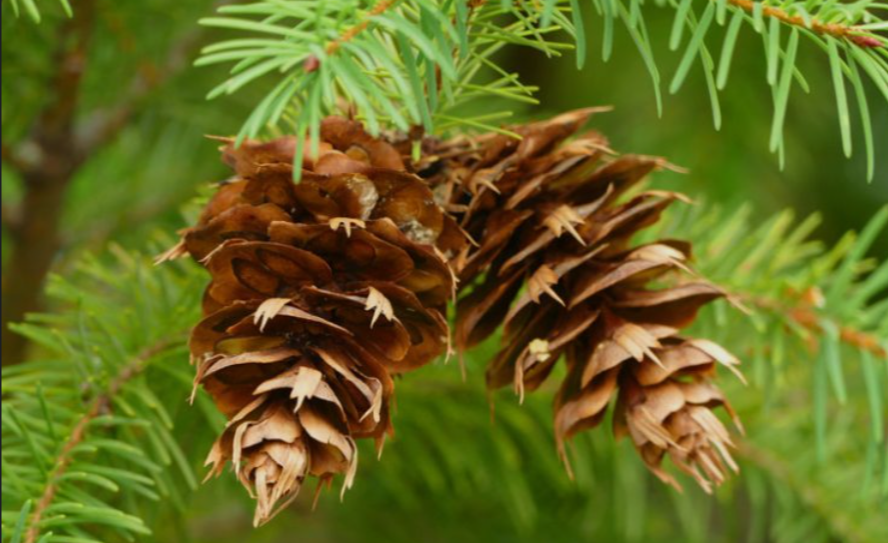
Douglas fir cones are 2 to 4 inches long and hang down from the branches. A three-pointed bract sticks out from under each cone scale. Many people say it looks like the back legs and tail of a tiny mouse.
A California Native American legend explains the shape. During a forest fire, mice ran up the tree and hid inside the cones to escape the flames. The tree sheltered them, and their tails and feet still show today.
4. It Is the Second-Tallest Tree Species on Earth
Douglas fir is the second-tallest tree species in the world, behind only the coast redwood. Coastal trees can grow more than 300 feet tall. It is the tallest member of the pine family.
The record holder is the Doerner Fir in Coos County, Oregon, which stood about 327 feet tall. The tree is about 450 years old and has a trunk about 11.5 feet across. In August 2025, a fire in its upper trunk burned off part of its crown and cost it some of that record height.
5. It Can Live for More Than 1,000 Years
Douglas firs are very long-lived trees. Many old-growth trees pass 500 years, and some reach 1,000. Apart from redwoods and sequoias, few North American trees live longer.
One of the oldest known Douglas firs, near Mount Vernon, Washington, was estimated at about 1,400 years old. Another in southern Oregon is thought to be around 1,200 years old. These old trees are home to dozens of species of moss and lichen.
6. Its Bark Can Be a Foot Thick
Young Douglas firs have thin, smooth, gray bark dotted with resin blisters. As the tree ages, the bark becomes deeply furrowed and corky. On mature trees it can be 4 to 12 inches thick.
That thick bark shields the living wood from heat. It makes Douglas fir one of the most fire-resistant trees native to the Pacific Northwest. Old trees often survive fires that kill their thinner-barked neighbors.
7. There Are Coast and Rocky Mountain Forms
Douglas fir grows in two main varieties: coast Douglas fir and Rocky Mountain Douglas fir. The coast form is the giant of the Pacific Northwest. It grows fast in the mild, wet climate west of the Cascades.
The Rocky Mountain form is hardier but slower-growing and shorter-lived. It seldom grows taller than 130 feet. Its needles are shorter and bluish-green, and its cones are barely 3 inches long.
8. Its Range Stretches From Canada to Mexico
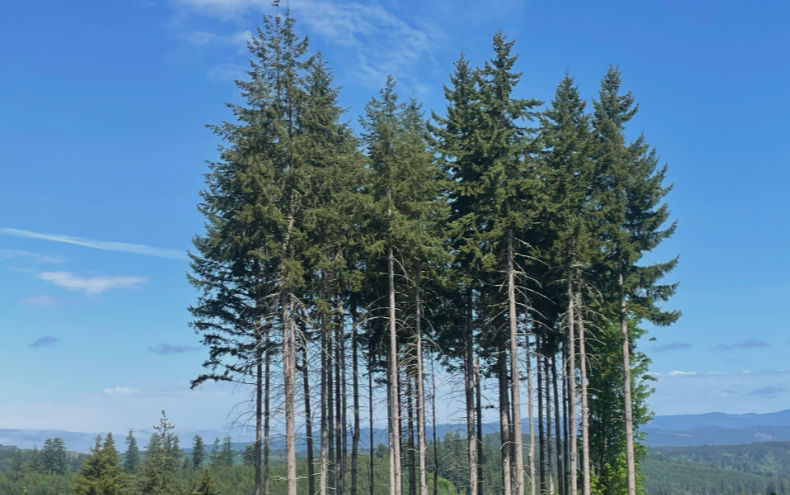
Coast Douglas fir grows from west-central British Columbia south to central California. In Oregon and Washington, it covers the land from the Cascades to the Pacific. A small stand grows as far south as Santa Barbara County.
The Rocky Mountain form grows inland across the interior West. Its range runs from central British Columbia to the Mexican border. It grows on warm, south-facing slopes in the north and cool, north-facing slopes in the south.
9. It Is Oregon’s State Tree
Oregon named Douglas fir its state tree in 1939. The choice honored the tree’s huge role in the state’s economy. It is also the most common tree in Oregon.
The tree shows up on Oregon license plates and in parks across the state. Portland’s Lone Fir Cemetery is named after a single Douglas fir that stood on the grounds. The city has 8 Douglas firs listed as Heritage Trees.
10. It Is America’s Classic Christmas Tree
Douglas fir has been a top Christmas tree choice in the United States since the 1920s. Its soft needles, sweet scent, and full cone shape make it a favorite. Farm-grown trees are sheared to give that “old-fashioned” look.
Oregon is the nation’s top Christmas tree producer, supplying more than 33 percent of the U.S. market. Douglas fir makes up about 38 percent of the state’s production. A 6-foot tree usually takes 7 to 12 years to grow.
11. Its Lumber Builds Much of North America
Douglas fir produces more timber than any other tree species in North America. Its wood is strong, stiff, and straight-grained. That makes it a top choice for beams, framing, plywood, and pilings.
Early settlers used it for floors, beams, and fine carving. Today it is also used for flooring, cabinets, furniture, and millwork. The forests of western Oregon, Washington, and British Columbia are among the most productive timberlands on the continent.
12. Its Needles Are Soft, Not Prickly
Douglas fir needles are flat and soft to the touch. They are about 1 to 1.5 inches long and grow all around the twig in a bottlebrush shape. The undersides have 2 faint white stripes.
The buds at the branch tips are another clue to its identity. They are sharply pointed and reddish-brown, unlike the rounded buds of true firs. Crushed needles give off a sweet, citrusy scent.
13. One Rodent Eats Nothing but Its Needles
The red tree vole lives high in old-growth Douglas firs in western Oregon. It eats almost nothing but Douglas fir needles. It even gets its water by licking rain and fog off them.
The vole strips out the bitter resin ducts before eating each needle. Young voles must eat adult droppings to get the gut bacteria needed to digest the tough needles. The vole is a key prey animal for the northern spotted owl.
14. It Feeds Squirrels, Birds, and Porcupines
Douglas squirrels harvest and hoard huge numbers of Douglas fir cones. Piles of cone scales often build up under trees where they sit to eat. Forgotten cones help spread the tree’s seeds.
Birds rely on the tree too. One type of red crossbill has adapted to feed mainly on Douglas fir seeds. In winter, North American porcupines feed on the tree’s inner bark.
15. It Is Grown on Other Continents
Douglas fir grows so well that it has been planted far outside North America. It was introduced to New Zealand in 1859 and is now a major plantation tree there. It is also widely grown for timber across Europe.
Foresters prize it for its fast growth and strong wood. In some regions, it has spread beyond plantations into the wild. In parts of New Zealand, it is now managed as a wilding conifer.
16. It Returns Quickly After Fire
Douglas fir is one of the first trees to come back after a fire. Its winged seeds drift on the wind into burned areas. Seedlings grow best in open, sunny ground.
Fire also helps the tree by clearing out competing species. Pure stands are common where fires happen often. Over time, shade-tolerant trees like western hemlock may slowly move in beneath the canopy.
Sources
- Oregon State University Extension, “Understanding Names of Oregon Trees” (EC 1502)
- Oregon State University, “Landscape Plants: Douglas-fir”
- University of California Agriculture and Natural Resources, “Douglas-fir” (Forestry Research and Outreach)
- University of Puget Sound, “Douglas-fir”
- Pacific University, “The Douglas Fir”
- Oregon State University Extension, “OSU Research Keeps Oregon Christmas Tree Industry No. 1 in the Nation”