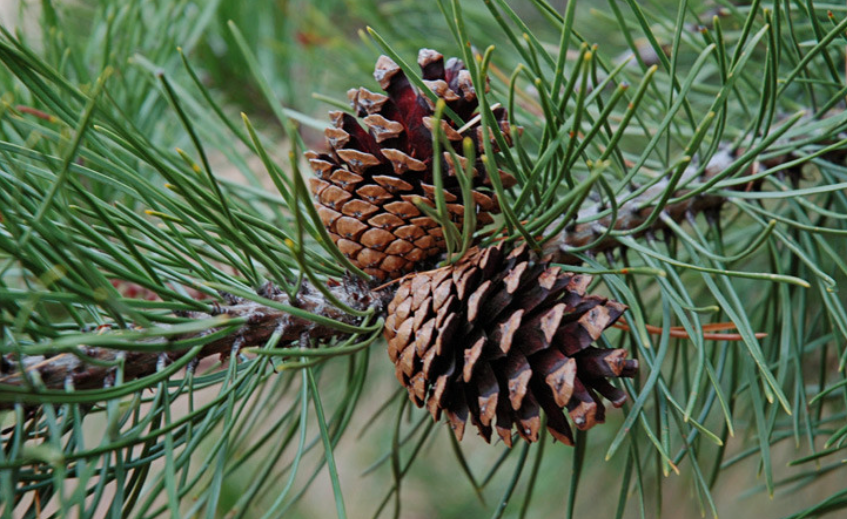
Lodgepole pine is one of the most widespread and hardworking trees in western North America, covering huge areas of mountain country from the Yukon to Baja California. Its tall, straight trunks rise in tight ranks across the Rockies, often so close together that a hiker can barely pass between them. In places like Yellowstone, it is the forest.
The tree’s name comes from its long, slender trunks, which Native American peoples cut for the frames of tipis and lodges. Lewis and Clark noted that tribes traveled into the Rocky Mountains to gather these poles. That same straight form later made it a favorite for fence posts, railroad ties, and log cabins.
What makes lodgepole pine remarkable is its relationship with fire. Many of its cones stay sealed shut with resin for years, opening only when the heat of a wildfire melts the seal. A blaze that kills the parent trees can release millions of seeds onto the fresh ash, starting a new forest within a few seasons.
That strategy has made lodgepole pine both a survivor and a symbol of the western landscape. It is also a tree under pressure, after a mountain pine beetle outbreak killed pine across an area of British Columbia roughly 5 times the size of Vancouver Island. From wildfire seeds to provincial emblems, this pine has a story as tall as its trunk.
1. It Was Named for Tipi and Lodge Poles
Lodgepole pine gets its common name from Native American tipis and lodges. Its straight, narrow trunks made ideal frame poles. Younger trees were especially prized because they were light and uniform.
Lewis and Clark are credited with recording the name during their expedition. They observed tribes traveling into the Rocky Mountains to collect “lodgepoles.” The trunks were also used for travois poles and fence posts.
2. It Grows Remarkably Tall and Slender
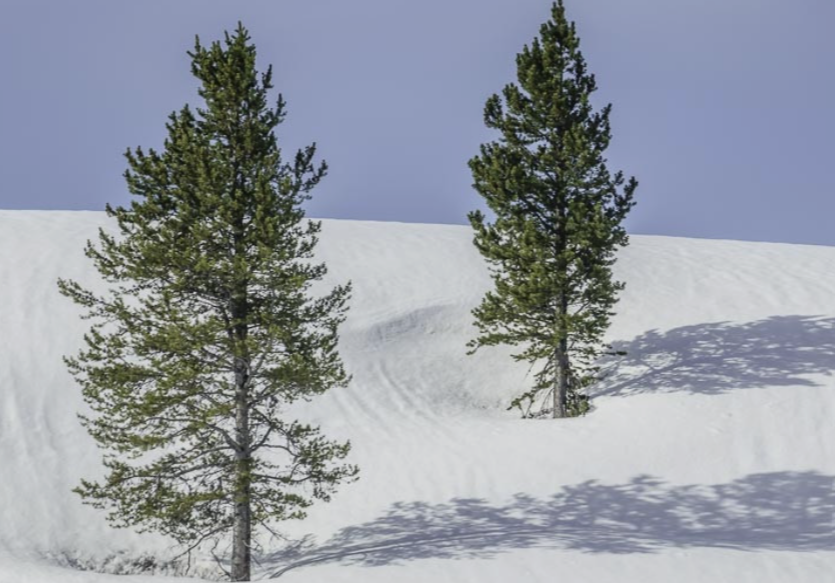
A mature lodgepole pine averages about 70 feet tall with a trunk around 24 inches across. Even trees only 5 inches in diameter can reach 50 feet. The trunk has very little taper from bottom to top.
The crown is small and narrow, sitting high on the tree. Lower branches die off and drop as the stand grows dense. This self-pruning habit is what gives lodgepole its clean, pole-like trunk.
3. Its Needles Grow in Pairs
Lodgepole pine needles come in bundles of 2. They are 1 to 3 inches long, stout, and yellow-green. Many needles have a slight twist.
Each needle stays on the tree for 4 to 6 years before dropping. The buds are about a quarter-inch long and coated in sticky resin. Young twigs are orange-brown and darken to black with age.
4. Many of Its Cones Need Fire to Open
Lodgepole pine is famous for serotinous cones, which stay sealed shut on the branches. A special resin glues the cone scales closed. That resin melts only at temperatures between 113 and 140 degrees Fahrenheit.
These sealed cones can hold viable seeds for up to 20 years. When a wildfire sweeps through, the heat opens them and releases the seeds. The seeds land on bare ash with full sunlight, which is exactly what seedlings need.
5. A Single Tree Can Make Two Kinds of Cones
Lodgepole pine produces both regular open cones and sealed serotinous cones. Open cones mature and drop their seeds in their second autumn. Those seeds rarely survive unless they land in a sunny gap.
The share of sealed cones varies widely across the tree’s range. Serotiny is common in the Rocky Mountains but rare on the Pacific Coast. It is absent altogether in the Sierra Nevada and southern California populations.
6. It Dominates Yellowstone’s Forests
Lodgepole pine makes up nearly 80 percent of the forests in Yellowstone National Park. Large fires burn through these forests about every 150 to 300 years. The tree is well adapted to that cycle.
The 1988 fires burned about 800,000 acres, or roughly 36 percent of the park. Researchers later found seedling densities ranging from under 100 to more than 500,000 per hectare. Those young trees have since grown into new forests.
7. It Sprouts in Crowded “Doghair” Stands
After a fire, lodgepole seedlings often come up in staggering numbers. Burned sites can sprout several thousand seedlings per acre. Foresters call these packed thickets “doghair” stands.
The trees compete fiercely for light, and many die as the stand thins itself. Lodgepole is shade-intolerant, so seedlings struggle under a closed canopy. That is why the tree usually forms even-aged, single-species forests.
8. It Has One of the Widest Ranges of Any Western Tree
Lodgepole pine grows from the Yukon south through California into Baja California. Its range reaches as far east as the Black Hills of South Dakota. It covers mountains, plateaus, coastlines, and boreal forest.
In Oregon, pure stands are found throughout the central and eastern parts of the state. In Utah, it grows at higher elevations in the north. It also stretches across western Canada into Alberta’s foothills.
9. It Takes Very Different Forms Along the Coast
On the Pacific Coast, the same species grows as shore pine, a short, twisted tree shaped by wind and salt spray. In the Rockies, it grows tall and straight. The Sierra Nevada form is different again, with thicker bark and few sealed cones.
Because of these variations, the tree has many local names. It is also called shore pine, beach pine, tamarack pine, and black pine. Botanist David Douglas first described it from the coastal shore pine form in the 1820s.
10. It Is Wyoming’s Most Common Forest Type
Lodgepole pine is the most abundant forest type in Wyoming. It covers over 2.6 million acres, about 23 percent of the state’s forest land. That is more than spruce-fir and ponderosa pine.
It is also the most common tree in much of the Rocky Mountains. Montana and Wyoming together hold several million acres of lodgepole forest. Most of these stands were born from past wildfires.
11. It Is the Provincial Tree of Alberta
Alberta’s Legislative Assembly named lodgepole pine the provincial tree in 1984. It is the most common tree in the Rocky Mountain and foothills regions of the province. It grows in 3 of Alberta’s 4 forest regions.
The only region where it is missing is the aspen parkland. Blackfoot elders have described using the trunks for tipi poles and center lodge poles. The tree also held medicinal uses in Indigenous traditions.
12. It Survived the Largest Beetle Outbreak on Record
A mountain pine beetle outbreak in British Columbia affected more than 18 million hectares of forest. It began in the 1990s and peaked in 2005. Lodgepole pine was the beetle’s main host.
By 2012, the outbreak had killed about 53 percent of the province’s merchantable pine volume. Warmer winters helped the beetles survive and spread. The outbreak eventually pushed east of the Rockies into Alberta.
13. Its Thin Bark Offers Little Protection From Fire
Unlike ponderosa pine, lodgepole pine has thin, scaly bark. It is orange-brown to gray and stays thin even on old trees. A hot fire easily kills mature lodgepoles.
The tree’s survival plan relies on seeds, not bark. Sealed cones protect the next generation while the parents burn. In this way, the species often gains an edge over less fire-adapted trees.
14. It Produces Seeds in Huge Quantities
Lodgepole pine is a prolific seed producer. Good cone crops come every 1 to 3 years. A single tree can carry anywhere from a few hundred to a few thousand cones.
In central Montana, researchers recorded 40,000 to 90,000 seeds falling per acre each year. The seeds are tiny, about one-sixteenth of an inch long. Each has a wing about half an inch long that helps it drift on the wind.
15. Its Wood Builds Homes, Poles, and Paper
Lodgepole pine wood has thick sapwood and light brown heartwood. It is used for lumber, posts, poles, and railroad ties. Treated wood also goes into mine timbers.
Its slim, straight trunks are still preferred for log homes and utility poles. The fibers are excellent for paper and composite products. The tree has even been tested as a commercial timber species in Sweden.
16. It Tolerates Brutal Conditions
Lodgepole pine is hardy in USDA zones 2 through 6. It resists frost, drought, and salt spray. It can grow where many other trees would die.
Despite its toughness, it is rarely planted in home landscapes. Its growth rate is relatively slow outside its natural setting. A few dwarf cultivars, such as ‘Chief Joseph,’ are sold for rock gardens and conifer collections.
Sources
- Utah State University Extension, “Lodgepole Pine” (Tree Identification)
- Utah State University Extension, “Lodgepole Pine” (Range Plants of Utah)
- University of Montana, “Lodgepole Pines and Wildfire”
- University of Washington, “Lodgepole Pine Species Profile”
- National Park Service, “Ecological Consequences of Fire” (Yellowstone)
- Natural Resources Canada, “Mountain Pine Beetle (Factsheet)”