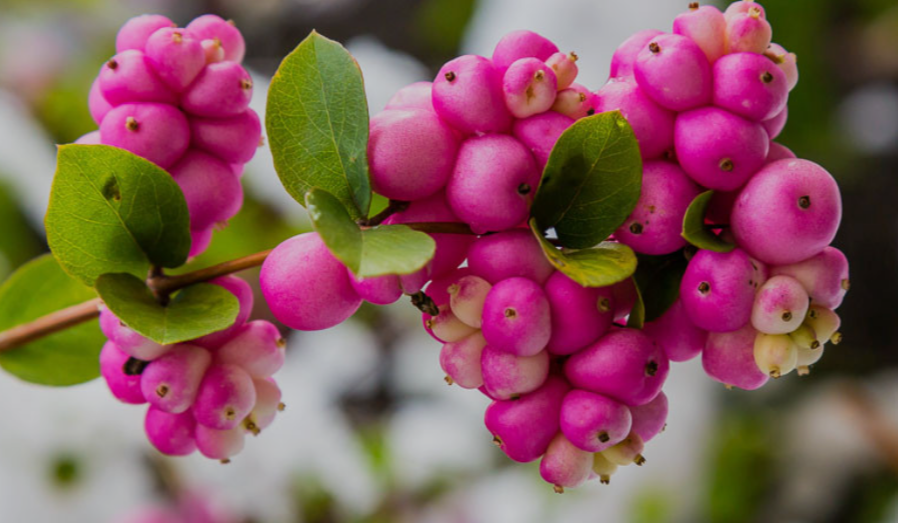
Shrubs with pink berries are far harder to find than shrubs with red, black, or blue ones, which is exactly why they stand out in a fall garden. Pink is one of the rarest fruit colors in the plant world. A hedge or border that carries it draws attention from October well into winter.
Part of the rarity comes down to birds. Most fruit-eating birds go first for red and black berries, so plants gain little from making pink ones. Pink fruit often hangs untouched for months, which is good news for anyone who wants lasting color.
Not everything sold as a pink berry is a true berry, and not all of it is safe. Some are seed capsules that split open, some are pink only for a few weeks while ripening, and a few are toxic. Others were bred for the table and taste as good as they look.
This list of 15 shrubs is sorted with that in mind, moving from long-lasting ornamental fruit to color-changing and splitting types, and ending with edible varieties. Each entry states plainly whether the fruit can be eaten. Hardiness ranges refer to USDA zones in the United States.
1. Coralberry
Coralberry is a native shrub that grows wild from New York to Texas along woodland edges and old fields. It stays 2 to 5 feet tall but spreads 4 to 8 feet wide by suckering roots. Small coral-pink to purplish berries pack tightly along the arching stems.
The berries appear in October and persist into late winter, long after the leaves have dropped. Birds mostly ignore them until hard weather, which is why the display lasts. The fruit is mildly toxic to people, and the shrub is hardy in zones 2 to 7.
2. ‘Hancock’ Chenault Coralberry
‘Hancock’ Chenault coralberry is a low, spreading hybrid used mainly as a groundcover on slopes. It grows only about 2 feet tall while reaching 6 feet or more across. The stems root where they touch the ground, which helps hold soil in place.
Its berries have an unusual two-tone look, rose-pink on the side facing the sun and white on the shaded side. They ripen in early fall and hang on into winter. The fruit is not edible, and the plant grows best in zones 4 to 7.
3. Proud Berry Coralberry
Proud Berry coralberry is a modern selection bred for larger, brighter fruit than the wild type. The berries are dark bubblegum pink and noticeably plumper, at nearly half an inch across. Bell-shaped pink flowers come first in summer and attract bees.
The pink color deepens as nights turn cold in October and November. The shrub forms a rounded mound 3 to 4 feet tall and wide in zones 3 to 7. Like the other coralberries, it is grown for looks only, and the cut stems last well in fall arrangements.
4. Prickly Heath
Prickly heath is a compact evergreen from southern South America with small, glossy, sharp-tipped leaves. Its marble-sized berries come in white, lilac, deep rose, and several shades of pink, depending on the variety. They are among the largest ornamental berries on any small shrub, at about half an inch wide.
Most plants are either male or female, so a male must grow nearby for the females to fruit. The shrub reaches 2 to 4 feet tall and needs acidic, moist soil in zones 7 to 9. It performs best in the Pacific Northwest, and the berries should not be eaten.
5. ‘Welch’s Pink’ Beautyberry
‘Welch’s Pink’ is a rare form of American beautyberry, a native shrub of the Southeast that normally bears violet-purple fruit. This selection was found in Texas and carries clear pink berries instead. They form tight clusters that wrap completely around the stems at each leaf joint.
The fruit colors in September and holds until birds strip it in late fall. Plants grow 4 to 6 feet tall and are hardy in zones 7 to 10. The raw berries are bland and astringent, but they are safe and are traditionally cooked into jelly.
6. Brandywine Viburnum
Brandywine viburnum is a selection of a native shrub found in wet woods across the eastern United States. Its berries start green, turn vivid pink, and then ripen to deep blue. Because they change at different speeds, pink and blue fruit sit side by side in the same cluster.
The two-color stage runs for several weeks in September and October. The shrub grows 5 to 6 feet tall and wide, with glossy leaves that turn wine-red in fall. It is hardy in zones 5 to 9 and tolerates damp soil, though the berries are left for birds and not eaten by people.
7. Vilmorin’s Mountain Ash
Vilmorin’s mountain ash is a large shrub or small tree with fine, fern-like leaves made up of many tiny leaflets. Its berry clusters open rose-red, fade to pink, and finish nearly white with a pink blush. The slow fade means the plant shows 2 or 3 shades at once through late fall.
It usually reaches 12 to 15 feet and grows best in cool-summer areas such as the Pacific Northwest. Roughly zones 6 to 8 suit it, and it struggles in southern heat. The berries are bitter and should not be eaten raw.
8. European Spindle
European spindle bears hanging, four-lobed pink fruits that are capsules and not true berries. In October each capsule splits to show bright orange seeds against the pink shell. The contrast is among the strongest of any fall shrub.
This is a big plant at 12 to 20 feet tall, hardy in zones 4 to 7. All parts are poisonous to people and pets, especially the seeds. It also seeds into woodlands in parts of the Northeast and Midwest, so gardeners there should choose a native relative.
9. Eastern Wahoo
Eastern wahoo is the native counterpart to European spindle, growing wild from the Great Plains to the East Coast. Its smooth capsules are pink to rosy-red and split open to reveal scarlet seeds. The fruit hangs on thin stalks after the leaves fall.
The shrub reaches 10 to 20 feet and turns pink-red in autumn before the leaves drop. It is hardy in zones 3 to 7 and tolerates shade better than most fruiting shrubs. The fruit, seeds, and bark are toxic to people, although birds eat the seeds safely.
10. Strawberry Bush
Strawberry bush is a slender native shrub of southeastern woodlands, also known as hearts-a-bustin’. Its fruits are round, bright pinkish-red capsules covered with conical bumps, each about three-quarters of an inch wide. They burst in early fall to show orange-red seeds.
Despite the name, the fruit is poisonous to people and has nothing to do with real strawberries. Plants grow 4 to 6 feet tall on green stems in zones 6 to 9. Deer browse it so heavily that it often needs fencing until it is established.
11. ‘Pink Lemonade’ Blueberry
‘Pink Lemonade’ is a true blueberry that ripens deep pink and never turns blue. It was developed by USDA plant breeders and became the first widely sold pink blueberry in the country. The berries pass through green and pale pink before reaching their final color in mid to late summer.
The fruit is firm, sweet, and milder than a standard blueberry. Bushes grow 4 to 5 feet tall in zones 4 to 8 and need acidic soil with a pH near 5. Part of its parentage is rabbiteye blueberry, so it crops best with a rabbiteye variety planted nearby.
12. Pink Popcorn Blueberry
Pink Popcorn blueberry is a cold-hardy variety released by the University of Minnesota in 2014. Its blush-colored berries are paler than those of ‘Pink Lemonade’, closer to cream with a pink flush. The flavor and crisp texture match a good blue variety.
This is the pink blueberry for northern gardens, since it survives winters down to zone 3. The bush reaches 4 to 5 feet and ripens from early to midseason. White spring flowers and crimson fall leaves make it useful as a landscape shrub as well.
13. ‘Pink Champagne’ Currant
‘Pink Champagne’ currant carries long, hanging strings of translucent pink berries in July. The fruit is sweeter and less sharp than red currants, so it is one of the few currants pleasant to eat fresh. Each berry is about a quarter inch wide.
The upright bush grows 3 to 5 feet tall and is hardy in zones 3 to 7. Yields run lower than those of red varieties, which is the main trade-off. Some states restrict currants to protect white pines from blister rust, so buyers should check local rules first.
14. ‘Pixwell’ Gooseberry
‘Pixwell’ gooseberry was developed in North Dakota in 1932 and is still the most common gooseberry in American gardens. Its berries turn rosy-pink when fully ripe, starting from pale green. Fruit left on the bush for a long time can deepen toward purple.
The name is a play on “picks well,” because the berries hang on long stems away from the few small thorns. Bushes grow 3 to 5 feet tall and yield 4 to 6 quarts a year at maturity. They are hardy in zones 3 to 6 and tolerate partial shade.
15. ‘Captivator’ Gooseberry
‘Captivator’ gooseberry is a cross between American and European types that bears large, teardrop-shaped fruit. The berries ripen pinkish-red and are sweet enough to eat straight from the bush. They are noticeably bigger than those of ‘Pixwell’.
The canes are nearly thornless once mature, which makes picking and pruning simple. Plants reach 3 to 5 feet and resist the powdery mildew that troubles European gooseberries. It is hardy in zones 3 to 7 and ripens in mid-July across most northern states.
Key Takeaways
- Shrubs with pink berries provide an uncommon and attractive fruit display that can brighten gardens from late summer through fall and, in some species, winter.
- Beautyberry, coralberry, snowberry, viburnum, rose, cotoneaster, and spindle trees are among the shrubs that can produce pink, rosy, or coral-colored fruits.
- Berry color often changes as fruits mature, so some shrubs may show pink, red, purple, or darker berries at different stages of the season.
- Many berry-producing shrubs offer food and shelter for birds and other wildlife, making them valuable choices for wildlife-friendly gardens.
- These shrubs come in a range of sizes and growth habits, with suitable options for borders, hedges, woodland gardens, foundation plantings, and naturalized areas.
- Some pink-berried shrubs are deciduous, while others are evergreen, allowing gardeners to choose plants based on their desired year-round structure and seasonal interest.
- Berry color alone should not be used to determine whether a fruit is edible; some ornamental shrubs produce fruits that can be harmful if consumed, so proper identification is important.