Shrubs with red berries are the most common fruiting shrubs in American yards, hedgerows, and woodlands, and that is no accident. Birds spread most shrub seeds, and birds see red sharply against green leaves. Over time, red became the standard signal that fruit is ready.
That signal was never meant for people. A red berry can be a currant fit for jelly or the fruit of a daphne that can put a child in the hospital. Color alone says nothing about safety, so every entry here states whether the fruit can be eaten.
Timing matters as much as color. Some shrubs turn red in June and are stripped bare within 2 weeks, while others hold their fruit on bare stems until March. A yard planted with both kinds can show red berries for 9 months of the year.
This list of 50 shrubs follows the calendar, starting with summer fruit and ending with evergreens that carry berries through winter. It also includes several invasive shrubs, because most people searching for a red-berried shrub are trying to identify one. Hardiness ranges refer to USDA zones in the United States.
1. Red Currant
Red currant is a compact fruiting shrub that carries translucent red berries in long, hanging strings. The fruit ripens in late June and July, making it one of the first red berries of the year. Bushes grow 3 to 5 feet tall and are hardy in zones 3 to 7.
The berries are edible and sharply tart, which suits jelly, sauces, and juice better than fresh eating. ‘Red Lake’ has been the standard American variety since the 1930s. Some states restrict currants to protect white pines from blister rust, so checking local rules comes first.
2. ‘Hinnomaki Red’ Gooseberry
‘Hinnomaki Red’ gooseberry is a Finnish variety with dark red, grape-sized fruit. The berries have tangy skin and sweet flesh, and they ripen in July. Plants stay 3 to 4 feet tall and grow well in zones 3 to 7.
The fruit is edible fresh and holds its shape in pies and preserves. This variety resists the powdery mildew that damages many gooseberries in humid summers. The stems are thorny, so gloves make picking easier.
3. Nanking Cherry
Nanking cherry is a dense, twiggy shrub covered in pale pink flowers in early spring. Bright red cherries about half an inch wide follow in late June and July. It grows 6 to 10 feet tall and survives winters as cold as zone 2.
The fruit is edible, juicy, and tart-sweet, though too soft to ship or store. Two plants are needed for good pollination and a full crop. It has long been used in farm windbreaks across the northern Great Plains.
4. Goumi
Goumi bears oval red berries dusted with tiny silver speckles, each hanging on a long stalk. The fruit ripens in June, well ahead of most other shrubs. Plants reach 6 to 8 feet and are hardy in zones 4 to 9.
The berries are edible but astringent until fully soft and dark red. Goumi roots fix nitrogen, so the shrub grows in poor soil without fertilizer. It does not spread the way its invasive relative, autumn olive, does.
5. Red Elderberry
Red elderberry is a native shrub of cool forests across the northern states and western mountains. It produces cone-shaped clusters of small, bright red berries in June and July. Plants grow 8 to 12 feet tall in zones 3 to 7.
The raw berries are not edible for people, and the seeds cause nausea and vomiting. Birds strip the fruit within days of ripening. The shrub prefers moist soil and partial shade and struggles in hot, dry sites.
6. Red Huckleberry
Red huckleberry is a Pacific Northwest native that often sprouts from rotting stumps and fallen logs. Its translucent red berries are about a quarter inch wide and ripen in July and August. The shrub has bright green, angled stems and reaches 4 to 10 feet.
The fruit is edible and pleasantly tart, and it has been gathered in the region for centuries. It grows in zones 6 to 8 along the coast from Alaska to central California. Outside that range it is hard to establish, because it needs acidic soil rich in decayed wood.
7. February Daphne
February daphne blooms on bare stems in late winter, with rosy-purple flowers that carry a strong, sweet scent. Glossy red berries line the same stems in June and July. The shrub stays 3 to 5 feet tall and is hardy in zones 4 to 7.
This is the most dangerous plant on the list, and the berries must never be eaten. Every part is highly poisonous, and even a few berries can seriously harm a child. It has also escaped gardens in parts of the Northeast.
8. Barbados Cherry
Barbados cherry is a warm-climate shrub grown in South Florida and the lower Rio Grande Valley of Texas. Its glossy, three-lobed red fruits are about 1 inch across. Flowers and fruit come in repeated flushes from spring through fall.
The fruit is edible, tart, and among the richest natural sources of vitamin C. Berries ripen only 3 to 4 weeks after flowering and bruise easily. Plants reach 8 to 12 feet and tolerate only light frost in zones 9 to 11.
9. Cornelian Cherry
Cornelian cherry is a large shrub in the dogwood family, known for its yellow flowers in March. Glossy, olive-shaped red fruits ripen in August and are often half hidden by the leaves. It grows 15 to 25 feet tall and is hardy in zones 4 to 8.
The fruit is edible and tastes like a sour cherry when fully ripe. It is usually cooked into preserves or syrup because of the large pit. The shrub has few pest or disease problems and lives for decades.
10. Silver Buffaloberry
Silver buffaloberry is a thorny native shrub of the northern Great Plains with narrow, silver-gray leaves. Female plants bear small red berries in August and September, so both a male and a female are needed. It grows 6 to 15 feet tall and is hardy to zone 2.
The fruit is edible but sour and reportedly becomes sweeter after a frost. It makes a well-regarded jelly. The shrub fixes its own nitrogen and tolerates drought and alkaline soil.
11. Goji Berry
Goji berry is a sprawling shrub with long, arching canes and small purple flowers. Its oblong, orange-red berries ripen from midsummer until the first hard frost. Plants reach 8 to 10 feet if left unpruned and are hardy in zones 5 to 9.
The berries are edible and are usually dried, since the fresh fruit has a slightly bitter aftertaste. Goji belongs to the tomato family and suffers from some of the same pests. It suckers freely, so a root barrier or a large container keeps it contained.
12. Fragrant Sumac
Fragrant sumac is a low native shrub found from the East Coast to the Great Plains. Female plants carry small clusters of fuzzy red berries in July and August. The species grows 2 to 6 feet tall, while the popular ‘Gro-Low’ stays near 2 feet.
The tart berries are edible and have been steeped to make a lemonade-like drink. The three-part leaves resemble poison ivy but are harmless and smell citrusy when crushed. It is hardy in zones 3 to 9 and turns orange and red in fall.
13. Staghorn Sumac
Staghorn sumac holds upright, cone-shaped clusters of fuzzy crimson fruit at its branch tips. The clusters color in August and stay on the plant through winter. This native grows 15 to 25 feet tall in zones 3 to 8, with velvety young stems.
The berries are edible when steeped in cold water for a sour drink. Poison sumac is easy to tell apart, because it has white, drooping berries and grows only in swamps. Staghorn sumac spreads by root suckers and needs room or regular mowing around it.
14. Spicebush
Spicebush is a native understory shrub of eastern forests, known for its spicy-scented twigs and leaves. Female plants ripen glossy, oval red berries in September. The shrub grows 6 to 12 feet tall and is hardy in zones 4 to 9.
The berries are edible as a seasoning and have been dried and ground as a substitute for allspice. They are high in fat, so migrating thrushes strip them within a few weeks. A male plant must grow nearby for the female to fruit.
15. Rugosa Rose
Rugosa rose is included for its hips, which are fleshy seed cases and not true berries. They are tomato-shaped, up to 1 inch wide, and turn orange-red from August onward. The shrub grows 4 to 6 feet tall and is hardy in zones 2 to 7.
The hips are edible, rich in vitamin C, and used for tea and jelly once the seeds are removed. The plant shrugs off salt spray and sandy soil. That toughness has made it invasive on some coastal dunes in New England.
16. Mountain Holly
Mountain holly is a little-known native of bogs and cool woods in the Northeast, the Great Lakes region, and the Appalachians. Its dull crimson berries hang on unusually long, thin stalks in August and September. The shrub grows 6 to 10 feet tall in zones 3 to 6.
The berries are not edible for people, though birds take them quickly. Male and female flowers grow on separate plants, so fruiting needs both. It is rarely sold and requires wet, acidic soil.
17. Tea Viburnum
Tea viburnum is a vase-shaped shrub that carries some of the heaviest berry crops of any viburnum. Drooping clusters of orange-red to red fruit ripen in September and bend the branches with their weight. It grows 8 to 10 feet tall and is hardy in zones 5 to 7.
The berries are grown for display and are not eaten. A second, genetically different plant must grow nearby, or fruit set will be poor. The berries often persist into December because birds turn to them late.
18. Linden Viburnum
Linden viburnum produces flat clusters of bright red berries in September and October. The fruit often lasts into December and shrivels like small raisins after hard frost. Plants grow 8 to 10 feet tall in zones 5 to 7.
The berries are not considered edible. Two different varieties are needed for pollination and a heavy crop. The shrub seeds into woodlands in the mid-Atlantic states, where several agencies now list it as invasive.
19. American Cranberrybush
American cranberrybush is a native viburnum of the northern states with maple-shaped leaves. Its translucent red berries ripen in September and hang on the branches through winter. The shrub reaches 8 to 12 feet and is hardy in zones 2 to 7.
The fruit is edible and tart, and it is cooked into jelly and sauce as a cranberry substitute. It is not related to true cranberries. Viburnum leaf beetle can defoliate it in the Northeast and Great Lakes states.
20. European Cranberrybush
European cranberrybush looks almost identical to the American shrub and is often sold in its place. The red berries ripen at the same time and persist just as long. It grows 8 to 12 feet tall in zones 3 to 8, and the ‘Compactum’ form stays near 5 feet.
The berries are technically edible when cooked but taste bitter and smell musky. The two shrubs can be separated by the tiny glands on the leaf stalk, which are dished in the European plant and rounded in the American one. The European shrub has naturalized across the northern states.
21. Red Chokeberry
Red chokeberry is a native shrub of the eastern states that grows in both wet and dry soil. Its glossy red berries are about a quarter inch wide and ripen in September. The variety ‘Brilliantissima’ is the one most often sold, at 6 to 8 feet tall.
The fruit is edible but so astringent that few people eat it raw, which is how the plant got its name. Birds avoid it for the same reason, so the berries last well into winter. It is hardy in zones 4 to 9 and has vivid red fall foliage.
22. Winterberry
Winterberry is a native holly that drops its leaves in fall and leaves bare stems lined with red berries. The fruit colors in September and can last until late winter. Standard plants reach 6 to 10 feet, and compact types such as ‘Red Sprite’ stay near 4 feet.
The berries are mildly toxic to people and pets. Only female plants fruit, and gardeners should plant at least one male holly for up to 10 female plants, within 50 feet. It is hardy in zones 3 to 9 and tolerates wet ground.
23. Possumhaw
Possumhaw is a deciduous holly native to the Southeast and the lower Midwest. Its orange-red to red berries stand out against silver-gray bare branches all winter. The shrub is larger than winterberry, at 7 to 15 feet tall.
The berries are not edible for people. Possumhaw tolerates drier and more alkaline soil than winterberry, which makes it the better choice in Texas and Oklahoma. It is hardy in zones 5 to 9 and also needs a male plant nearby.
24. Japanese Barberry
Japanese barberry is a dense, thorny shrub with small, oblong red berries that dangle beneath the stems. The fruit ripens in October and stays through winter. Plants grow 3 to 6 feet tall in zones 4 to 8.
The berries are not eaten, and the bigger issue is the plant itself. It is invasive in more than 20 states, and several have banned its sale. Research in Connecticut has also linked barberry thickets to higher numbers of ticks.
25. Amur Honeysuckle
Amur honeysuckle is the tall, arching shrub with paired red berries that fills woodland edges across the Midwest and East. The glossy fruit lines the stems in October and November. Mature plants reach 15 feet and hold green leaves weeks after native shrubs have dropped theirs.
The berries are mildly toxic to people and should not be eaten. This shrub is one of the worst woodland invaders in the country and should be removed, not planted. Its fruit is also poor food for birds, with far less fat than native berries.
26. Burning Bush
Burning bush is grown for its scarlet fall leaves, but it also carries small red fruits in September and October. These are seed capsules that split to show orange-red seeds, not true berries. The standard shrub reaches 8 to 15 feet in zones 4 to 8.
All parts are toxic if eaten. Birds spread the seeds into forests, and the shrub is invasive across the Northeast and Midwest. States including Massachusetts, New Hampshire, and Maine prohibit its sale.
27. Cranberry Cotoneaster
Cranberry cotoneaster is a low, mounding shrub with arching branches and tiny glossy leaves. Its red fruits are close to the size of real cranberries and color from August to October. The shrub stays 2 to 3 feet tall and spreads to 6 feet.
The fruit is not edible and can upset the stomach. Plants are hardy in zones 4 to 7 and suit slopes and low walls. Spider mites and fire blight are the main problems in hot, dry sites.
28. Rockspray Cotoneaster
Rockspray cotoneaster is known for flat branches arranged in a neat herringbone pattern. Small, bright red berries line every twig in fall and often last into winter. It grows 2 to 3 feet tall and up to 8 feet wide.
The berries are not edible. The shrub is often trained flat against walls, where the branch pattern shows best. It is hardy in zones 5 to 7, and birds have spread it into wild areas along the West Coast.
29. Scarlet Firethorn
Scarlet firethorn produces some of the largest berry displays of any shrub, with dense clusters covering whole branches. The fruit ripens orange-red to red in September and lasts into winter. Plants reach 6 to 12 feet and carry long, sharp thorns.
The berries are bland and mealy and are not eaten fresh. Firethorn is often trained against walls and fences in zones 6 to 9. Disease-resistant varieties such as ‘Mohave’ avoid the scab and fire blight that ruin older types.
30. Heavenly Bamboo
Heavenly bamboo, also sold as nandina, bears large, upright sprays of bright red berries from fall through winter. It is not a bamboo but an evergreen shrub with cane-like stems. Standard plants grow 6 to 8 feet tall in zones 6 to 9.
The berries contain cyanide-producing compounds and are toxic. They were identified as the cause of death in a flock of cedar waxwings in Georgia in 2009. The shrub is also invasive in the Southeast, so fruitless varieties are the responsible choice.
31. American Cranberry
American cranberry is a trailing evergreen shrub native to bogs in the Northeast and the Great Lakes region. It stays under 1 foot tall and spreads by thin, wiry runners. The familiar red berries ripen in September and October.
The fruit is edible and is the same species grown commercially in Wisconsin and Massachusetts. Home plants do not need flooding, only acidic, sandy, evenly moist soil. It is hardy in zones 2 to 7 and turns burgundy in winter.
32. Lingonberry
Lingonberry is a low evergreen shrub, 6 to 12 inches tall, that spreads slowly by underground stems. It bears clusters of small, bright red berries, often twice a year in mild climates. The first crop comes in midsummer and the second in fall.
The berries are edible and tart, and they are the classic preserve of Scandinavian cooking. The plant grows wild across Alaska and the far northern states, where it is called mountain cranberry. It needs acidic soil with a pH near 5 and grows in zones 2 to 6.
33. Wintergreen
Wintergreen is a creeping native of eastern forests that stands only 4 to 6 inches tall. Its glossy leaves turn bronze in cold weather, and its red berries hang on from October into spring. The plant spreads slowly to form a loose mat in shade.
The berries are edible in small amounts and taste of wintergreen, the flavor once drawn from this plant for gum and candy. It needs acidic, humus-rich soil and does poorly in clay. It is hardy in zones 3 to 8.
34. Bearberry
Bearberry, also called kinnikinnick, is a flat evergreen groundcover native to the northern states, the Rockies, and the West Coast. Small red berries appear in August and last through winter. Plants stay 6 to 12 inches tall and spread 3 to 6 feet.
The berries are edible but dry, mealy, and nearly tasteless. Bears and grouse eat them freely, which gave the plant its name. It thrives in sandy, acidic, infertile soil in zones 2 to 6 and resents fertilizer.
35. Bearberry Cotoneaster
Bearberry cotoneaster is an evergreen groundcover with small, dark, glossy leaves on trailing stems. Red berries dot the plant from late summer into winter. It grows 1 to 2 feet tall and spreads 6 feet or more.
The berries are not edible. The variety ‘Coral Beauty’ is the most common and fruits heavily on sunny slopes. It is hardy in zones 5 to 8 and roots where its stems touch the ground.
36. Yaupon Holly
Yaupon holly is an evergreen native of the Southeast, found from coastal Virginia to central Texas. Female plants carry translucent red berries along the stems from fall through winter. It grows 10 to 20 feet tall, while most dwarf forms are male and never fruit.
The berries are not edible and cause vomiting. The leaves are another matter, since the plant is unusual among North American plants because it produces caffeine and is brewed as tea. It tolerates drought, salt, and poor soil in zones 7 to 9.
37. Blue Holly
Blue holly is a group of cold-hardy hybrids bred on Long Island, New York, in the mid-1900s. The leaves are spiny and blue-green on purple stems, and the berries are large and bright red. ‘Blue Princess’ is the heaviest-fruiting variety, at 8 to 12 feet tall.
The berries are mildly toxic and are not eaten. A male such as ‘Blue Prince’ must grow nearby for fruit to form. These hollies brought the classic Christmas look to zones 5 to 7, where English holly fails.
38. Burford Holly
Burford holly is a form of Chinese holly with glossy leaves that end in a single spine. It bears very large red berries in dense clusters from fall through winter. The standard plant reaches 15 to 20 feet, and ‘Dwarf Burford’ stays near 6 to 8 feet.
The berries are not edible. Unlike most hollies, this one sets fruit without a male plant. It handles heat and drought well and is a staple across the South in zones 7 to 9.
39. ‘Nellie R. Stevens’ Holly
‘Nellie R. Stevens’ holly is a fast-growing hybrid with a neat pyramid shape and dark, glossy leaves. It grows up to 3 feet a year and reaches 15 to 25 feet. Bright red berries ripen in fall and hold through winter.
The berries are not edible. The plant traces to seeds collected in 1900 by a Maryland woman of the same name, and it was formally named in 1954. It fruits without a male, though a nearby Chinese holly increases the crop, and it is hardy in zones 6 to 9.
40. Toyon
Toyon is an evergreen shrub native to the chaparral of California. Large clusters of red berries ripen from November to January, which earned it the names Christmas berry and California holly. It grows 8 to 15 feet tall in zones 8 to 10.
The raw berries are mildly toxic, though native peoples cooked them to make them safe. Toyon is the official native plant of the city of Los Angeles. Once established, it needs no summer water at all.
41. Compact Strawberry Tree
Compact strawberry tree is the shrub-sized form of a small Mediterranean evergreen, kept to 6 to 10 feet. Its round, bumpy fruits take a full year to ripen, passing from yellow to orange to red. Because of that slow cycle, white flowers and red fruit appear together in fall.
The fruit is edible but mealy and bland, so most gardeners leave it for the birds. The shrub also has attractive, peeling red-brown bark. It suits the West Coast and other mild regions in zones 8 to 10.
42. Japanese Skimmia
Japanese skimmia is a slow, mounding evergreen for shade, usually 3 to 4 feet tall. Female plants hold tight clusters of red berries from October through winter. Fragrant white flowers open in spring above leathery leaves.
The berries are toxic if eaten in quantity. One male plant is needed for about every 6 females to get fruit. It grows best in zones 6 to 8, especially in the Pacific Northwest and the mid-Atlantic.
43. Japanese Aucuba
Japanese aucuba is a broadleaf evergreen that tolerates deeper shade than almost any other shrub. Female plants bear large, oblong red berries about half an inch long from winter into spring. The fruit often hides beneath the big, glossy leaves.
The berries are mildly toxic and are not eaten. A male plant must be nearby, and the common gold-spotted form sold as gold dust plant is female. The shrub grows 6 to 10 feet tall in zones 7 to 10.
44. Butcher’s Broom
Butcher’s broom is a stiff, knee-high evergreen for dry shade, at 2 to 3 feet tall. What look like leaves are flattened stems, each tipped with a sharp spine. The marble-sized red berries sit right in the middle of those false leaves.
The berries are not edible. Most plants are male or female, so fruit requires both unless a self-fertile variety is planted. It is hardy in zones 7 to 9 and survives under trees where little else grows.
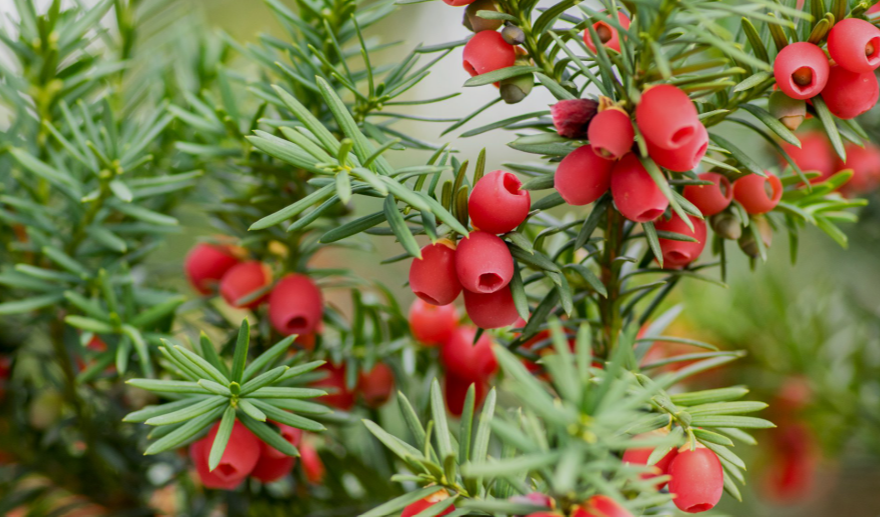
45. Japanese Yew
Japanese yew carries soft, red, cup-shaped fruits in fall, each wrapped around a single dark seed. These are fleshy seed coverings called arils and are not true berries. Only female plants produce them.
The seed inside and the needles are highly poisonous to people, pets, and livestock, so the fruit should never be eaten. Shrub forms range from 4 to 15 feet and are hardy in zones 4 to 7. Deer browse yew heavily despite its toxicity.
46. Fragrant Sweet Box
Fragrant sweet box is a small evergreen for deep shade, growing 3 to 5 feet tall. Tiny white flowers open from January to March and scent the air well beyond the plant. Round red berries follow and often remain when the next flowers open.
The berries are not edible. The shrub tolerates dry shade under trees once its roots are established. It is hardy in zones 7 to 9 and grows slowly, so it needs little pruning.
47. Wild Coffee
Wild coffee is a Florida native shrub with glossy, deeply veined leaves that look quilted. Bright red, oval berries ripen in late summer and fall and often last into winter. It grows 4 to 6 feet tall in shade or part shade.
The berries are not a coffee substitute, contain no caffeine, and are not recommended for eating. Birds eat them readily, which makes the shrub valuable in wildlife gardens. It is frost-tender and limited to zones 9 to 11.
48. Simpson’s Stopper
Simpson’s stopper is another Florida native, used as a hedge or small specimen in zones 9 to 11. Fragrant white flowers are followed by orange-red berries about a third of an inch wide. It can reach 20 feet, though compact forms stay near 5 feet.
The berries are edible and mildly sweet, with a faint citrus flavor. Older trunks shed their bark in flakes to show cinnamon-colored wood. The shrub tolerates salt, drought, and alkaline soil.
49. Christmasberry
Christmasberry is a thorny native shrub of salt marsh edges along the Gulf and southern Atlantic coasts. It has small, fleshy leaves and lavender flowers, and it grows 3 to 6 feet tall. Shiny, teardrop-shaped red berries peak around December.
The berries are edible and taste somewhat like a small tomato, a close relative. They are a key winter food for the whooping cranes that winter on the Texas coast. The shrub handles salt and flooding in zones 8 to 10.
50. Coral Ardisia
Coral ardisia is a small evergreen shrub with glossy, scallop-edged leaves and drooping clusters of coral-red berries. The fruit hangs below the foliage and stays on the plant nearly all year. It grows 2 to 6 feet tall in shaded woods in zones 8 to 10.
The berries are suspected of being poisonous and should not be eaten. This shrub is a declared noxious weed, and it is illegal to buy, sell, plant or transport in the state of Florida. Anyone who finds it in a yard along the Gulf Coast should pull it out.
Key Takeaways
- Shrubs with red berries provide strong seasonal color and can brighten gardens during fall and winter when many other plants have lost their flowers.
- Holly, winterberry, cotoneaster, firethorn, viburnum, barberry, and rose are among the many shrubs known for producing attractive red fruits.
- Red berries can appear in different shapes and sizes, ranging from small clustered fruits to larger berries that stand out against evergreen foliage.
- Many red-berried shrubs provide valuable food and shelter for birds and other wildlife, making them useful additions to wildlife-friendly landscapes.
- These shrubs vary in size and growing requirements, with options suitable for hedges, borders, foundation plantings, woodland gardens, and naturalized areas.
- Not all red berries are edible, and some can be harmful to people, so berries should never be consumed based solely on their appearance or color.