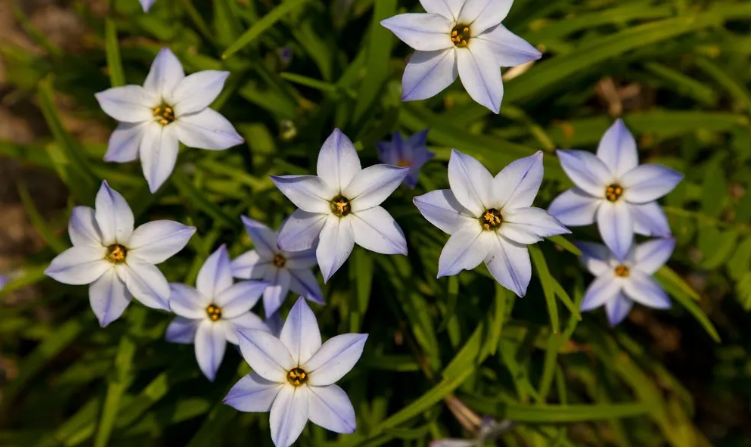
Few forms in the natural world carry the same sense of wonder as the star-shaped flower. With its petals radiating outward from a central point in perfect or near-perfect symmetry, the star flower form is one of the most ancient and widespread in the plant kingdom. It appears across hundreds of genera, on every continent except Antarctica, in habitats ranging from deep ocean-side cliffs to high alpine meadows, dense tropical forests, and sun-baked desert plains.
The star form — known botanically as rotate or stellate — is among the most primitive flower shapes in evolutionary terms, and yet it has persisted and diversified across millions of years because of its extraordinary effectiveness as a pollination platform. The open, flat, radially symmetrical structure provides easy landing access for a vast range of insect visitors, from tiny hoverflies to large bumblebees, making it one of the most ecologically inclusive flower designs in existence.
Star-shaped flowers appear in some of the largest and most important plant families on Earth. The Boraginaceae family, Liliaceae, Primulaceae, Solanaceae, and Rubiaceae all contain hundreds of star-flowered species. The number of plant species producing recognizably star-shaped flowers runs into the thousands — some estimates suggest that over 15% of all flowering plant species produce blooms with a fundamentally star-like symmetry.
Beyond their ecological importance, star-shaped flowers hold deep cultural and symbolic significance worldwide. The star form appears in the flowers of plants as economically vital as the potato, tomato, coffee, and jasmine. In the language of flowers — the Victorian art of floriography — star-shaped blooms were frequently associated with guidance, ambition, and celestial connection. And in gardens around the world, they bring a sparkling, light-catching brilliance to borders, containers, and wildflower meadows that few other flower forms can match.
Whether tiny and jewel-like or large and dramatically showy, star-shaped flowers bring an inherent sense of radiant energy to everything they touch. The following fifty plants represent the full breadth and beauty of this remarkable flower form.
Also Read: Flowers That Look Like Sunflowers
Stargazer Lily (Lilium orientalis ‘Stargazer’)
Stargazer Lily is one of the most celebrated star-shaped flowers in the world, producing large, upward-facing blooms with six broad, recurving petals in deep crimson-pink edged with white and densely spotted with darker markings, on stems 3 to 4 feet tall. It was bred in California in 1978 by lily hybridizer Leslie Woodriff and has since become one of the top five most commercially important cut flowers globally, with hundreds of millions of stems sold annually. Its powerful, sweet fragrance is among the most recognizable of any cut flower.
Borage (Borago officinalis)
Borage produces small, perfectly formed, five-pointed star flowers of the most intense, pure sky-blue of almost any annual flower, with a contrasting cone of black stamens at the center, on plants 18 to 24 inches tall. It self-seeds with great enthusiasm and blooms from early summer through autumn, providing a continuous supply of edible star flowers that are widely used to decorate salads, cakes, and drinks. The flowers are one of the most popular edible blooms in the culinary world, valued for their mild cucumber flavor.
Star of Bethlehem (Ornithogalum umbellatum)
Star of Bethlehem produces loose clusters of pure white, six-pointed star flowers with a distinctive green stripe on the reverse of each petal, on stems 6 to 12 inches tall in spring. Each flower is a geometrically precise star of exceptional cleanliness and simplicity, opening fully only in sunshine and closing tightly at night and on overcast days. It naturalizes freely in lawns and borders and can form dense colonies of thousands of plants over time in favorable conditions.
Jasmine (Jasminum officinale)
Common Jasmine produces clusters of small, pure white, five-pointed star flowers of intoxicating sweetness on a vigorous climbing plant that can reach 30 to 40 feet in ideal conditions. It is one of the most important plants in the global perfume industry — jasmine absolute, extracted from its flowers, is used in an estimated 80% of all fine fragrances worldwide. Flowers must be harvested by hand before sunrise to capture peak fragrance intensity, and it takes approximately 8,000 hand-picked flowers to produce just one gram of jasmine absolute.
Campanula Star (Campanula poscharskyana)
Serbian Bellflower produces masses of small, star-shaped, lavender-blue flowers — more star-like than bell-like in this spreading species — on trailing plants that cascade 6 to 12 inches across walls, rockeries, and container edges. It blooms prolifically from late spring through summer and often produces a second flush of star flowers in early autumn. It is one of the most vigorous and free-flowering of all low-growing perennials, capable of covering a square meter of ground or wall with star blooms in a single season.
Also Read: Flowers That Look Like Daffodils
Scilla (Scilla siberica)
Siberian Squill produces nodding, brilliant blue, six-pointed star flowers of intense, almost electric color on stems just 4 to 6 inches tall in early spring. It naturalizes rapidly and freely, spreading to form dense carpets of vivid blue beneath deciduous trees and shrubs that are among the most spectacular early spring displays in any garden. A well-established colony of Siberian Squill can produce thousands of individual star flowers per square meter, creating a groundcover that rivals any blue-flowering plant for sheer color impact.
Allium (Allium giganteum)
Giant Allium produces spherical heads composed of up to 100 individual small, star-shaped, violet-purple flowers packed together in a perfect globe up to 6 inches across on stems reaching an impressive 3 to 4 feet tall. The overall globe effect is created by hundreds of tiny stars radiating outward in all directions simultaneously, making it one of the most structurally extraordinary of all star-flowered bulbs. It is native to central Asia and has become one of the most popular ornamental bulbs for dramatic late spring border displays.
Primrose (Primula vulgaris)
Common Primrose produces solitary, soft yellow, five-petaled star flowers with a darker yellow eye at the center on stems just 4 to 6 inches tall in early spring, often beginning to bloom in February in mild climates. It is one of the most beloved of all British wildflowers, growing in hedgerows, woodland edges, and meadows across the country. In the Victorian language of flowers, the primrose represented young love and was one of the most symbolically loaded of all star-shaped spring blooms.
Forget-Me-Not (Myosotis sylvatica)
Forget-Me-Not produces clouds of tiny, five-petaled, sky-blue star flowers with a distinctive yellow central eye on delicate, branching plants 6 to 12 inches tall. Each individual flower measures just 5 to 8 millimeters across, yet massed together they create some of the most breathtaking blue haze effects of any spring-flowering plant. The forget-me-not is the national flower of Alaska and holds deep symbolic significance in the remembrance traditions of multiple countries and cultures worldwide.
Also Read: Flowers That Look Like Bells
Amsonia (Amsonia tabernaemontana)
Blue Star Flower produces clusters of small, pale steel-blue, five-pointed star flowers with slightly twisted petals on upright, bushy plants 2 to 3 feet tall in late spring. It is an exceptionally long-lived and trouble-free native American perennial, with established clumps known to persist and improve for 30 years or more without division. As a secondary season of interest, its foliage turns a brilliant, clear golden-yellow in autumn that rivals the finest ornamental trees for fall color.
Potato Flower (Solanum tuberosum)
The Potato produces small, perfectly star-shaped flowers in shades of white, pale lilac, and purple with a prominent yellow anther cone at the center on plants 18 to 24 inches tall. As the flower of one of the world’s most important food crops — the potato is the fourth largest food crop globally, with over 370 million metric tons produced annually — this modest star flower has arguably had more impact on human civilization than almost any other bloom in history. The flower is characteristic of the entire Solanaceae family, which includes tomatoes, peppers, and aubergines.
Star Jasmine (Trachelospermum jasminoides)
Confederate Jasmine produces masses of small, pure white, pinwheel-like star flowers with five twisted petals and an intensely sweet fragrance on a vigorous evergreen climber that can reach 20 to 30 feet. It is one of the most widely planted fragrant climbing plants in warm-temperate and subtropical gardens worldwide and blooms for several weeks in late spring and early summer. The fragrance released by a well-established plant on a warm evening can carry 20 meters or more downwind.
Also Read: Flowers That Look Like Tulips
Ipheion (Ipheion uniflorum)
Spring Starflower produces solitary, upward-facing, pale lavender-blue to white star flowers with six petals and a honey-like fragrance on stems just 6 to 8 inches tall in early spring. It naturalizes with exceptional enthusiasm, spreading freely to form dense, grassy carpets of star blooms beneath trees and along border edges. Each small bulb multiplies rapidly and a single planting of 10 bulbs can expand to a colony of 100 or more within just three to four years.
Phlox (Phlox paniculata)
Garden Phlox produces large, domed clusters of small, five-petaled star flowers in shades of white, pink, red, lavender, and bicolor on upright stems 3 to 4 feet tall throughout summer. Individual florets within each cluster are perfectly star-shaped, and the overall dome of hundreds of stars creates one of the most impressive massed flower effects of any border perennial. There are approximately 67 species of phlox, all native to North America except one, making it one of the most distinctively American of all garden genera.
Hosta (Hosta plantaginea)
While hostas are principally grown for their dramatic foliage, the August Lily species produces tall spikes of large, fragrant, white, star-to-funnel-shaped flowers of considerable beauty on stems 18 to 24 inches tall above the leaf mound. The flowers are among the most powerfully fragrant of any shade perennial and attract moths as primary pollinators in the evening hours. There are over 3,000 registered hosta cultivars worldwide, and the genus has inspired dedicated collector societies in over 20 countries.
Lungwort (Pulmonaria officinalis)
Lungwort produces small, tubular flowers that open into five-petaled stars in shades of blue, pink, and purple — often with all three colors present simultaneously on the same plant as flowers age and change color — on plants 9 to 12 inches tall in early spring. It is one of the most important early-season nectar plants for queen bumblebees emerging from winter dormancy and blooms weeks before most other shade perennials. Its spotted, silver-marked foliage provides ornamental interest throughout the rest of the growing season.
Pentas (Pentas lanceolata)
Egyptian Star Flower produces dense, domed clusters of small, vivid five-pointed star flowers in shades of red, pink, white, and lavender on bushy plants 18 to 24 inches tall that bloom almost continuously in warm conditions. It is native to tropical Africa and the Arabian Peninsula and is one of the most effective butterfly-attracting plants in warm-climate gardens. Studies have shown that Pentas plantings can support more butterfly visits per square meter than almost any other warm-climate annual or perennial.
Also Read: Flowers That Look Like Sunflowers
Tweedia (Tweedia caerulea)
Southern Star produces small, five-petaled, perfectly formed star flowers of one of the rarest and most sought-after colors in the flower world — a true, clear, powder-blue that ages gracefully through lilac to purple — on a semi-climbing plant 18 to 24 inches tall. It is native to Uruguay and southern Brazil and is exceptionally popular with florists for its unusual color and long vase life. Few other flowers can offer this particular shade of clear, soft blue in a star form small enough for detailed floral work.
Nicotiana (Nicotiana alata)
Flowering Tobacco produces long-tubed, star-shaped flowers in shades of white, pink, red, and lime green that open fully in the evening and release a powerful, sweet fragrance on plants 18 to 36 inches tall. The five petals spread into a perfect star at the end of each slender tube and glow luminously in fading evening light. Nicotiana is pollinated primarily by hawkmoths in its native South American habitat, and its evening fragrance is specifically evolved to attract these large, long-tongued nocturnal visitors.
Catmint (Nepeta x faassenii)
Catmint produces long wands densely set with tiny, two-lipped flowers that, viewed individually, display a star-like arrangement of petals in soft lavender-blue, violet, and white on plants 18 to 24 inches tall. Massed together, the individual star flowers create a haze of blue that is among the most effective soft-color effects in the summer garden. It is one of the top-performing perennials for bees — research from the Royal Horticultural Society identified Nepeta as among the most bee-attractive plants in temperate gardens.
Boronia (Boronia heterophylla)
Pink Boronia produces masses of small, four-petaled, deep rose-pink star flowers with an extraordinary, complex fragrance widely described as one of the finest of any Australian native plant, on a neat evergreen shrub 3 to 5 feet tall. It blooms in late winter and spring, providing star-shaped color during a season when few other shrubs are at their peak. Boronia absolute, extracted from its flowers, is one of the rarest and most expensive natural perfumery materials in the world, used in only the most prestigious fine fragrances.
Verbena (Verbena bonariensis)
Tall Verbena produces small, five-petaled, violet-purple star flowers in tight, domed clusters at the tops of tall, wiry, branching stems reaching 4 to 6 feet tall. The near-invisible stems allow the flower clusters to appear to float above other plants in a border, creating a remarkable see-through effect of hovering purple stars. It self-seeds freely and is one of the most consistently recommended plants for butterfly gardens, with research showing it supports a higher diversity of butterfly species than almost any other tall garden annual.
Also Read: Flowers That Look Like Daffodils
Stellaria (Stellaria holostea)
Greater Stitchwort produces a profusion of deeply notched, white, ten-petaled star flowers — each petal so deeply divided it creates the impression of ten petals rather than five — on delicate, straggling plants 12 to 18 inches tall in spring. It is one of the most charming of all British woodland wildflowers, scrambling through hedgerow grasses in April and May in a foam of white stars. Its deeply notched petals are a reliable identifying feature and give the flowers a particularly delicate, lacy quality.
Lobularia (Lobularia maritima)
Sweet Alyssum produces dense, honey-fragrant clusters of tiny, four-petaled white, pink, or purple star flowers on low, spreading plants just 3 to 6 inches tall that bloom from spring through autumn. The individual flowers are minuscule — barely 3 to 4 millimeters across — yet massed in such abundance that a single plant can carry thousands of star blooms simultaneously. It is one of the most effective and widely used edging and container plants in temperate horticulture worldwide.
Muscari (Muscari armeniacum)
Grape Hyacinth produces dense, upright spikes of tiny, urn-shaped flowers in the deepest, richest blue-purple of any spring bulb on stems just 6 to 8 inches tall. While individual florets are more urn than star, the overall spike and the flat, star-like opening of each floret’s mouth gives the plant a sparkling, star-studded quality. A single established clump can produce 20 to 30 flower spikes simultaneously, and Muscari naturalizes freely to form impressive drifts beneath deciduous trees and shrubs.
Chionodoxa (Chionodoxa luciliae)
Glory of the Snow produces loose clusters of upward-facing, six-petaled blue-violet star flowers with a distinctive white center on stems just 4 to 6 inches tall, blooming in early spring. Its common name refers to its habit of blooming while snow is still on the ground, and it is one of the earliest and most cheerful of all star-flowered bulbs to emerge each year. It naturalizes prolifically in lawns, borders, and woodland floors, increasing steadily each year to carpet large areas in blue and white stars.
Trachelium (Trachelium caeruleum)
Throatwort produces large, domed clusters of tiny, five-petaled, violet-blue to white star flowers, each measuring just 3 to 4 millimeters across, assembled in flat-topped heads 3 to 4 inches wide on plants 18 to 30 inches tall. The overall effect of hundreds of tiny stars assembled in a single head is breathtakingly delicate and is highly valued by florists for both fresh and dried arrangements. It is an important nectar plant for small butterflies and hoverflies that can access the shallow, star-form flowers with ease.
Also Read: Types of Ninebark Shrubs (Physocarpus opulifolius)
Anemone (Anemone blanda)
Grecian Windflower produces solitary, upward-facing, star-like flowers with 10 to 15 narrow petals in shades of blue, violet, pink, and white radiating from a central boss of yellow stamens on stems just 4 to 6 inches tall in early spring. The numerous narrow petals give the open flower a particularly star-like quality, especially in the blue varieties where the petals have a slightly glossy, light-catching surface. It naturalizes freely under deciduous trees and shrubs, forming dense carpets of spring stars within a few years of initial planting.
Cerastium (Cerastium tomentosum)
Snow-in-Summer produces masses of small, deeply notched, five-petaled white star flowers of great purity and brightness above a dense mat of silvery-grey foliage on plants just 4 to 8 inches tall. It blooms prolifically in late spring and early summer, covering itself so completely in white stars that the silvery leaves are barely visible at peak flowering. It spreads rapidly to form a ground-covering mat of silver and white that is particularly effective when allowed to cascade over walls and rocky banks.
Crossandra (Crossandra infundibuliformis)
Firecracker Flower produces clusters of flat, five-petaled, vivid orange to salmon-pink star flowers on upright, bushy plants 12 to 18 inches tall that bloom almost continuously in warm conditions. It is native to southern India and Sri Lanka, where it is one of the most commonly used temple offering flowers and is cultivated on a significant commercial scale for the flower garland trade. A single well-grown plant in tropical conditions can produce flowers continuously for ten or more months of the year without a significant break.
Stellaria Media (Stellaria media)
Common Chickweed, while typically regarded as a garden weed, produces delicate, deeply notched white star flowers of genuine beauty on sprawling stems 4 to 12 inches tall throughout most of the year. Each five-petaled flower is so deeply notched that it appears to have ten petals, creating a particularly refined star form. It is one of the most widespread flowering plants on Earth, found on every inhabited continent, and its flowers are an important early nectar source for small bees and hoverflies in late winter and early spring.
Spergularia (Spergularia marina)
Sea Sandwort produces small but perfectly formed, five-petaled pink to white star flowers on low, mat-forming plants just 4 to 8 inches tall, growing in coastal salt marshes, sandy shores, and saline grasslands. It is one of the most salt-tolerant of all star-flowered plants and is adapted to survive in conditions — waterlogged, saline, exposed — that would defeat virtually any other flowering plant. Its tiny stars have a delicate charm disproportionate to the harsh environments they inhabit.
Plumbago (Plumbago auriculata)
Cape Plumbago produces large, loose clusters of small, five-petaled, sky-blue to white star flowers with a slightly sticky calyx on a vigorous, scrambling shrub 6 to 10 feet tall that blooms almost continuously in warm climates. It is one of the most widely grown flowering shrubs in Mediterranean, subtropical, and tropical gardens worldwide, valued for its long flowering season and unusual, clear blue flower color. Few shrubs can match Plumbago’s ability to cover a large wall or fence with sky-blue stars for eight or more months of the year.
Isatis (Isatis tinctoria)
Woad produces dense, branching clusters of tiny, four-petaled bright yellow star flowers on plants 2 to 4 feet tall in early summer, followed by distinctive pendant, black seed pods. It is one of the oldest cultivated plants in European history, grown for the deep blue dye extracted from its leaves and used to color cloth — and reportedly to paint the skin — by Celtic and Germanic peoples for thousands of years. Julius Caesar famously described blue-painted British warriors in his account of the Gallic Wars, referring to dye almost certainly derived from woad.
Also Read: Plants for Hillsides and Steep Slope Planting
Rubia (Rubia tinctorum)
Madder produces small, five-petaled, pale yellow-green star flowers in loose, branching clusters on scrambling plants 3 to 4 feet tall in summer. While its flowers are modest, Madder is one of the most historically significant of all star-flowered plants — its roots produce the red dye alizarin, which was the primary source of red pigment in European textiles and painting for over 2,000 years. Madder cultivation was a major industry across Europe and the Middle East from ancient Egyptian times through to the 19th century.
Galium (Galium odoratum)
Sweet Woodruff produces loose whorls of tiny, four-petaled, pure white star flowers above neat rings of bright green, lance-shaped leaves on delicate plants just 6 to 12 inches tall in late spring. It spreads gently to form a beautiful, fragrant groundcover beneath shaded trees and shrubs, and the dried foliage releases the sweet, hay-like scent of coumarin, making it a traditional strewing herb and moth deterrent. It is the traditional flavoring herb used to make the German Maibowle — May wine — a seasonal spring punch.
Tweedia (Oxypetalum caeruleum)
Blue Milkweed Star produces small, five-petaled, powder-blue star flowers that age to lavender and then purple on a semi-twining, softly hairy plant 18 to 24 inches tall. The three-color aging process — blue, lavender, and purple — means a single plant displays multiple star colors simultaneously, creating a remarkably rich effect from a single specimen. It is native to Brazil and Uruguay and is one of the very few plants that produces flowers of true, clear powder-blue in a star form.
Nierembergia (Nierembergia caerulea)
Blue Cup Flower produces upward-facing, cup-to-star-shaped flowers of soft lavender-blue to violet with a yellow center on low, compact plants 6 to 12 inches tall that bloom continuously from spring through autumn. It is native to Argentina and thrives in cool to mild conditions, performing particularly well in spring and autumn when temperatures are moderate. Few low-growing plants can match its output of lavender-blue star flowers over such a long season in both borders and containers.
Sisyrinchium (Sisyrinchium striatum)
Pale Yellow-Eyed Grass produces spikes of small, six-petaled, pale cream-yellow star flowers with darker veining on upright, iris-like fans of foliage 12 to 18 inches tall. It blooms in late spring and early summer and self-seeds gently to naturalize in gravel gardens, border edges, and paving cracks. There are approximately 80 species of Sisyrinchium, all native to the Americas, and most produce the same characteristic small star flowers in shades of blue, violet, yellow, and white.
Also Read: Best Drought Tolerant Lawn Grasses
Stellaria Nemorum (Stellaria nemorum)
Wood Stitchwort produces loose clusters of deeply notched, white star flowers, each petal cut so deeply as to create an apparent ten-petaled star of exceptional delicacy, on slender, scrambling stems 12 to 20 inches tall in damp woodland habitats. It is native to the deciduous woodlands of Europe and western Asia, blooming in the dappled shade of late spring when the woodland floor is still bright before the canopy closes over. Its flowers have a translucent, almost luminous quality when backlit by filtered woodland sunlight.
Lithospermum (Buglossoides purpurocaerulea)
Purple Gromwell produces small, five-petaled, intensely vivid blue star flowers — among the most electric and saturated blues of any European wildflower — on low, arching stems 12 to 18 inches tall that root where they touch the ground. The flowers open red-purple and age rapidly to a breathtaking deep blue, with flowers at all color stages visible simultaneously on the same plant. It is native to the woodland edges and scrubby habitats of Europe and western Asia and is increasingly appreciated as an ornamental ground-covering plant.
Calamintha (Clinopodium nepeta)
Lesser Calamint produces masses of tiny, two-lipped but star-like, pale lavender-pink flowers on bushy, aromatic plants 12 to 18 inches tall that bloom from midsummer through early autumn. The individual flowers are minuscule but produced in such extraordinary abundance — a single plant can carry thousands simultaneously — that the overall effect is of a cloud of hovering pink stars. Research has identified calamint as one of the most important plants for small native bees, particularly solitary species that prefer shallow, open flowers.
Hepatica (Hepatica nobilis)
Liverleaf produces solitary, upward-facing star flowers with 6 to 10 petals in shades of blue-violet, pink, and white, the color intensity and purity of which is among the finest of any early spring woodland flower. It grows just 3 to 6 inches tall and blooms in February and March, often while snow is still present. It is exceptionally long-lived — established woodland clumps can persist for 50 years or more — and the rarest double-flowered Japanese cultivars, known as Oborozuki, are among the most expensive garden plants in the world, sometimes selling for thousands of dollars per plant.
Claytonia (Claytonia virginica)
Spring Beauty produces loose racemes of small, five-petaled white to pale pink star flowers delicately veined with deeper pink on slender stems just 6 to 12 inches tall in early spring. It is one of the most elegant of all North American woodland wildflowers and one of the earliest to bloom, often appearing in late February and March. Its small, potato-like corms were an important food source for many Native American peoples, who ate them raw, boiled, or roasted.
Also Read: Types of Dieffenbachia Plants
Ixia (Ixia viridiflora)
Green Ixia is one of the most unusual of all star-shaped flowers, producing six-petaled, turquoise-green to jade star flowers with a dark purple-black central eye on wiry stems 12 to 18 inches tall — a color combination found in virtually no other flower in cultivation. It is native to the Western Cape of South Africa and blooms in late spring in full sun. The extraordinary green-and-black color scheme of its star flowers makes it one of the most sought-after of all South African bulbs by specialist collectors worldwide.
Saponaria (Saponaria ocymoides)
Rock Soapwort produces masses of small, five-petaled, rose-pink star flowers on trailing, mat-forming plants just 4 to 6 inches tall that cascade beautifully over walls, rocky banks, and container edges in late spring and early summer. It is exceptionally floriferous, covering itself so completely in pink stars that the foliage is invisible at peak bloom, creating a vivid pink cascade effect. The leaves contain saponins — natural foaming compounds — that produce a gentle lather in water, giving the plant its common name and a historical use as a mild soap.
Trientalis (Lysimachia europaea)
Chickweed Wintergreen produces solitary, seven-petaled white star flowers — an unusually odd number of petals for a star flower — held on a slender stem above a single whorl of leaves on plants just 4 to 6 inches tall in woodland habitats across the Northern Hemisphere. The seven-petaled star form is one of the most distinctive and geometrically unusual of any wildflower, and the clean white stars hover above the foliage with a quiet, ethereal beauty perfectly suited to their shaded woodland home.
Lysimachia (Lysimachia punctata)
Garden Loosestrife produces upright spikes densely set with small, five-petaled, bright yellow star flowers with fringed petal margins on vigorous, spreading plants 2 to 3 feet tall from early to midsummer. It spreads strongly by underground rhizomes to form large, impressive clumps and is one of the most reliable and low-maintenance of all yellow-flowered star perennials for moist or partly shaded conditions. The dense, golden spikes of star flowers are highly attractive to bumblebees and hoverflies throughout their long season of bloom.
Spiderwort (Tradescantia virginiana)
Virginia Spiderwort produces clusters of three-petaled, triangular star flowers in shades of blue-violet, purple, pink, and white with prominent, fuzzy yellow stamens on upright plants 18 to 24 inches tall that bloom from late spring through summer. Each individual flower lasts only a single day, but a well-established clump produces dozens of buds in succession, maintaining the display for many weeks. It is native to the eastern United States and has been cultivated in European gardens since its introduction in the early 17th century.
Sisymbrium (Hesperis matronalis)
Dame’s Rocket produces loose, branching clusters of four-petaled white, pink, or purple star flowers with an intense, clove-like evening fragrance on tall, upright plants 2 to 4 feet high in late spring and early summer. Despite superficially resembling phlox, its four-petaled, cross-shaped flowers identify it as a member of the cabbage family — the cross form being characteristic of the entire Brassicaceae family. It self-seeds freely and naturalizes beautifully in cottage and wildflower gardens, reappearing each year in new and unpredictable combinations of white, pink, and purple.
Also Read: Ground Covers With Purple Flowers
Gentiana (Gentiana verna)
Spring Gentian produces solitary, vivid, five-petaled deep blue star flowers of extraordinary intensity and purity on tiny plants just 2 to 4 inches tall, growing in alpine and subalpine meadows across Europe and western Asia. Its color is considered among the most perfect and saturated blues in the entire plant kingdom, and it blooms in April and May just as the snow retreats from high-altitude meadows. It is the national emblem of the Bavarian Alps and one of the most iconic wildflowers of the European mountain landscape.