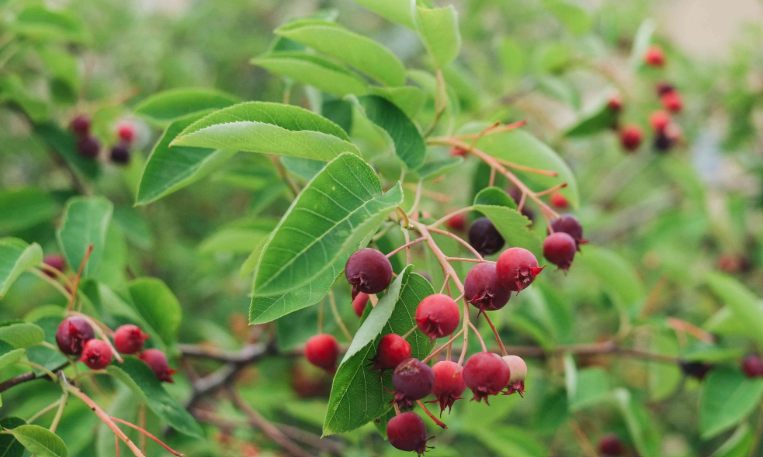
Serviceberries get their name from a piece of genuine American folklore: the plants bloom as soon as the ground thaws in early spring, and in some rural communities, that first flush of white flowers signaled that the frozen earth was finally soft enough to dig graves and hold burial services for anyone who’d died over the winter. It’s a slightly morbid origin for a tree most people now plant for exactly the opposite reason, since serviceberries are genuinely one of the most reliable multi-season landscape plants available: white flowers in April, sweet purple-black fruit by June, and fiery red-orange fall color before winter reveals a smooth, attractive gray bark underneath it all.
There are more than 30 species in the genus, and nearly all of them are native to North America, closely related to apples and pears within the rose family. They hybridize with each other so readily in the wild that even botanists sometimes struggle to tell one species from another, which is part of why the nursery trade leans so heavily on named cultivars bred for a specific, predictable size and fall color rather than the wild species themselves.
What follows covers 30 types of serviceberries, spanning wild species and named cultivars, with the real numbers on mature size and general lifespan pulled from university extension data where it’s available.
Downy Serviceberry
Downy serviceberry grows as a multi-stemmed shrub or small tree reaching 15 to 25 feet tall, hardy to zone 4 and tolerant of both full sun and partial shade. Its fruit is edible but not especially flavorful compared to some of its relatives, which is why breeders have leaned on it mainly for its reliable form and adaptability rather than its taste.
It tolerates moist soil and some air pollution better than most other serviceberry species, making it a practical choice near a pond, stream, or urban planting site.
Allegheny Serviceberry
Allegheny serviceberry, also called smooth serviceberry, is a narrow, multi-stemmed shrub native to eastern North America that typically reaches 25 feet tall and 5 to 10 feet wide, though some sources document specimens climbing to 40 or 45 feet under ideal conditions. It tolerates drier, rockier soil better than many of its relatives.
Its smooth bark and narrow profile make it a good fit for a tighter planting space than the broader, more spreading species on this list.
Shadblow Serviceberry
Shadblow serviceberry gets its name from its habit of blooming right around the time American shad swim upriver to spawn each spring, a seasonal coincidence that gave the plant its common name along the Atlantic coast. It grows as a multi-trunked shrub with a rounded crown, typically reaching around 15 feet tall.
It thrives along woodland edges and open, sunny sites, and its fall color runs through the same yellow-to-red range typical of the broader genus.
Saskatoon Serviceberry
Saskatoon serviceberry, named for the city in Saskatchewan where it’s especially common, is a compact, multi-stemmed shrub reaching 4 to 15 feet tall and 6 to 9 feet wide depending on the specific cultivar. It’s widely considered the best-tasting serviceberry species, which is why nearly every fruit-focused cultivar on this list traces back to it.
Prairie communities historically dried and pounded its fruit into pemmican alongside buffalo meat and fat, a practical winter food that kept for months.
Apple Serviceberry
Apple serviceberry is a naturally occurring hybrid between downy and Allegheny serviceberry, producing the largest flowers of any serviceberry type, some with a distinct pink tinge. It generally stays somewhat shorter than either parent species and tolerates shade particularly well.
Nearly every popular ornamental serviceberry cultivar sold today, including Autumn Brilliance, Princess Diana, and Ballerina, is a selection of this specific hybrid.
Running Serviceberry
Running serviceberry spreads via underground suckers into low, colony-forming thickets rather than growing as a single upright shrub, staying considerably shorter than most other species on this list. That spreading habit makes it more useful as an erosion-control groundcover than a specimen tree.
It tolerates poor, sandy soil and produces fruit that birds and wildlife readily consume, even where the fruit itself isn’t cultivated for human harvest.
Utah Serviceberry
Utah serviceberry grows as a drought-tolerant shrub adapted to the arid mountain and canyon habitat of the interior western United States, generally staying more compact than its eastern relatives. Its resilience in dry, rocky soil sets it apart from species that need consistent moisture.
It’s an important browse plant for deer and other wildlife throughout its native range, valued as much for habitat as for its own fruit.
Roundleaf Serviceberry
Roundleaf serviceberry produces distinctly rounded leaves, a helpful identifying feature in a genus notorious for species that otherwise look nearly identical to one another. It generally grows as a modest shrub reaching a similar height range to other eastern species.
It favors the same woodland edge and open habitat typical of the broader genus, blooming in the same early spring window as its relatives.
Low Serviceberry
Low serviceberry stays genuinely compact compared to nearly everything else in this genus, growing as a low, spreading shrub rather than reaching tree height under any circumstances. Its diminutive size makes it a practical choice for a smaller garden bed.
It tolerates the same drier, rockier soil conditions as Allegheny serviceberry, thriving where richer, moister soil isn’t available.
Bartram’s Serviceberry
Bartram’s serviceberry is a cold-climate species found in the northeastern United States and Canada, generally staying shrubby and compact in the harsh, often boggy or rocky habitat it favors. It’s less commonly cultivated than the showier ornamental hybrids, staying largely a wild, regional species.
It tolerates cold and wet conditions that would stress out many of the more southern serviceberry species on this list.
Coastal Serviceberry
Coastal serviceberry grows along the Atlantic coastal plain, adapted to the sandy, well-drained soil typical of that habitat. It generally stays shrubbier and more compact than inland relatives like Allegheny serviceberry.
It tolerates salt exposure and sandy soil conditions better than most other species in the genus, a genuine advantage in its native coastal range.
Nantucket Serviceberry
Nantucket serviceberry is a genuinely rare, regionally restricted species found in a narrow range along the northeastern coast, staying low and shrubby in the sandy, exposed habitat it occupies. Its limited natural range has made it a species of specific conservation interest.
It shares the sandy soil and salt tolerance common to its coastal relatives, surviving conditions that would challenge more inland-adapted species.
Autumn Brilliance
Autumn Brilliance is one of the most widely planted apple serviceberry cultivars, reaching a mature height under 25 feet with a rounded form, hardy to zone 4 and rated as having medium overall longevity. Its brilliant red fall foliage and above-average disease resistance are what made it a nursery standard in the first place.
It’s commonly grown as a multi-trunked small tree, tolerates power line proximity given its restrained mature height, and its purple fruit draws birds heavily each summer.
Princess Diana
Princess Diana grows in a spreading form reaching 15 to 20 feet tall and 12 to 15 feet wide, distinguished from other apple serviceberry cultivars by its yellow flower buds that open into white spring flowers. Its fall color runs a vivid red.
It’s prone to the same leaf spot issues common across the genus and, like most apple serviceberry cultivars, tends to send up root suckers that need occasional removal to keep a tidy single-trunk form.
Robin Hill
Robin Hill grows in an upright, oval form reaching a notably tall 20 to 30 feet, distinguished by pale pink flowers rather than the pure white typical of most other serviceberry cultivars. Its fall color shifts through a yellow-to-red range.
Its taller mature height makes it a better fit for a larger property than some of the more compact apple serviceberry selections on this list.
Ballerina
Ballerina grows into a genuinely wide, spreading form reaching up to 20 to 25 feet tall and just as wide, with bronze-purple new growth and unusually large flower clusters. It’s more prone to fire blight than some other cultivars, worth watching for in a humid climate.
Its considerable spread makes it one of the larger apple serviceberry selections available, better suited to open ground than a tight garden corner.
Cole’s Select
Cole’s Select grows in a tidy, upright form reaching about 15 feet tall and wide, with orange-red fall color and a compact enough footprint to fit where the larger cultivars on this list would crowd a smaller yard. It’s a downy serviceberry selection rather than an apple serviceberry hybrid.
Its balanced, symmetrical shape has made it a popular choice specifically where a smaller, tidier specimen tree is needed.
Rainbow Pillar
Rainbow Pillar grows in a genuinely narrow, tight, upright column reaching around 25 feet tall, a distinctly different silhouette from the rounded or spreading forms typical of most other serviceberry cultivars. Its fall foliage turns a mottled mix of yellow, orange, and red on the same plant simultaneously.
Its narrow profile makes it one of the few serviceberry cultivars genuinely well suited to a tight side-yard planting or a formal, columnar hedge row.
Standing Ovation
Standing Ovation grows in an upright, oval form reaching 10 to 20 feet tall, with orange-red fall color and a somewhat more compact overall footprint than taller cultivars like Robin Hill. Its moderate size makes it adaptable to a range of residential planting situations.
Its upright form holds its shape well without extensive pruning, a practical advantage for anyone who doesn’t want to maintain a specific silhouette by hand every year.
Regent
Regent is a Saskatoon serviceberry cultivar bred specifically for fruit quality, staying a compact 4 to 8 feet tall and wide depending on the source, with notably sweet fruit compared to ornamental-focused cultivars. It’s one of the more widely available fruiting serviceberries for home gardeners.
Its manageable size makes it a realistic choice for harvesting fruit by hand from a home garden rather than requiring an orchard-scale planting.
Northline
Northline is a Saskatoon serviceberry cultivar developed specifically for cold-climate fruit production, bred to handle harsh Prairie winters while still producing a reliable, flavorful crop. It’s commonly recommended alongside Smoky, Thiessen, and Regent as one of the standard fruiting cultivars for northern gardens.
Its cold-climate breeding makes it a dependable choice anywhere winters are too severe for less hardy fruiting cultivars.
Smoky
Smoky is another Saskatoon serviceberry cultivar bred for fruit production, valued alongside Northline and Thiessen as one of the more commonly planted options for anyone growing serviceberries specifically to eat rather than for ornamental display. Its fruit quality has kept it in commercial and home-orchard use for decades.
It shares the compact, multi-stemmed shrub form typical of Saskatoon cultivars, generally staying well under the height of ornamental apple serviceberry selections.
Thiessen
Thiessen rounds out the standard set of cold-hardy Saskatoon fruiting cultivars alongside Northline, Smoky, and Regent, bred specifically for reliable fruit production in harsh Prairie conditions. It remains a staple recommendation for anyone in a cold climate wanting serviceberries primarily for the harvest rather than the fall color.
Like its fellow Saskatoon cultivars, it stays considerably more compact than the larger apple serviceberry hybrids grown mainly for ornamental use.
Pembina
Pembina is a Saskatoon serviceberry cultivar specifically noted for its fruit quality, grown alongside Smoky, Northline, Thiessen, and Regent as one of the standard named selections bred from the best-tasting serviceberry species available. It shares that group’s compact, multi-stemmed shrub form.
Its inclusion among the small set of named Saskatoon cultivars reflects just how much smaller and more specialized the fruit-focused breeding pool is compared to the sprawling list of purely ornamental apple serviceberry selections.
Juneberry
Juneberry, more precisely Amelanchier lamarckii, grows in an upright form reaching 15 to 25 feet tall and wide, with red-orange fall color and, per Montana State University Extension’s disease chart, no serious disease issues to watch for, a genuine advantage over several other cultivars on this list. It’s sometimes treated as its own distinct hybrid rather than a straightforward species.
Its relative freedom from the leaf spot and fire blight problems that affect several apple serviceberry cultivars has made it a low-maintenance option where disease pressure is a real concern.
Dwarf Serviceberry
Dwarf serviceberry, botanically Amelanchier spicata, spreads via underground suckers into low, dense thickets rather than growing as a single upright shrub, generally staying under 6 feet tall even at full maturity. Its thicket-forming habit makes it more of a groundcover or bank-stabilizing plant than a specimen tree.
It tolerates poor, sandy soil and cold exposure well, thriving in the same rough, exposed conditions that several of its low-growing relatives favor.
Rubescens
Rubescens is an apple serviceberry cultivar distinguished by flowers flushed with pink, opening from noticeably darker pink buds rather than the pure white typical of most other selections. That subtle color variation has made it a favorite among gardeners who want something slightly different from the standard white-flowering types.
It shares the general size range and growth habit of other apple serviceberry cultivars, generally reaching a moderate 15 to 20 feet at maturity.
Tradition
Tradition grows in a distinctly upright, pyramidal form rather than the rounded or spreading shapes typical of many other apple serviceberry cultivars, making it a good fit where a narrower, more formal silhouette is wanted. Its fall color runs through the same orange-red range common across the group.
Its tidy, predictable shape requires less corrective pruning over time than some of the more naturally sprawling cultivars on this list.
Prince Charles
Prince Charles is an apple serviceberry cultivar selected in part for improved disease resistance, growing in a rounded, oval form comparable in size to other mid-sized selections like Cole’s Select. Its dependable health record has made it a popular choice where leaf spot or fire blight has been a recurring problem with other cultivars.
It produces the same white spring flowers and purple summer fruit typical of the broader apple serviceberry group, with reliably good fall color.
Snowcloud
Snowcloud is an apple serviceberry cultivar bred specifically for an unusually heavy spring flower display, living up to its name with a bloom dense enough to genuinely resemble a low cloud settled over the branches. Its fruit and fall color follow the same general pattern as its relatives, though the flowering display is the main reason it’s chosen over other cultivars.
Its exceptional bloom makes it a strong choice for anyone prioritizing the spring flower show over fall foliage or fruit production specifically.
Conclusion
Serviceberries include several attractive shrubs and small trees known for their spring flowers, edible berries, and colorful fall foliage. Although the different types share many characteristics, they can vary in size, growth habit, berry color, and preferred growing conditions.
Choosing the right serviceberry depends on factors such as available space, climate, soil, and the desired landscape effect. Some types are well suited to smaller gardens, while others can develop into larger multi-stemmed shrubs or small trees. Their berries can also provide a valuable food source for birds and other wildlife.
With suitable growing conditions and basic care, serviceberries can provide several seasons of interest in the landscape. Their flowers, fruits, foliage, and attractive form make them useful additions to gardens, naturalized areas, and wildlife-friendly landscapes.