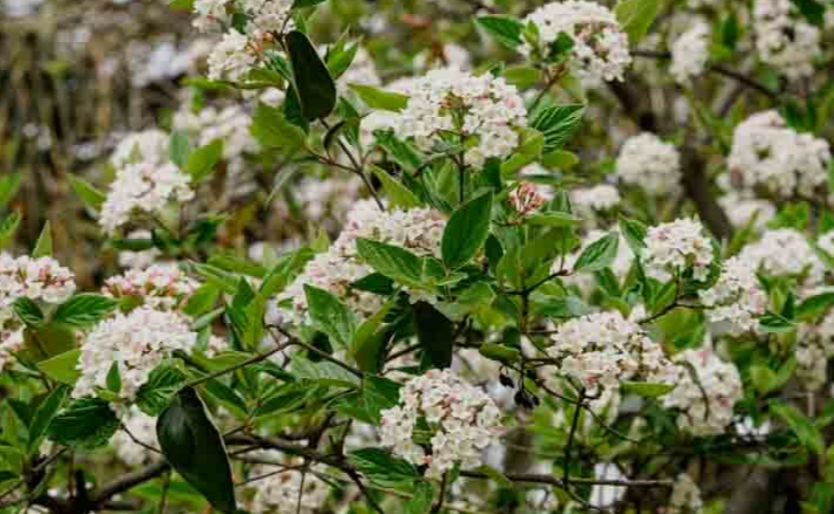
Koreanspice viburnum is widely considered one of the most fragrant shrubs a temperate gardener can grow. For a few weeks each spring, its rounded clusters of pink-budded white flowers release a rich, spicy scent of cloves and sweet spice cake that can drift across an entire yard. It blooms just before lilacs, so it often opens the season’s great fragrance show. Gardeners who plant one near a door, patio, or open window often say spring does not truly arrive until this shrub flowers.
Its appeal goes beyond scent. Koreanspice viburnum is compact compared with many viburnums, growing 4 to 8 feet tall and wide. It is hardy through much of the northern United States and needs little care once established. Its soft, gray-green leaves can turn wine-red in autumn, and its small fruit feeds birds in late summer. This guide covers its history, how to identify it, the best cultivars, and how to place and grow the shrub to get the most from its famous fragrance.
Botanical Classification
Koreanspice viburnum is a deciduous, multi-stemmed shrub in the viburnum genus, a group of roughly 150 to 175 species of shrubs and small trees spread across the Northern Hemisphere. Like its relatives, it has moved between plant families as classifications were revised. Older references list it in the honeysuckle family, others in the moschatel family, and current systems give viburnums their own family. Nursery tags and extension publications often use any of the three.
Within the genus, it belongs to a group of viburnums known for dense, rounded clusters of strongly fragrant flowers. It is also the parent of several of the most popular fragrant garden hybrids. Burkwood viburnum, Judd viburnum, and the fragrant snowball viburnum all trace part of their scent and flower form to this species. Breeders crossed it with other viburnums to combine its fragrance with larger flowers, semi-evergreen leaves, or better disease resistance.
Brief History
Koreanspice viburnum is native to Korea and to Tsushima Island, which lies between Korea and Japan. There it grows on rocky slopes, forest edges, and open hillsides. The shrub was first described scientifically in 1885 from a specimen collected by William Richard Carles. He was a British consular official who explored Korea in the early 1880s, and the plant’s botanical name honors him. Seeds and plants moved from Korea to Japan in the late 1890s and then into European and American gardens in the early 20th century.
The shrub quickly became a favorite in Western gardens for its fragrance. Breeders soon used it as a parent in new hybrids. Two of its best-known cultivars came from nurseries on opposite sides of the Atlantic. The University of Connecticut notes that ‘Compactum’ was introduced by a Rhode Island nursery in 1953. ‘Aurora’ was selected from seedlings at the Slieve Donard Nursery in Northern Ireland and released in 1958. It later earned the Royal Horticultural Society’s Award of Garden Merit.
Identifying Characteristics
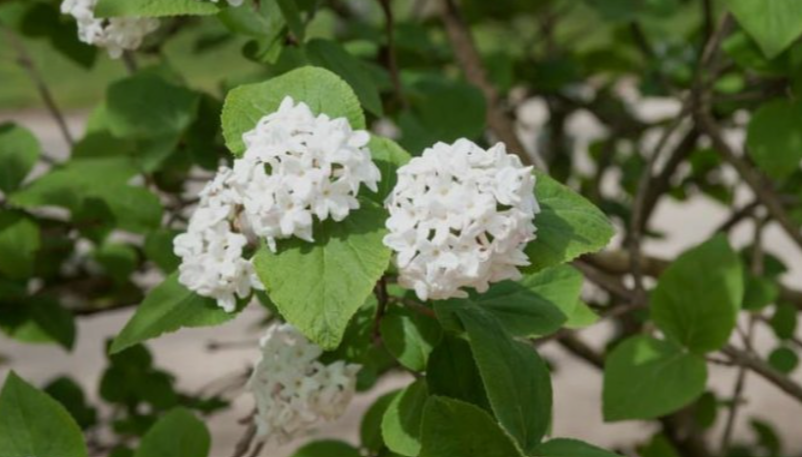
The flowers are the shrub’s signature feature. They form dense, rounded to semi-domed clusters about 2 to 3 inches across, at the tips of the branches in April and early May, before most of the leaves have fully expanded. The buds are deep pink to red and open into small, waxy, tubular white flowers, often with a soft pink blush. The clusters stay partly pink-and-white for days as the buds open in stages, so the shrub looks two-toned during its peak.
The fragrance sets this viburnum apart from almost every other flowering shrub. The Clemson Cooperative Extension Home and Garden Information Center describes the scent as clove-like and notes that it carries a great distance. On calm, warm spring evenings, many gardeners notice it 30 feet or more from the plant. The scent is sweet and spicy rather than heavy, and many people compare it to cloves, carnations, or freshly baked spice cake.
The leaves are opposite, broadly oval, and usually 1 to 4 inches long, with irregular teeth along the edges. Both the upper and lower surfaces are covered with fine hairs, which give the foliage a dull, slightly velvety, gray-green look. In autumn the leaves may turn red to wine-purple, though fall color is inconsistent and some years the leaves simply drop. The fruit forms sparsely in late summer as small oval berries that ripen red and then black. It is rarely showy, since most plants set only a few berries.
Popular Cultivars
‘Aurora’ is often considered the finest Koreanspice selection. The University of Tennessee Gardens notes that it has a superior floral display, with larger clusters of pinkish-white blooms opening from deep pink-red buds and a very strong fragrance. It typically grows 6 to 8 feet tall and wide, and its young leaves often have a coppery flush. ‘Diana’ is a similar selection with strong red buds that has also received the Royal Horticultural Society’s Award of Garden Merit.
For smaller gardens, ‘Compactum’ is the classic dwarf form. It usually stays 3 to 4 feet tall and wide while keeping the full fragrance of the species. ‘Spice Island’ was selected for a uniformly compact, well-branched habit that avoids the lopsided growth some dwarf forms develop. ‘Spiro Spice Girl’ is a newer compact selection. Gardeners who struggle with leaf diseases often choose ‘Cayuga’, a hybrid released by the U.S. National Arboretum. It combines Koreanspice fragrance with a denser, more compact habit and improved resistance to powdery mildew and leaf spot.
Landscape Uses
Placement matters more for Koreanspice viburnum than for most shrubs, because its greatest asset is scent. Plant it near entrances, walkways, patios, decks, and windows that are opened in spring, where the fragrance can be enjoyed every day it blooms. Many gardeners place it upwind of outdoor seating areas so that spring breezes carry the scent toward them. Even a single shrub in the right spot can perfume a small garden.
Its moderate size and rounded shape make it useful in foundation plantings, mixed shrub borders, and cottage gardens. Compact cultivars work well in groups of 3 along a walk or in front of taller shrubs. Because the shrub is fairly plain after bloom, it looks best combined with plants that carry summer interest, such as hydrangeas, perennials, and ornamental grasses. It also pairs naturally with spring bulbs, flowering at the same time as late tulips and early perennials.
Also Read: Different Types of Viburnum Shrubs
Wildlife Value
The fragrant spring flowers attract early-season pollinators, including bees, butterflies, and many flies and beetles that feed on the nectar and pollen. Because Koreanspice viburnum blooms before many other shrubs, it provides an important early food source at a time when relatively little else is flowering. The scent is strongest on warm, sunny days, when pollinators are most active.
The fruit is sparse but still eaten by birds as it ripens in late summer. Because the plant is native to Asia rather than North America, it supports far fewer native caterpillars than native viburnums. NC State Extension suggests arrowwood viburnum as a native alternative for gardeners who want more wildlife value. Many wildlife-minded gardeners plant both and use Koreanspice for fragrance near the house and native viburnums along property edges.
Growing Considerations
Koreanspice viburnum is hardy from Zone 4 through Zone 7, with some gardeners succeeding in sheltered parts of Zone 8. It performs best in full sun to partial shade. Plants in full sun produce the heaviest flowering, while afternoon shade helps protect the foliage in hotter southern climates. The shrub is not well suited to the hot, humid conditions of the Deep South, where it often struggles with heat stress and leaf diseases.
It prefers moist, fertile, well-drained soil that is slightly acidic to neutral. It tolerates clay reasonably well as long as the ground does not stay waterlogged. Plant it in spring or early fall, and water it regularly through the first growing season while the roots establish. Spread 2 to 3 inches of mulch over the root zone to keep the soil cool and evenly moist. Established shrubs tolerate short dry spells but bloom best with consistent moisture during summer, when next year’s flower buds form.
Prune Koreanspice viburnum immediately after it finishes flowering, since pruning later in the year removes next spring’s buds. Light shaping and removal of dead or crossing branches is usually all that is needed. Every few years, overgrown plants can be renewed by removing a few of the oldest stems at the base. One more caution: older plants were often grafted onto a different viburnum rootstock, and suckers from that rootstock can eventually take over if left uncut. Remove any shoots that look different from the main shrub.
Pests and Problems
Koreanspice viburnum is generally a dependable shrub, but it is more prone to a few problems than some other viburnums. Bacterial leaf spot is one of the most common. It causes water-soaked, angular spots that turn brown and can make leaves drop early in wet seasons. Avoid overhead watering, space plants for good air circulation, and rake up fallen leaves to help limit its spread. Powdery mildew can also coat the leaves in humid summers.
The viburnum crown borer is a more serious threat. It tunnels into the lower stems and crown, causing wilting and dieback, especially on stressed or older plants. Keeping shrubs healthy and well watered and avoiding wounds near the base reduces the risk. Koreanspice viburnum generally shows good resistance to the viburnum leaf beetle compared with arrowwood and the cranberrybush viburnums, likely because of its thick, hairy leaves. It is also relatively deer resistant and tolerates growing near black walnut trees.
Sources
University of Connecticut Plant Database, “Koreanspice Viburnum”
Clemson Cooperative Extension Home and Garden Information Center, “Korean Spice Viburnum”
University of Tennessee Gardens, “April 2018 Plant of the Month: Koreanspice Viburnum”
NC State Extension Gardener Plant Toolbox, “Koreanspice Viburnum”