Burkwood Viburnum: The English Hybrid That Brought Fragrance to Warmer Gardens
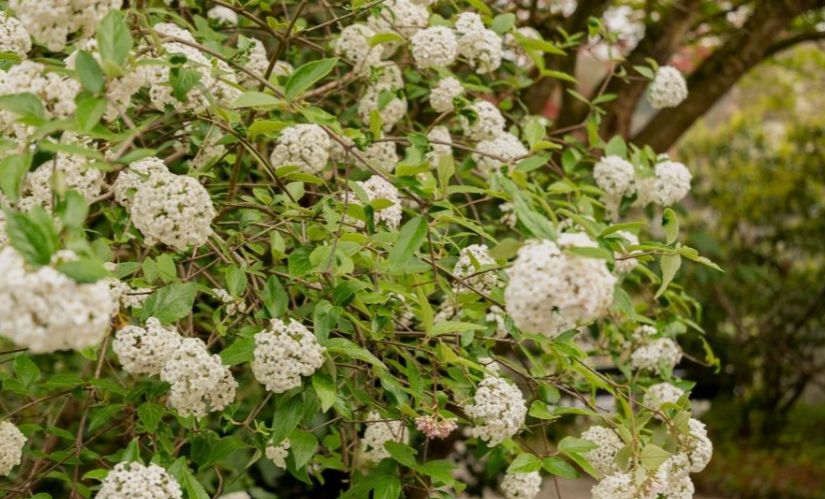
Burkwood viburnum is one of the most successful hybrid shrubs ever created. It combines the sweet, spicy fragrance of Koreanspice viburnum with the glossier, more durable foliage of a Chinese evergreen viburnum. In early to mid spring, its pink buds open into domed clusters of white, intensely fragrant flowers. In mild climates its dark green leaves often hold on well into winter. The result is a shrub that gives gardeners much of the Koreanspice fragrance experience in places where Koreanspice itself struggles.
Nearly a century after it was first raised in an English nursery, Burkwood viburnum remains a mainstay of shrub borders, foundation plantings, and fragrance gardens across North America and Europe. It handles heat and drought better than its famous parent, resists several common leaf diseases, and comes in a growing number of cultivars. This guide covers its unusual origin, its identifying features, how its leaves behave from climate to climate, and how to grow it.
Botanical Classification
Burkwood viburnum is a hybrid shrub in the viburnum genus, a group of roughly 150 to 175 species of shrubs and small trees found mostly in the Northern Hemisphere. Like its relatives, it has been placed in several plant families over the years. Older references list the honeysuckle family, others the moschatel family, and current classifications give viburnums their own family. All three appear on nursery labels and in extension fact sheets.
The plant is a cross between 2 Asian species. One parent is the Koreanspice viburnum, a deciduous shrub from Korea famous for its clove-scented spring flowers. The other is the service viburnum, a slender, evergreen shrub from central China with small, glossy leaves and good tolerance of heat and dry soil. Burkwood viburnum inherited fragrance and flower form from the first parent and glossier, longer-lasting leaves and better adaptability from the second. Because it is a hybrid rather than a wild species, it has no native range.
Brief History
Burkwood viburnum was created in England in the 1920s at the nursery of the Burkwood brothers and their partner Geoffrey Skipwith in Kingston upon Thames. Oregon State University dates the original cross to 1924. The nursery became famous for its deliberate crosses between viburnums and other flowering shrubs, at a time when most new garden plants still came from wild collection. Several of its creations still carry the Burkwood name, including a popular hybrid daphne and an osmanthus.
The hybrid quickly reached North America, where it became a backbone of the mid-20th-century nursery trade. Later breeders at the U.S. National Arboretum used Burkwood viburnum as a parent in a series of new selections. The University of Arkansas Cooperative Extension notes that the breeder Donald Egolf trialed his new viburnums at sites across the country before deciding to name and release them. That careful testing produced several of the most reliable cultivars sold today.
Identifying Characteristics
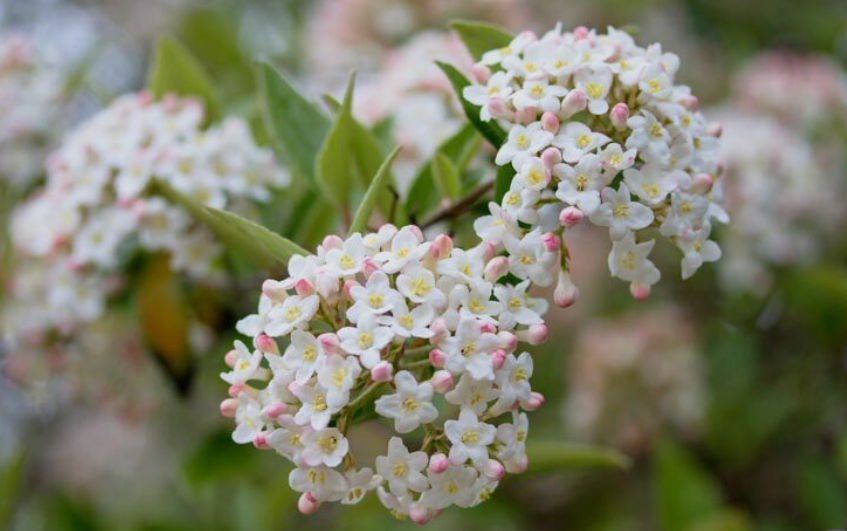
The flowers open in early to mid spring, usually in April in much of the United States. They form rounded, slightly domed clusters about 2 to 3½ inches across. The buds are pink to soft red and open into small, tubular white flowers that may keep a faint pink blush. The fragrance is sweet and spicy, very much like Koreanspice viburnum, though many gardeners describe it as slightly lighter. On warm, still days the scent carries well beyond the plant.
The leaves are the easiest way to tell Burkwood from Koreanspice. They are oval, typically 1½ to 4 inches long, and noticeably glossy, dark green on top. The underside is covered with pale gray-brown felt. Koreanspice leaves, by contrast, are dull and softly hairy on both sides. In autumn, Burkwood leaves may turn wine-red to burgundy, and in mild-winter regions many of them stay on the shrub into the new year.
Mature plants usually reach 8 to 10 feet tall and 6 to 7 feet wide. They form an upright, somewhat open, multi-stemmed shrub that can look a little leggy with age. The small oval fruit ripens red and then black in late summer, though it forms sparsely and is rarely ornamental. The stems are covered with fine hairs when young and become gray-brown with age.
Evergreen, Semi-Evergreen, or Deciduous?
One of the most frequently searched questions about Burkwood viburnum is whether it keeps its leaves in winter. The answer depends almost entirely on climate. In the coldest parts of its range, around Zones 4 and 5, the shrub behaves as a deciduous plant and drops most of its leaves in late fall after showing some red fall color. In Zones 6 and 7, it is usually semi-evergreen, holding part of its foliage through winter, often with a bronze or burgundy tint.
In the mildest areas, in Zone 8 and in the Pacific Northwest, Burkwood viburnum can stay nearly evergreen and keep a full leafy look through winter. Certain cultivars, especially ‘Conoy’, keep their leaves more reliably than the original hybrid. Gardeners who want year-round screening should choose such a cultivar and plant it in a sheltered spot. In colder climates, they should not rely on the shrub for winter privacy.
Popular Cultivars
‘Mohawk’ is one of the most celebrated Burkwood selections. It is a backcross to Koreanspice viburnum, and the Cornell University woody plants database describes it as compact, with dark red flower buds that open late to white flowers and superior orange-red to burgundy fall color. It typically grows about 6 to 8 feet tall and wide. Its red buds are striking for weeks before the flowers open, and it has a reputation for good resistance to leaf spot and mildew.
‘Conoy’ is an evergreen selection from a 1968 cross between the service viburnum and the ‘Park Farm Hybrid’ form of Burkwood viburnum. It was named and released in 1988. It grows into a dense, mounded shrub about 5 to 6 feet tall and 8 to 9 feet wide, with glossy, dark leaves that take on a maroon blush in winter. Its pink buds open into white flowers that are less fragrant than those of the original hybrid, but its year-round foliage makes it one of the most useful evergreen shrubs for warmer gardens.
Several older selections remain widely grown. ‘Park Farm Hybrid’ is a vigorous, spreading form with larger flower clusters and good fragrance. ‘Chenaultii’ is a more compact, slightly later-blooming selection that often holds its leaves longer. ‘Anne Russell’ is a backcross to Koreanspice viburnum with dense growth and especially strong fragrance. ‘Fulbrook’ produces large, sweetly scented flower clusters on a fairly upright plant.
Landscape Uses
Like its fragrant parent, Burkwood viburnum should be planted where its spring scent can be enjoyed. Plant it near doors, walkways, patios, decks, and windows, or along paths you use daily. Its upright, multi-stemmed habit suits mixed shrub borders, informal hedges, and foundation plantings. In mild climates it also makes a useful screen for most of the year.
Because older plants can look somewhat open and leggy, Burkwood viburnum often looks best with lower shrubs or perennials planted in front of it to hide the bare lower stems. Compact cultivars such as ‘Mohawk’ and ‘Conoy’ fit smaller gardens and can be grouped in 3s or planted as a low hedge. Evergreen and semi-evergreen forms pair well with spring bulbs, hellebores, and early perennials, which flower at the same time and enjoy similar conditions.
Wildlife Value
The fragrant spring flowers attract a range of early-season pollinators, including native bees, honeybees, butterflies, and many flies and beetles. Because the shrub blooms relatively early in spring, it fills an important gap when few other flowering shrubs are open. The scent is strongest on warm, sunny afternoons, when pollinator activity is also highest.
The fruit is sparse but is eaten by birds when it ripens in late summer. The dense branching gives songbirds some cover, especially on evergreen forms that keep their leaves through winter. Because Burkwood viburnum is a hybrid of 2 Asian species, it supports far fewer native caterpillars than native North American viburnums. Gardeners who want to maximize wildlife benefits often plant it near the house for fragrance and use native viburnums elsewhere on the property.
Also Read: Different Types of Viburnum Shrubs
Growing Considerations
Burkwood viburnum is generally hardy from Zone 4 through Zone 8, though some cultivars are rated only to Zone 5. It grows best in full sun to partial shade. Plants in full sun produce the heaviest flowering and the densest growth, while afternoon shade helps protect the leaves in the hottest climates. Utah State University notes that, once established, it has good heat and drought tolerance. That is a major advantage over Koreanspice viburnum in warmer regions.
The shrub prefers moist, fertile, well-drained soil that is slightly acidic to neutral. It tolerates clay and moderately alkaline soils better than many viburnums, as long as drainage is good. Plant it in spring or early fall, and water it consistently through the first growing season while the roots establish. A 2 to 3 inch layer of mulch over the root zone keeps soil evenly moist and cool during summer, when next year’s flower buds form.
Prune Burkwood viburnum right after it flowers, because pruning later removes the buds for the following spring. Light shaping and removal of dead or crossing branches is usually enough. To correct the leggy look common on older plants, remove a few of the oldest, tallest stems at ground level every few years. That encourages new growth from the base and keeps the shrub fuller and more compact over time.
Pests and Problems
Burkwood viburnum is generally considered more disease resistant than Koreanspice viburnum, which is one reason the hybrid became so popular. It is less prone to bacterial leaf spot, though the disease can still appear in wet, humid seasons, especially on crowded plants. Powdery mildew sometimes coats the leaves in late summer, particularly in shade or in sites with poor air circulation. Good spacing, morning sun, and watering at the base rather than overhead reduce most foliage problems.
Aphids may occasionally curl new spring growth. Like other viburnums, Burkwood viburnum can be attacked by crown borers, which tunnel into the lower stems of stressed or damaged plants. The viburnum leaf beetle tends to favor other species, such as arrowwood and the cranberrybush viburnums, but some feeding can occur where beetle populations are heavy. Keeping shrubs healthy and watered during drought is the best overall defense against both insects and disease.
Sources
Oregon State University Landscape Plants, “Burkwood Viburnum”
University of Arkansas Cooperative Extension, “Plant of the Week: Conoy Viburnum”
Cornell University Woody Plants Database, “Mohawk Burkwood Viburnum”
Utah State University Extension, Varga Arboretum, “Burkwood Viburnum”