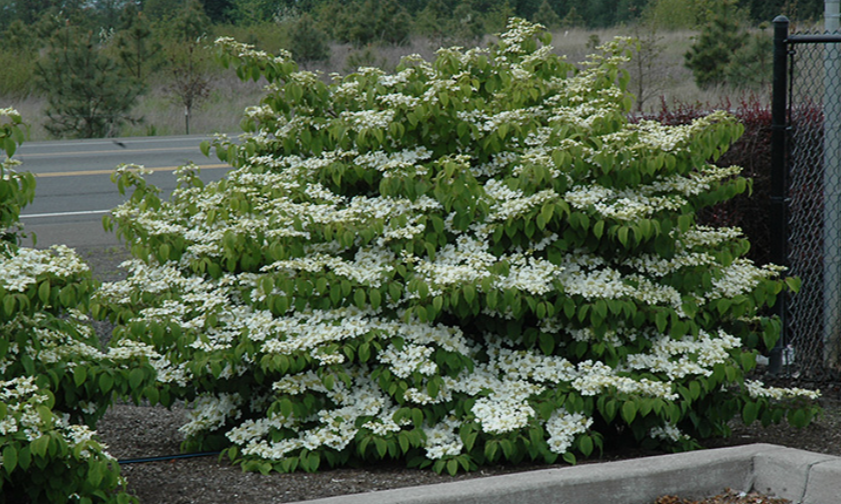
Doublefile viburnum is often called one of the most beautiful flowering shrubs in temperate gardens. Its fame rests on one unforgettable feature. In late spring, its strongly horizontal branches carry 2 neat rows of flat white flower clusters along their upper surface. From a distance, the shrub looks like a tiered cake or a set of shelves dusted with fresh snow. The effect is so architectural that landscape designers often treat a mature doublefile viburnum as a living sculpture rather than just another shrub in the border.
The display lasts well beyond spring. Bright red fruit follows the flowers in summer and draws birds as it ripens to black. Then the deeply pleated leaves turn burgundy and wine-purple in autumn, and the layered branch pattern stays visible through winter. Doublefile viburnum is not suited to every site, however. It dislikes heavy wet soil and drought, and recent observations suggest it may spread beyond gardens in some regions. This guide covers what makes the shrub special, how to choose among its cultivars, and how to grow it well.
Botanical Classification
Doublefile viburnum is a deciduous, multi-stemmed shrub in the viburnum genus, a group of roughly 150 to 175 species of shrubs and small trees across the Northern Hemisphere. Like other viburnums, it has been reassigned among plant families over the years. Older references place it in the honeysuckle family, more recent ones in the moschatel family, and current systems give viburnums their own family. Gardeners comparing nursery tags and extension publications will find all three.
The plant is the wild, fruit-bearing form of a species that also includes the Japanese snowball viburnum. The 2 look quite different in bloom. NC State Extension explains that the Japanese snowball bears sterile, ball-shaped clusters that produce no fruit, while doublefile viburnum bears flat, fertile clusters along tiered horizontal branches. Botanists generally treat doublefile as the wild variety and the snowball as a long-cultivated garden form, so the names are not interchangeable even though nurseries sometimes blur them.
Brief History
Doublefile viburnum is native to the forests and mountain thickets of Japan and China, with related populations reported in Korea and Taiwan. In Japan, the wild shrub grows along forest edges and stream valleys, where its horizontal branches spread to catch filtered light. The cultivated snowball form had been grown in Asian gardens for centuries before Western plant collectors arrived. The wild doublefile type was introduced to Western horticulture somewhat later.
One of the most important early selections, ‘Mariesii’, is named for Charles Maries. He was an English plant collector who explored Japan and China in the late 19th century for the famous Veitch nursery. That selection’s exceptionally flat, layered branches set the standard for doublefile viburnums for nearly a century. The next major advance came from the U.S. National Arboretum. There, a 1954 breeding cross involving ‘Mariesii’ eventually produced ‘Shasta’, the first doublefile viburnum cultivar to come from a formal breeding program. It remains one of the most widely planted today.
Identifying Characteristics
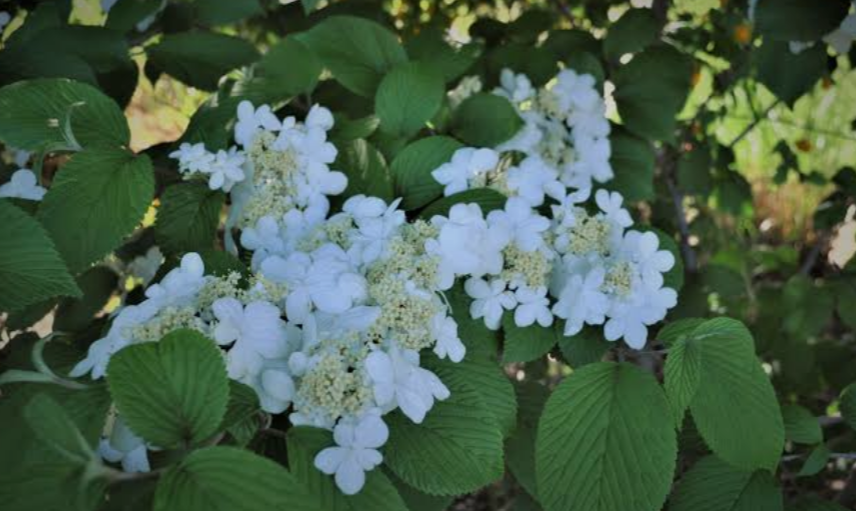
The name “doublefile” describes how the flowers are arranged. Virginia Tech explains that the flower clusters appear in pairs, side by side, along the length of each stem. They sit above the foliage and create a distinctly layered look. Each flat cluster is 2 to 4 inches across, with a center of small fertile flowers surrounded by a ring of large white sterile flowers, each about 1 inch wide. The shrub blooms in May in most regions, and the cluster pairs line up so evenly that they look almost deliberately arranged.
The leaves are opposite, oval, and pointed, typically 2 to 5 inches long, with finely toothed edges. Their most distinctive trait is the deeply sunken, parallel veins that give the surface a pleated or folded look, which is where the botanical name comes from. The upper surface is dark green, and the underside is softly fuzzy. In autumn the leaves usually turn deep red, burgundy, or purple, and the leaves emerge early in spring, before the flowers open.
The branching pattern is just as recognizable as the flowers. The main stems send out side branches in near-horizontal tiers, creating what UMass Amherst describes as a fishbone pattern. The bark is gray-brown with orange lenticels, and the young stems are covered in fine hairs. Mature shrubs usually reach 8 to 10 feet tall and spread 9 to 12 feet wide, often noticeably wider than tall. The small oval fruit ripens bright red in mid to late summer, then turns black, and birds usually eat it within a few weeks.
Popular Cultivars
Choosing the right cultivar is the most important decision with this shrub, because the selections differ a great deal in size and habit. ‘Mariesii’ is the classic old-fashioned form, growing about 10 feet tall with especially flat, tiered branches and large sterile flowers raised on longer stalks. ‘Lanarth’ is similar but slightly larger, with branches that are not quite as horizontal. Both suit large gardens where the shrub has room to reach its full width.
‘Shasta’ is often considered the standard by which other doublefile viburnums are judged. The University of Connecticut notes that it grows to at least 10 feet tall with a wide spread and looks best when left unpruned. Its flowers are about 1.5 times larger than those of most other cultivars, and the plant often grows twice as wide as tall. ‘Shoshoni’ offers similar beauty on a smaller scale, usually around 5 feet tall and 8 feet wide. ‘Shasta Variegated’ adds leaves edged in yellowish-green.
For smaller spaces and longer bloom, ‘Summer Snowflake’ is the most popular choice. It is more upright and compact than the classic types, usually 5 to 8 feet tall. After its main spring show, it keeps producing scattered flowers through summer and sometimes into fall. Gardeners looking for color can choose ‘Pink Beauty’, whose flowers age to soft pink, or ‘Molly Schroeder’, which flowers pink fairly reliably and often reblooms in summer.
Landscape Uses
Doublefile viburnum is at its best as a specimen plant, placed where its layered habit can be seen from several sides. It suits a corner of a lawn, the end of a border, or the edge of a woodland garden, especially against a dark evergreen background that sets off the white flowers. Many gardeners place one near a patio or window to enjoy the spring display up close. With careful pruning of lower stems, older plants can be trained into small, multi-trunked trees that show off their horizontal limbs even more.
The shrub also works well in groups or loose informal hedges, as long as there is room for its natural width. Because it spreads so broadly, it should be planted at least 8 to 10 feet from walkways, foundations, and other shrubs. Crowding forces heavy pruning, which ruins the layered effect. Its tolerance of partial shade makes it a natural companion for hydrangeas, hostas, ferns, and other woodland-edge plants.
Wildlife Value
The flowers attract a range of pollinators in late spring, especially small native bees, flies, and beetles that work the central fertile flowers. The large sterile outer flowers produce no pollen or nectar, but they act as a landing signal that draws insects into the cluster. Cultivars with heavier fruit set, such as ‘Shasta’ and ‘Mariesii’, also support the most birds later in the season.
The fruit ripens earlier than that of most viburnums, usually in July and August. That makes it an important midsummer food for catbirds, robins, thrashers, and other songbirds. Because birds eat it so readily, the red-to-black fruit show is usually brief. The shrub’s dense, layered branches also give small birds shelter and nesting cover. As a non-native plant, however, it supports fewer native caterpillars than native viburnums such as arrowwood or blackhaw.
Growing Considerations
Doublefile viburnum is generally hardy from Zone 5 through Zone 8. Some sources extend the range to Zone 4 in protected sites, but stems can be damaged in very harsh winters. It grows best in full sun to partial shade. In hotter southern regions, afternoon shade helps prevent scorched leaf edges. In the North, full sun produces the heaviest flowering and fruit.
Soil is critical. The shrub needs moist, fertile, well-drained soil rich in organic matter. It performs poorly in heavy clay that stays wet, where root rot and stem dieback become common. It is also less drought tolerant than many viburnums and may show browned leaf margins after dry spells in late summer. Water deeply during extended droughts, especially in the first 2 to 3 years after planting, and keep a 2 to 3 inch layer of mulch over the root zone. Mulch keeps the soil cool and evenly moist.
Pruning should be minimal and careful. Never shear the shrub into a ball or box shape, because that destroys the horizontal layering that makes it worth growing. If pruning is needed, do it right after flowering. Remove dead wood, crossing branches, or stems that break the tiered pattern, cutting them back to a side branch or the base. Choosing a cultivar sized for the space at planting avoids nearly all pruning problems later.
Pests and Problems
Doublefile viburnum is relatively trouble-free when grown in the right site. Most problems trace back to poor soil drainage or drought stress. Stem dieback and canker diseases often appear on plants that are stressed, wounded, or sitting in soggy ground. Affected branches suddenly wilt and die, so cut them out well below the damaged area. Occasional leaf spots, powdery mildew, and spider mites can show up in hot, dry, or crowded conditions.
Doublefile viburnum is generally resistant to the snowball aphid, which badly disfigures European snowball viburnums. It is also less favored by the viburnum leaf beetle than highly susceptible species such as arrowwood and the cranberrybushes, though feeding can still occur where beetle populations are heavy. In parts of the mid-Atlantic and Southeast, self-sown seedlings have been observed in woodlands near plantings. Gardeners near natural areas should watch for escaped seedlings and remove them.
Sources
NC State Extension Gardener Plant Toolbox, “Doublefile Viburnum”
Virginia Cooperative Extension, Virginia Tech, “Doublefile Viburnum”
UMass Amherst Landscape, Nursery and Urban Forestry Program, “Doublefile Viburnum”
University of Connecticut Plant Database, “Doublefile Viburnum”