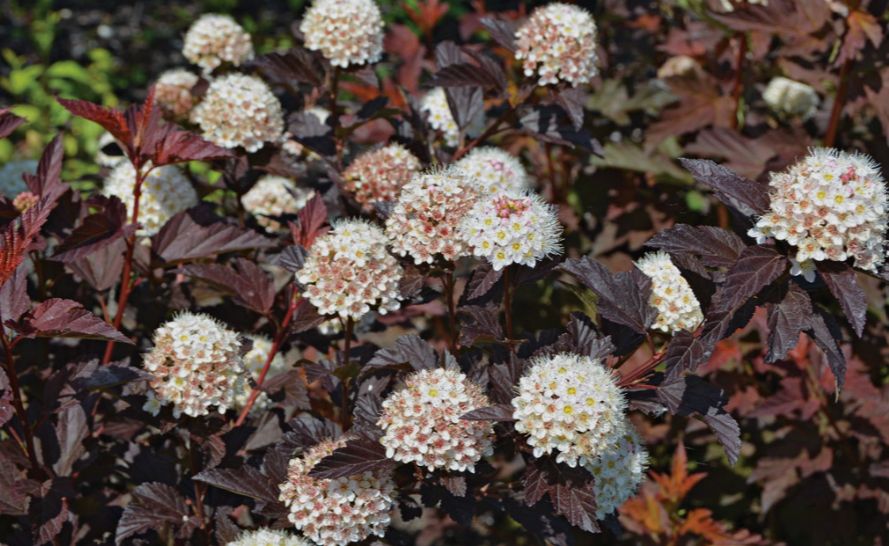
Common Ninebark: A Hardy Native Shrub Grown for Its Peeling Bark and Colorful Foliage
Common ninebark is one of the toughest flowering shrubs native to North America. It survives bitter prairie winters, wet stream banks, and dry, rocky slopes with little help from the gardener. For years it was dismissed as a plain woodland shrub. Then nurseries introduced purple-, gold-, and copper-leaved varieties, and ninebark became one of the most widely planted native shrubs in American gardens.
Much of its appeal is that it changes through the year. Clusters of white to pinkish flowers open in late spring, inflated reddish seed capsules follow in summer, and peeling, cinnamon-toned bark shows in winter. Few deciduous shrubs give a garden as much to look at once their leaves have dropped.
Botanical Classification
Ninebark is a flowering, deciduous shrub in the rose family and native to central and eastern North America. That places it in the same family as roses, spireas, serviceberries, and hawthorns. Its flowers show the family resemblance: small and 5-petaled, gathered in rounded clusters like a spirea’s. The plant is also known as Eastern ninebark, Atlantic ninebark, or simply ninebark, and is named for its peeling, multi-hued bark.
Several other ninebark species grow wild in North America. The mallow ninebark is a medium-sized shrub native to the western U.S. and Canada, reaching about 6 feet tall and 3 to 4 feet wide, with leaves more rounded than those of common ninebark. In eastern gardens and nurseries, though, common ninebark is by far the most widely grown, and it is the parent of nearly every named variety sold today.
Brief History
The name comes from the bark. The showy bark, made of reddish inner bark framed by paper-like strips of older bark, peels away in layers, sometimes as many as 9. Early settlers took the count literally, and the name stuck even though most stems show far fewer layers.
Indigenous peoples knew the shrub long before it had an English name. Native Americans used a decoction made from the inner bark as a pain reliever, emetic, and laxative. Because the bark contains compounds that can be harmful, it should not be used as a home remedy. For most of the 20th century ninebark was a minor shrub of conservation plantings and windbreaks. Its fortunes changed with the arrival of ‘Diablo’, a cultivar with deep purple leaves that turned it into a mainstream ornamental. Breeders have since released dozens of new forms.
Identifying Characteristics
Common ninebark is an upright, spreading shrub with arching branches. The University of Connecticut Plant Database describes it as a multistemmed deciduous shrub 6 to 10 feet tall with an equal width. The leaves are 3-lobed with toothed edges, a bit like a small maple or currant leaf, and usually medium green in the wild species. Young twigs are shiny and reddish-brown, while older, mature stems have brown exfoliating bark.
Flowering comes in late spring to early summer. The shrub produces clusters of white-pink flowers in May and June. The blooms are followed by small, puffy seed capsules that ripen from green to red or reddish-brown. They often look as attractive as the flowers and hang on into fall and winter. The peeling bark is easiest to see in the dormant season, although UConn notes that the twiggy growth tends to cover the ornamental bark.
Native Range and Habitat
Common ninebark is native from Quebec down through Tennessee and is hardy to zone 2, which makes it one of the most cold-tolerant flowering shrubs available. Its range runs west into the Great Plains and Upper Midwest and south along the Appalachians. It is less common on the southeastern coastal plain.
In the wild, it is often found along waterways, streambanks, and forest edges, as well as on rocky bluffs, lakeshores, and open woodland slopes. That mix of wet and dry habitats explains why the shrub adapts so easily to garden conditions that would trouble fussier plants.
Landscape Uses
Ninebark earns its place in the garden for structure, color, and toughness. It can be used in mass for shrub borders, hedges, screens, or erosion control on banks, and is also planted in native plant gardens. Its fibrous root system holds soil well on slopes, and its tolerance for periodic flooding makes it a good choice for rain gardens and stormwater basins. Clemson Cooperative Extension recommends it for rain gardens because it provides year-round color from foliage, flowers, and bark.
Colored-leaf varieties are popular as contrast plants in mixed borders. A purple-leaved ninebark sets off silver, chartreuse, or blue-green neighbors, and gold-leaved forms brighten partly shaded corners. Compact varieties under 5 feet fit foundation plantings and large containers. Taller selections work as informal hedges and privacy screens along property lines.
Wildlife Value
As a native shrub, common ninebark supports a wide range of insects and birds. Both short- and long-tongued bees visit the shrub for its abundant flower nectar, and mining bees are frequent pollinators of ninebark flowers. Butterflies, flies, and beetles also work the blooms in late spring.
After flowering, the seed capsules attract seed-eating birds. The dense, twiggy branches give nesting cover to songbirds, and the foliage feeds the caterpillars of several native moths. Gardeners hoping for the most wildlife value often choose the green-leaved straight species or lightly colored varieties. Research suggests insects may feed less on some deep purple selections.
Also Read: Different Types of Ninebark Shrubs
Popular Cultivars
‘Diablo’ is the variety that made ninebark famous. Its dark purple-red foliage holds its color through summer in full sun, and it grows into a large shrub of roughly 8 to 10 feet. For smaller gardens, Summer Wine is a compact 5- to 6-foot shrub with deeply cut wine-red foliage and good mildew resistance. Little Devil and Tiny Wine are even smaller, at about 3 to 4 feet, and are well suited to containers and low hedges.
Gold and orange varieties add warmth. ‘Dart’s Gold’ and ‘Nugget’ have bright yellow spring foliage that ages to lime green. ‘Coppertina’ opens copper-orange and matures to deep red. ‘Center Glow’ starts gold in the middle of the plant and shades to burgundy at the tips. New leaves on most colored cultivars are especially vivid. Clemson notes that new growth on cultivars is often brightly colored.
Growing Considerations
Ninebark is easy to grow across most of North America. The University of Minnesota lists it as hardy in zones 2 to 7. In the hot, humid Deep South it tends to struggle and gets more disease. It grows best in full sun to partial shade. Purple and gold varieties need at least 6 hours of direct sun to keep their richest color. In heavy shade they fade to a muddy green and flower less.
Ninebark is tolerant to a wide range of site conditions, from clay to sand and from acidic to slightly alkaline soils. Water new plants regularly during their first growing season. Established shrubs handle short dry spells, though they look their best with occasional deep watering. Fertilizer is rarely needed. Rich soil and extra nitrogen produce soft, floppy growth that is more prone to mildew.
Pruning keeps older plants vigorous and shows off the bark. Ninebark blooms on wood grown the previous year, so prune right after flowering in early summer. Remove about ⅓ of the oldest, thickest stems at ground level every 2 to 3 years to make room for new shoots. Overgrown shrubs can be cut back almost to the ground in late winter and will regrow quickly, though they may skip a season of flowers.
Pests and Diseases
Powdery mildew is the most common problem, especially on purple-leaved varieties in humid summers or crowded, shady sites. It shows up as a white, dusty coating on the leaves in mid to late summer. Mildew is mostly cosmetic. Choosing resistant varieties such as Summer Wine, giving plants plenty of sun and airflow, and avoiding overhead watering will keep it in check. Leaf spot and, occasionally, fire blight can also appear on stressed plants.
Insect pests are usually minor. Calligrapha leaf beetles, a group of small, mottled native beetles, sometimes chew holes in the foliage, and aphids may cluster on tender new shoots in spring. Healthy shrubs shrug off both without treatment. Deer generally leave ninebark alone, which makes it a reliable choice for rural and suburban landscapes where browsing is a problem.
Sources
Clemson Cooperative Extension, “Rain Garden Plants: Ninebark”
University of Connecticut Plant Database, “Common Ninebark, Eastern Ninebark”
University of Minnesota, “Ninebark”