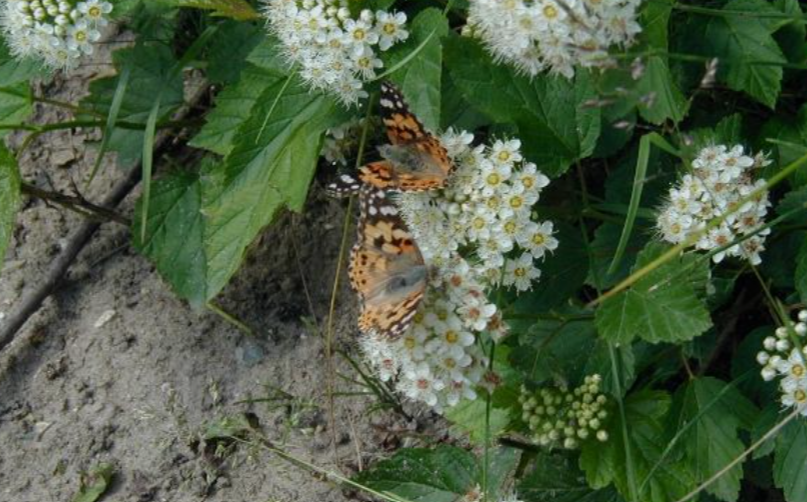
Mallow Ninebark: The Drought-Tough Ninebark of the Rocky Mountains
Mallow ninebark is the dry-country member of the ninebark family. It is a hardy native shrub of rocky canyons, sunny hillsides, and open pine and Douglas-fir forests across the interior West. Its relatives prefer damp ground: common ninebark grows on eastern stream banks and Pacific ninebark in coastal wetlands. Mallow ninebark grows where summers are hot and dry, winters are cold, and wildfire is a regular part of the landscape.
That toughness makes it one of the most practical native shrubs for gardeners from eastern Washington and Idaho to Utah, Montana, and Colorado. It has the cinnamon-colored peeling bark and white spring flowers typical of ninebarks. Unlike them, it thrives on little water once established, and after fire or disturbance it comes back from its roots. Land managers have long valued it for holding soil on steep, eroding slopes.
Botanical Classification
Mallow ninebark belongs to the rose family, the same large family as roses, spireas, serviceberries, chokecherries, and oceanspray. It is also called mallow-leaved ninebark. The name refers to its rounded, softly lobed leaves, which look a little like the leaves of mallow plants. Botanists formally described it in the late 1800s, and it has been grown in cultivation in the United States since 1897.
It is 1 of 5 ninebarks native to North America. It is most closely related to mountain ninebark, a smaller shrub of the southern Rockies. The 2 are easy to confuse where their ranges overlap. Both have only a few flowers per cluster and only 1 or 2 seed pods per flower, compared with the many-flowered clusters and 3 to 5 pods of common and Pacific ninebarks.
Brief History
Mallow ninebark has long been part of the shrub layer in the dry forests of the northern Rockies and Intermountain West. Indigenous peoples of the region knew it well, and its tough, flexible stems had a variety of everyday uses. Like other ninebarks, it gets its common name from its bark, which peels away in thin, papery layers. People once believed each stem carried 9 of them.
In the 20th century, foresters and range scientists began studying mallow ninebark because of its role in forest communities. It is one of the dominant shrubs beneath Douglas-fir and ponderosa pine in parts of Idaho, Montana, and eastern Washington, where it shares the understory with Douglas-fir in a widespread plant community. More recently it has found its way into water-wise and native plant gardens across the West. Its main draw there is its ability to look good with very little supplemental water.
Also Read: Different Types of Ninebark Shrubs
Identifying Characteristics
Mallow ninebark is a medium-sized, upright to vase-shaped deciduous shrub with arching branches. Most plants reach 3 to 6 feet tall and spread as wide or wider. The leaves are alternate, about 1 to 3 inches long, and rounded, with 3 to 5 shallow lobes and toothed edges. Compared with common ninebark, they look broader and softer, and they are often slightly fuzzy underneath. In fall, they can turn yellow, orange, or reddish before dropping.
The flowers open in late spring to early summer, generally in June. They are small, white, 5-petaled, and grouped in loose, rounded clusters at the branch tips, with fewer flowers per cluster than the eastern and coastal ninebarks. The seed pods are small, dry, and fuzzy, about ½ inch long, and turn brown to reddish as they ripen. They are less showy than the bright red pods of common ninebark. The bark on older stems is thin and yellow, orange, or red-brown. It shreds and peels in long strips, giving the shrub a shaggy look in winter.
Native Range and Habitat
Mallow ninebark is native to western North America. It grows from southeastern British Columbia through eastern Washington and eastern Oregon to Idaho and Montana, and south to Wyoming, Utah, Nevada, and Colorado. It is a characteristic plant of the northern Rocky Mountains and the mountain ranges of the Great Basin.
It grows on dry, rocky hillsides, in canyon bottoms, along forest edges, and in open woodlands of ponderosa pine, Douglas-fir, and quaking aspen. Common companions include oceanspray, snowberry, white spirea, serviceberry, creeping Oregon grape, and pinegrass. In some places it forms dense stands that cover large areas of hillside.
Fire and Disturbance
Mallow ninebark is notable for how well it rebounds after fire. The shrub spreads by underground stems called rhizomes, which survive even when the shrub above ground burns. Within a season or 2 after a wildfire, new shoots sprout from these roots, and mallow ninebark often becomes more abundant than it was before the burn.
This makes it an important plant for stabilizing soil after fires, logging, road building, and other disturbances. On steep, burned slopes, its quick regrowth helps hold soil in place before heavy rain or snowmelt can wash it away. Its spreading habit and tolerance for poor, rocky soil also make it useful for erosion control and reclamation on dry sites.
Landscape Uses
In gardens, mallow ninebark is an excellent choice for dry, sunny sites where common ninebark would struggle. It works well in native plant gardens, water-wise landscapes, informal hedges, wildlife borders, and naturalistic plantings on slopes. Its arching branches, rounded leaves, and peeling bark give it a soft, natural look that fits mountain, foothill, and high-desert landscapes.
Because it spreads slowly by rhizomes, it can fill in large areas over time and makes a good choice for stabilizing banks and hillsides. In smaller gardens, plant it where it has room to form a clump, or remove unwanted suckers each year to keep it in bounds. Its white spring flowers and cinnamon bark add interest in 2 seasons, and its fall color adds a third.
Wildlife Value
Mallow ninebark’s flowers attract a variety of native pollinators, including bees, butterflies, flies, and beetles. Because it blooms in early summer, after many spring shrubs have finished, it extends the nectar season in dry western landscapes. The foliage also feeds the caterpillars of several native moths and butterflies.
The dense, twiggy branches provide cover and nesting sites for songbirds and shelter for small mammals. Deer and elk browse it lightly, especially in spring, but it is not usually a preferred food. That light browsing pressure helps it hold its own on wildlife-heavy rural properties.
Growing Considerations
Mallow ninebark is hardy across most of the interior West and grows well in cold mountain climates. Sources list hardiness ranging from about USDA zones 4 to 8, with some rating it as cold-hardy as zone 2. It grows best in full sun to partial shade. In hot, low-elevation gardens, a little afternoon shade helps it look its best through summer.
It tolerates a wide range of soils, including rocky, sandy, and clay soils, as long as they are not constantly waterlogged. Water new plants regularly through their first growing season to help the roots establish. Once established, mallow ninebark is quite drought-tolerant and needs only occasional deep watering during long dry spells. Avoid rich soil and heavy fertilizer, which produce weak, floppy growth.
Prune right after flowering, since the shrub blooms on wood from the previous year. Every few years, remove some of the oldest stems at ground level to keep the shrub vigorous and open. Old, overgrown plants can be renewed by cutting them nearly to the ground in late winter. Like mallow ninebark after a wildfire, they resprout quickly.
Propagation
Mallow ninebark can be grown from seed, cuttings, or divisions of its rhizomes. The seeds are tiny, about 46,800 per ounce. Sow them outdoors in fall so they get the cold period they need to germinate. Seed stored cool and dry can stay viable for at least 5 years.
Softwood cuttings taken in late spring or early summer root fairly easily. Suckers that sprout from the rhizomes can also be dug up with a piece of root attached and replanted in early spring. Native plant nurseries in the western United States commonly offer mallow ninebark in containers for landscaping and restoration.
Pests and Diseases
Mallow ninebark is a tough, low-maintenance shrub with few serious problems. Powdery mildew can appear on the leaves in late summer, especially in shaded, crowded, or overwatered plantings. It is mostly cosmetic and rarely harms the shrub. Leaf spot may also show up in wet years.
Aphids sometimes cluster on tender new shoots in spring, and leaf beetles and caterpillars may chew the foliage. Healthy plants usually tolerate this minor damage without treatment, and the insects feed birds and beneficial predators. Good drainage, adequate sunlight, and avoiding heavy fertilizer are the best ways to keep mallow ninebark healthy.
Sources
USDA Forest Service, “Woody Plant Seed Manual: Ninebark”
Virginia Tech Dendrology, “Mallow Ninebark”
Utah State University Extension, “EcoRestore Native Plant Species Finder: Mallow Ninebark”
Extension Landscape Water Conservation, “Plants for a Water-Wise Pollinator Garden: Ninebark”