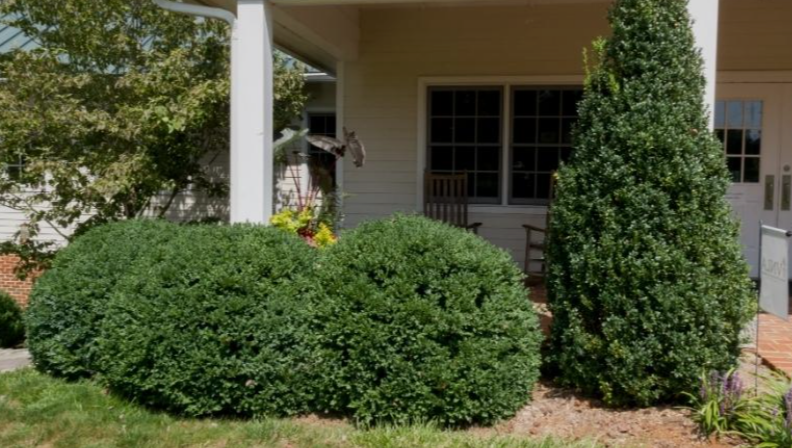
Common boxwood is the classic evergreen shrub of formal gardens. Its small, glossy leaves and dense branches can be clipped into neat hedges, low edging, globes, cones and elaborate topiary, and a well-kept plant can hold its shape for generations. In the United States it is often called American boxwood, even though it is not native to North America.
This slow-growing shrub has been planted in gardens for more than 2,000 years. It is long-lived, deer-resistant and green through winter, which helps explain why it remains one of the most popular hedge plants in the world. It also has some challenges, including a few serious pests and diseases that gardeners should know about before planting.
Botanical Classification
Common boxwood belongs to the box family, a small group of evergreen shrubs and trees that also includes pachysandra and sweet box. The boxwood genus contains roughly 70 to 100 species, found in Europe, Asia, Africa and the Caribbean. Of these, common boxwood is by far the most widely grown.
It is the parent of a huge number of garden varieties. About 400 named cultivars of common boxwood exist, more than all littleleaf and Korean boxwood cultivars combined. English boxwood, the slow, mounding plant that lines historic garden paths, is a dwarf form of common boxwood rather than a separate species.
Brief History
Common boxwood is native to southern and western Europe, North Africa and western Asia. It grows wild on chalky hillsides and in open woods, often in limestone soils. Places such as Box Hill in southern England were named for the large wild stands that once covered them.
The Romans clipped boxwood into hedges and shapes, making it one of the earliest topiary plants. During the Renaissance and Baroque periods, European gardeners planted it in intricate knot gardens and parterres, where low hedges formed swirling patterns. Colonists brought it to North America in the 1600s, and it soon became a fixture of gardens in Virginia, Maryland and the Carolinas.
Its dense, yellowish wood is among the hardest in Europe. It was once used for carved figures, chess pieces, rulers, tool handles, woodwind instruments and printing blocks for fine engravings.
Identifying Characteristics
Common boxwood has small, oval leaves about half an inch to an inch long. They are smooth-edged, leathery and dark glossy green on top with a paler underside. The leaves grow in pairs on opposite sides of the stem, packed closely together. Crushed leaves give off a sharp, musky scent that some people find unpleasant.
Left unpruned, common boxwood can grow into a large, rounded shrub or small tree reaching 15 to 20 feet tall. Most garden plants are kept much smaller with regular clipping. Its growth is slow, often only a few inches a year, and old plants can live for centuries.
In early spring, it produces tiny, pale yellow-green flowers tucked among the leaves. They have no petals but are fragrant and attract bees. The flowers are followed by small, three-horned seed capsules that split open in summer.
Landscape Uses
Common boxwood is one of the best plants for formal hedges. It tolerates close shearing and fills in densely, creating a solid green wall. Low forms are used to edge paths and flower beds, while taller forms make privacy screens and backdrops for perennials.
It is also the traditional choice for topiary. Gardeners clip it into spheres, cones, spirals and animals, and it works well in containers flanking doorways and gates. Because deer rarely browse it, it is useful in areas where many shrubs are eaten.
All parts of the plant are toxic if eaten, so it should be kept away from pets and livestock that might chew on it. Its foliage is also popular in holiday wreaths and garlands.
Growing Considerations
Common boxwood is generally hardy from about USDA zone 5 to zone 8, though some cultivars need the milder end of that range. It grows best in partial shade to full sun. In hot summers, afternoon shade helps prevent leaf scorch, and in cold areas, protection from winter wind and sun helps prevent winter burn.
Good drainage is essential. Boxwood roots rot quickly in heavy, waterlogged soil, so it does best in loose, well-drained ground with plenty of organic matter. It prefers slightly acidic to neutral soil, around pH 6.5 to 7.0.
Its roots are shallow, so a thin layer of mulch, about 1 to 2 inches, helps keep them cool and moist. Mulch should be kept away from the stems to prevent rot. Water deeply during dry spells, especially for young plants and before the ground freezes in fall.
Prune boxwood in late spring after the first flush of growth hardens, and avoid heavy pruning in late summer, which can trigger tender growth that is damaged by frost. Thinning out a few branches each year lets light and air into the center of the plant and lowers the risk of disease.
Pests and Diseases
Boxwood blight is the most serious threat to common boxwood in North America. This fungal disease, first found in the United States in 2011, causes dark leaf spots, black streaks on stems and rapid leaf drop. Common boxwood is among the most susceptible groups, and English boxwood is especially vulnerable. Buying plants from reputable nurseries, spacing them for good airflow and avoiding overhead watering all help.
The box tree moth is another growing concern. This invasive caterpillar from Asia spread rapidly across Europe after 2007 and reached Canada in 2018. Its larvae can strip boxwoods of their leaves in a single season.
Other common pests include the boxwood leafminer, a small fly whose larvae tunnel inside leaves, as well as boxwood psyllids and spider mites. Diseases such as Volutella blight and root rot can cause branches to yellow and die back. Winter bronzing, where leaves turn orange-brown in cold, sunny weather, is usually cosmetic and fades in spring.
Popular Cultivars
English boxwood is the best-known form, with soft, rounded leaves and a billowy shape. It grows extremely slowly and is ideal for low edging, though it is highly susceptible to boxwood blight. Vardar Valley is a low, spreading form with blue-green leaves and good cold hardiness, collected from the Balkans.
For narrow, upright accents, Graham Blandy forms a very slim column, while Dee Runk and Fastigiata grow into taller columns and pyramids. Elegantissima has small leaves edged in creamy white, making it a popular variegated choice for containers and shady corners.
Rotundifolia has larger, rounder leaves and a looser habit, and the tree-like form Arborescens can be grown as a small specimen tree. Gardeners in areas with boxwood blight may want to consider newer disease-resistant boxwoods, many of which are hybrids or other species rather than common boxwood.
Sources
Ohio State University, “Box Tree Moth: Range and Spread”
Virginia Tech, “Boxwood Blight Resistant and Susceptible Cultivars”
Cornell University, “Woody Plants Database: Boxwood”
New York State Department of Agriculture and Markets, “Pest Alert: Box Tree Moth”