Fruits that grow in the desert have found ways to survive extreme heat, intense sunlight, poor soil and very little rain. Deserts are usually defined as places that receive less than about 10 inches of rain a year, and together they cover roughly a third of Earth’s land surface. Yet these dry landscapes produce some of the world’s sweetest dates, juiciest melons and most unusual cactus fruits.
Desert fruit plants use clever survival strategies. Cacti store water in thick, swollen stems, date palms and mesquite trees send roots deep to reach underground water, and wild melons pack their fruit with water to carry their seeds through dry seasons. Many desert fruits ripen quickly after the rare rains, giving animals and people a burst of food and moisture.
People have relied on desert fruits for thousands of years. The Tohono O’odham people of Arizona harvest saguaro fruit each summer, the San people of the Kalahari depend on wild tsamma melons for water, and dates have fed travelers across North Africa and the Middle East since ancient times. Today, irrigated desert valleys in California, Arizona, Israel, Chile and the Middle East also grow huge quantities of grapes, melons, citrus and dates.
Some of these fruits grow wild in the desert, while others are cultivated in desert regions with careful watering. The 25 fruits below come from deserts in North America, Africa, the Middle East, Asia and Australia, along with where each one grows wild or is farmed today.
1. Prickly Pear
The prickly pear is the most widespread cactus fruit. It grows on flat, paddle-shaped cactus pads. Its fruit is egg-shaped and covered in tiny, hair-like spines. When ripe it turns red, purple, orange or yellow. Its flesh is juicy, sweet and full of small seeds. The fruit is called a tuna in Spanish.
The fruit is eaten fresh, juiced or made into jelly, syrup and candy. The tiny spines must be removed carefully before eating. Its young pads, called nopales, are also eaten as a vegetable. The plant survives long droughts by storing water in its pads. It is native to Mexico and the American Southwest and is now grown in North Africa, the Mediterranean, Ethiopia and South America.
2. Saguaro Fruit
Saguaro fruit grows on the giant saguaro cactus. The fruit forms at the tips of the cactus arms. It is green on the outside and splits open when ripe. Inside is bright red, sweet pulp filled with tiny black seeds. The fruit ripens in early summer. It is a vital food for birds, bats and other wildlife.
The Tohono O’odham people traditionally harvest the fruit with long poles in June. The harvest marks the start of their new year. The pulp is made into syrup, jam and wine. The seeds are ground into a nutritious paste. The saguaro can live more than 150 years. It is native only to the Sonoran Desert of Arizona and northwestern Mexico.
3. Organ Pipe Cactus Fruit
Organ pipe cactus fruit grows on a tall, many-stemmed cactus. The cactus has stems that rise like the pipes of an organ. Its fruit is round and covered in spines that fall off when ripe. Inside is sweet, red pulp with small black seeds. It ripens in summer. It is also called pitaya dulce, or sweet pitaya.
It is one of the most prized wild fruits of the Sonoran Desert. The Tohono O’odham and Seri peoples traditionally harvest it. The pulp is eaten fresh or dried. Bats pollinate its night-blooming flowers. The cactus grows slowly in warm, frost-free areas. It is native to southern Arizona and northwestern Mexico, including Organ Pipe Cactus National Monument.
4. Hedgehog Cactus Fruit
Hedgehog cactus fruit grows on a small, clumping cactus. The fruit is round and covered in spines. It turns bright red when ripe. Its flesh is sweet and tastes faintly of strawberries. It is also called strawberry cactus. It ripens in summer.
The spines brush off easily once the fruit is ripe. The fruit is eaten fresh or made into preserves. Its bright magenta flowers bloom in spring. It grows on rocky desert slopes. It is one of the tastiest wild cactus fruits. It is native to the deserts of the American Southwest and northern Mexico.
5. Barrel Cactus Fruit
Barrel cactus fruit grows on a round, barrel-shaped cactus. The fruit is yellow and shaped like a small pineapple. It sits in a ring on top of the cactus. It stays on the plant for months. Its flesh is tart and lemony. Its seeds are black and crunchy.
The fishhook barrel cactus produces the most commonly eaten fruit. The fruit has no spines and is easy to pick. It is eaten fresh, cooked or made into jam. Its seeds can be toasted and ground. The cactus can live for decades. It is native to the Sonoran and Chihuahuan Deserts of Arizona, New Mexico, Texas and northern Mexico.
6. Pomegranate
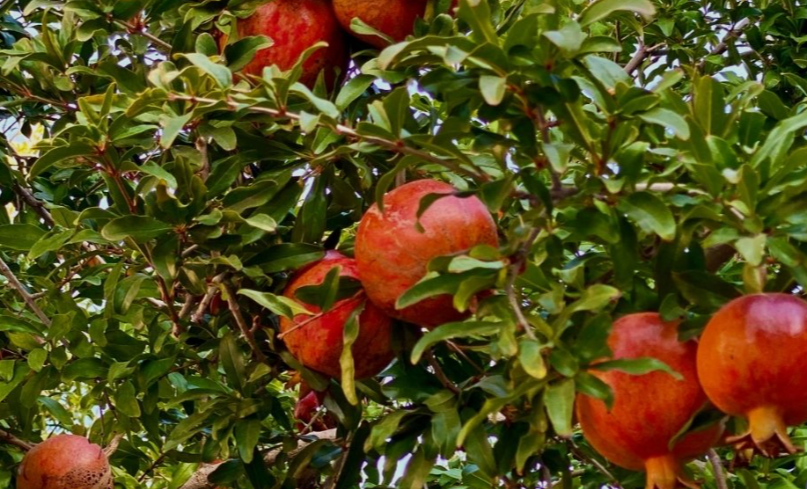
The pomegranate thrives in hot, dry climates. Its fruit is round with a leathery red skin. Inside are hundreds of juicy, ruby-red seeds. The seeds are sweet-tart and refreshing. The tree is small and shrubby. It has bright orange-red flowers in spring.
The University of Arizona has tested more than 30 pomegranate varieties near Yuma, Tucson and Cochise County and studied heirloom trees from old Spanish missions. It needs little water once established. Dry air helps prevent fruit diseases. Some old trees still grow near desert springs in southern Arizona. It is native from Iran to northern India and is grown in Arizona, California, Spain, Israel, Iran and India.
7. Mesquite
Mesquite produces long, sweet seed pods. The pods are tan to reddish and about 4 to 8 inches long. They dry on the tree in summer. They have a sweet, nutty flavor. The tree is thorny and grows in tough desert soils. Its roots can reach water far below the surface.
Native peoples ground the dried pods into a sweet flour. The flour is still used in baking today. The pods are also a major food for desert animals. The tree tolerates heat, drought and poor soil. Its wood is prized for barbecue smoke. It is native to the deserts of the American Southwest and Mexico.
8. Dragon Fruit
Dragon fruit grows on a climbing cactus. Its fruit is bright pink with green, leaf-like scales. Inside, the flesh is white, red or pink. It is speckled with tiny black seeds. It is mildly sweet and juicy. It is also called pitaya.
It is grown commercially in the deserts of southern Israel. The cactus needs much less water than most fruit crops. Its huge white flowers bloom for only one night. It needs some shade in the hottest deserts. It suits warm, frost-free climates. It is native to Central America and is grown in Vietnam, Israel, Mexico and the American Southwest.
9. Jujube
The jujube is a tough, drought-tolerant fruit tree. Its fruit is small and oval. It turns from green to reddish-brown as it ripens. Fresh fruit is crisp and sweet, like an apple. Dried fruit is chewy, like a date. It is also called Chinese date.
It handles both desert heat and cold winters. Its deep roots help it survive drought. It grows well in alkaline soils. It is popular in desert gardens in the American Southwest. Its branches carry small spines. It is native to northern China and is grown in China, Korea, the Middle East and the southwestern United States.
10. Goji Berry
The goji berry grows on a thorny shrub. Its berries are small, oval and bright orange-red. They are sweet and slightly tangy. They are usually sold dried. The shrub has arching branches and purple flowers. It tolerates drought and salty soil.
It has been used in Chinese food and medicine for centuries. It grows well in dry, sunny climates. Related wild wolfberries grow in North American deserts. It is easy to grow in desert gardens. It is often sold as a health food. It is native to northwestern China, especially the dry Ningxia region.
11. Tsamma Melon
The tsamma melon is a wild watermelon of the Kalahari. Its fruit is round and pale green with darker markings. Its flesh is pale and mostly water. It can be sweet or bitter. Its seeds are rich in oil and protein. It grows on trailing vines across the sand.
Stellenbosch University notes that travel through the Kalahari was once almost impossible except in a good tsamma year, because the fruit supplied food and water for oxen and travelers. The San people squeeze water from its pulp. Its seeds are roasted or pressed for oil. It is considered a wild relative of the common watermelon. Bitter fruit should not be eaten. It is native to the Kalahari region of Botswana, Namibia and South Africa.
12. Olive
The olive is one of the most drought-tolerant fruit trees. Its fruit is small and oval. It turns from green to purple-black when ripe. The fresh fruit is very bitter and must be cured before eating. Its fruit is also pressed for olive oil. The tree has silvery-gray leaves.
It can survive long, hot, dry summers. Some olive trees live for more than a thousand years. It grows well in rocky, poor soils. It is grown in irrigated desert areas of California, Arizona and the Middle East. It needs some winter chill to fruit well. It is native to the Mediterranean and is grown in Spain, Italy, Greece, Tunisia and California.
13. Fig
The fig is an ancient fruit that loves heat. Its fruit is soft and pear-shaped. It is green, purple or brown when ripe. Inside, the flesh is sweet, jammy and full of tiny seeds. The tree has large, lobed leaves. It often bears two crops a year.
The University of Arizona notes that the common fig was domesticated in the Near East about 11,400 years ago. Common figs develop fruit without the fig wasp needed by wild figs. It grows well in desert gardens with some summer water. It tolerates alkaline soils. It produces quickly from cuttings. It is native to the Middle East and Mediterranean and is grown in Arizona, California, Turkey and Egypt.
14. Carob
Carob produces long, sweet seed pods. The pods are dark brown and leathery. They are sweet and chocolate-like when dried. They are ground into a powder used as a cocoa substitute. The tree is evergreen and broad. It tolerates drought very well.
Its seeds are so uniform in weight that they were once used to weigh gems. The word carat comes from carob. The tree grows on dry, rocky hillsides. It needs little water once established. It is also used as a shade tree in dry climates. It is native to the Mediterranean and Middle East and is grown in Spain, Portugal, Morocco and California.
15. Colocynth
Colocynth is a wild desert gourd. Its fruit is round, about the size of an orange. It is green with stripes and turns yellow when ripe. Its flesh is very bitter and poisonous. Its seeds are rich in oil and protein. It grows on trailing vines across sand and gravel.
Its pulp is a powerful purgative and should never be eaten. Its seeds have been eaten after careful processing in parts of the Sahara. It has been used in traditional medicine for thousands of years. It survives extreme heat and drought. It is also called bitter apple. It is native to the Sahara, the Arabian Peninsula and western Asia.
16. Nara Melon
The nara melon is a spiny desert melon. Its fruit is round and covered in short spines. It is green, turning yellow-green when ripe. Its flesh is orange and juicy. Its seeds are rich in oil. The plant has no leaves, only thorny green stems.
Researchers at the University of Bonn note that the nara is used extensively as food and medicine by local people in the very arid Namib Desert. Its roots reach deep underground for water. It grows on sand dunes near dry riverbeds. The Topnaar people harvest the fruit and seeds. The seeds are eaten as a snack. It is native to the coastal Namib Desert of Namibia and nearby parts of Angola and South Africa.
17. Doum Palm Fruit
Doum palm fruit grows on a branching desert palm. The fruit is shiny, orange-brown and egg-shaped. Its flesh is dry and fibrous. It tastes like gingerbread. Its hard seed is used as vegetable ivory. The palm grows along desert riverbeds and oases.
It is also called the gingerbread palm. Its fruit has been found in ancient Egyptian tombs. The fruit is chewed or soaked to make a sweet drink. Its leaves are woven into mats and baskets. It is one of the few palms with branching trunks. It is native to Egypt, Sudan, the Sahel and East Africa.
18. Argan Fruit
Argan fruit grows on a thorny tree of southwestern Morocco. Its fruit is small, oval and green, turning yellow when ripe. It has a bitter, fleshy outer layer. Inside is a very hard nut. The nut holds oil-rich kernels. The tree tolerates heat and drought.
Its kernels are pressed to make argan oil, used in cooking and cosmetics. Goats climb argan trees to eat the fruit. The tree helps hold back desert sands. It is protected as a UNESCO biosphere reserve. Its oil is produced largely by women’s cooperatives. It is native to the semi-desert of southwestern Morocco.
19. Baobab Fruit
Baobab fruit grows on one of the world’s most famous trees. Its fruit is large and oval, with a hard, velvety shell. Inside is dry, powdery, cream-colored pulp. The pulp is tangy and rich in vitamin C. Its seeds are embedded in the pulp. The fruit hangs from long stalks.
The baobab stores water in its massive trunk. Some trees are more than a thousand years old. The pulp is mixed into drinks, porridges and sweets. Its leaves are also eaten as a vegetable. It grows in dry savannas and semi-desert regions. It is native to mainland Africa, especially the Sahel and East and southern Africa.
20. Quandong
The quandong is a native Australian desert fruit. Its fruit is round and bright red. Its flesh is tart and slightly sweet. It has a large, wrinkled stone. Its kernel is also edible. It is also called desert peach.
It is rich in vitamin C. It has been eaten by Aboriginal Australians for thousands of years. It is used in jams, pies and sauces. It is partly parasitic, drawing water from the roots of nearby plants. It tolerates heat, drought and salty soil. It is native to the arid and semi-arid interior of Australia.
21. Desert Lime
The desert lime is a tiny wild citrus. Its fruit is small, round and green to yellow. It is only about the size of a grape. Its flavor is sharp, tangy and aromatic. The plant is a spiny shrub or small tree. It tolerates drought, heat and frost.
It is one of the hardiest citrus plants in the world. It has been eaten by Aboriginal Australians for thousands of years. It is used in marmalades, sauces and drinks. It is now grown commercially as a bush food. Breeders use it to develop tough citrus varieties. It is native to the semi-arid regions of Queensland, New South Wales and South Australia.
22. Bush Tomato
The bush tomato is a small Australian desert fruit. Its fruit is round and about the size of a marble. It turns from green to yellow, then dries to brown on the bush. Dried fruit tastes like caramel and tomato. It is also called desert raisin. It grows on a small, spiny shrub.
Only fully ripe, dried fruit should be eaten, because green fruit is toxic. It has been a staple food for Aboriginal people of central Australia. It is ground into a spice used in bush food cooking. It sprouts quickly after fires and rain. It thrives in sandy desert soils. It is native to the deserts of central Australia.
23. Cantaloupe
Cantaloupe grows well in hot, dry desert valleys. Its fruit is round with a netted, tan skin. Its flesh is orange, juicy and very sweet. It grows on sprawling vines. It ripens in about three months. Hot, dry weather concentrates its sugars.
Desert growers produce melons in winter and spring when other regions cannot. Dry air helps reduce leaf diseases. It needs regular irrigation to grow well. It is a major crop in irrigated desert valleys. It is harvested by hand. It is grown in California’s Imperial Valley, Arizona’s Yuma area, Mexico and the Middle East.
24. Grapes
Grapes grow well in hot, dry desert valleys with irrigation. They grow in clusters on climbing vines. They come in green, red and purple. They can be eaten fresh, dried into raisins or made into wine. Desert heat ripens them early. Dry air reduces fungal diseases.
California’s Coachella Valley produces the earliest table grapes in the United States. Desert valleys in Chile’s Atacama region also grow grapes for export. Grapes are dried into raisins in many hot, dry regions. Vines need regular water in the desert. They also need winter pruning. They are grown in California, Arizona, Chile, Israel, Egypt and Iran.
25. Date
The date is the classic desert fruit. It grows in large clusters on tall date palms. Its fruit is oblong and turns yellow, red or brown when ripe. It is very sweet and chewy. Dried dates keep for months. A palm can produce well over 200 pounds of fruit a year.
The University of Arizona has documented how growers, government agencies and the university worked together to build a date industry suited to Arizona’s harsh desert climate. Date palms need intense heat and plenty of water at their roots. Ripe dates are about 60 to 80% sugar. Male and female flowers grow on separate trees, so growers pollinate by hand. They have fed desert travelers for thousands of years. They are native to North Africa and the Middle East and are grown in Saudi Arabia, Egypt, Iran, California and Arizona.
Sources:
- University of Arizona: Pomegranates, The Arizona Story
- Stellenbosch University Botanical Garden: Tsamma melon
- University of Arizona Campus Arboretum: Edible Landscapes
- University of Bonn (via IDW): Melon crop diversity in southern Africa
- University of Arizona: Date Palms in the Desert
- Environmental Information Service Namibia: Nara melon
- Environmental Information Service Namibia: Kalahari Melon Seed Oil
- Atlas Obscura: Tsamma Melon
- Rick’s Garden Spot (University of Arizona Extension agent): Jujube