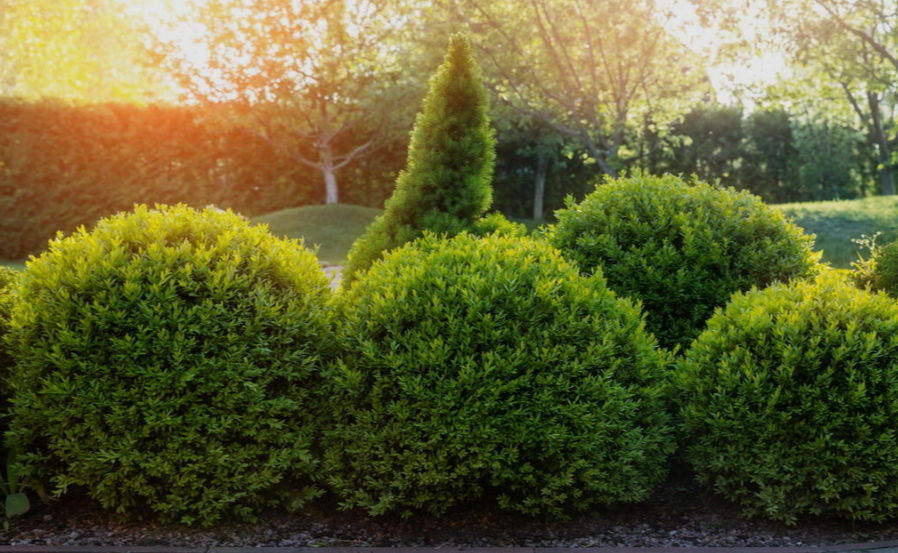
English boxwood is the slow-growing, cloud-shaped evergreen that lines the paths of historic gardens on both sides of the Atlantic. Its soft, rounded mounds of small green leaves give old estates and courtyards a sense of permanence that few plants can match. In the United States, it is closely tied to colonial gardens in Virginia and the Carolinas, where some plantings are well over 200 years old.
Despite its name, English boxwood is not a separate species. It is a dwarf form of common boxwood that has been grown in European gardens for centuries and was carried to North America by early colonists. It remains one of the most admired edging plants in the world, though it has become more challenging to grow in recent years.
Botanical Classification
English boxwood belongs to the box family, a small group of evergreen shrubs that also includes pachysandra and sweet box. It is a naturally dwarf selection of common boxwood, which grows wild in southern and western Europe, North Africa and western Asia. Gardeners have propagated it from cuttings for so long that its exact origin is unknown.
Common boxwood can grow into a 20-foot shrub or small tree, but English boxwood stays far smaller. Its compact size, tight branching and rounded growth come from its genetics, not from pruning. That natural shape is a large part of its appeal.
Brief History
English boxwood has been used for low hedges in Europe since at least the 1500s. Renaissance and Baroque gardeners planted it in knot gardens and parterres, where clipped lines of box formed geometric patterns filled with flowers, herbs or colored gravel. It became especially popular in Britain and the Netherlands, which is how it gained its common name.
Colonists brought English boxwood to North America in the 1600s. It soon became a symbol of wealth and refinement in the gardens of the Chesapeake region. Restored gardens at places such as Mount Vernon and Colonial Williamsburg still feature old English boxwood hedges, some planted in the 18th and 19th centuries.
Its slow growth made mature plants valuable. Large, old specimens were sometimes dug up and sold to new estates in the early 1900s, a practice that helped spread the plant across the eastern United States.
Identifying Characteristics
English boxwood has small, rounded to oval leaves about half an inch long. They are soft, medium to dark green and slightly cupped. The leaves grow densely along short stems, giving the plant a fine, almost velvety texture.
The plant grows into soft, billowy mounds that look like clouds. It grows extremely slowly, often only about an inch a year. After decades, plants typically reach 2 to 3 feet tall, and very old specimens can grow 4 to 5 feet tall and wider than they are tall.
Like other boxwoods, its leaves give off a strong, musky scent, especially in warm weather. Some people find the smell nostalgic, while others find it unpleasant. In spring it produces tiny, pale yellow-green flowers that are easy to miss but attract bees.
Landscape Uses
English boxwood is best known as an edging plant. It forms low, informal hedges along paths, driveways and garden beds. Its soft outline suits both formal designs and relaxed cottage gardens.
It is also used in parterres and knot gardens, where its fine texture and compact size help create neat patterns. Single plants make attractive accents near steps, entrances and foundation plantings. It also does well in large containers and urns.
Because it grows so slowly, English boxwood is often expensive at larger sizes. Many gardeners buy small plants and let them fill in over several years. Its foliage is also popular in holiday greenery.
Growing Considerations
English boxwood is generally hardy in USDA zones 6 to 8. It prefers mild winters and warm, but not scorching, summers. In hot regions, it benefits from afternoon shade, while in colder areas it needs protection from drying winter winds.
It needs excellent drainage. Heavy, waterlogged soil quickly leads to root rot, so it grows best in loose, well-drained soil rich in organic matter. It prefers slightly acidic to neutral soil, around pH 6.5 to 7.0. Raised beds or gentle slopes help in heavy clay.
Its roots are shallow and spread widely near the surface. A thin layer of mulch, about 1 inch deep, helps hold moisture and keep roots cool. Mulch should not touch the stems, and soil should not be piled against the base of the plant.
Water deeply during dry spells, especially in the first two years after planting. Avoid overhead watering when possible, since wet foliage encourages disease. Watering at the base in the morning is best.
Pruning and Care
English boxwood needs much less pruning than most hedge plants because of its natural shape and slow growth. Many experienced gardeners avoid heavy shearing altogether. Instead, they thin the plant by reaching inside and removing small branches here and there, a technique sometimes called plucking or cloud pruning.
Thinning lets light and air into the center of the plant and helps prevent disease. It also encourages new growth inside the mound instead of only on the surface. The best time to prune is late winter or early spring before new growth begins.
Dead leaves and debris tend to collect inside the dense branches. Gently shaking the plant or clearing out this debris each year helps reduce disease. Fallen leaves around the base should also be removed.
Pests and Diseases
English boxwood is one of the most disease-prone boxwoods. It is highly susceptible to boxwood blight, a fungal disease first found in the United States in 2011. Blight causes dark leaf spots, black streaks on stems and rapid leaf drop. It spreads in warm, humid weather and on infected plants, tools and clothing.
It is also prone to a problem known as English boxwood decline. This condition causes branches to turn yellow, then tan, and slowly die. It is linked to a combination of fungal diseases, root rot and stress from poor drainage, drought or crowding.
Other common pests include the boxwood leafminer, whose larvae tunnel inside leaves, the boxwood psyllid, which cups new leaves, and spider mites. The invasive box tree moth, which has spread across Europe and into parts of North America, can also strip plants of their leaves.
To keep English boxwood healthy, buy plants from reputable nurseries, space them for good airflow and avoid working among wet plants. Removing infected branches promptly and cleaning tools between plants also helps.
Alternatives to English Boxwood
Because of its disease problems, many gardeners now look for plants with a similar look but better resistance. Several newer boxwoods offer a dense, rounded shape with better tolerance to boxwood blight and leafminer. Some disease-resistant introductions released since 2020 were bred specifically to replace English boxwood in hedges and edging.
Compact Korean and Japanese boxwood cultivars are another option, especially in colder or hotter climates. In areas where boxwood blight is common, some gardeners switch to non-boxwood alternatives such as dwarf yaupon holly, inkberry or Japanese holly. These offer a similar small-leaved, evergreen look without the same disease risks.
For gardeners who love the history and charm of English boxwood, it can still thrive with careful siting, good drainage and attentive care. Many old plantings have lasted for centuries, and new ones can too in the right conditions.
Sources
Virginia Tech, “Boxwood Blight Resistant and Susceptible Cultivars”
North Carolina State University, “Susceptibility of Commercial Boxwood Cultivars to Boxwood Blight”