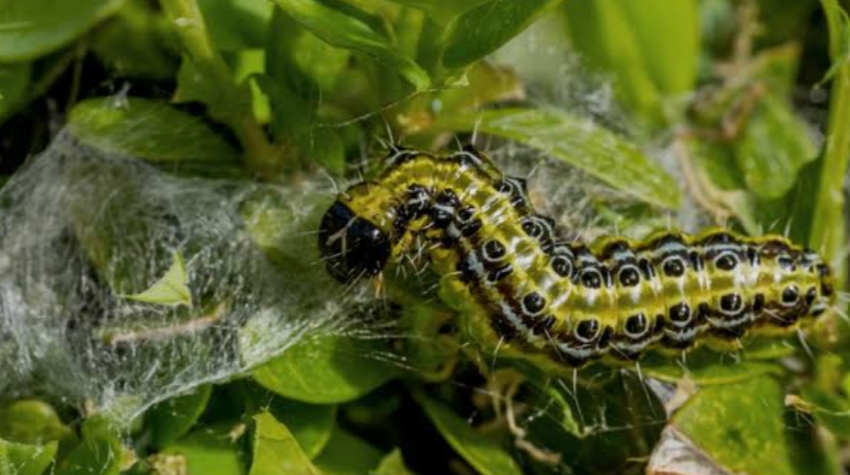
The box tree moth is an invasive insect from East Asia, and it has quickly become the most serious threat to boxwood in North America. Its caterpillars feed almost exclusively on boxwood. They can strip a healthy hedge of its leaves in a matter of weeks and kill heavily infested shrubs by chewing through the bark. Since its arrival in the United States in 2021, it has spread from the Great Lakes region into the Mid-Atlantic, prompting federal and state quarantines in a growing number of states.
For gardeners, landscapers, and nursery growers, learning to recognize the box tree moth early is now an essential part of caring for boxwood. This guide covers the pest’s history, how to identify every life stage, its life cycle, the damage it causes, where it is found, and how to manage and prevent it.
Classification and Name
The box tree moth is a member of the grass moth family, a large group of small to medium-sized moths that includes many crop and garden pests. It is native to subtropical and temperate regions of eastern Asia, including northern China, Korea, and Japan. In its native range, natural predators and parasites help keep its populations in check.
Its common name comes from its primary host. In Britain and Europe, boxwood is commonly called “box,” and the moth was named for its devastating effect on box trees and hedges there. In North America it is also sometimes called the boxwood moth. Regulatory agencies often refer to it by the abbreviation BTM.
Brief History
The box tree moth first appeared outside Asia in Europe in the mid-2000s. Cornell University reports that it was detected in Europe in 2006 and spread across the continent over the following 15 years, mainly through shipments of nursery stock. It is believed to have arrived on boxwood plants imported from Asia, and it is now established in about 30 European countries. It has severely damaged historic gardens and wild boxwood forests in the Caucasus.
The moth reached North America in 2018. A citizen scientist in Toronto spotted it that August, and the Canadian Food Inspection Agency confirmed it that November, marking the first confirmed detection on the continent. According to Cornell University’s Integrated Pest Management program, it first appeared in New York State in 2021, likely carried on a storm from the nearby infestation in Ontario. That same year, infested boxwood shipped from a Canadian nursery reached distributors in several states. The shipments triggered a nationwide tracing and destruction effort.
Identifying Characteristics
Adult box tree moths are fairly large for moths, with a wingspan of about 1½ to 1¾ inches. The most common form has shiny, translucent white wings with a wide brown border and a small white comma-shaped mark on each forewing. A less common form has wings that are almost entirely brown but still shows the white comma marks. Adults rest with their wings spread flat or slightly tented and often hide under leaves during the day.
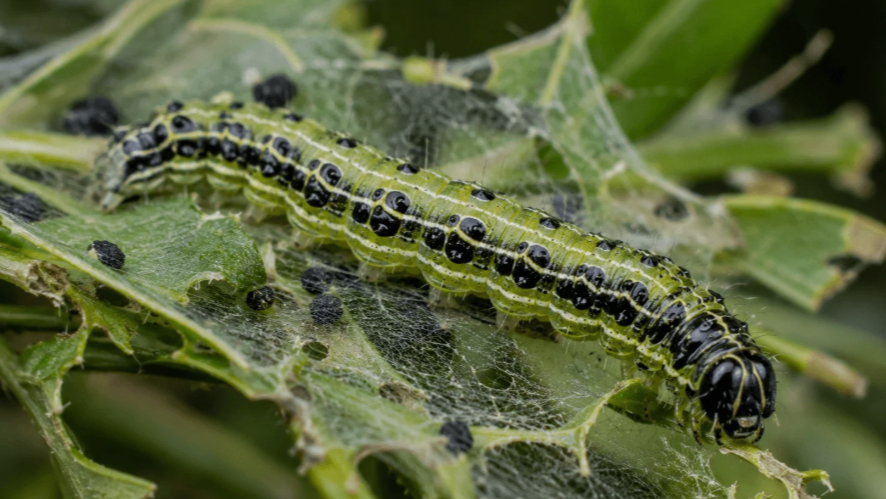
The caterpillars are the most destructive and easiest stage to recognize. Young caterpillars are small, pale yellow-green, with a black head. Mature caterpillars grow up to about 1½ inches long and are lime green with thick black and thin white or yellow stripes running along the body, along with black spots. Their heads are shiny black.
Eggs are laid in flat, overlapping clusters on the undersides of boxwood leaves, resembling tiny fish scales. Each cluster usually contains 5 to 20 pale yellow eggs. As they mature, the eggs develop a black dot, the developing caterpillar’s head, just before hatching. Pupae are green to brown and are wrapped in loose silk among the leaves. The adult moth resembles the native melonworm moth, but the melonworm moth lacks the white comma marks.
Also Read: Boxwood Diseases
Life Cycle
Box tree moths overwinter as young caterpillars inside small silk shelters spun between boxwood leaves. Cornell University notes that the overwintering caterpillars can survive temperatures as low as −22°F. That means harsh northern winters do little to stop the pest. In spring, typically from March to May depending on location, the caterpillars resume feeding, then pupate and emerge as adults.
The full life cycle, from egg to adult, takes about 45 days in summer conditions. Adults live about 2 weeks, mate, and lay eggs that hatch within a few days. Michigan State University Extension expects 2 to 3 generations per year in southern Michigan, and similar numbers are expected across much of the northern United States. In warmer climates, the moth may complete up to 5 generations per year. Generations often overlap, so caterpillars, eggs, pupae, and adults can all be present at the same time during summer.
Signs of Damage
Box tree moth damage often starts unnoticed inside the shrub, because young caterpillars feed on the interior leaves first. They chew the lower surface of the leaves, leaving a thin, papery, see-through layer. As the caterpillars grow, they eat entire leaves, often leaving only the midrib and edges. Heavily infested shrubs develop a brown, scorched appearance.
Other telltale signs include silk webbing that ties leaves and branches together, clumps of green-black droppings, and caterpillars hiding in the webbing. When the leaves are gone, the caterpillars may move onto the green bark and chew it away. That can girdle stems and kill the plant. Repeated defoliation over several seasons weakens even established hedges and can lead to their death.
Host Plants
Boxwood is by far the main host of the box tree moth in North America, and all common boxwood species and cultivars are believed to be susceptible. There is currently no boxwood variety known to resist it. Varieties bred for boxwood blight resistance offer no protection against this insect.
In its native range and in some reports elsewhere, the moth has occasionally fed on euonymus and some hollies, typically after nearby boxwoods have been stripped. The University of Delaware notes that these other plants may become secondary hosts after boxwoods are defoliated. In practice, North American gardeners should focus monitoring on boxwood while watching nearby euonymus and holly in heavily infested areas.
Where Box Tree Moth Is Found in the United States
Since its arrival in 2021, the box tree moth has steadily expanded its range in the eastern United States. It was first established in western New York near the Canadian border and later confirmed in southeastern Michigan in 2022 and southwestern Ohio in 2023. Since then, federal and state quarantines have been established or expanded in New York, Michigan, Ohio, Massachusetts, Pennsylvania, Delaware, West Virginia, Virginia, and Maryland, as detections continue.
The U.S. Department of Agriculture regulates the movement of boxwood from quarantined areas to slow the spread of the pest. Nurseries and businesses must operate under compliance agreements to ship boxwood out of affected areas. Because the moth’s range is changing quickly, gardeners should check their state department of agriculture or the USDA box tree moth webpage for the latest quarantine maps.
How to Monitor for Box Tree Moth
Regular inspection is the most important step in managing box tree moth. From spring through fall, check boxwoods at least every 1 to 2 weeks. Part the outer branches and look inside the shrub, where young caterpillars usually begin feeding. Look for papery or chewed leaves, webbing, green-black droppings, and caterpillars.
Pheromone traps, which use a scent that attracts male moths, are available to help detect adult moths in an area. They can show when moths are flying and help time treatments. However, they do not control infestations on their own. Adult moths are also attracted to lights at night, so gardeners may notice them on porches or walls near boxwood plantings.
How to Manage Box Tree Moth
Small infestations can often be managed by hand. Pick off and destroy caterpillars, eggs, and pupae, or prune out heavily infested branches. Seal them in plastic bags and dispose of them with household trash. Avoid composting infested boxwood material, since caterpillars and eggs can survive and spread.
For larger infestations, extension services recommend insecticides that target caterpillars. Products containing the biological insecticide Btk, a naturally occurring bacterium that affects only caterpillars, are effective against young larvae and are safe for most beneficial insects. Btk works only when caterpillars are actively feeding, so it must be applied when larvae are present. It may need to be repeated with each generation. Other insecticides labeled for caterpillars may be used for heavier infestations, following label directions and local extension guidance.
Also Read: How to Grow And Care For Boxwood Shrubs
Preventing the Spread
Box tree moth spreads mainly through the movement of infested boxwood plants, clippings, and holiday greenery. Gardeners can help slow its spread by buying boxwood only from reputable nurseries that follow state and federal regulations. Inspect new plants carefully before planting, and avoid moving boxwood clippings or plants out of quarantined areas.
If you suspect box tree moth in an area where it has not yet been confirmed, report it to your state department of agriculture or local extension office. Early reports help regulators track the pest and limit its spread. In areas where box tree moth is established, many gardeners are also replacing boxwood with alternative evergreen shrubs that are not affected by the pest.
Sources
Cornell University Integrated Pest Management, “Box Tree Moth”
University of Kentucky Entomology, “Box Tree Moth: Invasive Pest of Boxwoods”
University of Delaware Cooperative Extension, “Box Tree Moth”