Blackhaw Viburnum: The Native Small Tree with Edible Fruit and Dogwood-Like Charm
Blackhaw viburnum is one of the most versatile native trees in eastern North America. It can grow as a dense, multi-stemmed shrub or be trained into a handsome small tree, and it gives gardeners interest in nearly every season. In spring it bears flat, creamy-white flower clusters that look a lot like flowering dogwood from a distance. In late summer and fall it carries sweet, edible blue-black fruit that has been made into preserves since colonial times. Its leaves turn rich shades of burgundy, red, and purple in autumn, and its rugged, blocky bark adds texture through winter.
Despite all this, blackhaw remains surprisingly underused in home landscapes. It is tough enough to handle heat, drought, clay, and poor soil. It grows slowly into a manageable size, rarely needs care, and supports native birds, insects, and small mammals. This guide covers its history, how to identify it, how it compares with similar native viburnums, and how to grow and harvest it.
Botanical Classification
Blackhaw viburnum is a deciduous shrub or small tree in the viburnum genus, a group of roughly 150 to 175 species of shrubs and small trees found mostly in the Northern Hemisphere. Like other viburnums, it has been placed in several plant families over the years. Older references list the honeysuckle family, others the moschatel family, and current classifications give viburnums their own family. Its botanical name means “plum-leaved,” a reference to leaves that closely resemble those of wild cherries and plums.
It belongs to a group of North American viburnums often called the “black haws.” Their fruit ripens dark blue to black and is generally sweet and edible. The group includes rusty blackhaw, a closely related southern species, and nannyberry, a taller northern relative. These shrubs are among the few viburnums whose fruit people have long eaten fresh as well as cooked. The common name “haw” comes from the plant’s resemblance to hawthorns, whose fruit has the same name, though blackhaw has no thorns.
Brief History
Blackhaw has a long history of use by people across its native range. Oregon State University notes that its edible fruit has been used for preserves since colonial times. Native peoples and early settlers gathered the sweet fruit from woodland edges and old fields and ate it fresh, dried, or cooked into sauces. Children in rural areas often snacked on the soft, raisin-like berries after the first frosts of autumn.
The bark also has a notable place in American medical history. In the 19th and early 20th centuries, dried root and stem bark was widely sold as a remedy for cramps, and it was listed in official American drug references for several decades. That use paralleled the “crampbark” tradition of related viburnums in Europe and North America. Today, blackhaw is valued mainly as an ornamental and wildlife plant, and it is increasingly recommended as a native alternative to non-native flowering trees.
Native Range and Habitat
Blackhaw viburnum is native to a large part of the eastern and central United States. Oregon State University describes its range as stretching from Connecticut south to Florida and west to Michigan and Texas. It is especially common in the Piedmont and lower Midwest. In the wild it grows along woodland edges, in thickets, along fencerows and roadsides, on rocky hillsides, and in old fields reverting to forest.
Its natural habitat explains its toughness. In the wild it often grows in thin, dry, or rocky soil, competing with larger trees for light and moisture. That background makes it one of the most adaptable native small trees for difficult garden sites. It also grows on richer, moister soils along streams, which shows it can thrive across a wide range of conditions.
Identifying Characteristics
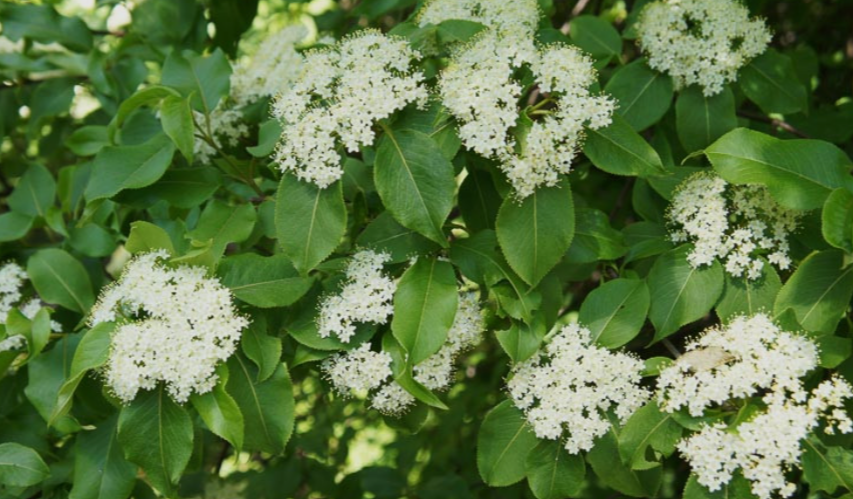
The flowers open in April and May, usually just as the leaves are unfolding. They form flat-topped clusters about 2 to 4 inches across. Each cluster holds many tiny flowers about ¼ inch wide. Prominent yellow stamens give the clusters a soft creamy-white tone rather than pure white. Blooming shrubs along woodland edges are often mistaken for flowering dogwood or wild pear at a distance. Up close, the flowers have a mild, pleasant fragrance.
The leaves are opposite, oval to elliptical, and typically 1½ to 3½ inches long, with finely toothed edges. They are dark green and often slightly glossy, on short leaf stalks that are frequently reddish. The leaves look much like cherry leaves, but cherries have alternate leaves rather than opposite ones. In autumn the foliage turns deep red, burgundy, or reddish-purple, and blackhaw has some of the most reliable fall color of any native viburnum.
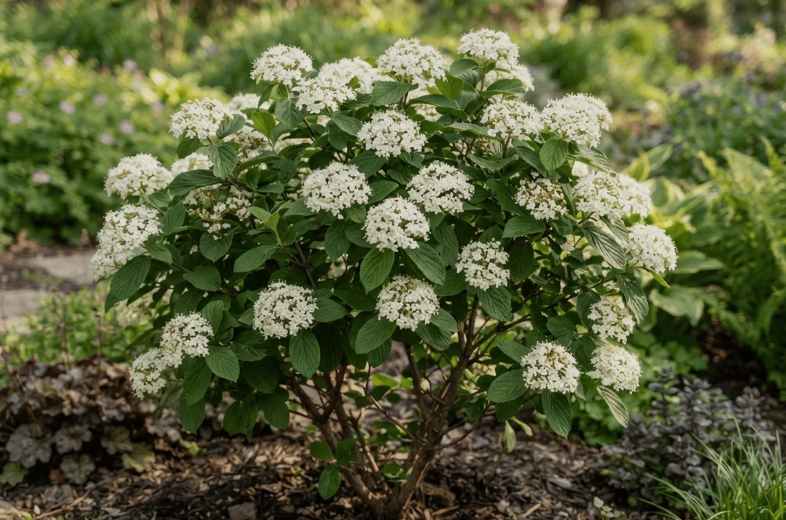
The fruit forms in drooping clusters and ripens in September and October. It begins green, turns rosy-pink, and finally ripens to a deep blue-black with a waxy, powdery bloom. Each oval fruit is up to about ½ inch long and holds a single flat seed. Mature plants usually reach 12 to 15 feet tall and 8 to 12 feet wide, with stiff, spreading branches. The dark bark breaks into small, blocky plates that resemble alligator hide or the bark of flowering dogwood.
Also Read: Types of Viburnum Shrubs
Blackhaw vs. Rusty Blackhaw and Nannyberry
Blackhaw is easily confused with 2 close relatives. Rusty blackhaw, which grows mainly in the Southeast, has very glossy, almost leathery leaves. Its winter buds, young twigs, and leaf stalks are covered in dense, rust-colored hairs, which give the species its name. Blackhaw’s buds are smooth or only lightly hairy, and its leaves are usually less glossy. Rusty blackhaw also tends to grow larger, sometimes reaching 25 feet.
Nannyberry is the main look-alike in the North. It usually grows taller, up to 20 feet or more. Its leaves have long, slender, pointed tips, and its leaf stalks are often edged with narrow, wavy wings. Blackhaw’s leaves are more rounded at the tip, and its leaf stalks lack the wings. All 3 species bear similar sweet, dark fruit and offer similar wildlife value, so the choice among them often comes down to which is native to your region.
Popular Cultivars
Most blackhaw sold in nurseries is grown from seed, but a few named cultivars offer more predictable features. ‘Mrs. Henry Large’ has glossy summer leaves and red, deep purple, to scarlet fall color. The Purdue University Arboretum notes that it bears rose-pink fruit that ripens to blue-black and grows 12 to 15 feet tall and 8 to 12 feet wide. ‘Early Red’ is known for early, intense red fall color.
Forest Rouge, sold under the cultivar name ‘Ovazam’, has glossy leaves and strong burgundy-red autumn color, and it grows into a dense, upright shape. ‘Summer Magic’ is another compact selection valued for its healthy summer foliage and reliable fall display. Since blackhaw sets the heaviest fruit when 2 genetically different plants grow near each other, pairing a cultivar with a seedling-grown plant or a second cultivar improves fruiting.
Edible Uses
Blackhaw fruit is one of the better-tasting wild fruits of the eastern United States. The Purdue University Arboretum notes that the fruit is sweet and can be eaten fresh or used in jams and preserves. Fully ripe fruit is soft and dark blue-black, with a flavor many people compare to raisins, prunes, or dates. Flavor is best after the first light frosts of autumn, which soften the fruit and concentrate its sugars.
Each fruit contains a large, flat seed, so the flesh layer is thin. Many foragers eat the fruit fresh and spit out the seed, or cook the fruit down and press it through a strainer to separate the pulp. The University of Tennessee notes that the fruit makes good jelly. The pulp can also be used in sauces, fruit leathers, and baked goods. Anyone foraging wild plants should confirm the identification first and eat only fully ripe, dark fruit.
Landscape Uses
Blackhaw is one of the best native small trees for home landscapes. Trained to a single trunk or a few trunks, it makes an excellent specimen tree for small yards, patios, and courtyards, with a shape and bloom much like flowering dogwood. Oregon State University notes that it can also be sheared into a hedge and is sometimes recommended as a substitute for hawthorn. Its stiff, dense branching makes a strong screen or living fence.
The tree suits native plant gardens, pollinator gardens, edible landscapes, woodland edges, and naturalized areas. NC State Extension describes it as a high-value wildlife plant with 3 seasons of interest. Because it tolerates dry soil, it is a good choice for difficult sites such as slopes, hot parking-lot islands, and areas beneath taller trees where many other flowering shrubs struggle.
Wildlife Value
Blackhaw supports a wide range of wildlife. Its spring flowers attract bees, butterflies, and many native flies and beetles that feed on the nectar and pollen. Like other native viburnums, its leaves are food for the caterpillars of several moths and butterflies, including species whose larvae feed only on viburnums. Those caterpillars in turn feed nesting songbirds during spring and early summer.
The fruit is eaten by many birds, including robins, cedar waxwings, bluebirds, and catbirds, along with squirrels, chipmunks, foxes, and other mammals. The fruit often hangs on the branches into early winter, providing food during migration and cold weather. The dense branching gives cover and nesting sites for small birds. Blackhaw is generally resistant to deer browsing, which makes it a reliable choice where deer pressure is high.
Growing Considerations
Blackhaw viburnum is hardy from Zone 3 through Zone 9, one of the broadest ranges of any native viburnum. It grows best in full sun to partial shade. Plants in full sun flower and fruit most heavily and develop the best fall color, while plants in heavier shade grow more open and set fewer fruit. It tolerates clay, loam, sand, rocky soil, and a wide range of pH, and once established it handles heat and drought well.
Blackhaw grows slowly to moderately, typically adding 1 foot or less per year. That makes it a good long-term small tree that rarely outgrows its space. Plant it in spring or fall, and water it regularly through its first growing season. Mulch spread 2 to 3 inches deep over the root zone keeps the soil cool and conserves moisture. Once established, it needs little or no supplemental watering except during extended droughts.
To grow blackhaw as a small tree, choose 1 to 3 strong main stems while the plant is young and remove the others at ground level. Remove suckers from the base each year to keep the tree form. As a shrub or hedge, it can be left multi-stemmed and lightly shaped. Prune right after flowering to keep the next year’s flower buds, and remove dead, damaged, or crossing branches as needed.
Pests and Problems
Blackhaw is one of the most trouble-free native viburnums and has few serious pests or diseases. Powdery mildew sometimes coats the leaves in late summer, especially in shaded, crowded sites, but it rarely harms the plant. Leaf spots appear occasionally in wet seasons. Good air circulation and full sun reduce both problems.
The snowball aphid sometimes curls new spring leaves, and scale insects occasionally build up on twigs of stressed plants. In regions where the viburnum leaf beetle is established, blackhaw can be fed on, though it is generally less heavily damaged than arrowwood and the cranberrybush viburnums. Check twigs in winter for rows of small capped egg sites and prune out infested wood before spring. Grown in a sunny site with reasonable drainage, blackhaw can remain healthy and productive for decades.
Sources
Oregon State University Landscape Plants, “Blackhaw Viburnum”
Purdue University Arboretum, “Mrs. Henry Large Blackhaw Viburnum”
University of Tennessee, Tennessee Yards and Neighborhoods, “Blackhaw Viburnum”