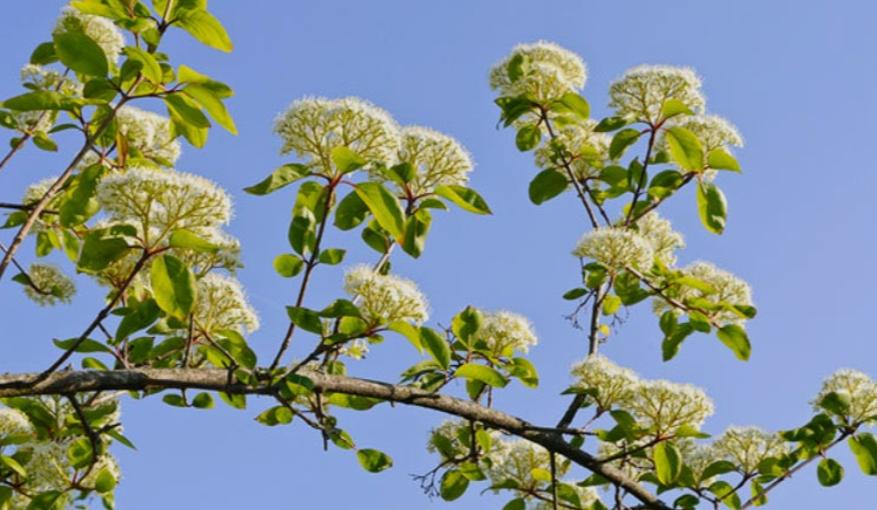
Nannyberry Viburnum: The Cold-Hardy Native “Wild Raisin” of the Northern Woods
Nannyberry viburnum is the toughest and most northern-reaching of the native viburnums that bear sweet, edible fruit. It grows wild from the forests of New England and eastern Canada across the Great Lakes to the edge of the northern Great Plains. It survives winters that would kill many ornamental shrubs. Its creamy-white spring flowers, glossy green leaves, burgundy fall color, and drooping clusters of blue-black fruit make it attractive in every season. The fruit is sweet and raisin-like when fully ripe and often hangs on the branches deep into winter, feeding birds when little else is available.
Nannyberry is a working plant as much as an ornamental. It is planted in farm windbreaks, along roadsides where de-icing salt kills other shrubs, in shelterbelts across the northern prairies, and as a fast-growing native screen in home landscapes. This guide covers its history and names, how to identify it in any season, how it differs from similar viburnums, and how to grow and harvest it.
Botanical Classification
Nannyberry viburnum is a large deciduous shrub or small tree in the viburnum genus, a group of roughly 150 to 175 species of shrubs and small trees across the Northern Hemisphere. Like other viburnums, it has been placed in several plant families over the years. Older references list the honeysuckle family, others the moschatel family, and current systems give viburnums their own family. Oregon State University explains that its botanical name means “flexible” and was chosen by Linnaeus because the twigs are tough and bend easily without breaking.
Nannyberry belongs to the same group of North American viburnums as blackhaw and rusty blackhaw, all of which produce sweet, dark fruit that people can eat. These species are closely related enough to cross where their ranges overlap. Botanists have documented hybrids between nannyberry and blackhaw in parts of the Midwest. Nannyberry is the northernmost member of the group and by far the most cold-hardy.
Brief History and Common Names
Nannyberry has collected an unusual number of folk names, many of them tied to its fruit. It is widely known as sheepberry and wild raisin, and sometimes as sweet viburnum or black haw. “Wild raisin” describes the fruit well: when fully ripe and slightly shriveled, it looks and tastes much like a raisin. The origins of “nannyberry” and “sheepberry” are less certain. A common explanation links them to the musky, goat-like odor some people notice in the crushed leaves and ripening fruit.
Native peoples across the northern woodlands gathered the fruit fresh from the branches or dried it for winter use. Early settlers adopted it as well. They ate it fresh, cooked it into sauces and jams, and sometimes fed the fruit-laden branches to livestock. The tough, flexible stems were occasionally used for small tools and woven items. Today, nannyberry is valued mainly for conservation and wildlife plantings, though foragers still seek out its fruit each fall.
Native Range and Habitat
Nannyberry grows naturally across a wide area of northern North America. Its range runs from Quebec and New Brunswick west through Ontario and the Great Lakes states to Manitoba and Saskatchewan. It reaches south through New England and the Appalachian highlands to Virginia, and west to Missouri, Nebraska, and the Dakotas. Iowa State University notes that it grows in upland woods and in many areas throughout Iowa, and rates it hardy from Zone 2 through Zone 9.
In the wild, nannyberry grows along forest edges, in thickets, along streams and riverbanks, on rocky hillsides, in old fields, and along fencerows. It is equally at home in moist bottomlands and on drier slopes. That adaptability helps explain its wide natural range. It often forms small colonies by suckering from the roots, creating dense thickets that shelter birds and small mammals.
Also Read: Different Types of Viburnum Shrubs
Identifying Characteristics
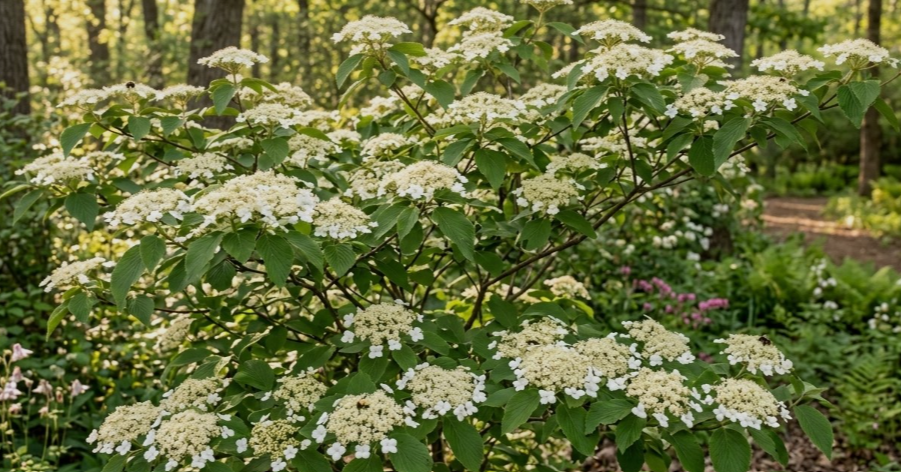
The leaves are the best clue in summer. They are opposite, oval, and 2 to 4 inches long, with finely toothed edges and a glossy, dark green upper surface. The tip of each leaf narrows into a long, slender point, which is noticeably sharper than the more rounded tip of blackhaw. The leaf stalks are often edged with narrow, wavy wings, one of the most reliable features for telling nannyberry apart from its relatives. In autumn the leaves turn purplish-red to burgundy, though the color can vary from plant to plant.
The flowers open in May, usually after the leaves have unfolded. They form flat to slightly rounded clusters about 3 to 4½ inches across, made of many tiny creamy-white flowers with prominent stamens. The clusters are larger than those of blackhaw and give the shrub a frothy look when in full bloom. Some people find the flowers’ musky scent slightly unpleasant up close.
The fruit forms in drooping clusters on reddish stalks and ripens in September and October. It is oval, about ½ inch long, and ripens from green through yellowish-pink to deep blue-black with a waxy bloom. In winter, nannyberry is easy to recognize by its distinctive buds. The leaf buds are long and slender, while the flower buds are swollen at the base and taper to a long point, giving them a shape often compared to a bird’s head or a small flask. Mature plants usually reach 15 to 20 feet tall, and the Utah State University arboretum notes they can reach 30 feet when grown as a tree.
Nannyberry vs. Blackhaw Viburnum
Nannyberry and blackhaw are often confused, since both bear creamy-white spring flowers and sweet blue-black fruit. Size is one clue. Nannyberry usually grows larger and more open, often 15 to 20 feet or more, while blackhaw typically stays 12 to 15 feet with stiffer branching. Nannyberry also suckers much more freely and forms thickets, while blackhaw tends to stay in a single clump.
Leaves and buds give the clearest distinctions. Nannyberry leaves have long, tapering tips and winged leaf stalks, while blackhaw leaves have shorter, more rounded tips and wingless stalks. Nannyberry’s winter flower buds are long and beaked, while blackhaw’s are shorter and plumper. Range matters too. Nannyberry is the better choice in the far North and the northern Plains, while blackhaw is better suited to the South and lower Midwest.
Edible Uses
Nannyberry fruit is sweet and edible once fully ripe. It is softest and sweetest after the first frosts of autumn, when the skin begins to wrinkle and the flesh takes on a raisin-like texture and flavor. Many foragers describe it as tasting like a blend of dates, prunes, and raisins, with a slightly musky aftertaste. The fruit can be eaten fresh straight from the branch, though each one contains a large, flat seed that makes up much of its volume.
To use the fruit in larger quantities, simmer it with a little water. Then press the pulp through a strainer or food mill to remove the seeds and skins. The resulting thick, sweet pulp can be used in jams, fruit butters, sauces, fruit leathers, and baked goods. Because the fruit often stays on the branches into early winter, it can be harvested long after most wild fruits are gone. Identify the plant with confidence before eating, and eat only fully ripe, dark fruit.
Landscape Uses
Nannyberry is one of the most useful native shrubs for screening and windbreaks in cold climates. North Dakota State University notes that it makes an excellent hedge and background for naturalized plantings. Its dense branching and fast growth make it ideal for privacy screens, shelterbelts, wildlife hedgerows, and buffer plantings along property lines. It can also be trained to a single trunk and grown as a small native tree in larger yards.
Its tolerance of tough conditions sets it apart. Utah State University notes that it tolerates full sun, different soil types, drought, and some road salt. That makes it a good choice for roadsides, driveways, and parking areas where de-icing salt damages many other shrubs. It also handles partial shade well, so it is useful along woodland edges and in the understory of taller trees. Because it suckers freely, it works best where it has room to spread or where suckers can be mowed or removed regularly.
Wildlife Value
Nannyberry is an excellent wildlife plant. Its spring flowers feed native bees, butterflies, and many flies and beetles. Its leaves host the caterpillars of numerous native moths and butterflies, which in turn feed nesting songbirds. The dense thickets it forms give cover and nesting sites for birds such as cardinals, catbirds, and brown thrashers.
The fruit is eaten by many birds, including robins, cedar waxwings, bluebirds, grosbeaks, and ruffed grouse. Squirrels, chipmunks, foxes, and other mammals eat it too. Because the fruit often stays on the shrub into winter, it is a valuable late-season and winter food source in northern regions, when other foods are scarce. Deer browse the twigs in some areas, though nannyberry generally recovers well from browsing.
Growing Considerations
Nannyberry viburnum is hardy from Zone 2 through Zone 8, and Iowa State University extends its rating to Zone 9. It grows best in full sun to partial shade. Plants in full sun produce the heaviest flowers and fruit and the densest growth, while plants in shade grow more open and fruit less. It adapts to clay, loam, sand, and rocky soils across a wide pH range, and it tolerates both moist bottomland soils and drier upland sites once established.
Nannyberry grows at a moderate to fast rate, so it fills in quickly as a screen or hedge. Plant it in spring or fall, and water it regularly through the first growing season while the roots establish. Spread 2 to 3 inches of mulch over the root zone to conserve moisture and reduce competition from grass and weeds. Once established, it rarely needs watering except during prolonged droughts.
Prune nannyberry right after flowering, because next year’s flower buds form during the summer. To grow it as a small tree, choose 1 to 3 strong main stems while the plant is young and remove the others, along with any root suckers, every year. To grow it as a hedge or screen, let it stay multi-stemmed and remove the oldest, weakest stems at the base every few years to keep it dense and vigorous.
Pests and Problems
Powdery mildew is the most common problem on nannyberry, especially on plants growing in shade or crowded sites with poor air circulation. It shows up as a white, powdery coating on the leaves in late summer. It is mostly cosmetic, but it can dull the fall color. Planting in full sun with good spacing reduces mildew significantly.
The viburnum leaf beetle can feed on nannyberry in regions where the beetle is established, though nannyberry is generally less severely damaged than European and American cranberrybush viburnums. Check twigs in winter for rows of small, capped egg sites, and prune out infested twigs before the eggs hatch in spring. Aphids, scale insects, and leaf spots occasionally appear but rarely cause serious harm. Healthy, well-sited nannyberry plants can live and fruit for many decades.
Sources
Oregon State University Landscape Plants, “Nannyberry”
Iowa State University Extension and Outreach, “Nannyberry Viburnum”
Utah State University Extension, Varga Arboretum, “Nannyberry Viburnum”
North Dakota State University Extension, “Nannyberry Viburnum”