Boxwood Leafminer: How to Identify, Prevent, and Control the Most Common Boxwood Pest
The boxwood leafminer is the most common insect pest of boxwood in North America. It is a tiny fly whose larvae live and feed inside boxwood leaves, hidden from view for most of the year. Infested leaves develop blister-like swellings, turn yellow or orange-brown, and often drop early. Over time, a heavy infestation leaves a once-dense hedge thin, discolored, and weak. Because the damage builds slowly, many gardeners don’t notice the pest until a significant part of the shrub is affected.
The good news is that boxwood leafminer is well understood. Its life cycle is predictable, its damage is easy to recognize once you know what to look for, and many boxwood varieties resist it. This guide covers how to identify the pest, understand its life cycle, recognize the damage, and choose resistant varieties. It also explains how to manage infestations effectively.
Also Read: Boxwood Blight
What Is the Boxwood Leafminer?
The boxwood leafminer belongs to the gall midge family, a large group of tiny, delicate flies, many of which feed inside plant tissue. It is native to Europe, where it is widespread but rarely causes serious damage. The University of Florida’s Featured Creatures program notes that the pest is suspected to have arrived in North America in potted boxwood shrubs. In the absence of the natural controls found in Europe, it became a major pest throughout the boxwood-growing regions of the United States.
Unlike many leaf-feeding insects, the boxwood leafminer spends nearly its entire life inside the leaf. The larvae feed between the upper and lower leaf surfaces, where they are protected from weather, predators, and most sprays. That hidden lifestyle is what makes the pest both damaging and challenging to control.
Identifying the Boxwood Leafminer
Adult boxwood leafminers are tiny, delicate, gnat-like flies only about 2 to 3 millimeters long, roughly 1/10 inch. Their bodies are orange-yellow to reddish, and they have long legs and clear wings. Adults are short-lived and are most often seen in late spring. They appear as small swarms of orange flies hovering around boxwoods, especially in the early morning.
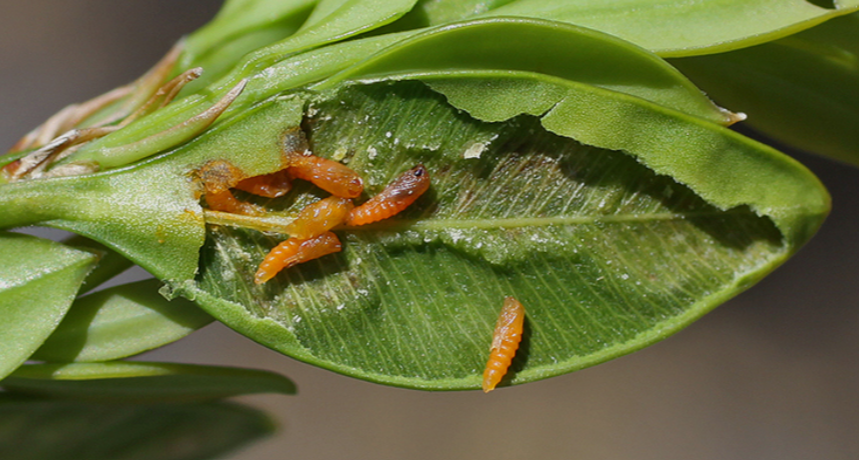
The larvae are small, legless maggots about 3 millimeters long that live inside the leaf. In summer they are yellowish-white to green. By spring they turn bright yellow to orange. Gardeners can find them by gently peeling apart a blistered leaf. Pupae, which form in spring, are orange and often push partway through the underside of the leaf just before the adult emerges. After emergence, the empty white pupal case may remain stuck to the leaf.
Life Cycle
The boxwood leafminer completes 1 generation per year. Partially grown larvae spend the winter inside the leaves. As temperatures warm in spring, the larvae resume feeding and grow quickly, turning bright yellow to orange. By late April they transform into orange pupae inside the leaf mines.
Adults typically emerge from mid-May to early June, depending on location and weather. The University of Massachusetts notes that emergence often coincides with the bloom of old-fashioned weigela, a handy natural signal for gardeners. Emergence lasts only about 2 weeks. The adults mate quickly, and females insert their eggs into the tender new leaves produced during the spring flush of growth. Adults die shortly after mating and laying eggs.
The eggs hatch within a few weeks. The new larvae begin feeding inside the leaves and continue feeding slowly through summer and fall. By winter they are partially grown and dormant, and the cycle repeats the following spring. Growing degree-day models developed by Cornell Cooperative Extension place adult emergence at about 350 to 600 growing degree days, base 50°F, counted from March 1. Commercial growers and landscapers use those models to time treatments precisely.
Signs of Damage
The first visible sign of boxwood leafminer is small, blister-like swellings on the undersides of leaves. When held up to light, infested leaves show yellowish or translucent blotches where the larvae have hollowed out the inside. As feeding continues, the leaves may become puckered, swollen, and discolored, turning yellow, orange, or brown.
In late spring, before adults emerge, the undersides of infested leaves may be covered with small orange bumps where the pupae are pushing through. After emergence, tiny holes and white pupal cases remain. Heavily infested leaves often drop early, leaving branches thin and bare. Repeated heavy infestations over several years weaken boxwoods. Weakened shrubs are more vulnerable to winter injury, disease, and other pests.
Host Plants and Resistant Varieties
Boxwood leafminer feeds only on boxwood, but varieties differ greatly in how susceptible they are. University of Massachusetts Extension reports that the pest attacks most cultivars of American and Japanese boxwood. English boxwood, the slow-growing dwarf form used for edging, is rarely attacked. Several common boxwood cultivars are considered highly resistant, including ‘Vardar Valley’ and ‘Handsworthiensis’.
Other boxwoods described as resistant or less susceptible include ‘Memorial’, ‘Pendula’, and ‘Pyramidalis’. Newer varieties such as NewGen Independence and NewGen Freedom were bred specifically for better leafminer resistance as well as tolerance of boxwood blight. In contrast, some popular cold-hardy varieties, such as Chicagoland Green, are very susceptible. Research at the University of Maryland found that adults laid eggs on resistant and susceptible cultivars at similar rates. The larvae, however, survived far less often in resistant varieties.
Choosing resistant varieties is the most reliable long-term way to prevent boxwood leafminer problems. When planting new hedges or replacing damaged shrubs, ask your nursery about leafminer resistance. Choose varieties suited to your climate.
How to Monitor for Boxwood Leafminer
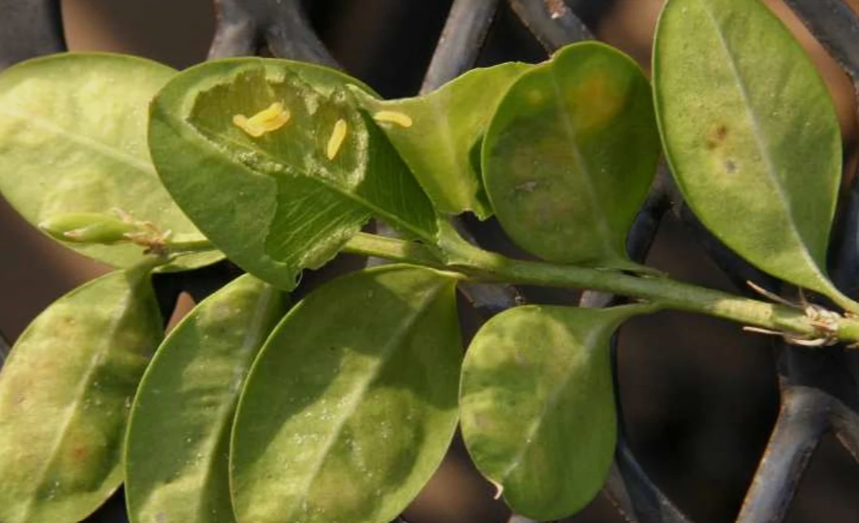
Regular inspection helps catch infestations early, before they cause serious damage. In winter and early spring, look closely at the undersides of boxwood leaves for blisters. Gently peel open a few to check for yellow-orange larvae inside. Shrubs with many infested leaves are likely to have a large adult emergence in late spring.
In late April and May, watch for orange pupae on the undersides of leaves and for swarms of tiny orange flies. University of Massachusetts Extension suggests shaking bushes beginning in late April to detect flying adults, or placing yellow sticky cards near plants. Tracking when adults appear helps time any control measures accurately.
Also Read: Boxwood Diseases
How to Manage Boxwood Leafminer
Keeping boxwoods healthy is the foundation of leafminer management. Water deeply during dry periods, mulch the root zone, and avoid excessive nitrogen fertilizer. Lush, soft growth is more attractive to egg-laying females. Vigorous plants tolerate light infestations much better than stressed ones.
Light infestations on small plants can sometimes be reduced by pruning. In early spring, before adults emerge, shear or clip off heavily infested leaves and branch tips. Destroy the clippings so the larvae inside cannot complete development. That reduces the number of adults that emerge and lay eggs on new growth.
For heavier infestations, insecticides may be needed. Because most of the life cycle takes place inside the leaf, products that move into leaf tissue are generally the most effective. University of Massachusetts Extension notes that foliar-absorbed or systemic insecticides work best against the immature stages. Research at the University of Maryland found that translaminar insecticides applied at adult emergence gave the best control. Always choose products labeled for boxwood leafminer, follow label directions carefully, and consult your local extension office for current recommendations in your area.
Preventing Future Infestations
The most effective way to prevent boxwood leafminer problems is to plant resistant varieties from the start. When buying boxwoods, inspect the undersides of the leaves for blisters, discoloration, or larvae. Avoid bringing infested plants into the garden. Plants from reputable nurseries that follow good pest management practices are less likely to carry the pest.
In established gardens, combining resistant varieties, good care, regular inspection, and well-timed controls keeps boxwood leafminer at manageable levels. Because the pest completes only 1 generation per year, consistent management over a few seasons can greatly reduce populations. Healthy, well-chosen boxwoods can then remain dense and green for many years.
Sources
University of Florida IFAS, “Boxwood Leafminer”
UMass Amherst Landscape, Nursery and Urban Forestry Program, “Boxwood Leafminer”
UMass Amherst Extension Insect and Mite Guide, “Boxwood Leafminer”
University of Maryland, “Integrated Management of the Boxwood Leafminer”
University of Delaware Cooperative Extension, “Ornamentals Hotline”