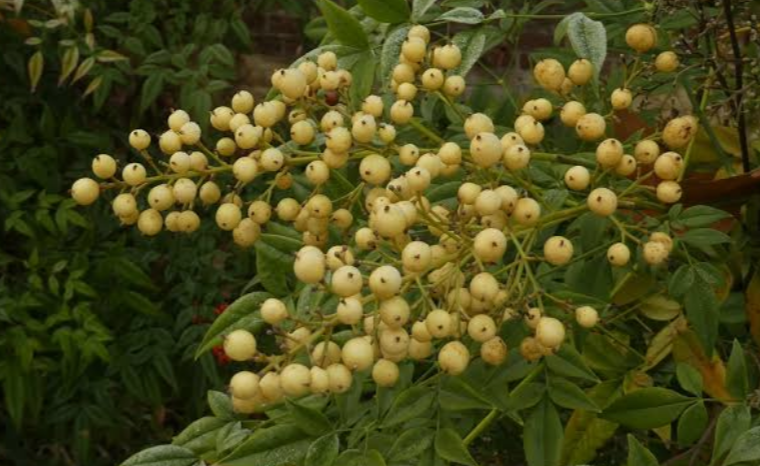
Shrubs with yellow berries are mostly accidents of nature that gardeners decided to keep. About 4 out of 5 of the plants on this list are yellow-fruited forms of shrubs that normally bear red berries. Each began as a single odd branch or seedling that lacked red pigment.
That missing pigment turns out to be useful. Birds tend to take red fruit first and leave yellow fruit for later, sometimes for weeks. A yellow-berried holly or viburnum often stays loaded after the red one beside it has been picked clean.
Yellow also reads differently in the landscape. It shows up against dark evergreens and brick, and it stays visible on gray winter days when red can look almost black. Planted next to a red-berried partner, it makes both colors stronger.
This list of 30 shrubs starts with those yellow variants, grouped by plant family, then moves to shrubs whose fruit is yellow by nature and ends with edible kinds. Each description notes whether the fruit can be eaten and whether a pollinator is needed. Hardiness ranges refer to USDA zones in the United States.
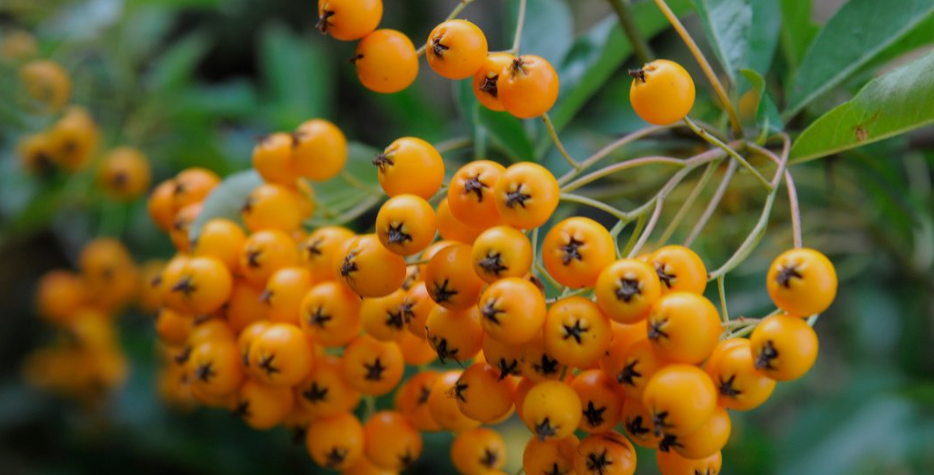
1. Berry Heavy Gold Winterberry
Berry Heavy Gold winterberry is a yellow-fruited form of the native deciduous holly of eastern wetlands. Large, bright gold berries line the bare stems from September into winter. The shrub grows 6 to 8 feet tall and is hardy in zones 3 to 9.
Winterberry breeders have developed varieties for berry color in red, orange, and yellow, and this is the clearest yellow of the group. A male winterberry must grow within 50 feet for fruit to set. The berries are mildly toxic and are not eaten.
2. ‘Winter Gold’ Winterberry
‘Winter Gold’ winterberry began as a single branch on a red-berried shrub at an Indiana nursery. Its fruit opens pinkish-orange and ages to a soft golden yellow. Plants reach 7 to 8 feet tall with a rounded shape.
The berries hold through much of winter and are widely cut for holiday arrangements. A late-blooming male such as ‘Southern Gentleman’ is the right pollinator. It shares the species’ tolerance for wet soil and its range of zones 3 to 9.
3. ‘Finch’s Golden’ Possumhaw
‘Finch’s Golden’ possumhaw is a yellow form of the deciduous holly native to the Southeast and lower Midwest. Its berries are clear yellow and stand out against smooth, silver-gray bare branches. The shrub is large, at 10 to 15 feet tall.
Possumhaw tolerates drier and more alkaline soil than winterberry does. A male possumhaw or a male American holly nearby will pollinate it. It is hardy in zones 5 to 9, and the fruit is not edible.
4. ‘Saratoga Gold’ Yaupon Holly
‘Saratoga Gold’ yaupon is a yellow-berried selection of the evergreen holly native to the southern coastal plain. The small, translucent berries cluster tightly along the stems from fall through winter. It grows as a large shrub, 10 to 15 feet tall.
Female plants need a male yaupon in the neighborhood, which is rarely a problem in the South. The shrub handles drought, salt spray, and heavy pruning in zones 7 to 9. The berries cause vomiting and must not be eaten.
5. ‘Golden Girl’ Blue Holly
‘Golden Girl’ is the yellow-berried member of the blue holly group, bred for cold winters. It forms a broad pyramid of dark, spiny evergreen leaves 8 to 12 feet tall. The berries are large and bright yellow.
A male blue holly such as ‘Blue Prince’ is required for pollination. It is hardy in zones 5 to 8 and gives northern gardens a yellow evergreen holly. The fruit is mildly toxic and is grown only for show.
6. ‘D’Or’ Chinese Holly
‘D’Or’ is a yellow-fruited form of Chinese holly, closely related to the red-berried Burford holly. The leaves are glossy and nearly spineless, and the berries are among the largest of any yellow holly. Plants grow 10 to 15 feet tall.
This shrub takes heat and drought better than most hollies and suits zones 7 to 9. It makes a dense screen without much pruning. The berries are not edible.
7. ‘Bacciflava’ English Holly
‘Bacciflava’ is the classic yellow-berried English holly, with the spiny, polished leaves seen on Christmas cards. It grows as a large shrub or small tree, usually 15 to 25 feet in gardens. Heavy crops of yellow berries last from fall into late winter.
A male English holly is needed for fruit. The plant grows best in the mild, moist climate of the Pacific Northwest, where the species has also become invasive in forests. It is hardy in zones 7 to 9, and the berries are toxic.
8. ‘Michael Dodge’ Linden Viburnum
‘Michael Dodge’ linden viburnum is the standard yellow-berried viburnum in American nurseries. This selection is noted for its heavy production of bright yellow fruit in flat clusters. The fruit colors in September and October and persists into December.
The shrub grows 6 to 10 feet tall, and its leaves turn red in fall behind the yellow berries. A second linden viburnum variety is needed for pollination. The species seeds into woodlands in the mid-Atlantic states, and the fruit is not eaten.
9. ‘Xanthocarpum’ European Cranberrybush
‘Xanthocarpum’ is a yellow-fruited form of European cranberrybush, a viburnum with maple-shaped leaves. Its berries are golden yellow and turn translucent after the first hard frost. The shrub grows 6 to 8 feet tall in zones 3 to 8.
The fruit hangs on deep into winter because birds find it bitter. People find it bitter too, and it is not worth eating. White, lace-cap flowers in May give the plant a second season of interest.
10. ‘Flavum’ Sargent Viburnum
‘Flavum’ Sargent viburnum is a large, upright shrub from northeastern Asia with corky bark and three-lobed leaves. This form bears golden-yellow fruit where the species has red. Even its flower anthers are yellow, while those of the red-fruited type are purple.
It reaches 10 to 12 feet and is hardy in zones 4 to 7. The shrub prefers cool summers and struggles in the heat of the South. The berries are not considered edible.
11. ‘Soleil d’Or’ Firethorn
‘Soleil d’Or’ firethorn is the best-known yellow form of a shrub that usually fruits orange or red. Dense clusters of golden-yellow berries cover the branches from September into winter. The plant grows 8 to 10 feet tall and wide and carries sharp thorns.
It is often trained flat against a wall or fence, where the fruit shows best. White flower clusters in late spring draw large numbers of bees. It is hardy in zones 6 to 9, and the mealy berries are not eaten fresh.
12. ‘Teton’ Firethorn
‘Teton’ firethorn was bred at the U.S. National Arboretum for disease resistance and an upright shape. It grows about 12 feet tall but only 4 feet wide, which suits narrow spaces. The berries are yellow-orange, a warmer shade than ‘Soleil d’Or’.
This variety resists both scab and fire blight, the two diseases that ruin older firethorns. It is also among the hardiest, surviving in zones 6 to 9. The fruit persists well into winter and is left for birds.
13. ‘Rothschildianus’ Cotoneaster
‘Rothschildianus’ cotoneaster is a large, arching shrub with narrow, willow-like leaves. It bears heavy clusters of creamy-yellow berries in fall. The plant was raised at an English estate garden and reaches 10 to 15 feet.
The leaves stay on through mild winters and drop in cold ones. It grows in zones 6 to 8 and does best on the West Coast and in the upper South. The berries are not edible and can cause stomach upset.
14. ‘Exburiensis’ Cotoneaster
‘Exburiensis’ cotoneaster is a close relative of ‘Rothschildianus’ with a similar tall, arching habit. Its berries open apricot-yellow and take on a pink tinge as winter sets in. The shrub grows 12 to 15 feet tall.
The long branches bend under the weight of fruit in a good year. It is hardy in zones 6 to 8 and tolerates poor, dry soil once established. Fire blight is the main disease to watch for, and the berries are not eaten.
15. Yellow-Berried Heavenly Bamboo
Yellow-berried heavenly bamboo is a form of nandina with creamy-yellow fruit where the common type has red. The plant lacks red pigment entirely, so its new growth and fall foliage stay lime-green and yellow. It grows 4 to 6 feet tall in zones 6 to 9.
The berries are toxic to people, pets, and some birds, just like the red ones. Nandina also spreads into woodlands across the Southeast. Clipping the fruit clusters before they ripen is the safest way to keep an existing plant.
16. Yellow Spicebush
Yellow spicebush is a rare form of the native spicebush of eastern forests, which normally has red fruit. Its oval berries ripen yellow-orange in September, at the same moment the leaves turn clear yellow. The shrub grows 6 to 12 feet tall in zones 4 to 9.
Only female plants fruit, and a male spicebush must grow nearby. The berries can be dried and used as a seasoning, as the red ones are. The leaves feed the caterpillars of the spicebush swallowtail butterfly.
17. White February Daphne
White February daphne is the white-flowered form of a shrub that usually blooms rosy-purple. The link between flower and fruit color is fixed, so white-flowered plants always bear yellow berries. The fruit ripens along the stems in June and July.
Every part of this shrub is highly poisonous, and the berries are the most dangerous part. It should not be planted where small children play. The shrub stays 3 to 4 feet tall and is hardy in zones 4 to 7.
18. Yellow-Berried English Yew
Yellow-berried English yew bears soft, golden, cup-shaped fruits around a single seed. These are fleshy seed coverings called arils and are not true berries. They appear on female plants in early fall.
The seed and needles are highly poisonous, so the fruit must never be eaten. This form grows slowly into a large shrub of 10 to 20 feet and is hardy in zones 6 to 7. It tolerates deep shade and heavy shearing.
19. Golden Dewdrop
Golden dewdrop is a tropical shrub named for its hanging chains of round, golden-yellow berries. Blue-violet flowers and ripe fruit often appear on the same branch. It grows 6 to 18 feet tall in zones 9 to 11 and is used as a summer annual farther north.
The fruits of golden dewdrop are poisonous to humans, though birds eat them without harm. Each berry is about half an inch wide. Florida experts now advise against planting it there because of its potential to spread.
20. Hardy Orange
Hardy orange is a fiercely thorny citrus relative that survives winters as cold as zone 5. Its fuzzy yellow fruits are the size of a golf ball and ripen in September and October. Citrus fruits count botanically as a special type of berry, which earns it a place here.
The fruit is technically edible but extremely sour, bitter, and full of seeds. Small amounts are used in marmalade. The shrub reaches 8 to 15 feet and has escaped into woodlands in parts of the Southeast.
21. Flowering Quince
Flowering quince is grown for its early spring blossoms, but it also sets hard, yellow-green fruits about 2 inches wide. They ripen in October and give off a strong, sweet scent. The fruit is a small pome, like an apple, and not a true berry.
Raw quince is too sour and astringent to eat, but it is rich in pectin and makes excellent jelly. The thorny shrub grows 6 to 10 feet tall in zones 5 to 8. Fruit set is heavier when two different varieties grow together.
22. Sea Buckthorn
Sea buckthorn is a silver-leaved shrub whose branches are crowded with golden-yellow to orange berries. The fruit ripens in August and September and clings tightly through winter. Plants grow 8 to 12 feet tall and are hardy in zones 3 to 7.
The berries are edible, very sour, and exceptionally high in vitamin C, and they are usually pressed for juice. Only female plants fruit, and 1 male is needed for every 6 to 8 females. The shrub fixes nitrogen and spreads by root suckers.
23. Salmonberry
Salmonberry is a native shrub of the Pacific Northwest, found along streams from Alaska to northern California. Its fruits look like large raspberries and range from golden yellow to orange-red on different plants. They ripen from May to July, earlier than most wild berries.
The berries are edible, with a mild, slightly watery flavor. Magenta flowers open in early spring and are an important food for returning hummingbirds. The shrub forms thickets 4 to 10 feet tall in moist soil in zones 5 to 8.
24. ‘Fall Gold’ Raspberry
‘Fall Gold’ is a yellow raspberry, a color form of the red raspberry that lacks red pigment. The golden berries are soft and notably sweet, with less acid than red types. Raspberries are cane-forming shrubs, with stems 4 to 5 feet tall.
This variety bears two crops, a small one in July and a larger one from late August to frost. It is self-fertile and hardy in zones 4 to 8. The fruit is too soft to ship, which is why yellow raspberries are rare in stores.
25. ‘Hinnomaki Yellow’ Gooseberry
‘Hinnomaki Yellow’ gooseberry is a Finnish variety with yellow-green fruit that turns golden when fully ripe. The flavor is sweet and aromatic, often compared to apricot. Berries ripen in July on a compact bush 3 to 4 feet tall.
It is one of the best gooseberries for eating fresh. The plant resists powdery mildew and grows well in zones 3 to 7. The stems are thorny, and some states regulate gooseberries because of white pine blister rust.
26. Yellow Cornelian Cherry
Yellow cornelian cherry is a form of a large shrub in the dogwood family that normally bears red fruit. Its olive-shaped fruits ripen bright yellow in August. They are a little larger and sweeter than the red ones.
The fruit is edible and is cooked into preserves and syrup. The yellow color also hides it from birds, so more of the crop survives to harvest. The shrub grows 15 to 20 feet tall in zones 4 to 8 and blooms yellow in March.
27. ‘Goldeye’ Buffaloberry
‘Goldeye’ is a yellow-fruited selection of silver buffaloberry, a thorny native shrub of the northern Great Plains. Yellow fruit occurs naturally in this species, on roughly 12 to 20 percent of wild female plants. The berries ripen in August and September among narrow, silver leaves.
The fruit is edible and tart, and the berries are used for jellies. Both a male and a female plant are needed. The shrub tolerates drought, salt, and alkaline soil and is hardy to zone 2.
28. Golden Goji
Golden goji is a yellow-fruited form of the goji berry, sold under names such as ‘Amber Sweet’. The oblong, amber-yellow berries ripen from midsummer until frost. Plants have arching canes 5 to 8 feet long.
The berries are edible and noticeably sweeter and less bitter than red goji. They can be eaten fresh or dried. The shrub is hardy in zones 5 to 9 and suckers freely, so it is best grown in a large container.
29. Lemon Guava
Lemon guava is the yellow-fruited form of strawberry guava, an evergreen shrub with smooth, peeling bark. Its round yellow fruits are 1 to 1.5 inches wide and ripen in late summer and fall. The plant grows 10 to 15 feet tall in zones 9 to 11.
The fruit is edible, sweet-tart, and slightly lemony. It is grown in Southern California with few problems. In Florida and Hawaii, however, the species is a serious invasive plant and should not be planted.
30. Kei Apple
Kei apple is a dense, thorny evergreen shrub used as a barrier hedge in Southern California and Florida. Its round, bright yellow fruits resemble small apricots and measure 1 to 1.5 inches across. They ripen in late summer on female plants.
The fruit is edible but very acidic, so it is usually sweetened and cooked into jam. A male plant is needed for pollination. The shrub grows 10 to 15 feet tall, tolerates drought and salt, and is hardy in zones 9 to 11.
Key Takeaways:
- Shrubs with yellow berries add an unusual splash of golden color to gardens, particularly during late summer, fall, and winter.
- Yellow-fruited pyracantha, sea buckthorn, cotoneaster, holly, barberry, and some viburnums are among the shrubs that can produce yellow or yellow-orange fruits.
- Some shrubs produce berries that change color as they mature, meaning yellow fruits may eventually become orange, red, pink, purple, or black.
- Many berry-producing shrubs provide food and shelter for birds and other wildlife, making them useful in wildlife-friendly and naturalized gardens.
- Yellow-berried shrubs come in different sizes and growth habits, making them suitable for hedges, borders, screens, woodland gardens, slopes, and specimen plantings.
- Not every yellow berry is edible, and some ornamental shrubs can produce harmful fruits, so berries should never be consumed without reliable identification.