The white poplar tree is one of the most visually striking members of the poplar family, instantly recognizable by the silvery-white undersides of its leaves that shimmer and flash whenever the wind moves through the canopy. Prized for over a century in North American landscapes for its fast growth and ornamental bark, the white poplar has also earned a reputation as an aggressive spreader that many municipalities now regulate.
This article breaks down everything landscapers, homeowners, and tree enthusiasts need to know about the species, from its botanical background to its growing requirements.
Botanical Classification
The white poplar belongs to the willow family, placing it in the same broader plant group as willows, aspens, and cottonwoods. Within that family, it sits in the poplar genus, a group of roughly 25 to 35 recognized species distributed across the Northern Hemisphere. The white poplar is a deciduous broadleaf tree, meaning it drops its leaves annually, and it is classified as dioecious, which means individual trees are either male or female rather than producing both types of flowers on the same plant.
Taxonomists often note that the white poplar hybridizes readily with the closely related aspen, producing a variety commonly referred to as the grey poplar. This hybridization has occurred so frequently across parts of Europe and North America that some naturalized populations show intermediate characteristics between the two parent trees, complicating field identification for even experienced botanists.
Brief History
The white poplar is native to central and southern Europe, North Africa, and parts of western and central Asia, where it has grown along riverbanks and in open woodlands for thousands of years. Historical records suggest the tree was cultivated by the Greeks and Romans, who valued its fast growth and used its wood for lightweight construction and its leaves as livestock fodder.
European colonists introduced the white poplar to North America in the 18th century, drawn to its ornamental appeal and its tolerance for poor soils. By the mid-1800s, it had become a popular shade tree in American cities, planted along streets and in parks for its rapid growth, which can exceed 3 feet per year under favorable conditions. That same vigor, however, allowed the species to escape cultivation, and it is now considered naturalized or invasive across at least 25 U.S. states, particularly in the Northeast, Midwest, and parts of the Pacific Northwest.
By the early 20th century, many American cities began phasing out new plantings of the white poplar due to its aggressive root systems, which frequently damaged sidewalks, sewer lines, and building foundations. Despite this, mature specimens planted a century ago still stand in many older neighborhoods, some reaching heights of over 100 feet.
Identifying Characteristics
The most distinctive feature of the white poplar is its foliage. The upper surface of each leaf is a dark, glossy green, while the underside is coated in dense white or silvery hairs, creating a dramatic two-tone effect that becomes especially noticeable on windy days. Leaves are typically 2 to 4 inches long, with a lobed shape somewhat resembling a maple leaf, though the lobes are less deeply cut.
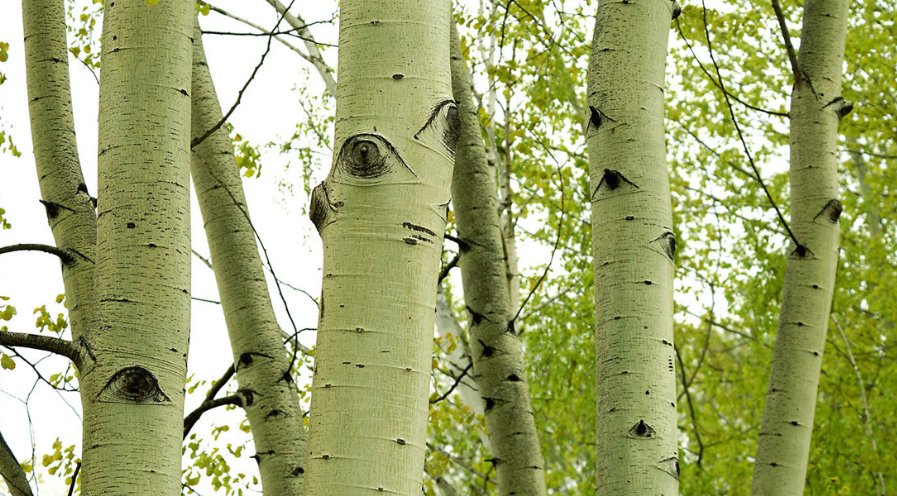
Bark is another key identifier. Young white poplar bark is smooth and pale grayish-white, often marked with distinctive dark, diamond-shaped lenticels, the small pores that allow gas exchange. As the tree matures, the lower trunk develops rough, dark furrows, while the upper trunk and branches typically retain the smoother, pale coloring.
The tree produces catkins in early spring before the leaves emerge. Male catkins are thick and gray with red anthers, growing up to 3 inches long, while female catkins are more slender and green. Because the species is dioecious, only female trees produce the cottony seed capsules that mature in late spring, releasing seeds that can be carried significant distances by wind, sometimes traveling more than a quarter mile from the parent tree.
Mature white poplars typically reach 40 to 70 feet in height, though exceptional specimens have been recorded at over 100 feet, with a trunk diameter that can exceed 3 feet. The crown is broad and irregular, often wider than it is tall in open-grown specimens, and root suckers frequently emerge from the shallow root system, sometimes appearing 30 feet or more from the trunk.
Habitat and Distribution
In its native range, the white poplar favors riverbanks, floodplains, and disturbed open ground, thriving in areas with full sun and access to consistent moisture. This preference for moist, disturbed soils explains why the species has adapted so successfully to roadside ditches, abandoned fields, and urban lots throughout its introduced range in North America.
Within the United States, white poplar populations are documented from Maine to Georgia along the East Coast, extending west through the Midwest into states like Ohio, Michigan, and Illinois, with additional naturalized populations reported in parts of California, Washington, and Oregon. Several state invasive species councils list the white poplar on watch lists or outright prohibit new plantings, citing its tendency to form dense colonial thickets through root suckering that can crowd out native vegetation across an area of an acre or more from a single original tree.
The species tolerates an unusually wide range of soil types, growing successfully in sandy, loamy, and even moderately compacted clay soils, though it performs poorly in consistently waterlogged conditions. It also demonstrates notable drought tolerance once established, a trait that has helped it persist in urban environments where soil moisture is often inconsistent.
USDA Hardiness Zone and Growing Needs
The white poplar grows reliably across USDA hardiness zones 3 through 8, giving it one of the broader climate ranges among ornamental deciduous trees and making it viable from parts of the northern Great Plains down through the mid-Atlantic and into the transition zones of the South.
For those still choosing to plant or manage the species, several growing considerations matter most.
Full sun exposure produces the healthiest growth and the most vivid two-tone leaf color, though the tree tolerates partial shade with reduced vigor. Soil pH adaptability is broad, with the species performing well in slightly acidic to slightly alkaline conditions, generally between 5.5 and 7.5. Watering needs are moderate at establishment but drop significantly once the root system matures, since established trees show strong drought resistance.
Spacing should account for the aggressive root suckering habit, with most arborists recommending at least 50 feet of clearance from structures, septic systems, and underground utilities. Pruning is best done in late winter while the tree is dormant, minimizing sap loss and reducing disease risk.
Fertilization is rarely necessary in average soils, as the species is considered a light feeder compared to other ornamental shade trees. Pest resistance is moderate, though the tree can be susceptible to poplar borer and canker diseases, particularly in stressed or drought-weakened specimens.
Lifespan for the species averages 50 to 70 years, shorter than many hardwood shade trees, reflecting its fast-growth, fast-decline growth strategy. Root suckering control requires ongoing mowing or physical barriers, since cutting the tree down without addressing the root system typically triggers a surge of new suckers rather than eliminating the plant. Wind tolerance is generally good given the tree’s flexible branch structure, though the shallow, wide-spreading root system can make mature specimens vulnerable to toppling in saturated soil during severe storms.
Fun Facts and Additional Notes
The shimmering effect created by the white poplar’s leaves has inspired folklore across multiple cultures, with some European traditions associating the constant leaf movement with whispering or restlessness, a trait attributed to the long, flattened leaf stalks that allow even light breezes to set the foliage in motion.
A single mature white poplar can produce more than 25 million seeds in a single growing season, though the vast majority never encounter suitable germination conditions given the species’ specific need for bare, moist mineral soil.
The wood of the white poplar, while not commercially significant in modern markets, was historically used for matchsticks, pallets, and low-grade lumber due to its light weight and resistance to splintering, properties that made it useful despite its relatively low density compared to hardwoods like oak or maple.
Some of the oldest documented white poplar plantings in North America, dating to the early 1800s, still survive today in parts of New England, standing as living records of the species’ long history on the continent.
The white poplar remains a tree of contrasts: admired for its striking silver-and-green foliage and rapid shade production, yet managed cautiously due to its invasive tendencies and aggressive root behavior. For anyone considering the species, understanding both its ornamental appeal and its maintenance demands is essential to making an informed planting decision.