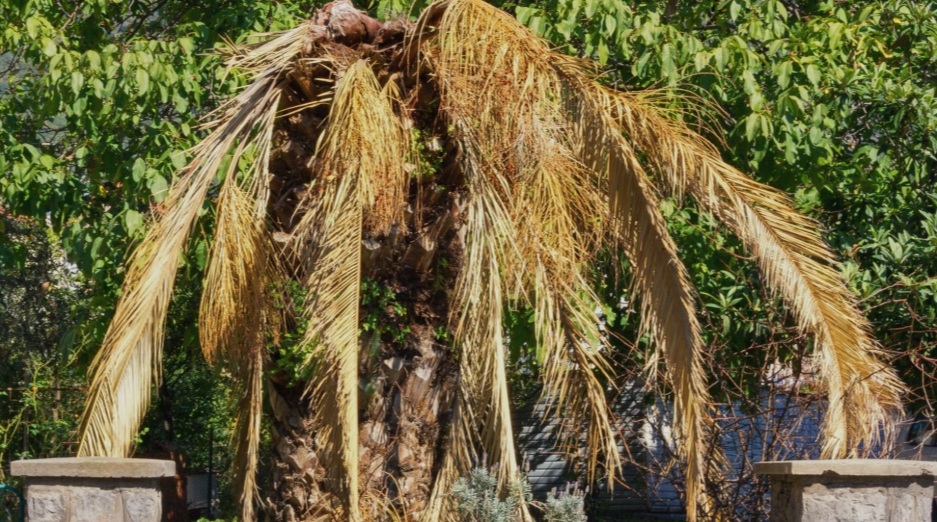
A palm tree can look perfectly healthy for months while trouble quietly builds inside its trunk or in the soil around its roots. Then one day the fronds turn orange, the newest leaf comes out crumpled, or the whole crown begins to droop. The most common palm tree problems are often hard to see at first, and by the time symptoms show up, a palm may have been struggling for a long time. Knowing what to look for makes the difference between saving a palm and replacing it.
Palms are built differently from oaks, maples, and other broadleaf trees. They grow from a single bud at the top of the trunk, and if that bud dies, the whole palm usually dies with it. They also can’t heal wounds in their trunks, so a scrape from a lawn mower or a nail driven into the bark is permanent. Because of these differences, problems that a regular tree would shrug off can be serious for a palm.
Most palm problems fall into a few broad groups. Nutrient deficiencies are by far the most common, especially in the sandy and alkaline soils of Florida and the Gulf Coast. Fungal diseases, deadly bacteria-like organisms called phytoplasmas, and insect pests cause the next largest share of trouble. Cold snaps, poor pruning, and careless lawn care account for much of the rest.
The good news is that many palm problems can be prevented with the right fertilizer, careful pruning, and attention to planting depth and drainage. Some diseases have no cure, so catching them early helps protect nearby palms. Below are the problems gardeners and landscapers in Florida, California, Texas, Arizona, and other palm-growing regions of the United States run into most often.
1. Potassium Deficiency
Potassium deficiency is the most widespread nutrient problem in landscape palms, especially in Florida. It first appears on the oldest, lowest fronds as small, translucent yellow to orange spots scattered across the leaflets. As it worsens, the leaflet tips turn brown, brittle, and frizzled, and the old fronds look withered and burned. In severe cases, the trunk narrows near the top, a condition often called pencil-pointing.
Damaged fronds never turn green again, so recovery depends on new leaves coming in healthy, which can take two years or more. Palms in sandy, quickly draining soils are most at risk because potassium leaches away easily. Regular feeding with a slow-release palm fertilizer that contains potassium, magnesium, and micronutrients is the best prevention. Avoid high-nitrogen lawn fertilizers near palms, because extra nitrogen can make potassium deficiency worse.
Also Read: Palm Trees with Thin Trunks
2. Magnesium Deficiency
Magnesium deficiency causes a broad, lemon-yellow band along the outer edges of the oldest fronds, while the center of each leaflet stays green. From a distance, the lower crown looks two-toned, with bright yellow outer fronds and darker green inner ones. This problem is especially common on Canary Island date palms and other date palms. Symptoms usually show up in spring and summer when palms are growing fastest.
Like potassium deficiency, magnesium deficiency can’t be reversed on fronds that are already yellow. Feeding with a balanced palm fertilizer that includes both potassium and magnesium will help new fronds grow in healthy. Applying magnesium alone can upset the nutrient balance and make potassium deficiency worse. For best results, spread fertilizer evenly under the canopy instead of piling it next to the trunk.
3. Manganese Deficiency
Manganese deficiency, often called frizzletop, affects the newest leaves at the top of the crown instead of the oldest ones. New fronds come out pale, weak, and streaked with brown, and in severe cases they look shriveled, scorched, and frizzled. If it isn’t corrected, the bud can stop producing healthy leaves, and the palm may die. Queen palms, royal palms, and coconut palms are among the most frequently affected.
This deficiency usually happens in alkaline soils, where manganese is present but locked in a form that roots can’t absorb. Cold, wet soil in winter can also trigger temporary symptoms. Manganese sulfate applied to the soil or sprayed on the leaves can correct the problem. Manganese oxide should be avoided because palms can’t absorb it well.
4. Boron Deficiency
Boron deficiency shows up in the newest leaves, which may be stunted, crumpled, or folded like an accordion. Sometimes the spear leaf fails to open properly and develops a hooked tip. In severe cases, the trunk may bend sideways or even begin growing downward, a symptom often seen on queen palms. Because the problem often comes and goes, a single trunk can show bands of damaged and healthy leaves.
Boron deficiency is most common after heavy rains leach the soil or during long dry spells, when roots can’t take it up. It can be corrected with very small amounts of boron, usually applied with a balanced palm fertilizer. Be very careful with the rate, because the difference between too little and too much boron is small. Too much can burn and kill the leaves.
5. Nitrogen Deficiency
Nitrogen deficiency makes the whole canopy look evenly pale, light green or yellowish green. The oldest fronds usually fade first, but the newer leaves soon follow, and growth slows noticeably. Unlike potassium or magnesium deficiency, it doesn’t create spots or bands. Instead, the entire palm simply looks washed out and hungry.
Nitrogen deficiency is most common in sandy, low-organic soils and in palms grown in containers. It is easy to fix, and palms usually green up within a few months after fertilizing. Use a palm fertilizer instead of lawn fertilizer, because palms need much more potassium and magnesium relative to nitrogen. Adding a layer of mulch around the base helps hold nutrients and moisture in the soil.
6. Iron Deficiency
Iron deficiency turns the newest fronds pale yellow, while the veins sometimes stay slightly greener. In severe cases, new leaves come out small and almost white, and the tips may turn brown. Queen palms are especially prone to this problem, but it can affect many species. The underlying cause is usually poor root health, not a true lack of iron in the soil.
Palms planted too deep, grown in waterlogged soil, or crowded by compacted ground often can’t absorb iron, even when there is plenty of it. Fixing drainage, raising palms that were planted too low, or loosening compacted soil usually solves the problem. Foliar sprays or soil applications of iron sulfate can improve leaf color in the short term. Without fixing the root problem, though, the symptoms tend to return.
7. Ganoderma Butt Rot
Ganoderma butt rot is a deadly fungal disease that decays the lower few feet of the trunk from the inside. The most obvious sign is a conk, a hard, shelf-like fungal growth that forms on the side of the trunk near the soil. Conks start as small white lumps and later turn reddish-brown with a white edge. By the time conks appear, much of the inner trunk has usually rotted away.
There is no cure for Ganoderma butt rot, and every species of palm can get it. Infected palms should be removed, because a weakened trunk can snap without warning. The fungus spreads by airborne spores and stays in the soil, so don’t plant another palm in the same spot. Avoiding trunk wounds and removing conks as soon as you spot them can help slow its spread.
8. Lethal Yellowing
Lethal yellowing is a fatal disease caused by a phytoplasma, a tiny bacteria-like organism carried by sap-feeding insects. It first causes coconuts and other fruits to drop early, and then the flower stalks turn black. Next, the fronds yellow from the bottom of the crown upward. Most infected palms die within three to six months after symptoms appear.
Lethal yellowing killed hundreds of thousands of coconut palms in South Florida during the 1970s. It affects coconut, Christmas, and dozens of other palm species. Infected palms should be removed quickly to slow the spread. Antibiotic trunk injections can protect valuable palms, and resistant coconut varieties are often recommended for replanting.
Also Read: Palm Trees with Multiple Trunks
9. Lethal Bronzing
Lethal bronzing is another deadly phytoplasma disease. It was first reported in Texas, where it was called Texas Phoenix palm decline, and it was confirmed in Florida in 2006. Infected palms drop their fruit, and then the oldest fronds turn reddish-brown to bronze. Soon the spear leaf dies and the whole crown collapses.
Lethal bronzing attacks date palms, Canary Island date palms, the cabbage palm, which is Florida’s state tree, and several other species. It has spread through much of Florida and along the Gulf Coast. There is no cure, and infected palms should be removed before the disease spreads to nearby trees. Preventive antibiotic injections can help protect high-value palms in areas where the disease is active.
10. Fusarium Wilt
Fusarium wilt is a fungal disease that blocks a palm’s water-conducting tissues. Its classic sign is one-sided death, where the leaflets on one side of a frond turn brown first while the other side stays green. Over months, more and more fronds die, starting from the bottom of the crown. Eventually the entire palm wilts and dies.
One form of Fusarium wilt kills Canary Island date palms and is common in California and Florida. Another form attacks queen palms and Mexican fan palms. There is no cure, so infected palms must be removed. The fungus spreads mainly through contaminated pruning saws, so disinfecting tools between palms is one of the best ways to prevent it.
11. Bud Rot
Bud rot is a fungal disease that attacks the single growing point at the top of the palm. The first sign is usually a spear leaf that wilts, turns brown, and pulls out easily. The base of the dead spear often smells foul. As the rot spreads, the newer fronds collapse while the older ones may stay green for weeks.
Bud rot often follows cold snaps, hurricanes, flooding, or heavy rains, which damage or soak the bud. Once the bud is fully rotted, the palm usually can’t be saved. If caught early, copper fungicides applied to the bud may help the palm recover. Gardeners in Florida and Texas often spray palms with copper fungicide after a freeze as a precaution.
12. Leaf Spots
Leaf spots are caused by a variety of fungi that form small brown, black, or tan spots on the fronds. Many spots have a yellow halo, and in heavy infections they merge into large dead patches. Young palms and nursery plants are most often affected. Date palms can also develop a related problem called false smut, which forms small black bumps with yellow threads.
Leaf spots are usually cosmetic and rarely kill a healthy palm. They are often worse on palms that are already weak from nutrient deficiencies. Avoid overhead watering, improve air circulation, and correct any nutrient problems. Fungicides are rarely needed in home landscapes but may help protect young palms in nurseries.
13. Palmetto Weevil
The palmetto weevil is the largest weevil in North America. It is a black or reddish beetle about 1 to 1.25 inches long. Its larvae tunnel through the bud and upper trunk, destroying the palm’s growing point. The first visible sign is often a crown that suddenly collapses or tilts.
This native beetle is found in Florida and across the Southeast. It is strongly attracted to stressed palms, especially newly transplanted ones. Canary Island date palms and Bismarck palms are among its favorite targets. Keeping palms healthy and well watered after planting is the best defense, though insecticide treatments may protect valuable trees.
14. Scale Insects
Scale insects are small, immobile pests that attach themselves to fronds and suck the palm’s sap. They look like tiny bumps or flecks that may be white, brown, or gray and are often clustered along leaf veins. Heavy infestations cause yellowing, spotting, and early leaf drop. Many scale insects also produce sticky honeydew that grows black sooty mold.
Scale insects attack outdoor palms and are especially common on indoor and container palms. Light infestations can be scrubbed off by hand or treated with horticultural oil or insecticidal soap. Severe infestations may need systemic insecticides. Avoid overfertilizing with nitrogen, which encourages soft new growth that scales favor.
15. Rugose Spiraling Whitefly
The rugose spiraling whitefly is an invasive pest first found in Miami-Dade County in 2009. The adults lay their eggs in spiral patterns covered with white wax on the undersides of fronds. Colonies produce large amounts of fluffy white wax and sticky honeydew. That honeydew drips onto cars, patios, and plants below and grows black sooty mold.
This whitefly attacks coconut, Christmas, and many other palms, along with dozens of other landscape plants. It weakens palms, but it rarely kills them. In many areas, natural enemies such as parasitic wasps and lady beetles have helped control it. Hosing off the fronds and avoiding broad-spectrum insecticides helps protect those natural enemies.
16. Cold Damage
Cold damage happens when temperatures drop below what a palm can tolerate. Fronds turn brown or bleached within days or weeks, and in severe freezes the spear leaf may pull out. Cold-sensitive palms such as coconuts, royal palms, and foxtail palms are most at risk. A palm may look dead after a freeze but still recover if its bud survives.
After a freeze, don’t remove damaged fronds right away, because even brown leaves help protect the bud. Wait until warm weather returns and new growth appears before pruning. Spraying the bud with copper fungicide after a freeze can help prevent bud rot. In cooler regions, choose palms that are rated for your area’s hardiness zone.
Also Read: Palm Trees With Smooth Trunks
17. Over-Pruning
Over-pruning is one of the most common mistakes in palm care. Many palms are trimmed into a narrow “hurricane cut,” leaving only a few upright fronds. Removing green fronds robs the palm of food and stored nutrients, especially potassium. Over time, over-pruned palms may grow thinner trunks and weaker crowns.
Only remove fronds that are fully dead or that pose a safety hazard. A good rule is to leave all fronds that point above horizontal, like the hands of a clock between 9 and 3 o’clock. Contrary to popular belief, heavy pruning doesn’t make palms more wind-resistant. Use clean, disinfected tools to avoid spreading diseases like Fusarium wilt.
18. Trunk Injuries
Trunk injuries are permanent because palms can’t heal or grow new tissue over wounds. String trimmers, lawn mowers, nails, staples, and climbing spikes all leave lasting scars. These wounds become entry points for Ganoderma butt rot and other trunk rots. Deep or repeated injuries can also weaken the trunk structurally.
The easiest way to prevent trunk injuries is to keep a ring of mulch around the base of the palm so lawn equipment stays away. Never use climbing spikes on palms you want to keep. When staking newly planted palms, wrap the trunk with burlap and padding instead of nailing supports directly into it. Protecting the trunk is one of the simplest ways to help a palm live a long, healthy life.