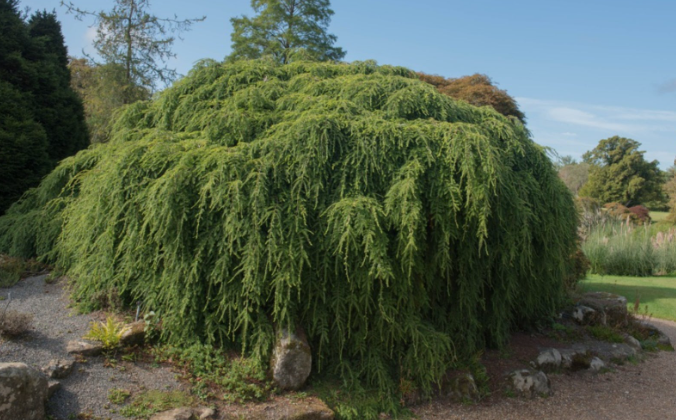
Weeping hemlock is one of the most distinctive conifers available to American gardeners, prized less for size than for the way its branches spill and cascade in an irregular, almost liquid form. Unlike the stiff, upright silhouette most people associate with evergreens, weeping hemlock reads as something closer to a slow-motion waterfall frozen mid-fall, which is exactly why landscape designers reach for it when a garden needs a focal point rather than another background tree.
Botanical Classification
Weeping hemlock belongs to the same broad conifer family as pines, firs, and spruces, sharing their needle-like foliage and cone-bearing habit rather than the broad leaves and flowers of deciduous trees. It’s a cultivated form derived from the eastern hemlock native to the cooler forests of the northeastern United States and eastern Canada, a species that in its natural upright form can reach over 100 feet in old-growth conditions.
The weeping habit itself isn’t the tree’s default state. It arose as a natural mutation first documented in the mid-1800s, when nurserymen noticed individual seedlings or branch sports growing with a pendulous, drooping form instead of the species’ typical straight-trunked shape. Those mutant individuals were propagated through cuttings and grafting rather than seed, since seed-grown offspring don’t reliably reproduce the weeping trait. Nearly every weeping hemlock sold commercially today traces back to one of a small handful of these original mutant specimens, discovered and preserved by careful growers over a century and a half ago.
A Brief History
The most famous of these original weeping hemlocks was discovered growing wild in the Fishkill Mountains of New York state around 1860, spotted by a nurseryman who recognized its ornamental value and began propagating it for sale. That single tree, and a few others found in similar circumstances across New England around the same era, became the genetic foundation for the dozens of weeping hemlock cultivars available today. Some of those original “mother trees” are still alive and can be visited at historic arboretums in the Northeast, making weeping hemlock one of the rare ornamental conifers whose commercial lineage can be traced back to specific, still-standing individual trees rather than a vague regional origin.
Interest in weeping conifers surged during the Victorian era, when elaborate, sculptural garden specimens were highly fashionable among wealthy American and European estate owners. Weeping hemlock fit that aesthetic perfectly, and it remained a staple of formal estate gardens through the early 20th century before falling somewhat out of fashion during the mid-1900s shift toward simpler suburban landscaping. It has since seen a steady revival over the past few decades as gardeners have returned to valuing specimen trees with genuine architectural presence.
Identifying Characteristics
Weeping hemlock typically grows into a low, broad mound rather than a tall, narrow form, often reaching just 8 to 10 feet in height after several decades while spreading considerably wider, sometimes 15 feet or more across. That width-to-height ratio alone distinguishes it from almost every other evergreen commonly planted in home landscapes.
Its needles are short, flat, and soft to the touch, arranged in two flattened rows along each branchlet and colored a deep, slightly glossy green with faint silvery banding visible on the undersides. The branches themselves grow with no fixed pattern, twisting, dipping, and cascading downward and outward in a way that makes every individual specimen genuinely unique; no two weeping hemlocks ever develop quite the same silhouette, even when grown from cuttings of the same parent plant.
Small, delicate cones appear seasonally, typically under an inch long, adding subtle textural interest without the visual weight of larger conifer cones. The bark on older specimens develops a rough, deeply furrowed texture in shades of gray-brown, providing quiet winter interest once the tree’s dramatic branch structure is more visible against a bare landscape.
Landscape Uses
Because weeping hemlock’s charm lies almost entirely in its irregular form, it performs best as a stand-alone specimen rather than planted in rows or masses, where its individuality would simply disappear into a hedge-like blur. It’s a natural fit near garden entrances, beside water features, or anchoring a rock garden, where its cascading branches can be viewed and appreciated from multiple angles without competition from surrounding plants.
Its manageable size, particularly compared to the towering height of a standard eastern hemlock, makes it genuinely practical for suburban lots and smaller properties where a full-sized hemlock would simply be impossible to accommodate. Some gardeners train young specimens over a low wall, boulder, or slope, encouraging the branches to drape downward and accentuate a change in elevation that a flat lawn wouldn’t showcase nearly as effectively.
Because it holds its foliage year-round, weeping hemlock also functions as a rare source of evergreen structure that isn’t simply a green wall or foundation planting. It tolerates light to moderate shade better than nearly any other conifer grown ornamentally in the US, which opens up placement options beneath high tree canopies or on the north side of a building, where most evergreens would thin out and decline.
Growing Considerations
Weeping hemlock prefers cool, humid climates and consistently moist, well-drained soil, performing best across USDA zones 4 through 7. It struggles noticeably in hot, dry summer conditions and in regions with heavy clay or poorly drained soil, where root rot becomes a persistent risk. Gardeners in the Southeast or the arid Southwest generally find it a poor match for local conditions compared to hardier native alternatives.
Its slow growth rate, often just a few inches per year, means a young specimen takes considerable patience before developing the full, sprawling character that makes mature weeping hemlocks so visually rewarding. That slow pace is also why long-established specimens, some now well over a century old, are treated as genuine landscape treasures rather than simply old trees, carrying both horticultural rarity and a direct, traceable link back to the original 19th-century discoveries that started the entire cultivar line.