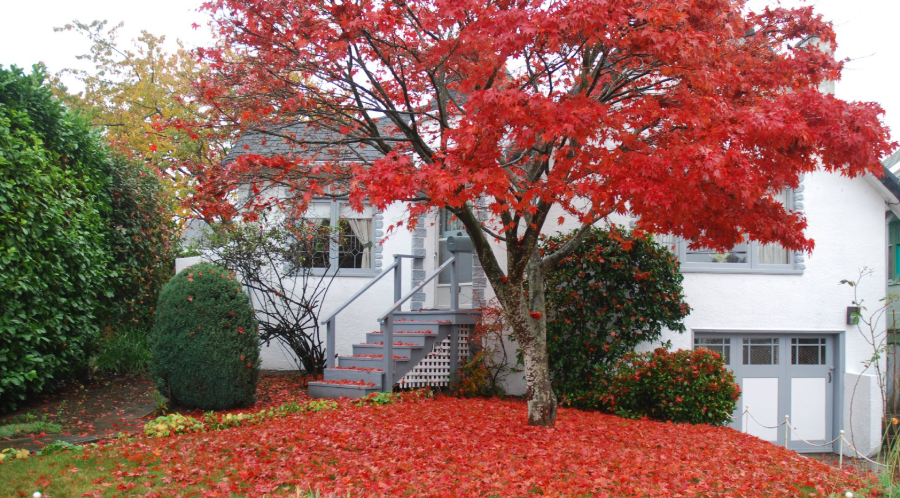
The best trees for front yard planting do more than fill empty space near the curb; they shape a home’s curb appeal, its energy bills, and even its resale value for decades after they go in the ground. According to the USDA Forest Service, landscaping with trees can raise a property’s value by as much as 20 percent, and a Purdue Extension analysis of tree benefits notes that well-placed trees also reduce cooling costs, absorb stormwater runoff, and lower stress for the people living around them. Few single landscaping decisions carry that much long-term weight.
Choosing well starts with matching a species to the realities of a front yard specifically, which is a narrower, more visible, and often more constrained space than a backyard. Overhead power lines, underground utilities, sidewalks, driveways, and sightlines to windows and house numbers all factor into which trees actually work near the street, something the Virginia Cooperative Extension’s guide to selecting shade trees emphasizes as the starting point before any aesthetic decisions get made.
Mature size matters just as much as appearance. A tree marketed simply as beautiful can become a liability within fifteen years if its root system lifts a sidewalk or its canopy grows into power lines, so the list below groups species loosely by their ultimate scale, from small ornamental accents under twenty-five feet to towering shade trees that can eventually top eighty feet. Growth rate matters too: arborists generally classify anything gaining more than twenty-five inches of height per year as fast-growing, while slow growers add closer to twelve inches or less, a distinction that affects both how soon a yard gets shade and how strong the resulting wood tends to be.
What follows covers thirty-five species commonly recommended for front yards across a range of climates, sizes, and design goals, along with the growth habits, seasonal features, and practical trade-offs that set each one apart.
In the end the following questions will have been answered:
- Which trees look best in a front yard?
- Which trees are low-maintenance?
- Which trees stay relatively small?
- Which trees provide good curb appeal?
- Which trees have attractive flowers or fall color?
- Which trees are evergreen?
- Which trees are suitable near a house?
- Which trees grow well your climate?
Red Maple
Red maple is one of the most widely planted shade trees in North America, valued for its adaptability to a huge range of soil types and its reliably brilliant red fall color, which often begins to show weeks before other species change. It grows at a medium to fast pace, typically adding fifteen to twenty-four inches per year, and can reach seventy-five feet at maturity with a broad, rounded canopy that provides substantial summer shade. Its tolerance for both wet and moderately dry soils makes it forgiving for yards with inconsistent drainage.
Sugar Maple
Sugar maple produces some of the most dramatic fall foliage of any shade tree, cycling through yellow, orange, and deep red before dropping its leaves, and it’s the same species tapped commercially for maple syrup production. It grows more slowly than red maple, generally under a foot per year, but rewards patience with a dense, long-lived canopy that can persist for well over a century. It prefers cooler climates and struggles in compacted urban soil or extreme summer heat.
Japanese Maple
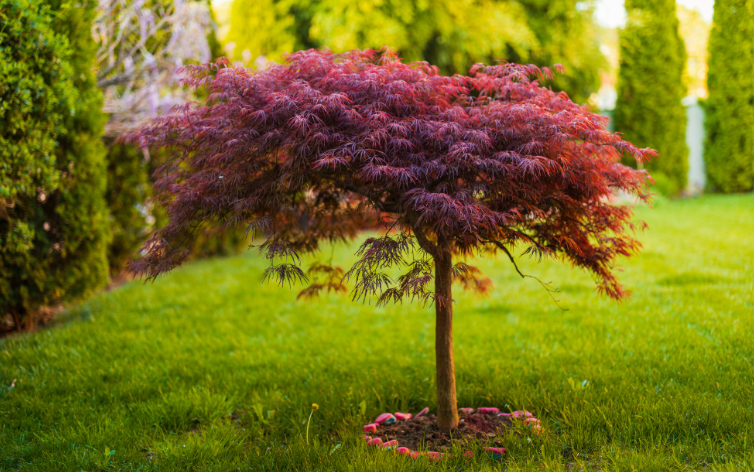
Japanese maple is the standard choice for a front yard accent tree rather than a shade tree, staying compact at fifteen to twenty-five feet with finely dissected leaves that range from deep burgundy to bright green depending on the cultivar. Its slow growth rate and manageable size make it well suited to planting near entryways or foundations where a larger tree would eventually cause problems. It prefers some afternoon shade in hotter climates, since its thin leaves can scorch under intense, direct sun.
Crape Myrtle
Crape myrtle is grown almost entirely for its long summer flowering season, producing clusters of pink, red, purple, or white blooms that can last from early summer well into fall in warm climates. Its smooth, mottled bark adds visual interest through the winter months after the leaves drop, and newer disease-resistant cultivars have made it far more reliable than older varieties prone to powdery mildew. It thrives in full sun and tolerates heat and drought better than most flowering trees on this list.
Flowering Dogwood
Flowering dogwood produces a spectacular display of white or pink bracts each spring before its leaves fully emerge, followed by red berries in fall that attract birds through the winter. It stays relatively small, typically twenty to thirty feet, making it a good fit for front yards where a full-sized shade tree would overwhelm the space. It prefers partial shade and well-drained, slightly acidic soil, and it can struggle with anthracnose disease in overly wet or humid conditions.
Kousa Dogwood
Kousa dogwood blooms several weeks later than flowering dogwood and carries pointed white bracts rather than rounded ones, along with notably better resistance to the anthracnose disease that affects its native cousin. Its exfoliating, mottled bark becomes increasingly attractive as the tree matures, adding four-season interest beyond the spring flowers and edible, raspberry-like fruit. It tolerates full sun better than flowering dogwood, giving it more placement flexibility in an open front yard.
Eastern Redbud
Eastern redbud is one of the earliest trees to bloom each spring, covering its bare branches in small pink-purple flowers before most other trees have even leafed out. It stays compact at twenty to thirty feet with a naturally graceful, spreading form, making it a popular understory or accent tree near a front entrance. It tolerates both sun and partial shade, and its heart-shaped leaves turn a soft yellow in autumn.
Saucer Magnolia
Saucer magnolia produces some of the largest and showiest spring flowers of any hardy tree, with tulip-shaped blooms in shades of pink and white that can span up to ten inches across. It grows to a modest twenty to thirty feet, making it appropriately scaled for most front yards, though its early bloom time means flowers are occasionally damaged by a late frost. Its multi-stemmed, spreading habit gives it a distinctive silhouette even after the flowers drop.
Southern Magnolia
Southern magnolia is an evergreen species prized for its large, glossy leaves and enormous, fragrant white flowers that bloom through summer rather than briefly in spring. It grows considerably larger than most magnolias, reaching sixty to eighty feet at maturity, so it needs a genuinely spacious front yard rather than a tight foundation planting. Its dense, year-round canopy makes it valuable for privacy screening in addition to its ornamental appeal.
Star Magnolia
Star magnolia is the most compact of the commonly planted magnolias, typically staying under twenty feet, which makes it one of the few magnolia options suited to smaller front yards or tight spaces near a driveway. Its narrow, star-shaped white petals open earlier than saucer magnolia’s, often becoming one of the first flowering trees to bloom each year. It tolerates both full sun and light shade and generally shows better cold hardiness than its larger relatives.
River Birch
River birch is distinguished by its peeling, salmon-to-cinnamon-colored bark, which provides visual interest through every season, including the bare winter months when most trees offer little to look at. It grows quickly, often exceeding two feet per year when young, and tolerates wet soil far better than most ornamental trees, making it a strong choice for front yards with drainage issues. Its fine-textured leaves turn a soft yellow before dropping in fall.
Yoshino Cherry
Yoshino cherry is the variety most associated with Washington, D.C.’s famous spring cherry blossom display, producing masses of pale pink to white flowers that typically last one to two weeks before dropping. It grows moderately fast to a mature height of forty feet, with a broad, rounded canopy that provides light shade once established. Its bloom window is brief, but the visual impact during that period is difficult to match with any other flowering tree.
Kwanzan Cherry
Kwanzan cherry produces the showiest blooms of the common flowering cherries, with double, deep pink flowers that appear in dense clusters along the branches. It stays somewhat smaller than Yoshino cherry, generally reaching thirty feet, and its upright, vase-shaped form when young gradually spreads into a broader canopy with age. It’s more susceptible to pests and disease than some other ornamental trees, so it benefits from more attentive care in the first several years.
Autumn Blaze Maple
Autumn Blaze is a hybrid maple bred specifically for rapid growth and reliable fall color, often adding three to five feet of height per year while still developing strong branch structure. Its fall foliage turns a consistent, vivid orange-red weeks earlier than many other maples, making it a popular choice for homeowners who want quick shade without waiting decades. It tolerates a range of soil conditions, though its fast growth means it benefits from structural pruning while young to avoid weak branch angles.
Little Leaf Linden
Little leaf linden offers a dense, symmetrical, pyramidal canopy that makes it a popular choice for formal front yard plantings and street tree rows alike. Its small, fragrant yellow flowers in early summer attract pollinators in large numbers, and its heart-shaped leaves provide dense summer shade. It grows at a moderate pace and tolerates urban pollution and compacted soil better than many other shade trees.
American Holly
American holly is a broadleaf evergreen that provides year-round structure and privacy, with spiny, dark green leaves and bright red berries on female trees that persist through winter. It grows slowly, often under a foot per year, but its dense form makes it useful as a living screen near a front yard’s edge as much as a standalone specimen. It tolerates shade better than most evergreens, though it produces the heaviest berry set in full sun.
Live Oak
Live oak is an iconic evergreen shade tree across the southeastern United States, known for its massive, wide-spreading canopy that can extend far beyond its height, sometimes exceeding a hundred feet across on older specimens. It grows slowly but lives for centuries, with some specimens documented at well over three hundred years old, making it a genuine multi-generational investment for a front yard. It tolerates coastal winds, salt spray, and poor soil better than nearly any other shade tree.
Willow Oak
Willow oak gets its name from its narrow, willow-like leaves, a distinctive departure from the classic lobed oak leaf shape, and it grows notably faster than most other oaks while still developing strong, storm-resistant wood. It can reach sixty to seventy-five feet with a dense, oval canopy that provides substantial shade within a couple of decades rather than the half-century some oaks require. Its smaller leaves and lack of large acorns also make fall cleanup considerably easier than with bigger-leaved oak species.
White Oak
White oak is one of the longest-lived shade trees available, with documented specimens surviving several centuries, and its wine-red to burgundy fall color rivals maples for seasonal display. It grows slowly, which discourages some homeowners, but its exceptionally strong wood and broad, rounded canopy make it one of the most storm-resistant large trees for a front yard. It requires well-drained soil and does not transplant as easily as faster-growing species, so nursery stock should be planted while still relatively young.
Pin Oak
Pin oak grows considerably faster than most other oaks, often adding over a foot per year, and its distinctive pyramidal shape with drooping lower branches sets it apart visually from rounder-canopied shade trees. Its deeply cut leaves turn a rich bronze-red in fall, and its tolerance for wet, compacted, or clay-heavy soil makes it a reliable choice where other large trees struggle. Its lower branches typically require occasional pruning to maintain clearance over sidewalks and driveways as the tree matures.
Northern Red Oak
Northern red oak grows faster than white oak while still producing the strong wood and long lifespan typical of the oak family, making it a popular compromise for homeowners who want an oak’s durability without waiting quite as long for results. Its leaves turn a deep red to reddish-brown in fall, and its broad, rounded canopy eventually provides dense shade over a wide area. It tolerates urban conditions reasonably well, including some soil compaction and pollution exposure.
Bald Cypress
Bald cypress is one of the few conifers that drops its needles each fall, turning a warm, coppery orange beforehand in a display that few other conifers can match. It tolerates both very wet and surprisingly dry soil once established, a flexibility that comes from its native swamp habitat, and its straight, tapering trunk develops attractive fluting with age. It grows at a moderate to fast pace and generally reaches fifty to seventy feet in a home landscape setting.
Tulip Poplar
Tulip poplar, also called tulip tree, is one of the tallest native hardwoods in North America, capable of exceeding ninety feet at maturity with a long, straight trunk and distinctive tulip-shaped leaves. It grows quickly, often adding two feet or more per year when young, making it a strong choice for homeowners wanting substantial shade sooner rather than later. Its size means it needs a genuinely large front yard, since its mature spread and root system aren’t well suited to tight urban lots.
Sweetgum
Sweetgum produces some of the most varied fall color of any shade tree, with individual leaves on the same tree sometimes displaying yellow, orange, red, and purple simultaneously. Its star-shaped leaves and rapid growth rate make it a popular shade tree, though its spiky seed pods create notable cleanup demands each fall. Newer fruitless cultivars have been developed specifically to address that drawback while preserving the tree’s fall color display.
Ginkgo
Ginkgo is remarkably resistant to pests, disease, and urban pollution, a resilience tied to its status as one of the oldest surviving tree species, with fossil records dating back over a hundred million years. Its fan-shaped leaves turn a uniform, brilliant gold each autumn and tend to drop within just a day or two, creating a dramatic, concentrated display rather than a gradual color change. Male cultivars are strongly preferred for front yards, since female trees produce a notoriously foul-smelling fruit.
Zelkova
Zelkova develops a vase-shaped silhouette reminiscent of the American elm, which made it a popular substitute after Dutch elm disease devastated elm populations across North America. It grows at a moderate to fast pace, tolerates urban stress well, and displays yellow to reddish-bronze fall color. Its arching branch structure provides a graceful canopy shape that works particularly well as a lawn specimen tree near a front walkway.
Chinese Elm
Chinese elm offers genuine resistance to Dutch elm disease, unlike its American counterpart, along with attractive, exfoliating bark that reveals mottled patches of gray, green, and orange as it matures. It grows quickly, tolerates drought, poor soil, and urban pollution better than most shade trees, and adapts to a wide range of climates. Its relatively small leaves also mean less dramatic fall cleanup compared to bigger-leaved shade trees.
Crabapple
Crabapple offers a spring flowering display in shades of white, pink, or red, followed by small ornamental fruit that persists into winter and provides food for birds. It stays compact, typically fifteen to twenty-five feet, making it well suited to smaller front yards or foundation plantings near the house. Disease-resistant cultivars are strongly recommended, since older varieties are prone to apple scab and other fungal issues in humid climates.
Serviceberry
Serviceberry produces delicate white flowers in early spring, followed by edible, blueberry-like fruit in early summer that attracts a wide range of songbirds before ripening fully. It stays small, generally under twenty-five feet, and its multi-stemmed form works well as either a specimen tree or a naturalized planting near a front entrance. Its fall color ranges from yellow to orange to red depending on the cultivar, adding a third season of interest beyond flowers and fruit.
Weeping Willow
Weeping willow is instantly recognizable for its long, cascading branches and narrow leaves that create a soft, graceful silhouette unlike any upright shade tree. It grows extremely fast, often several feet per year, but that rapid growth comes with weaker wood and a shorter lifespan than most other trees on this list. It needs consistently moist soil and considerable space to accommodate its wide, aggressive root system, which can pose problems near foundations, septic systems, or underground pipes.
Colorado Blue Spruce
Colorado blue spruce offers a striking silvery-blue color and a dense, symmetrical, pyramidal form that provides year-round structure and privacy screening. It grows slowly, typically under a foot per year, and prefers cooler climates, often struggling with heat stress and needle disease in hot, humid regions. Its stiff, sharp needles and formal shape make it a popular choice as a standalone specimen tree in more spacious front yards.
Eastern White Pine
Eastern white pine grows faster than most conifers, often exceeding two feet per year, with soft, blue-green needles that feel notably less prickly than spruce or other pines. It can reach eighty feet or more at maturity, making it best suited to larger properties rather than tight urban lots, and its relatively brittle branches can be prone to breakage in heavy ice or snow. Its soft texture and rapid growth make it a popular choice for privacy screening despite the size considerations.
Leyland Cypress
Leyland cypress is one of the fastest-growing evergreens available, commonly adding three feet or more per year, which has made it enormously popular for quick privacy screening along front property lines. Its dense, feathery foliage stays green year-round, but its rapid growth requires regular pruning to prevent it from becoming too large for its space within just a few years. It’s also more susceptible to canker diseases than slower-growing conifers, particularly in overly wet or poorly drained soil.
Arborvitae
Arborvitae offers dense, scale-like evergreen foliage in a naturally narrow, columnar form that makes it especially useful for front yard privacy screening without consuming much horizontal space. It grows at a moderate pace, generally twelve to eighteen inches per year, and tolerates pruning well for homeowners who want to maintain a specific size or shape. Its narrow footprint makes it a common choice for planting along property lines or flanking a front entrance in matched pairs.
Dwarf Korean Lilac Tree
Dwarf Korean lilac tree is a grafted, tree-form version of the classic lilac shrub, producing fragrant lavender-purple flower clusters each spring on a compact, rounded canopy typically under fifteen feet tall. Its small size and tidy form make it one of the few flowering trees genuinely suited to tight foundation plantings directly beside a front door or walkway.
Things to Remember
As the Clemson Cooperative Extension’s guide to tree selection and the UF/IFAS Gardening Solutions tree database both emphasize, matching a tree’s mature size to the available planting space, rather than judging it by its appearance at the nursery, remains the single most important factor in long-term success, a principle that applies just as much to a compact accent tree like this one as it does to a towering shade tree. For homeowners working through a full list of options by region, the North Carolina Extension Gardener Plant Toolbox offers a searchable database that can help confirm which of these species will actually perform well in a specific yard’s soil, sun exposure, and climate zone.
References
- University of Florida IFAS Extension — Selecting and Planting Trees.
University of Florida IFAS Extension — Selecting and Planting Trees
Useful for choosing landscape trees based on mature size, site conditions, sunlight, soil, and intended landscape use. - University of Minnesota Extension — Planting and Transplanting Trees and Shrubs.
University of Minnesota Extension — Planting and Transplanting Trees and Shrubs
Provides research-based guidance on selecting trees, planting locations, soil conditions, root development, and long-term tree establishment. - Iowa State University Extension and Outreach — Selecting Trees for Your Landscape.
Iowa State University Extension — Selecting Trees for Your Landscape
Helpful for comparing trees according to mature size, growth characteristics, ornamental features, and suitability for different landscape situations. - University of Illinois Extension — Selecting Trees for Your Home.
University of Illinois Extension — Selecting Trees for Your Home
A useful tree-selection database covering characteristics such as mature height, spread, growth rate, exposure, ornamental qualities, and landscape uses. - Penn State Extension — Selecting Trees for Your Landscape.
Penn State Extension — Selecting Trees for Your Landscape
Provides guidance on matching trees with available space, soil, climate, sunlight, and other site conditions while considering long-term maintenance. - Missouri Botanical Garden — Plant Finder.
Missouri Botanical Garden — Plant Finder
Particularly useful for checking individual landscape trees and their mature size, foliage, flowers, fruit, hardiness, light requirements, and other identifying characteristics. - U.S. Department of Agriculture — USDA Plant Hardiness Zone Map.
USDA Plant Hardiness Zone Map
An important reference for determining whether particular trees are likely to survive winter temperatures in a specific U.S. location. - Arbor Day Foundation — Tree Selection and Planting Resources.
Arbor Day Foundation — Tree Resources
Provides information on selecting, planting, and caring for trees, including considerations such as mature size, location, climate, and landscape purpose.