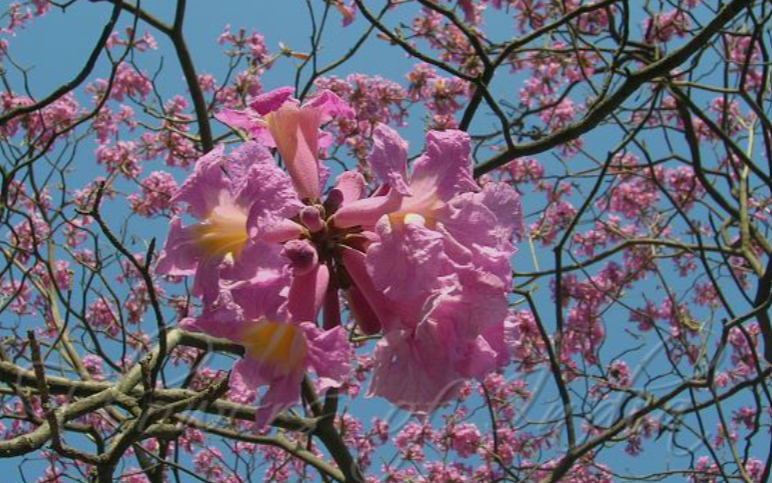
Rosy Trumpet Tree: El Salvador’s National Tree and a Tropical Showpiece
The rosy trumpet tree is one of the most widely planted flowering trees in the tropics. In the dry season it drops its leaves and covers itself in clusters of rose-pink, lavender, or nearly white trumpet-shaped flowers. Native to Central and northern South America, it is the national tree of El Salvador, where it is called maquilishuat. It lines streets and fills parks from Mexico City to Singapore, and in the United States it grows in the warmest corners of South Florida and Hawaii.
The rosy trumpet tree is also valued for its wood. Across its native range it is called roble de sabana, or “savanna oak,” because its strong, attractive timber has long been compared to oak. Few trees combine showy flowers and useful wood so well, which helps explain why it has spread to gardens and plantations around the world.
Botanical Classification
The rosy trumpet tree belongs to the bignonia family, alongside jacaranda, catalpa, trumpet creeper, desert willow, and the many other trumpet trees. It is one of the trumpet trees that botanists kept in the original genus when the group was split in the 2000s. Many of its pink and yellow cousins were moved into a separate genus at that time.
It goes by many common names. In English it is known as rosy trumpet tree, pink trumpet tree, pink poui, and pink tecoma. In Spanish-speaking countries it is called maquilishuat in El Salvador, macuelizo in Honduras, apamate in Venezuela, and amapa rosa in Mexico, and roble de sabana is used across much of the region. Because “pink trumpet tree” is also used for several other species, the name “rosy trumpet tree” is the clearest way to refer to this one.
Also Read: Types of Tabebuia (Trumpet) Trees
Brief History
The rosy trumpet tree is native from southern Mexico through Central America to Venezuela and Ecuador. It grows naturally in tropical dry forests, savannas, river valleys, and open woodlands, often in areas with a long dry season. For centuries, Indigenous peoples and later settlers across the region used its wood for construction, furniture, tools, and boats. Its bark has a long history in traditional medicine.
Its beauty made it a natural choice for ornamental planting. El Salvador named it its national tree, and its flowers are celebrated each year when the trees bloom across the country. In the 20th century it was introduced to the Caribbean, Brazil, Africa, South and Southeast Asia, and the Pacific. It is now a common street and park tree in cities such as Singapore, Hong Kong, Bangkok, and Kuala Lumpur.
Identifying Characteristics
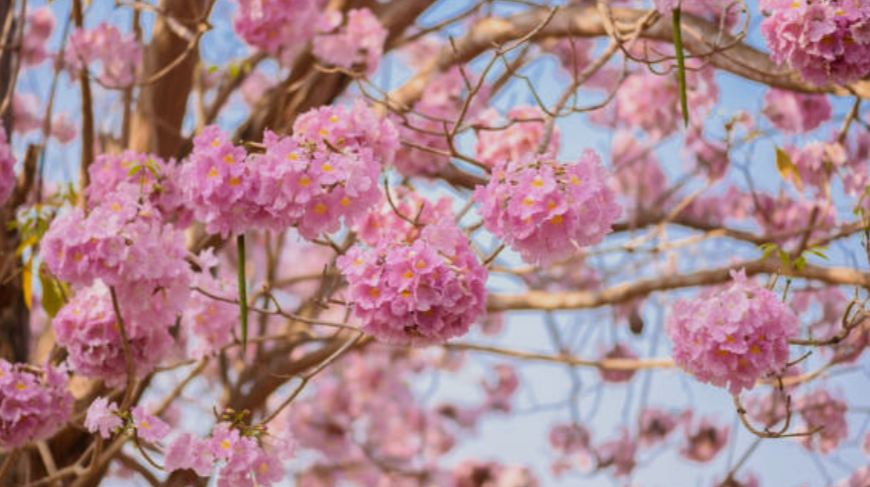
In its native forests, the rosy trumpet tree can grow to about 100 feet tall, with a trunk up to 3 feet across. In landscapes it is usually much smaller, often 30 to 50 feet tall, with a broad, irregular crown and a few thick, layered branches. The bark is gray to grayish brown and becomes furrowed with age.
The leaves are palmately compound, with 5 leaflets spreading from the end of a long stalk like the fingers of a hand. The center leaflet is the largest. The flowers are trumpet-shaped, about 2 to 3 inches long, with 5 ruffled lobes. They range from pale pink to rose, lavender, or nearly white, often with a yellow or pale throat. They grow in clusters at the branch tips. The flowers are followed by long, slender pods that split open to release papery, winged seeds carried by the wind.
How to Tell It From Other Pink Trumpet Trees
The rosy trumpet tree is easy to confuse with the South American pink trumpet tree, also called purple tabebuia or pink ipe, since both have pinkish-purple trumpet flowers. The difference shows up on close inspection. On the South American species, the leaf veins, the flower’s base, and the outside of the petals are covered with fine hairs. On the rosy trumpet tree, these surfaces are covered with tiny, flat scales instead.
The cup at the base of the flower is another clue. On the rosy trumpet tree it is 2-lipped. On the South American pink trumpet tree it ends in 5 small teeth. Overall size helps as well. The rosy trumpet tree usually grows larger and more open, while the South American species tends to stay smaller and more compact in landscapes.
Bloom Season
Across its native range, the rosy trumpet tree blooms during the dry season. In Central America that generally falls between January and April. Many trees drop their leaves first, so the flowers appear on bare branches and the whole crown turns pink. In some years and climates the tree blooms again after rain, and in the humid tropics it may flower several times a year.
The bloom is short but spectacular, usually lasting a few weeks. Fallen flowers often form a pink carpet beneath the tree. Bees, hummingbirds, and other pollinators visit the blooms heavily, and the seed pods ripen soon after flowering ends.
Where It Grows in the United States
The rosy trumpet tree is a true tropical tree with little tolerance for cold. In the United States, it is suited to frost-free and nearly frost-free areas, roughly USDA zones 10 and 11. That includes South Florida, the Florida Keys, Hawaii, Puerto Rico, and the U.S. Virgin Islands. It is occasionally planted in sheltered sites in Central Florida, such as the downtown tree walk in Tavares. Frost can damage young trees and flower buds there.
In marginal areas, young trees should be protected during cold snaps, and a warm, sheltered planting site makes a big difference. Gardeners farther north who want trumpet tree flowers usually have more success with the cold-hardier yellow trumpet trees.
Landscape Uses
The rosy trumpet tree makes an outstanding specimen tree for large yards, parks, campuses, and public spaces in tropical climates. In bloom it is one of the showiest trees in the landscape. Its open crown provides light, dappled shade the rest of the year. It is widely used as a street and avenue tree in tropical cities, where rows of trees in full bloom create a dramatic seasonal display.
Because it can grow large, it needs space. Plant it at least 15 to 20 feet from buildings, and avoid planting under power lines. Many gardeners pair it with yellow-flowered trumpet trees, royal poinciana, or jacaranda for a long season of color. Flowers and seed pods drop heavily during and after bloom, so avoid planting it right beside pools, patios, or driveways.
Growing Considerations
The rosy trumpet tree grows best in full sun. It flowers most heavily in sites with a distinct dry season, which helps trigger bloom. It tolerates a wide range of soils, from sandy to clay-loam, as long as they drain well. Poorly drained, waterlogged soils can lead to root problems.
Water young trees regularly during their first year or 2 while their roots establish. Once established, the rosy trumpet tree is fairly drought-tolerant, though it grows faster and stays healthier with occasional deep watering during long dry periods. Light fertilizing in spring and summer supports healthy growth, but too much fertilizer can produce leafy growth at the expense of flowers.
Propagation and Pruning
The rosy trumpet tree is usually grown from seed. Its winged seeds are short-lived and should be sown fresh, soon after the pods split. They germinate quickly in warm conditions. Seedlings grow fast, but trees grown from seed may take several years to flower. Some nurseries also propagate trees by grafting or air-layering to get earlier blooms or particular flower colors.
Young trees benefit from structural pruning to develop a strong central trunk and well-spaced branches. Remove competing leaders and crossing or crowded branches while the tree is young. For street trees, remove low branches gradually to provide clearance. Mature trees need little pruning beyond removing dead, damaged, or weak branches. That is best done after flowering, so next year’s bloom isn’t lost.
Wood and Traditional Uses
The rosy trumpet tree is valued as a timber tree throughout Central and South America. Its wood is moderately heavy, strong, and attractive, with a grain often compared to oak. It is used for furniture, cabinetry, flooring, boat building, tool handles, and general construction. In some countries it is grown in plantations and agroforestry systems for both timber and shade.
The bark and leaves have long been used in traditional medicine across the region. Researchers have studied extracts of the tree for possible medicinal properties. Like the bark of other trumpet trees, it contains naturally occurring compounds that can be harmful in large amounts. It should not be used as a home remedy without medical advice.
A Note on Planting Responsibly
The rosy trumpet tree produces large numbers of wind-dispersed seeds and grows quickly, so it can spread outside cultivation in some tropical climates. Several related trumpet trees have naturalized in Hawaii and the Caribbean. Before planting, gardeners in Florida, Hawaii, and other tropical areas should check with their local extension office or invasive plant council for current guidance.
When planted thoughtfully, the rosy trumpet tree is one of the most rewarding flowering trees for frost-free climates.
Sources
National Parks Board Singapore, “Flora & Fauna Web: Rosy Trumpet Tree”
Hong Kong Greening, Landscape and Tree Management Section, “Rosy Trumpet Tree, Pink Tecoma”
European and Mediterranean Plant Protection Organization, “Global Database: Rosy Trumpet Tree”
Food and Agriculture Organization of the United Nations, “Ecocrop: Rosy Trumpet Tree”
University of Florida IFAS Gardening Solutions, “Trumpet Trees”