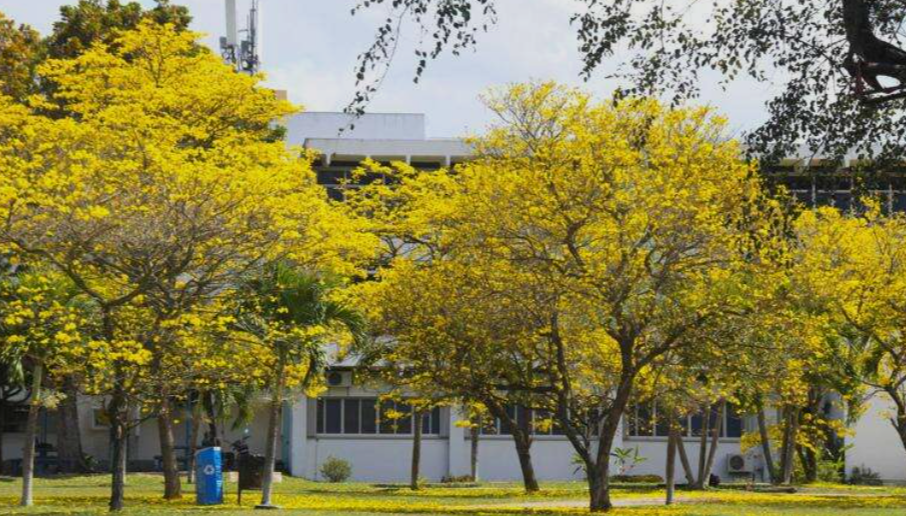
Yellow Poui: Trinidad’s Dry-Season Gold and One of the World’s Hardest Woods
The yellow poui is the tree that tells Trinidad and Tobago the rains are coming. Near the end of the long dry season, these tall trees drop their leaves and cover themselves in clouds of brilliant yellow trumpet flowers. They light up the hillsides of Trinidad’s Northern Range and towns and villages across both islands. Trinbagonians compare poui season to the cherry blossom season in Japan, a brief and much-anticipated burst of color that people gather to photograph and admire.
The yellow poui is also one of the most valuable timber trees in the Americas. Its wood, sold as ipe, is so hard, heavy, and rot-resistant that it has been used for bridges, railway ties, docks, and boardwalks around the world. That demand has taken a toll on wild populations. Today the yellow poui is considered endangered, and international trade in its timber is regulated.
Botanical Classification
The yellow poui belongs to the bignonia family, which includes jacaranda, catalpa, trumpet creeper, and all the trumpet trees. In 2007, a DNA study split the trumpet trees into separate genera. The yellow poui was placed with the golden trumpet tree, the araguaney, the lavender trumpet tree, and other species known for extremely hard, dense wood. Its scientific name refers to the toothed, or serrated, edges of its leaflets.
It goes by many common names. In the English-speaking Caribbean it is the yellow poui. In Florida it is often called the yellow trumpet tree. In the timber trade it is yellow ipe, and in South America it is known as pau d’arco, ipê amarelo, yellow lapacho, and tajibo amarillo. In Guyana and Suriname it is sometimes called cogwood or groenhart. That name causes confusion, because “greenheart” is also the name of an unrelated Guyanese timber tree.
Brief History
The yellow poui is native to tropical South America, from Bolivia and Brazil north through Peru, Ecuador, Colombia, Venezuela, and the Guianas to Trinidad and Tobago, with some populations in Central America. In Trinidad it is especially common in the island’s northern forests. Its hard, durable wood has been used for centuries for house posts, tools, and construction throughout its range.
In the 20th century, yellow ipe became an international commodity. It was exported for heavy construction, marine work, railway ties, and later for luxury decking and boardwalks in North America and Europe. Heavy logging led to steep declines in wild populations. The species is now listed as endangered by the International Union for Conservation of Nature. International trade in its timber is controlled under the Convention on International Trade in Endangered Species, known as CITES.
Identifying Characteristics
In its native forests, the yellow poui is a large tree, reaching up to about 120 feet tall. Its trunk can grow up to about 10 feet across. The trunk is usually straight and tall, often with large buttresses at the base. In Florida landscapes it is much smaller, typically 25 to 40 feet tall. The bark is smooth and grayish tan.
The leaves are palmately compound, with 3 to 5 leaflets spreading from the end of a long stalk. The center leaflet is the largest, about 6 to 10 inches long, and the leaflets have toothed edges. The flowers are a clear, brilliant yellow, with frilly, crinkled petals and a brown, hairy base. They grow in dense clusters at the branch tips. The flowers are followed by long, slender seed pods that split open to release many papery, winged seeds carried by the wind.
Poui Season in Trinidad and Tobago
In Trinidad and Tobago the dry season usually runs from about January to May, and poui season comes near its end. The yellow poui drops its leaves during the dry season and blooms in bursts, often several times over a few weeks. Along with the pink poui, its rosy-flowered cousin, it is one of the jewels of the dry season. Hillsides scorched brown by drought and bush fires are suddenly dotted with gold.
Each burst of bloom lasts only a few days, which adds to its appeal. Islanders traditionally associate the poui bloom with Easter and with the coming of the rains. When the rains arrive, the trees put out fresh new leaves and the hillsides turn green again. For many Trinbagonians, poui season is a cherished reminder that everything has its season.
Yellow Poui Versus Other Yellow Trumpet Trees
Several yellow trumpet trees look much alike in bloom, and nurseries often mix up their names. Leaves and size are the best clues. The yellow poui has relatively large, smooth leaflets with toothed edges, and it grows into a much larger tree in the wild than its relatives. The golden trumpet tree from Brazil has smaller, fuzzy, golden-haired leaves and stays smaller. The silver trumpet tree has silvery, leathery leaves with smooth edges.
The araguaney, Venezuela’s national tree, is a close relative with similar yellow flowers. It typically grows in drier forests and savannas than the yellow poui, which prefers moist evergreen lowland forests. All of these trees are sometimes sold simply as “yellow trumpet tree,” so gardeners who want a specific one should check the plant tag or ask the nursery.
Also Read: Different Types of Trumpet Trees
Where It Grows in the United States
In the United States, the yellow poui is grown mainly in South Florida, Puerto Rico, the U.S. Virgin Islands, and Hawaii. These are frost-free areas, roughly USDA zones 10 and 11. The University of Florida reports that it is commonly planted in Florida as an ornamental landscape and shade tree. Its bright yellow flowers are especially admired because they open on leafless branches.
Like other tropical trumpet trees, the yellow poui is sensitive to frost. Young trees can be killed by freezing temperatures, and cold snaps can damage flower buds on older trees. Gardeners at the edge of its range should plant in warm, sheltered sites and check with their county extension office about which yellow trumpet trees grow best locally.
Landscape Uses
The yellow poui makes an excellent shade and specimen tree for large yards, parks, campuses, and streets in warm climates. In Florida it usually stays a manageable 25 to 40 feet tall, providing light shade most of the year and a dramatic display of yellow flowers in late winter and spring.
One of its greatest strengths is its salt tolerance. The University of Florida notes that the yellow poui has relatively high tolerance to salt spray. That makes it a good street tree or yard specimen in coastal areas, where many flowering trees struggle. It pairs well with pink and lavender trumpet trees, which bloom at about the same time, and with palms and other salt-tolerant tropical plants.
Growing Considerations
The yellow poui grows best in full sun, which produces the heaviest flowering. It tolerates a range of well-drained soils, including sandy coastal soils. It does not tolerate waterlogged sites. Water newly planted trees regularly during their first year or 2 to help them establish. Once established, the yellow poui is drought-tolerant, which makes it easier to care for and less demanding on water resources.
Light fertilizing in spring supports healthy growth, but heavy fertilizing is unnecessary and can reduce flowering. Because the yellow poui can grow large, give it plenty of room. Plant it at least 15 to 20 feet from buildings and away from power lines. Its pollen is moderately allergenic, which may matter to people with seasonal allergies.
Propagation and Pruning
The yellow poui is usually grown from seed. The winged seeds should be sown fresh, soon after the pods split, since they lose their viability quickly. They germinate readily in warm, moist conditions. Seedlings may take several years to begin flowering. Some nurseries propagate the tree by grafting to produce flowering plants sooner.
Young trees benefit from structural pruning to develop a strong central trunk and well-spaced branches. Remove competing leaders and crossing or weak branches while the tree is young. Mature trees need little pruning beyond removing dead or damaged branches, which is best done after flowering.
The Ipe Wood Trade
Yellow ipe is one of the hardest and heaviest commercial woods in the world. Its heartwood is yellowish green when freshly cut and dries to light or dark olive brown, often with darker streaks. It is extremely strong and durable, and it naturally resists rot and insects. The bark and wood contain natural compounds, including lapachol, that contribute to that durability. One weakness is marine borers, the shipworms and other mollusks and crustaceans that can damage the wood in warm saltwater.
For decades, yellow ipe was used for bridges, house posts, railway ties, docks, boardwalks, flooring, tool handles, and outdoor decking. Its popularity, especially for luxury decks and boardwalks in North America and Europe, fueled heavy logging in South American forests. Today the species is endangered, and its timber trade is regulated under CITES. Shoppers considering ipe lumber should look for wood certified as legally and sustainably harvested. Many conservationists suggest choosing other durable decking materials instead.
Sources
University of Florida IFAS Extension, “Yellow Trumpet Tree”
University of Florida IFAS Gardening Solutions, “Trumpet Trees”
National Tropical Botanical Garden, “Tropical Plant Database: Yellow Poui”
World Agroforestry Centre, “Agroforestry Database: Yellow Poui”