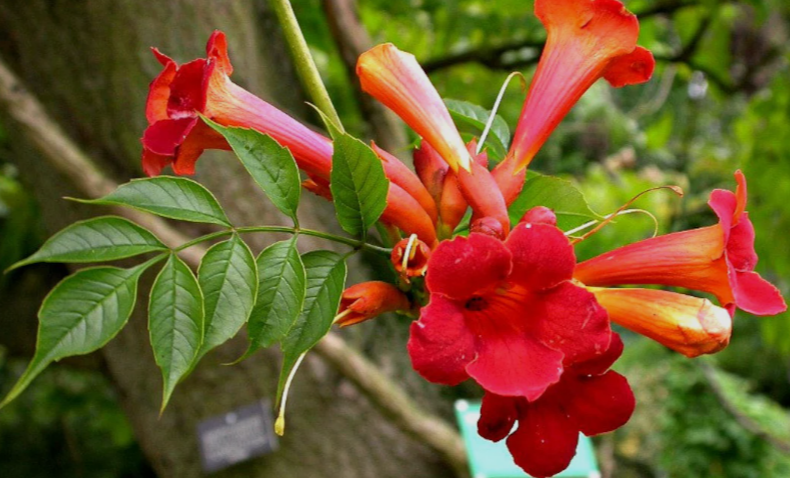
The red trumpet tree, also called the blood-red trumpet tree, is one of the rarest and most unusual trumpet trees in the world. Most of its relatives bloom in pink, yellow, or white, but this small tree bears clusters of deep blood-red to magenta tubular flowers. It grows wild only on the island of Puerto Rico, where it is known as roble cimarrón, roble colorado, or roble bobo. Few gardeners in the mainland United States have ever seen it.
Its rarity is part of its appeal. The species is listed as threatened, and much of its original habitat in Puerto Rico has been cleared. Since the early 2000s, U.S. Department of Agriculture scientists have collected its seeds to preserve the species. They are also studying it as a possible new flowering tree for gardens in Florida and other warm parts of the country.
Botanical Classification
The red trumpet tree belongs to the bignonia family, alongside jacaranda, catalpa, trumpet creeper, and the many pink and yellow trumpet trees. It is one of the trumpet trees that stayed in the original genus when botanists divided the group in the 2000s. Its closest relatives include the Caribbean pink trumpet tree, the rosy trumpet tree, and the silver trumpet tree.
It is endemic to Puerto Rico, meaning it grows naturally nowhere else on Earth. Its English names, blood-red trumpet tree and red trumpet tree, come from its flower color. Its Spanish name, roble cimarrón, roughly means “wild oak.” That follows the Caribbean custom of calling trumpet trees “roble,” or oak, because of their hard, durable wood.
Brief History
The red trumpet tree evolved in the dry hills and limestone forests of southwestern Puerto Rico. Botanists described it in the early 1800s. It was once fairly common within its small range, but centuries of land clearing for farming, grazing, and development destroyed much of the island’s original forest. Today, wild populations survive mostly in scattered patches within forest reserves.
In 2003, scientists from the USDA Agricultural Research Service began exploring Puerto Rico for native plants with garden potential. Horticulturist Tomás Ayala-Silva and plant geneticist Alan Meerow, based at the agency’s Subtropical Horticulture Research Station in Miami, made several trips to collect red trumpet tree seeds from different populations. The seeds were deposited at the National Germplasm Repository in Miami. They are preserved there for conservation and for future breeding of improved garden selections.
Identifying Characteristics
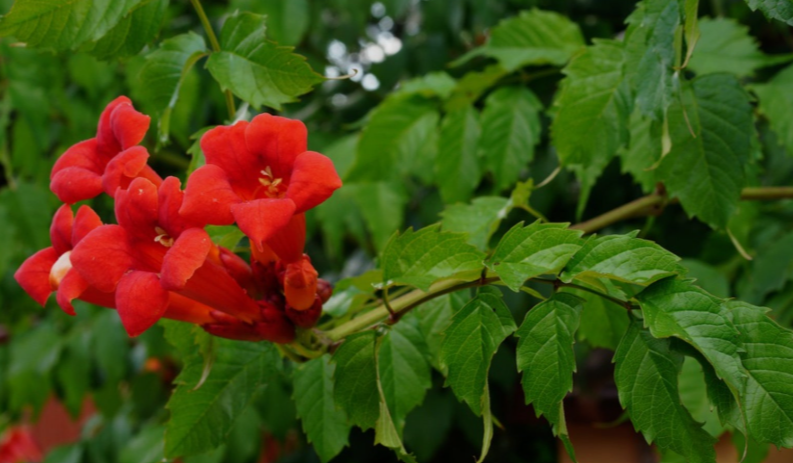
The red trumpet tree is a shrub or small tree. In the wild it usually grows 10 to 16 feet tall, and occasionally up to about 26 feet. Trunks are slender, usually no more than about 6 inches across. Young plants generally grow on a single stem but may branch after damage from fire or browsing. The crown is narrow and upright, which makes the tree well suited to small spaces.
Unlike most trumpet trees, the red trumpet tree is evergreen. It keeps its leaves while flowering instead of dropping them first. The leaves are compound, with several smooth-edged, oval leaflets about 1 to 6 inches long. New growth emerges red to bronze before maturing to green. The flowers are tubular, about 1¼ to 2 inches long, with 5 slightly irregular lobes. They range from deep blood red to magenta, sometimes with a yellow throat. The flowers are followed by slender seed pods about 2½ to 4½ inches long, which split to release papery, winged seeds.
Also Read: Different Types of Trumpet Trees
Bloom Season
One of the red trumpet tree’s most valuable traits is its long flowering season. Most trumpet trees put on a single dramatic display of a few weeks. The red trumpet tree blooms on and off for much of the year. Clusters of red flowers appear at the branch tips among the green leaves, giving the tree color over a long period.
Because the leaves stay on during bloom, the effect is different from the bare-branched displays of pink and yellow trumpet trees. The red flowers stand out against the dark foliage and the red-bronze new growth. Hummingbirds and other nectar-feeding birds are drawn to the tubular blooms.
Native Habitat
In Puerto Rico, the red trumpet tree grows mainly in the dry southwestern part of the island. That region receives much less rain than the island’s lush northern and eastern mountains. It grows on dry hillsides, rocky slopes, and limestone and serpentine soils, often in open scrub and dry forest alongside other drought-tolerant trees and shrubs.
These harsh conditions shaped the tree’s character. It tolerates heat, drought, poor rocky soils, and strong sun. That makes it a promising ornamental for hot, dry coastal landscapes in South Florida and other subtropical regions.
Conservation Status
The red trumpet tree is considered threatened. It is listed on the International Union for Conservation of Nature’s Red List of threatened species, along with more than 60 other trumpet tree species. Habitat loss is the main threat, and the species survives in a limited number of locations.
Protecting the remaining wild populations in Puerto Rico’s forest reserves is essential to its survival. Seed collections like the one held by the USDA in Miami serve as an insurance policy. If the tree becomes more widely grown in gardens, cultivation could also help reduce pressure on wild plants and raise awareness of Puerto Rico’s unique native flora.
How It Differs From Other Trumpet Trees
The red trumpet tree is easy to tell apart from other trumpet trees. Its flower color is the most obvious difference. Pink, rosy, and silver trumpet trees have pink, lavender, or yellow flowers, while the red trumpet tree has deep red to magenta flowers. Its flowers are also narrower and more tubular than the wide, bell-shaped flowers of most trumpet trees.
Its evergreen foliage and long bloom season set it apart as well. Pink and yellow trumpet trees usually drop their leaves before blooming and flower for only a few weeks. The red trumpet tree keeps its leaves and blooms on and off for much of the year. It is also smaller and narrower than most trumpet trees, generally staying under 20 feet in cultivation.
Growing in the United States
The red trumpet tree is a tropical species suited to frost-free climates, roughly USDA zones 10 and 11. It grows naturally in Puerto Rico, the only place in the United States where it is native. It is grown occasionally in South Florida and Hawaii. Specimens are planted in botanical gardens such as Kapiʻolani Park in Honolulu. Plants can be hard to find, though some specialty tropical nurseries offer them.
In marginal areas, protect young trees from frost, and plant them in a warm, sheltered site. Cold snaps can damage foliage and flower buds even when they don’t kill the tree.
Landscape Uses
The red trumpet tree’s small size and narrow crown make it a good choice for small yards, courtyards, patios, entryways, and narrow planting spaces. It also does well in large containers. It is a natural fit for hummingbird gardens, tropical gardens, and native and rare-plant collections. In Puerto Rico it is an excellent choice for native landscaping.
Plant it where the flowers can be seen up close, such as near a patio, window, or walkway. Because it stays fairly narrow and evergreen, it can serve as a small screen or accent tree. It pairs well with other drought-tolerant tropical plants, such as palms, agaves, bromeliads, and native Caribbean shrubs.
Growing Considerations
The red trumpet tree grows best in full sun, which produces the most flowers and the most compact growth. It needs well-drained soil and tolerates sandy, rocky, and alkaline soils. It does not tolerate waterlogged or poorly drained conditions. Raised beds or slopes work well where drainage is a concern.
Water newly planted trees regularly during their first year to help them establish. Once established, the tree is quite drought-tolerant and needs watering only during long dry spells. A light application of a balanced, slow-release fertilizer in spring and summer supports healthy growth. Heavy fertilizing is unnecessary and can reduce flowering.
Propagation and Pruning
The red trumpet tree is usually grown from seed. The winged seeds are short-lived, so sow them fresh, soon after the pods split. They germinate readily in warm, moist conditions. Seedlings grow slowly at first and may take several years to bloom. Some growers also propagate the tree from cuttings or by grafting to produce flowering plants sooner.
The tree naturally grows with a narrow, upright form and needs little pruning. Light pruning after a flush of flowers helps shape the tree and encourages bushier growth. Remove dead, damaged, or crossing branches as needed. Avoid heavy pruning, which can reduce flowering.
Hybrids and Future Prospects
Plant breeders see real promise in the red trumpet tree’s bold color, evergreen leaves, and long bloom season. One hybrid, ‘Carib Queen’, crosses the red trumpet tree with the Cuban pink trumpet tree. It combines red-trumpet traits with the larger flowers of its pink parent. USDA researchers hope to select and breed red trumpet tree plants with better form and larger flowers for gardens in Florida and other subtropical regions.
As interest in native and rare plants grows, the red trumpet tree may become a more familiar sight in warm-climate gardens. For now, it remains a rare treasure.
Sources
USDA Agricultural Research Service, “Puerto Rico Provides New Ornamental Options”
USDA Agricultural Research Service, “Agricultural Research Magazine: Island Treasures”
European and Mediterranean Plant Protection Organization, “Global Database: Blood-Red Trumpet Tree”
Université du Québec à Rimouski, “Trees of North America: Blood-Red Trumpet Tree”
University of Florida IFAS Gardening Solutions, “Trumpet Trees”