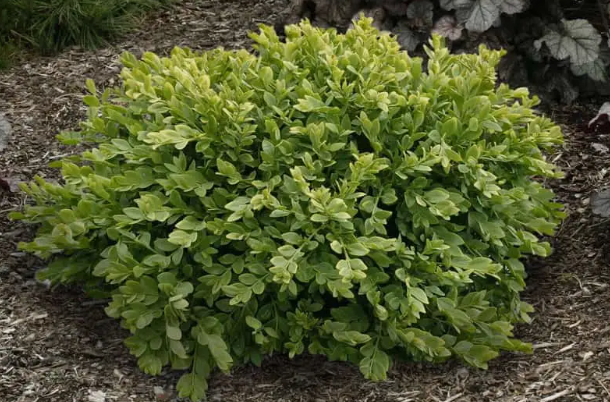
Korean boxwood is the cold-hardy member of the boxwood family. It brings the neat, small-leaved look of boxwood to northern gardens where many other boxwoods die back in winter. With its low, spreading habit and tolerance of harsh cold, it has become a go-to shrub for hedges and edging in the northern United States and Canada.
It is also one of the most important boxwoods in modern breeding. Many popular hybrid boxwoods owe their cold hardiness to Korean boxwood, and several of its cultivars offer good resistance to boxwood blight. For gardeners in cold climates, it is often the most reliable boxwood choice.
Botanical Classification
Korean boxwood belongs to the box family, a small group of evergreen shrubs that also includes pachysandra and sweet box. It is a variety of a small-leaved Asian boxwood species and was once grouped with littleleaf boxwood. Today, most botanists treat it as a variety of a Chinese boxwood species, though nurseries still use the simple name Korean boxwood.
It differs from common boxwood, which comes from Europe, and from Japanese boxwood, which is better suited to warm climates. Korean boxwood is distinguished by its smaller leaves, lower spreading habit and much greater cold hardiness.
Brief History
Korean boxwood grows wild on mountain slopes and islands in Korea and in parts of eastern China. It survives cold winters and dry winds in its native range, which helps explain its toughness in gardens.
It was introduced to North America in the early 1900s. Its value became clear in colder regions where common boxwood suffered winter damage. In the mid-1900s, breeders in Ontario, Canada, crossed Korean boxwood with common boxwood to create a group of hardy hybrids. These hybrids, including Green Velvet, Green Mountain, Green Mound and Green Gem, are now among the most popular boxwoods in North America.
Identifying Characteristics
Korean boxwood has small, oval to rounded leaves about a quarter to half an inch long. They are medium green and slightly less glossy than those of Japanese boxwood. The leaves grow in pairs on opposite sides of the stem, packed closely together.
In winter, the leaves of many Korean boxwoods turn bronze, brown or yellowish, especially in sun and wind. They usually green up again in spring. Some cultivars have been selected to hold their green color better through winter.
The plant grows into a low, spreading mound. Most Korean boxwoods reach about 2 to 3 feet tall and 3 to 4 feet wide. It grows slowly, often only a few inches a year, and has an open, somewhat loose shape when young that becomes denser with age.
In early spring, it produces tiny, fragrant, pale yellow-green flowers. They attract bees but are easy to miss among the leaves. Small seed capsules follow in summer.
Also Read: Japanese Boxwood
Landscape Uses
Korean boxwood is ideal for low hedges and edging in cold climates. Its compact size and slow growth make it easy to keep neat. It is often planted along walkways, garden beds and driveways.
It also works well in foundation plantings, where its low, mounding form fits under windows. Gardeners shape it into small balls and low topiary. It suits containers in milder areas, though potted plants need winter protection in very cold regions.
Like other boxwoods, it is deer-resistant. All parts of the plant are toxic if eaten, so it should be kept away from pets and livestock.
Growing Considerations
Korean boxwood is hardy from about USDA zone 4 to zone 8, and some cultivars survive zone 4 winters with little damage. It is one of the best boxwoods for the Upper Midwest, New England, the northern Plains and southern Canada.
It grows in full sun to partial shade. In cold climates, a site sheltered from strong winter wind and late-afternoon winter sun helps prevent leaf bronzing and burn. In hotter regions, afternoon shade is helpful.
Good drainage is essential. Boxwood roots rot in soggy soil, so plant Korean boxwood in loose, well-drained ground enriched with compost. It prefers slightly acidic to neutral soil, around pH 6.5 to 7.0.
Its roots are shallow, so a thin layer of mulch, about 1 to 2 inches, helps keep them moist and protected in winter. Keep mulch away from the stems. Water deeply in fall before the ground freezes, since evergreen leaves continue to lose moisture through winter.
Pruning and Care
Korean boxwood needs only light pruning because of its slow growth. Trim it in late spring after new growth hardens. Avoid pruning in late summer or fall, which can trigger soft growth that is damaged by frost.
Thinning a few interior branches each year lets in light and air and helps prevent disease. Light fertilizer in spring is helpful if growth is weak or leaves look pale. Avoid heavy feeding, which can encourage soft growth.
In very cold or windy sites, gardeners sometimes wrap young plants in burlap for the winter. This helps reduce winter burn and damage from snow and ice.
Pests and Diseases
Korean boxwood is generally tougher than English boxwood, but it can still face problems. Boxwood blight, a fungal disease first found in the United States in 2011, causes leaf spots, black streaks on stems and rapid leaf drop. Several Korean boxwood cultivars, including Wintergreen and Nana, show good resistance to blight.
The boxwood leafminer is a common pest. Its larvae tunnel inside leaves, causing yellow or brown blisters. Some Korean boxwood cultivars, such as Wintergreen and Nana, also resist leafminer well.
Other pests include spider mites and boxwood psyllids. Root rot can occur in wet soils. Winter bronzing, while not a disease, is common in exposed sites.
The invasive box tree moth has spread across Europe and into parts of North America, including southern Canada and the Great Lakes region. Its caterpillars can strip boxwoods of their leaves, so gardeners should watch for webbing and chewed foliage in late spring and summer.
Popular Cultivars
Wintergreen is the most popular Korean boxwood. It has small, bright green leaves that hold their color better in winter than many other boxwoods. It grows into a rounded shrub about 3 to 4 feet tall and has good resistance to boxwood blight and leafminer.
Nana is a compact, low-growing form that stays about 2 feet tall. It is among the most blight-resistant boxwoods and is often recommended for new plantings. Tide Hill is another low, spreading selection that forms a dense mat.
The Ontario hybrids bred from Korean boxwood, including Green Velvet, Green Mountain, Green Mound and Green Gem, combine its cold hardiness with the fuller look of common boxwood. These hybrids are now among the most popular boxwoods in North America, though some are susceptible to blight or leafminer.
Korean Boxwood vs. Japanese Boxwood
Korean and Japanese boxwood are often compared. Korean boxwood is much hardier and survives winters as cold as zone 4, while Japanese boxwood does best in zones 6 to 9. Japanese boxwood grows faster, has larger and glossier leaves and handles heat and humidity better.
Korean boxwood is lower and more spreading, while Japanese boxwood forms a taller, rounder shrub. In cold northern gardens, Korean boxwood is usually the better choice. In hot southern gardens, Japanese boxwood often performs better.
Sources
Virginia Tech, “Boxwood Blight Resistant and Susceptible Cultivars”
Virginia Tech, “Boxwood (Buxus species)”
Cornell University, “Woody Plants Database: Boxwood”
North Carolina State University, “Susceptibility of Commercial Boxwood Cultivars to Boxwood Blight”