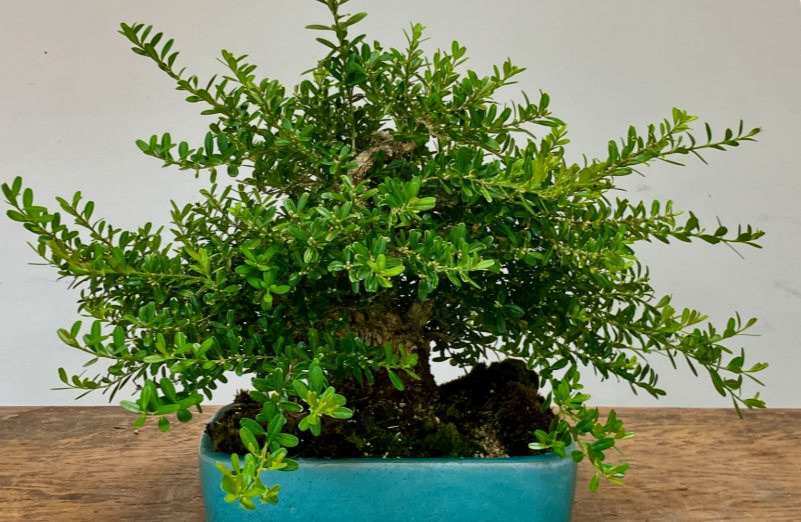
Harland boxwood is a small, heat-loving boxwood from southern China. Its narrow, bright green leaves and upright, vase-shaped form set it apart from the rounded boxwoods common in American gardens. It is especially valued in the southern United States, where many other boxwoods struggle with summer heat and humidity.
This compact evergreen is also one of the best boxwoods for bonsai and container growing. Its fine leaves, corky bark and tolerance of warm conditions make it popular with bonsai growers worldwide. It also ranks among the boxwoods most resistant to boxwood blight, a disease that has damaged many traditional boxwood plantings.
Botanical Classification
Harland boxwood belongs to the box family, a small group of evergreen shrubs that also includes pachysandra and sweet box. It is a distinct species from common boxwood, which comes from Europe, and from littleleaf, Japanese and Korean boxwood, which come from Japan, Korea and other parts of Asia.
It is easy to recognize by its long, narrow leaves, which look quite different from the oval or rounded leaves of most boxwoods. There is some confusion in the nursery trade, however. Some plants sold as Harland boxwood in the American South may actually be a related Chinese boxwood, so plants from different sources can vary slightly in leaf shape and size.
Brief History
Harland boxwood grows wild in coastal southern China, including Guangdong province, Hong Kong and Hainan Island, and reaches into northern Vietnam. It grows naturally in open woodlands, along streams and on rocky hillsides. Its tolerance for heat and seasonal dry spells reflects these warm, subtropical habitats.
It was first described by Western botanists in the 1800s, after plant collectors working in southern China sent specimens to Europe. Over the following century, it became more widely grown as an ornamental shrub. In recent decades, its heat tolerance and disease resistance have made it increasingly popular in the American Southeast and Gulf Coast.
Identifying Characteristics
The most distinctive feature of Harland boxwood is its leaves. They are long, narrow and up to about 1.25 inches long. Each leaf is bright to dark glossy green, slightly leathery and usually has a small notch at the tip. The leaves are thinner than those of most other boxwoods.
The plant grows into a small, upright shrub with a vase-shaped or flat-topped form. Most plants reach about 2 to 3 feet tall and wide, though older plants can grow larger in good conditions. It grows slowly, often only 2 to 3 inches a year.
Its bark becomes corky and fissured with age, adding character to older plants and bonsai. In spring, it produces small, fragrant, pale yellow-green flowers. On some plants, these flowers appear in more noticeable clusters than on most boxwoods.
In cold winters, its leaves can bronze or yellow, especially in exposed, windy sites. This color usually fades back to green in spring.
Landscape Uses
Harland boxwood makes an excellent low hedge or edging plant in warm climates. Its upright, narrow habit gives a slightly different look than the round mounds of English or Japanese boxwood. It is often used along walkways, in foundation plantings and around patios.
It is also an outstanding container plant. Its small size and fine texture suit urns, planters and window boxes. In the Deep South, it can be grown in containers year-round outdoors.
Harland boxwood is one of the most popular boxwoods for bonsai. Its small leaves stay in proportion to miniature trunks, and its corky bark gives bonsai an aged appearance. It also tolerates warm indoor conditions better than many boxwoods, so it is often sold as an indoor bonsai.
Like other boxwoods, it is deer-resistant. All parts of the plant are toxic if eaten, so it should be kept away from pets and livestock that might chew on it.
Growing Considerations
Harland boxwood is generally hardy in USDA zones 7 to 9, and some plants grow in zone 10. It is less cold-hardy than common, Korean or littleleaf boxwood. In colder areas, it is best grown in containers that can be moved to a sheltered spot for winter.
It leafs out early in spring, so new growth can be damaged by late frosts in borderline areas. Planting it in a spot protected from cold winds and early morning sun helps reduce this risk.
It grows in full sun to partial shade. In the hottest regions, a little afternoon shade helps keep its leaves green. It handles heat and humidity well and tolerates summer drought once established.
Good drainage is essential. Like all boxwoods, Harland boxwood can suffer from root rot in soggy soil. It grows best in loose, well-drained soil enriched with compost. A thin layer of mulch, about 1 to 2 inches, helps protect its shallow roots, but mulch should not touch the stems.
Pruning and Care
Harland boxwood tolerates pruning well and can be sheared into hedges or shaped into small forms. Because it leafs out early and new growth is sensitive to cold, pruning is best done after the last spring frost. Light trimming through early summer keeps hedges neat.
Thinning a few interior branches each year lets light and air reach the center of the plant. This helps reduce leaf spot and other diseases. Avoid heavy pruning in late summer, which can trigger tender growth that may be damaged by early frost.
For bonsai, Harland boxwood responds well to regular pinching and wiring. It needs bright light indoors or a sheltered outdoor spot in warm months. Bonsai plants also need regular watering and light feeding during the growing season.
Pests and Diseases
Harland boxwood is one of the most disease-resistant boxwoods. It is rated among the most resistant boxwoods to boxwood blight, a fungal disease first found in the United States in 2011 that causes leaf spots, black stem streaks and rapid leaf drop. Even so, it is not completely immune, and plants can still show some symptoms in very wet, humid conditions.
It is also resistant to the boxwood leafminer, a common pest whose larvae tunnel inside the leaves of many boxwoods. This resistance makes it especially useful in areas where leafminer is a problem.
Leaf spot can occur in humid weather, and root rot is a risk in poorly drained soils. Spider mites may appear in hot, dry conditions, especially on indoor bonsai. The invasive box tree moth, which has spread across Europe and into parts of North America, can also feed on Harland boxwood.
Popular Cultivars
Harland boxwood is usually sold as the species, but one cultivar is widely available. Richard is a selection with slightly larger, more rounded leaves and a smaller, compact habit. It is rated among the boxwoods least susceptible to boxwood blight.
Richard typically grows 1 to 3 feet tall and wide and does well in zones 7 to 9. It is popular in the Southeast as a low hedge, foundation plant and container shrub. It also makes a good choice for gardeners who want a boxwood that tolerates heat and resists disease.
Harland Boxwood vs. Other Boxwoods
Harland boxwood differs from most boxwoods in several ways. Its leaves are long and narrow instead of oval or rounded, and its habit is upright and vase-shaped rather than mounded. It handles heat and humidity better than common and English boxwood.
It is less cold-hardy than Korean, littleleaf and common boxwood, so it is best for warm climates. It is also among the most resistant boxwoods to both blight and leafminer. For gardeners in the South, it is often one of the most reliable boxwood choices.
Sources
North Carolina State University, “Harland Boxwood”
Virginia Tech, “Boxwood Blight Resistant and Susceptible Cultivars”
North Carolina State University, “Susceptibility of Commercial Boxwood Cultivars to Boxwood Blight”