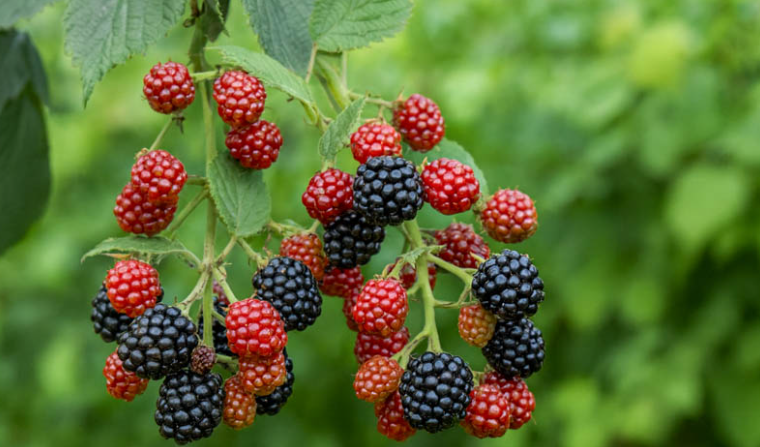
Blackberries are one of the most familiar bramble fruits, known for their deep purple-black color and juicy, tangy-sweet flavor. They grow on thorny (or sometimes thornless) canes and are technically classified as aggregate fruits, meaning each berry is made up of many tiny individual drupelets clustered together around a central core. This structure gives blackberries their signature bumpy texture and makes them easy to tell apart from single-seeded fruits like cherries or plums.
These fruits thrive in temperate climates and are often found growing wild along fences, forest edges, and roadsides, though they are also widely cultivated in home gardens and commercial farms. Blackberry canes typically produce fruit in their second year of growth, ripening from green to red before finally turning glossy black when fully mature. The plants are hardy and fast-spreading, which makes them a favorite for gardeners who want a low-maintenance fruit crop, but it also means they can become invasive if left unchecked.
Nutritionally, blackberries are packed with fiber, vitamin C, and antioxidants, making them a popular addition to smoothies, desserts, and jams. Their flavor profile balances sweetness with a slight tartness, and they hold their shape well when baked, which is why they show up so often in pies, cobblers, and preserves. Fresh blackberries are also a common topping for yogurt, oatmeal, and salads, prized both for their taste and their vibrant color.
Because of their distinctive clustered, bumpy appearance, blackberries are sometimes confused with other fruits that share a similar look but belong to entirely different plant families. Some of these lookalikes are close botanical relatives, while others simply resemble blackberries by coincidence due to their color or aggregate structure.
Fruits that Look Like Blackberries
Dewberries
Dewberries are close cousins of blackberries and can be almost impossible to tell apart from a distance. They grow on trailing, low-to-the-ground vines rather than upright canes, which is one of the easiest ways to distinguish them in the field. The berries themselves are dark purple to black, with the same clustered drupelet structure as blackberries, though they tend to ripen slightly earlier in the season.
Boysenberries
Boysenberries are a hybrid fruit, created by crossing blackberries, raspberries, and loganberries. They share the same deep purple-black color and bumpy texture as blackberries, but they are often noticeably larger and have a softer, juicier bite. Their flavor is sweeter and more complex, with a wine-like richness that sets them apart once tasted.
Marionberries
Marionberries are a specific cultivar of blackberry, so their resemblance is more than skin deep. They tend to be slightly longer and more elongated in shape compared to standard blackberries, with a glossy black finish. Their flavor is often described as deeper and more tart, making them a favorite for jams and baked goods.
Loganberries
Loganberries are another blackberry-raspberry hybrid, but unlike boysenberries, they retain a reddish-purple hue rather than turning fully black. Their shape and clustered texture closely mirror blackberries, which can lead to confusion at a glance. The flavor is notably more tart and sharp, closer to a raspberry than a blackberry.
Mulberries
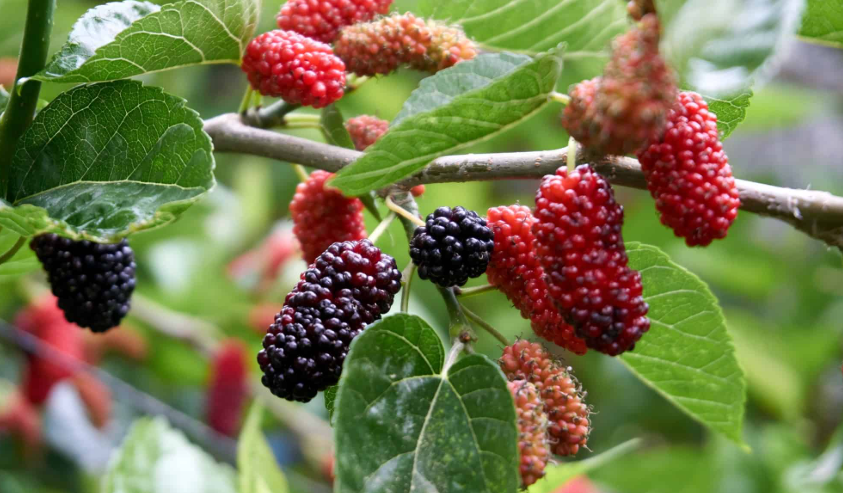
Mulberries grow on trees rather than brambles, but their long, cylindrical shape and clustered surface give them a strong visual similarity to blackberries. When fully ripe, mulberries turn a deep black-purple color that can be mistaken for blackberries in photos or at a market stall. Their flavor is milder and sweeter, without the tartness typically found in true blackberries.
Black Raspberries
Black raspberries are often confused with blackberries because of their matching dark color and bumpy, clustered appearance. The key difference lies in the core: raspberries are hollow in the center when picked, while blackberries retain their white core inside the fruit. Black raspberries also tend to be smaller and have a slightly duller, less glossy finish.
Salmonberries
Salmonberries share the same aggregate drupelet structure as blackberries, giving them a similar bumpy texture. However, they usually ripen to shades of orange, yellow, or red rather than black, which is the biggest visual giveaway. They grow on thorny shrubs in cooler, wetter climates, often found along the Pacific coast.
Wineberries
Wineberries have a similar clustered shape to blackberries but are covered in fine, reddish hairs on both the canes and the fruit itself, which is a distinguishing feature up close. When unripe, they can appear pale and even resemble a green blackberry, but they mature into a bright red rather than black. Their flavor is tart and refreshing, closer to a raspberry.
Elderberries
Elderberries grow in tight clusters on shrubby bushes, and while each individual berry is smaller and rounder than a blackberry drupelet, the overall bunch can create a similar visual effect from a distance. They ripen to a deep purple-black color that closely matches ripe blackberries. Unlike blackberries, elderberries are not eaten raw due to mild toxicity and must be cooked before use.
Blackcurrants
Blackcurrants are smooth, round, single berries that grow in small clusters on woody shrubs. While each individual currant lacks the bumpy drupelet texture of a blackberry, a full cluster of blackcurrants can create a similar dark, clustered appearance on the branch. Their flavor is sharply tart, often used in syrups, jams, and cordials rather than eaten fresh.
Chokeberries
Chokeberries, also known as aronia berries, grow in small clusters and ripen to a deep black or purple-black color that closely resembles blackberries at a glance. The individual berries are smooth and round, without the segmented drupelet texture, but their color and clustering pattern still cause confusion. Their flavor is extremely astringent and tart, which is why they are rarely eaten fresh.
Huckleberries
Huckleberries are small, round, dark purple to black berries that grow on low shrubs, often in wild or forested areas. While they lack the segmented, bumpy surface of a blackberry, their deep color and small clustered growth pattern can make them easy to mistake for blackberries from a distance. Their flavor is sweet with a slightly tart edge, often compared to a cross between a blueberry and a grape.
Bearberries
Bearberries grow low to the ground on evergreen shrubs and produce small, round berries that can appear dark red to nearly black depending on ripeness. Their clustered growth along the stem gives them a passing resemblance to blackberries, especially in photographs. The berries are mealy and mild in flavor, and are more commonly used in herbal remedies than as a fresh snack.
Serviceberries
Serviceberries, also called juneberries, ripen to a dark purple-black color and grow in loose clusters on small trees or shrubs. Individually, each berry is smooth and round rather than segmented, but the overall color and clustering can create a visual mix-up with blackberries. Their flavor is sweet and nutty, often compared to a blend of blueberry and almond.
Beautyberries
Beautyberries stand out for their vivid, glossy purple color and tight clusters that wrap directly around the stem, giving them a bramble-like appearance similar to blackberries. Unlike blackberries, the berries are perfectly round and smooth, without any segmented texture. They are technically edible but have a bland, slightly medicinal taste, and are more commonly grown as an ornamental plant than a food crop.
Blackberry Lily Seed Pods
Blackberry lilies are grown primarily as ornamental flowers, but it is their seed pods that create the blackberry resemblance. Once the pods dry out and split open, they reveal tight clusters of shiny black seeds that look remarkably like a cluster of blackberry drupelets. These seed clusters are not a true fruit and are not eaten, but their visual similarity is strong enough that they are often mistaken for berries in garden photos.
Pokeweed Berries
Pokeweed produces small, round berries that hang in long clusters along a reddish stem, ripening to a deep purple-black that closely mirrors ripe blackberries. Each individual berry is smooth rather than segmented, but the dense, drooping clusters can look strikingly similar to bramble fruit from a distance. Pokeweed berries are toxic if eaten raw and are not used as a food source, making correct identification especially important.
Virginia Creeper Berries
Virginia creeper is a climbing vine often found on fences and tree trunks, and it produces small clusters of dark blue-black berries in late summer. The berries grow in loose bunches on reddish stalks, giving them a passing resemblance to blackberries, especially once the vine’s leaves turn red in autumn. These berries are not edible for humans and are primarily a food source for birds.
Oregon Grape Berries
Oregon grape is an evergreen shrub that produces small, round berries in tight clusters, ripening to a dusty blue-black color reminiscent of blackberries. The berries grow close together along the stem, and their color can create confusion at a glance, though the individual berries are smooth rather than bumpy. Their flavor is very tart and seedy, and they are more commonly used in jellies than eaten fresh.
Juniper Berries
Juniper berries are technically small cones rather than true berries, but their round shape and blue-black, slightly bumpy surface give them a passing resemblance to blackberries. They grow scattered along evergreen juniper branches rather than in tight clusters, which is one way to tell them apart on the plant. Their flavor is sharp, resinous, and aromatic, and they are most commonly known as a flavoring for gin rather than a fresh snack.
Chokecherries
Chokecherries grow in long, hanging clusters on small trees or shrubs, ripening from red to a dark purplish black that closely resembles blackberries in photos. Each berry is round and smooth rather than segmented, but the dense clustering along the stem creates a similar visual pattern. The fruit is extremely astringent when raw and is typically cooked down into syrups, jellies, or wine rather than eaten fresh.