David Viburnum: The Turquoise-Berried Evergreen and the Secret to Getting It to Fruit
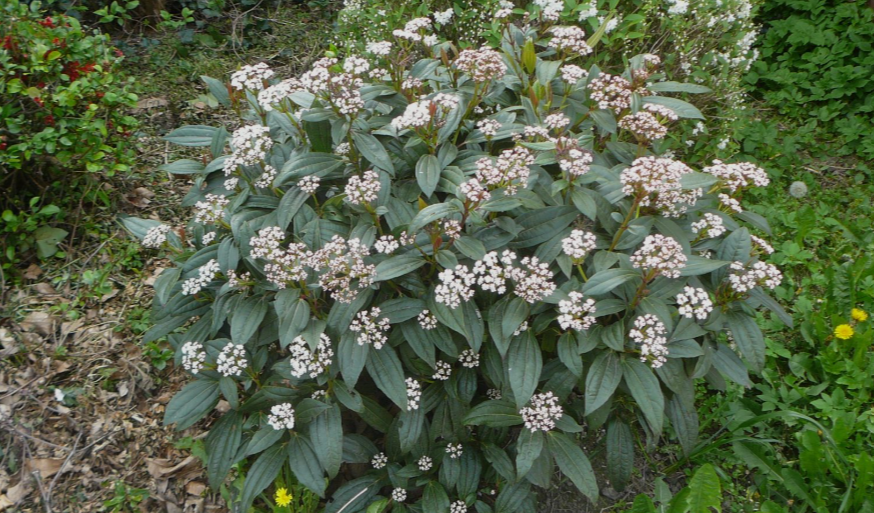
David viburnum is one of the most distinctive evergreen shrubs in temperate gardens. It is prized for 2 features no other common landscape shrub quite matches. The first is its foliage. The thick, leathery, dark blue-green leaves are carved with 3 deep, parallel veins that run the length of each leaf, which gives the plant a bold, sculptural texture year-round. The second is its fruit. In autumn, clusters of small berries ripen to an extraordinary metallic turquoise-blue on bright red stalks, and they often last through winter. Few garden plants produce fruit of this color.
David viburnum is also famous for frustrating gardeners. Many people plant a few shrubs, enjoy the foliage for years, and never see a single blue berry. The reason has to do with the plant’s unusual pollination biology, and it is easy to fix once understood. This guide covers the shrub’s history, how to identify it, why it often fails to fruit and how to solve that, how to grow it in different climates, and the new hybrids that bring its beauty to hotter regions.
Botanical Classification
David viburnum is a low, broad-leaved evergreen shrub in the viburnum genus, a group of roughly 150 to 175 species of shrubs and small trees found mostly in the Northern Hemisphere. Like other viburnums, it has been placed in several plant families over the years. Older references list the honeysuckle family, others the moschatel family, and current systems give viburnums their own family. It belongs to a group of Asian evergreen viburnums known for leathery, strongly veined leaves.
Its closest relatives include the Chinese evergreen viburnum and the cinnamon-leaved viburnum. Both share its glossy, 3-veined leaves but bear smaller, darker blue-black fruit. David viburnum stands out for its brighter, larger, turquoise fruit and its compact, mounded growth. Its close relationship to these species has made it a valuable parent in modern breeding programs.
Brief History
David viburnum is native to the mountains of western China, especially Sichuan province, where it grows in forests and thickets at moderate elevations. It honors Père Armand David, the 19th-century French missionary and naturalist who explored China extensively and sent thousands of plant and animal specimens to Paris. His discoveries included the giant panda and the dove tree. The viburnum was described scientifically in the late 1880s from material he collected.
Living plants did not reach Western gardens until the early 20th century. They came through the English plant hunter Ernest Wilson, who collected in western China for the famous Veitch nursery and introduced the shrub to Britain in 1904. It quickly became a favorite in British gardens, where the cool, moist climate suits it perfectly. It later earned the Royal Horticultural Society’s Award of Garden Merit. In North America it became especially popular in the Pacific Northwest, where conditions are similar to those of its native mountains.
Identifying Characteristics
The leaves are the plant’s signature. They are opposite, narrowly oval, and typically 2 to 6 inches long, with a thick, leathery texture and a glossy, deep blue-green upper surface. Each leaf has 3 prominent, deeply sunken veins running from base to tip. That gives the foliage a pleated, quilted look that is easy to recognize even from a distance. The undersides are paler, and the leaf stalks are short and often tinged red.
The flowers appear in late spring, usually in May and June. Pink buds form in tight clusters at the branch tips over winter and open into flat-topped clusters about 2 to 3 inches across of small, dull white flowers. They are attractive but not showy, and unlike many viburnums they have little or no fragrance. The pink buds are often more ornamental than the open flowers, adding color to the evergreen foliage through late winter and early spring.
The fruit ripens in early to mid autumn. Oregon State University describes it as small, oval, about ¼ inch long, and bright blue, held on red stalks. The berries pass through green, pinkish, and reddish stages before reaching their final metallic turquoise to blue-black color. The plant itself forms a low, dense, spreading mound, typically 3 to 5 feet tall and somewhat wider, though many garden plants stay closer to 2 to 3 feet.
Also Read: Different Types of Viburnum Shrubs
Why David Viburnum Often Won’t Fruit
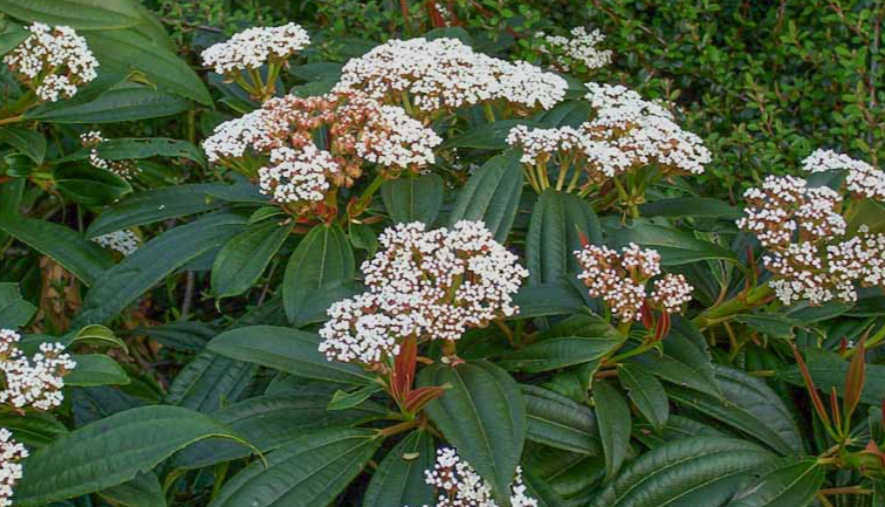
The most common complaint about David viburnum is a lack of berries, and the cause is almost always pollination. The species is described as functionally dioecious. In practice, individual plants behave mainly as either pollen-producing (“male”) or fruit-bearing (“female”) plants, even though the flowers are not strictly separate sexes. A fruiting plant needs pollen from a genetically different plant to set its turquoise berries.
The problem is made worse by how nurseries propagate the shrub. David viburnum is usually grown from cuttings, and a nursery may take cuttings from only a few stock plants. If all your shrubs came from the same clone, they are genetically identical and cannot cross-pollinate, even if you plant a dozen of them. The solution is to buy plants specifically labeled male and female, or to buy plants from different nurseries so they come from different parent stock. NC State Extension recommends planting several male and female plants for good cross-pollination and a strong winter fruit display.
Is David Viburnum Fruit Edible?
The fruit is primarily ornamental and is not considered a food plant. The Royal Horticultural Society advises that the berries should not be eaten. Some references note that eating the fruit can cause mild stomach upset. Because the bright blue berries can tempt children and pets, gardeners should treat them as decoration rather than food, especially where young children play.
Birds, however, eat the fruit, particularly in late winter when other food sources are scarce. Robins, thrushes, and other fruit-eating birds may strip the berries once colder weather arrives. Shrubs in protected spots near the house can be a good place to watch winter birds feeding.
Landscape Uses
David viburnum’s low, spreading, evergreen form makes it one of the most useful shrubs for the front of borders, foundation plantings, and large-scale groundcover. Planted in groups, it forms a solid, textured carpet of dark foliage that stays attractive all year. It pairs beautifully with finer-textured plants such as ferns, Japanese forest grass, heucheras, and small conifers, which highlight its bold leaves.
The shrub is especially valuable in winter gardens, where its glossy foliage, pink winter buds, and blue fruit provide color and interest when most plants are dormant. It also works well in woodland gardens, Asian-style gardens, shaded courtyards, and large containers. Because it grows slowly and stays compact, it rarely needs pruning to stay in bounds. That makes it a good choice for low-maintenance landscapes near walkways, patios, and entrances.
Growing Considerations
David viburnum is generally hardy from Zone 7 through Zone 9, with some sources rating it to Zone 7b. Near the northern edge of its range it may lose some or all of its leaves in severe winters. It performs best in climates with cool, moist summers and mild winters, such as the Pacific Northwest, coastal Northern California, and parts of the mid-Atlantic. In hot, humid summer climates such as the Southeast, it often struggles with heat stress and leaf scorch.
Light is critical. The shrub grows best in partial shade, especially with morning sun and afternoon shade. Oregon State University warns that full sun on a south-facing site may cause the foliage to sunburn. It prefers moist, fertile, well-drained soil rich in organic matter and does well in slightly acidic to neutral soils. Poorly drained soil quickly leads to root problems, so avoid low, soggy spots.
Plant David viburnum in spring or early fall, and water it consistently through the first growing season. Established plants tolerate short dry spells, but they look best and flower and fruit more heavily with regular moisture during summer. A 2 to 3 inch layer of mulch keeps the root zone cool and moist. Pruning is rarely needed. Remove dead or damaged branches as needed, and, if shaping is necessary, prune lightly right after flowering to protect the next year’s flower buds.
Yin and Yang: Hybrids for Hotter Climates
For decades, gardeners in the Southeast admired David viburnum but could not grow it well in their hot, humid summers. That changed with work by Dr. Thomas Ranney at North Carolina State University’s Mountain Horticultural Crops Research and Extension Center. In 2010, he crossed David viburnum with its heat-tolerant relative, the Chinese evergreen viburnum. The goal was a plant with David viburnum’s beauty that could also handle southern heat.
The program produced 2 companion cultivars named Yin and Yang. NC State Extension describes Yin as a compact shrub growing 2 to 4 feet tall and wide, with leathery, blue-green leaves. It notes that Yin and Yang should be planted together to produce blue fruit in fall. Yang is lower and wider, typically about 2 feet tall and 4 feet across. Both keep David viburnum’s distinctive 3-veined evergreen leaves and are generally rated for Zones 7b through 9. They have finally made this look possible in southern gardens.
Pests and Problems
David viburnum is generally free of serious problems when grown in the right climate and site. The most common issues are environmental. Leaf scorch and browning come from too much sun or heat. Root rot develops in heavy, poorly drained soils. Root rot organisms and honey fungus can kill plants in waterlogged ground, so good drainage is the best prevention. Gray mold and leaf spot occasionally appear in very wet, crowded conditions.
Aphids may feed on new growth in spring. The viburnum leaf beetle has become a concern in the Pacific Northwest, where David viburnum is most widely grown. Washington State University Extension warns that this invasive beetle is spreading in Washington State and can cause branch dieback and even death of viburnums. Gardeners there should check twigs in winter for rows of small, capped egg sites and prune out infested twigs before spring. David viburnum is also only mildly bothered by deer.
Sources
Oregon State University Landscape Plants, “David Viburnum”
NC State Extension Gardener Plant Toolbox, “David Viburnum”
NC State Extension Gardener Plant Toolbox, “Yin Viburnum”
Washington State University Extension, “Pest Watch: Viburnum Leaf Beetle”