Bodnant Viburnum: The Welsh-Bred Shrub That Perfumes the Garden in Winter
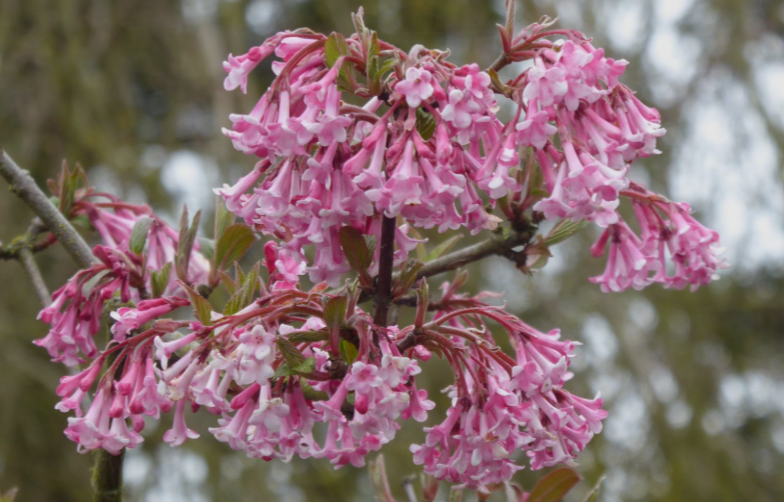
Bodnant viburnum is one of the few shrubs that does its most important work in the dead of winter. When most gardens are bare, frozen, or asleep, its stiff, leafless branches burst into clusters of rose-pink flowers. They release a sweet, rich fragrance that can fill a cold garden on a still day. Depending on climate, the flowers open from late fall through early spring, in flushes whenever the weather turns mild. For gardeners who long for color and scent in the darkest months, few plants are as rewarding.
The shrub’s name honors one of the world’s most famous gardens, Bodnant in North Wales, where it was raised in the 1930s. Its story involves a forgotten experiment in Scotland, a dynasty of head gardeners, and plant hunters who brought its parent species from the mountains of Asia. This guide covers that history, the 3 main cultivars and how to choose among them, and how to grow and place the shrub for the best winter display.
Botanical Classification
Bodnant viburnum is a deciduous hybrid shrub in the viburnum genus, a group of roughly 150 to 175 species of shrubs and small trees found mostly in the Northern Hemisphere. Like other viburnums, it has moved between plant families over the years. Older references list the honeysuckle family, others the moschatel family, and current systems give viburnums their own family. Because it is a hybrid of garden origin, it has no native range.
It is a cross between 2 winter-flowering Asian viburnums. The first parent is the fragrant viburnum, often called Farrer viburnum, a shrub from northern China known for its sweetly scented white to pale pink winter flowers. The second parent is a Himalayan viburnum with larger, deeper pink flower clusters and bigger leaves. Bodnant viburnum combines the strong fragrance and winter blooming of the first parent with the larger, pinker, showier flowers of the second.
Brief History
The story begins not at Bodnant but in Scotland. According to the Scott Arboretum of Swarthmore College, the first crosses between the 2 parents were made in 1933 by Charles Lamont at the Royal Botanic Garden in Edinburgh. They initially produced nothing considered worth naming. Lamont judged his few seedlings to be no improvement over the parents and did not propagate them.
Shortly afterward, the same cross was made at Bodnant Garden in the Conwy Valley of North Wales, home of the Aberconway family. Bodnant was then one of the most influential gardens in the world. It was famous for its rhododendron hybrids and its sponsorship of plant-collecting expeditions to Asia. The cross was made by the garden’s head gardener, a member of the Puddle family, whose 3 generations ran Bodnant’s gardens for most of the 20th century. One outstanding seedling was named ‘Dawn’. It gave the whole hybrid group its name and became one of the most widely planted winter shrubs in Britain.
Lamont’s overlooked Edinburgh seedlings were later re-examined, and the best of them was named ‘Charles Lamont’ in his honor. A third cultivar, ‘Deben’, came from a later cross made at Notcutts Nursery in Suffolk, England. All 3 have since received the Royal Horticultural Society’s Award of Garden Merit. Bodnant viburnum is now grown throughout temperate North America, especially in the Pacific Northwest and the mid-Atlantic, where its long winter bloom is most dependable.
Identifying Characteristics
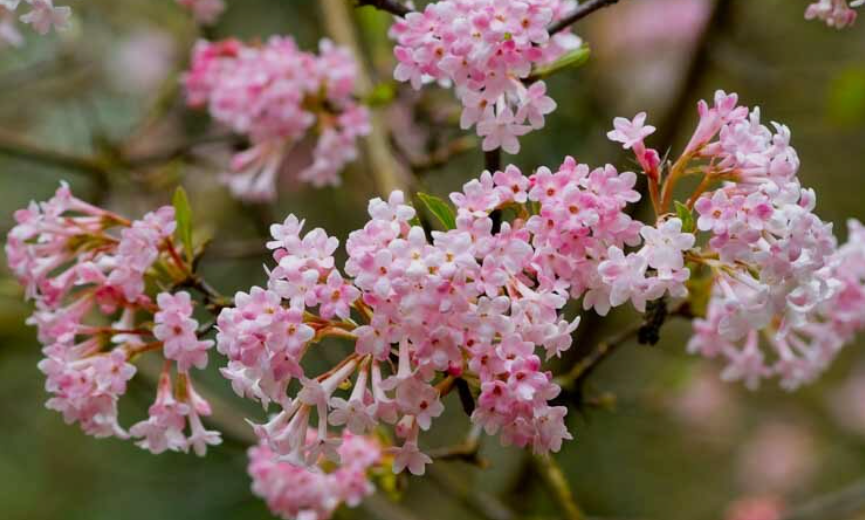
The flowers are the shrub’s defining feature. They form dense, rounded clusters about 2 to 3 inches across at the tips of bare branches. Each cluster is packed with small, tubular flowers that open from deep rose-pink buds. As the flowers mature, they fade to pale pink and finally to white with a pink blush, so a single shrub often shows several shades at once. The fragrance is sweet and spicy. People variously compare it to heliotrope, almond, or honey, and it is strongest on mild, sunny winter days.
The flowering habit is unusual. Instead of blooming all at once, Bodnant viburnum opens flowers in waves, starting as early as November in mild climates and continuing through March or April. Hard freezes may brown the open flowers, but the unopened buds usually survive and open when warmer weather returns. A single shrub can therefore keep producing new flowers for many weeks, even months, through winter.
The leaves emerge in spring with a bronze tint and mature to dark green, with toothed edges and deeply impressed veins. They are typically 2 to 4 inches long. In autumn they often turn red to wine-purple before dropping. The shrub grows into an upright, vase-shaped plant 8 to 10 feet tall and about 6 feet wide, with stiff, straight stems that may arch outward with age. Fruit sets only rarely, and the occasional berries ripen red and then black.
The 3 Classic Cultivars
‘Dawn’ is the original Bodnant selection and still the most widely grown. Its deep pink buds open into pink flowers that fade toward white, and it is reliably fragrant. The University of Washington Botanic Gardens describes it as one of the showiest and most reliably fragrant winter-blooming shrubs. It grows vigorously into a tall, upright shrub and is the best all-around choice for most gardens.
‘Charles Lamont’ is often considered the most colorful of the 3. The Scott Arboretum notes that it bears the brightest and pinkest flowers of the trio and the largest leaves, reflecting the stronger influence of its Himalayan parent. Its flowers hold their pink color longer before fading, making it the best choice for gardeners who want maximum color. ‘Deben’ takes the opposite approach. Its pink buds open into flowers that turn nearly pure white very quickly, giving a cooler, more delicate look. Some growers find its open flowers slightly more prone to frost damage.
Also Read: Different Types of Viburnum Shrubs
Bodnant Viburnum vs. Fragrant Viburnum
Bodnant viburnum is often confused with its parent, the fragrant or Farrer viburnum, which also blooms in winter on bare branches. The fragrant viburnum has smaller clusters of white to very pale pink flowers. Its leaves are smaller and smoother, and it tends to form a more compact, rounded shrub. It is somewhat hardier and blooms slightly earlier in some climates, but its flowers are far less showy.
Bodnant viburnum produces larger, pinker, more conspicuous flower clusters and grows taller and more upright, with larger leaves. Its hybrid vigor also makes it a stronger grower in most gardens. Gardeners who want fragrance above all can grow either. Those who want a bolder show of winter color usually prefer the Bodnant hybrid, especially ‘Dawn’ or ‘Charles Lamont’.
Landscape Uses
Because Bodnant viburnum flowers on bare branches, placement makes a big difference. Plant it in front of evergreen shrubs, conifers, or a dark wall or fence, where the pink flowers stand out against a solid background. Plant it as close as possible to a door, path, driveway, or window you use daily in winter, so you can enjoy the fragrance during the coldest months. A shrub by the front entrance becomes a welcome surprise on winter mornings.
It also works well at the back of mixed borders, where its plain summer foliage serves as a green backdrop for perennials and annuals. Pair it with other winter-interest plants such as witch hazels, hellebores, snowdrops, winter heaths, sweet box, and red-twigged dogwoods to create a full winter garden. Cut branches covered in buds can be brought indoors, where the flowers open in a vase and fill a room with fragrance.
Wildlife Value
Bodnant viburnum provides food for pollinators at a time of year when almost nothing else is flowering. On mild winter days, honeybees, early bumblebees, and flies often visit the fragrant clusters for nectar and pollen. In late winter and early spring, the flowers can be an important energy source for bumblebee queens emerging from hibernation.
Because the shrub rarely sets fruit, it offers little food for birds. Its dense, upright branching does provide some cover for small songbirds, especially once the leaves are out in summer. As a hybrid of Asian species, it supports far fewer native insects than native viburnums. Many gardeners therefore grow it alongside native shrubs, using it mainly for its winter flowers and fragrance.
Growing Considerations
Bodnant viburnum is generally hardy from Zone 5 or 6 through Zone 8, though flowering is most reliable in climates with mild winters. In colder regions the plant survives, but the flowers are often damaged by hard freezes. University of Illinois Extension describes a ‘Dawn’ viburnum that suffered when temperatures dropped below zero for several days just as it was budding out. Gardeners in colder zones should plant it in a sheltered spot, protected from harsh winter winds.
The shrub grows best in full sun to partial shade. Plants in full sun produce the most flowers, while some afternoon shade helps in hotter summer climates. It prefers moist, fertile, well-drained soil and tolerates a wide range of soil types, including clay and slightly alkaline soils. Plant it in spring or fall and water regularly through the first growing season. Spread 2 to 3 inches of mulch over the root zone to conserve moisture and moderate soil temperature.
Prune Bodnant viburnum right after its main flowering ends in spring, since it blooms on wood formed the previous summer. Older plants tend to become tall, leggy, and crowded with thick stems. The best way to manage them is renewal pruning: every year or two, cut 1 or 2 of the oldest stems to the ground to encourage fresh, vigorous shoots from the base. This keeps the shrub productive and prevents it from becoming bare at the bottom.
Pests and Problems
Bodnant viburnum is generally a tough, easy shrub with few serious problems. Aphids sometimes cluster on new spring shoots, curling young leaves, but beneficial insects usually control them. The viburnum leaf beetle can feed on the foliage in regions where it is established, so check twigs for rows of small, capped egg sites in winter and prune out infested wood before spring.
Most other problems come from poor drainage or harsh weather. Root rot can develop in heavy, waterlogged soils, so avoid low, soggy spots. Hard frosts may brown open flowers, but this is cosmetic, and new buds will open when the weather warms. Leaf spots and powdery mildew occasionally appear in crowded or humid sites. Good air circulation and regular renewal pruning keep the shrub healthy and blooming year after year.
Sources
Scott Arboretum of Swarthmore College, “Viburnum x bodnantense”
University of Illinois Extension, “Shrubs Blogs”
Oregon State University Landscape Plants, “Dawn Bodnantense Viburnum”