Ninebark Identification: How to Recognize This Native Shrub in Every Season
Once you know what to look for, ninebark is easy to identify. This native North American shrub combines 4 features that rarely show up together on one plant: maple-like lobed leaves, rounded clusters of small white flowers, puffy reddish seed pods, and bark that peels away in thin, papery strips. Seeing 2 or 3 of these at once is usually enough to confirm it.
Ninebark is still commonly confused with spirea, currant, viburnum, and even young maples, especially when it isn’t in bloom. These features change through the year, and so do the clues that separate ninebark from its lookalikes.
Leaves
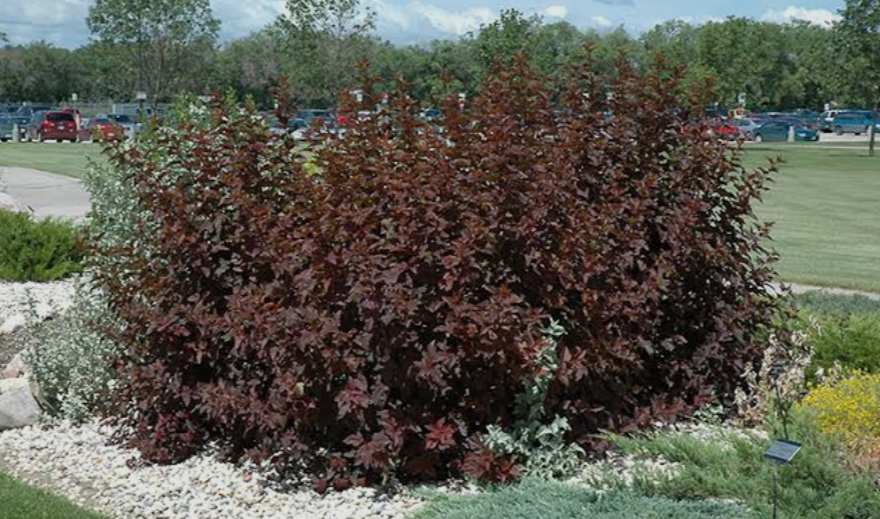
Ninebark leaves are alternate, meaning they are staggered along the stem rather than arranged in opposite pairs. They are usually 1 to 3 inches long, with 3 shallow lobes and coarsely toothed edges, a bit like a small maple or currant leaf. In the wild, the leaves are medium to dark green and often slightly glossy, turning yellow, bronze, or reddish-brown in fall. Garden varieties of common ninebark may have purple, burgundy, gold, or copper leaves.
The leaf arrangement is the fastest way to rule out a maple. Maples have opposite leaves, while ninebark leaves alternate. The lobed shape also separates ninebark from most spireas, which have narrow, unlobed leaves.
Flowers
Ninebark blooms in late spring to early summer, generally May and June in most of the United States. The flowers are small, about ¼ to ½ inch across. Each has 5 white to pale pink petals and a fuzzy center of many stamens. They are packed into dense, rounded, slightly domed clusters at the ends of short side branches. Pacific ninebark tends to have the largest, most ball-shaped flower heads.
The domed flower cluster helps separate ninebark from spirea, whose flowers grow in flatter clusters or narrow spikes. Viburnums also have white clusters, but their leaves are opposite and their fruit is a fleshy berry rather than a dry pod.
Seed Pods
After flowering, ninebark produces some of the most distinctive fruit of any shrub. Each flower develops into a small cluster of 3 to 5 inflated, papery pods that ripen from green to bright red or reddish-brown by midsummer. The pods are dry rather than fleshy, and they split open along their seams when mature. They often stay on the branches through fall and winter.
These puffy pods are one of the best identification clues. Currants and viburnums carry soft, juicy berries. Spirea seeds are tiny and inconspicuous.
Also Read: Different Types of Ninebark Shrubs
Bark
The feature that gives ninebark its name shows up best in winter. On stems more than a few years old, the outer bark shreds and peels away in long, thin, papery strips, exposing layers of reddish, orange, or cinnamon-brown inner bark. Young twigs are smooth, slightly shiny, and reddish-brown, and only start to peel as they age. The old belief that each stem carries 9 layers of bark gave the shrub its common name.
Few other native shrubs have bark this shaggy at shoulder height. Combined with the persistent seed pods and the arching, multistemmed form, it makes ninebark easy to recognize even when the leaves are gone.
Growth Habit
Ninebark grows as a dense, multistemmed shrub with an upright to arching shape. Older branches often curve outward like a fountain. Common ninebark usually reaches 5 to 10 feet tall and nearly as wide, while Pacific ninebark can reach 12 to 15 feet in ideal streamside sites. Mountain and dwarf ninebarks of the western interior are much smaller, often under 4 feet.
Ninebarks often spread into broad clumps or thickets. Look for them along stream banks, lakeshores, rocky bluffs, woodland edges, and wet meadows, where they commonly grow with dogwoods, willows, and alders.
Telling the Native Species Apart
Five species of ninebark are native to North America, and where they grow is often the best clue to which one you have. Common ninebark is native to central and eastern North America, from Quebec and the Great Lakes south to Tennessee and the Ozarks. Pacific ninebark grows along the West Coast from Alaska to California, mostly west of the Cascades.
The other 3 are western mountain and dry-country shrubs. Mallow ninebark has rounder, more velvety leaves and grows in the Rocky Mountains and Intermountain West. Mountain ninebark is a compact shrub of the southern Rockies and Black Hills. Dwarf ninebark is a low shrub of rocky sites in the Southwest. If you find a ninebark in an eastern garden, it is almost certainly common ninebark or one of its many cultivars.
Sources
University of Connecticut Plant Database, “Common Ninebark, Eastern Ninebark”
University of Minnesota, “Ninebark”
Clemson Cooperative Extension, “Rain Garden Plants: Ninebark”