Green Gem Boxwood: The Slow-Growing Globe That Brings Formal Structure to Cold Gardens
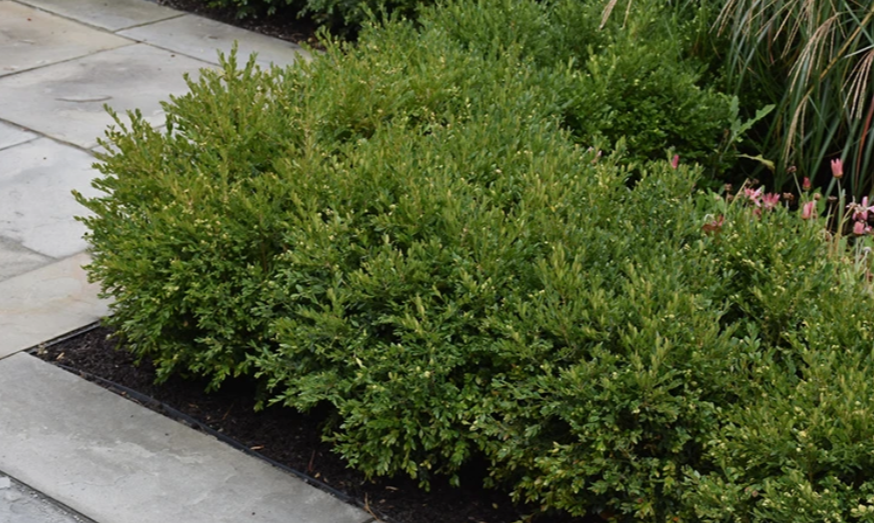
Green Gem boxwood is a compact, slow-growing evergreen shrub known for its naturally round shape, deep green leaves, and exceptional winter hardiness. Even without regular pruning, it forms a tidy globe that looks as though it had been carefully clipped. That makes it one of the easiest boxwoods to use for low hedges, edging, and formal designs. It holds its rich color through cold winters and resists boxwood blight better than most boxwoods. It is one of the most reliable small boxwoods for northern gardens.
Green Gem belongs to the famous family of Sheridan hybrids developed in Ontario, Canada, a group of boxwoods bred to survive harsh northern winters. Decades after its introduction, it remains a favorite of landscape designers, homeowners, and public gardens. This guide covers its history, appearance, landscape uses, care, and how it compares with other popular small boxwoods.
Botanical Classification
Green Gem is a broadleaf evergreen shrub in the boxwood family, a small group of slow-growing shrubs and small trees valued for their dense, fine-textured foliage. It is a hybrid between Korean boxwood and common, or English, boxwood. NC State Extension describes it as a hybrid cultivar of Korean and common boxwood developed in Canada at Sheridan Nurseries. That parentage combines the cold hardiness of Korean boxwood with the deep green color of English boxwood.
Green Gem has well-known siblings: ‘Green Velvet’, ‘Green Mountain’, and ‘Green Mound’. All share the same parentage and come from the same breeding program. Each has a slightly different shape and size. Green Gem is the smallest and roundest of the group, with the slowest growth rate.
Also Read: Best Boxwood Varieties for Zone 3 Gardens
Brief History
The story of Green Gem begins in 1922, when Sheridan Nurseries in Ontario obtained Korean boxwood seedlings from Harvard University’s Arnold Arboretum. These hardy plants became the foundation of the nursery’s boxwood breeding work. In the 1960s, at its farm in Oakville, Ontario, the nursery planted rows of Korean boxwood beside rows of common boxwood and let them cross-pollinate naturally. Seeds were collected from the Korean boxwood plants and grown into seedlings.
From those seedlings, the nursery selected a small number of outstanding plants. They combined the dwarf size and hardiness of Korean boxwood with the better winter color and compact growth of common boxwood. Green Gem was among the selections released, along with ‘Green Velvet’, ‘Green Mountain’, and ‘Green Mound’. These Sheridan hybrids transformed boxwood growing in cold climates. They made the formal boxwood look possible in gardens across Canada and the northern United States.
Identifying Characteristics
Green Gem grows into a dense, naturally rounded globe, typically reaching 2 to 3 feet tall and wide at maturity. Its growth is very slow, so young plants stay small for many years. That slow growth is part of its appeal: it holds its compact shape with minimal pruning, which makes it one of the lowest-maintenance boxwoods for formal designs.
The leaves are small, oval, and glossy, arranged in opposite pairs along the stems. They are deep green and packed tightly together, creating a fine, velvety texture. The Morton Arboretum notes that Green Gem’s leaves retain their dark green color in winter. That is a significant advantage over many hardy boxwoods, which turn bronze or yellow-green in cold weather.
In spring, Green Gem produces tiny, pale yellow-green flowers tucked among the leaves. They are not showy but have a light fragrance and attract early bees. The plant’s branches are densely arranged and fill out all the way to the ground. Even single plants look full and polished.
Hardiness and Climate
Green Gem is one of the hardiest boxwoods available, generally rated for Zones 4 through 8. It grows well in the northern United States and southern Canada, where winters regularly drop below 0°F. It also tolerates the heat and humidity of the central and mid-Atlantic states, so it is adaptable across a wide range of climates.
Green Gem resists winter burn better than many boxwoods, thanks to its compact form and dense foliage. It can still be damaged in very exposed, windy, or sunny locations, especially in the coldest parts of its range. Planting it on the north or east side of a building, or near other shrubs that block winter wind, helps keep its foliage deep green through the coldest months.
Disease Resistance
One of Green Gem’s greatest strengths is its resistance to boxwood blight, a serious fungal disease that has spread through much of North America since 2011. Boxwood blight causes dark leaf spots, rapid leaf drop, and black streaks on stems. It can kill entire hedges, and it spreads easily between closely planted boxwoods. University of Wisconsin–Madison Extension lists Green Gem among the hybrid boxwoods documented as resistant to boxwood blight.
That resistance makes Green Gem an especially valuable choice for low hedges, parterres, and knot gardens, where plants grow close together and disease can spread quickly. Resistance is not immunity. Plants can still develop symptoms when stressed by poor drainage, overcrowding, or overhead watering. Good spacing, healthy soil, and regular inspection remain important.
Landscape Uses
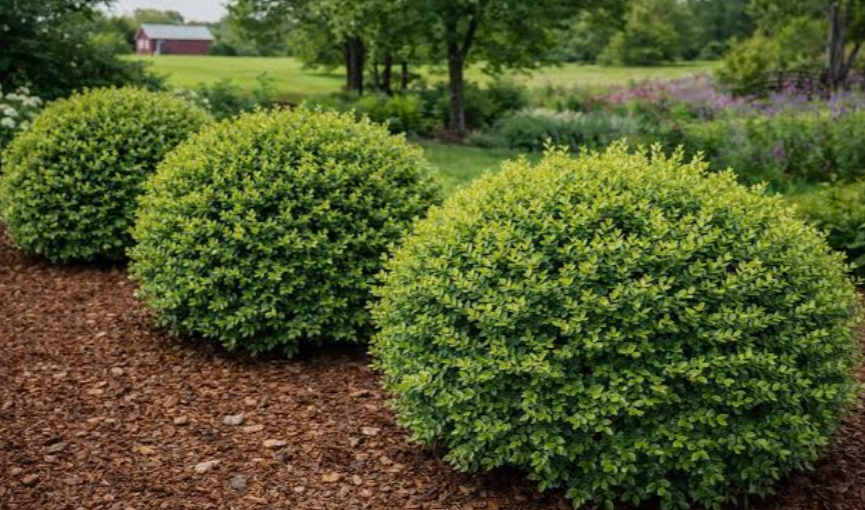
Green Gem is ideal for low formal hedges, edging along walkways, and defining garden beds. Its natural globe shape allows it to be used as a repeating element along paths and borders, creating a classic, structured look with little pruning. It is one of the best boxwoods for parterres and knot gardens, where small, uniform plants are essential.
It also works well in foundation plantings, small gardens, and courtyards where space is limited. Because it grows so slowly, it rarely outgrows its spot. It is excellent in containers, window boxes, and formal planters, and some gardeners use it for bonsai. In mixed borders, its dark green globes provide a strong contrast with flowering perennials, ornamental grasses, and colorful annuals.
Like most boxwoods, Green Gem is generally resistant to deer, which makes it useful in suburban and rural landscapes where browsing animals damage many other shrubs. Its evergreen leaves also provide valuable winter structure in gardens that otherwise look bare from late fall to spring.
Also Read: Different Types of Boxwood Shrubs
Growing Considerations
Plant Green Gem in spring or early fall in moist, well-drained soil. It tolerates a range of soil types, including clay and slightly alkaline soils, but it does not do well in soggy ground. Plant it at the same depth it grew in the container, or slightly higher, since boxwoods have shallow roots that are easily damaged by deep planting. Space plants about 12 to 18 inches apart for a low hedge, or farther apart for individual globes.
Green Gem grows best in partial shade to full sun. In the coldest regions, some protection from afternoon winter sun and wind is helpful. Water new plants deeply once or twice a week during the first growing season. Once established, they need about 1 inch of water per week in dry weather. Spread 2 to 3 inches of mulch around the base, keeping it a few inches away from the stems.
Because Green Gem grows so slowly, it needs little pruning. A light trim in late spring or early summer, after new growth has hardened, keeps it neat. Every few years, thinning a few small branches from the interior improves airflow and helps prevent disease. Fertilize lightly in early spring only if growth seems weak.
Winter Care
In most gardens, Green Gem needs little special winter care beyond good fall watering. Give plants a deep soaking in late fall before the ground freezes, especially after a dry autumn. In exposed locations, a burlap screen on the windward side can help reduce winter burn. Leave space between the screen and the plant.
Green Gem’s low, rounded shape helps it hold up well under snow. Heavy, wet snow can still bend or split branches. Gently brush snow off after storms, sweeping upward, and avoid piling salty snow from driveways and sidewalks on top of plants. In spring, prune out any winter-damaged branches once new growth begins.
Also Read: Best Boxwoods for Hedges
Pests and Problems
Green Gem is generally a healthy, low-maintenance shrub, but it can be affected by common boxwood pests. Boxwood leafminer may cause blistered, yellowing leaves. Boxwood mites can cause fine speckling, and boxwood psyllids can cause cupped new leaves. Most of these problems are minor and can be managed by keeping plants healthy and inspecting them regularly.
Like all boxwoods, Green Gem is susceptible to the box tree moth, an invasive caterpillar now established in parts of the Midwest and Northeast. Its caterpillars chew leaves, spin webbing, and can strip plants bare. In areas where box tree moth is present, check Green Gem regularly from spring through fall for chewed leaves, webbing, and caterpillars. Root rot can develop in poorly drained soil, so good drainage is essential.
Sources
NC State Extension Gardener Plant Toolbox, “Green Gem Boxwood”
University of Wisconsin–Madison Extension, “Boxwood Blight”
University of Arkansas Cooperative Extension, “Plant of the Week: Green Velvet Boxwood”