Mapleleaf Viburnum: The Native Shrub That Thrives Where Little Else Will Grow
Mapleleaf viburnum is one of the best answers to one of gardening’s hardest problems: dry shade. This small native shrub grows naturally beneath oaks, hickories, and maples in the woodlands of eastern North America. It thrives in deep shade, root-filled soil, and drought that defeat most flowering plants. Its 3-lobed leaves look so much like maple leaves that the shrub is often overlooked as a maple seedling. On closer inspection, it reveals creamy spring flowers, dark winter fruit for birds, and some of the most unusual fall color of any native shrub.
Mapleleaf viburnum rarely gets the attention of showier viburnums, but it fills a niche few other plants can. It is ideal for woodland gardens, shady foundation beds, naturalized areas, and wildlife plantings under large trees. This guide covers its history, how to tell it apart from look-alike plants, why its fall color is so distinctive, and how to grow it in difficult shady sites.
Botanical Classification
Mapleleaf viburnum is a small deciduous shrub in the viburnum genus, a group of roughly 150 to 175 species of shrubs and small trees across the Northern Hemisphere. Like other viburnums, it has been placed in several plant families. Older references list the honeysuckle family, others the moschatel family, and current systems give viburnums their own family. Its botanical name means “maple-leaved,” and it was one of the viburnums named by Linnaeus in 1753.
The species varies quite a bit across its range, and botanists have described several regional forms that differ in leaf hairiness and flower density. Those differences matter mainly to specialists. In the garden, all forms share the same maple-like leaves, shade tolerance, and compact, suckering habit. Unlike most landscape viburnums, mapleleaf viburnum has almost no named cultivars, so nearly all plants sold are grown from seed or wild-type stock.
Brief History and Common Names
Mapleleaf viburnum has collected many regional names over the centuries. The most unusual is dockmackie, a name used in the Hudson Valley and parts of the Northeast that is believed to have come from early Dutch settlers or an Indigenous word. Other old names include maple-leaved arrowwood, possum-haw, and squash-berry. Some of these names are shared with other native shrubs, which can confuse anyone searching old references.
Native peoples of the eastern woodlands used the plant in traditional medicine. Its bark and leaves were brewed into teas used for cramps and other complaints, similar to the uses of related viburnums. Early American botanists noted the shrub’s abundance in dry woods and its distinctive autumn colors. It was grown in a few early gardens, but it never became a nursery staple, because its value lies in shade and naturalistic plantings rather than showy bloom.
Native Range and Habitat
Mapleleaf viburnum grows across much of eastern North America. Its range runs from New Brunswick and southern Quebec west to Ontario and Minnesota, and south to Georgia, northern Florida, and eastern Texas. It is especially common in the Appalachian Mountains and Piedmont and in the hardwood forests of the Northeast and Midwest. It is one of the most widespread understory shrubs in eastern deciduous forests.
In the wild, it grows in dry to moist upland forests, on rocky slopes and bluffs, in ravines, and along woodland edges. The University of Maryland Extension notes that it is one of the few locally native shrubs that can thrive in dry woods and is very tolerant of both heavy shade and drought. It often spreads by underground runners into loose colonies beneath the forest canopy, where it competes successfully with the roots of large trees.
Identifying Characteristics
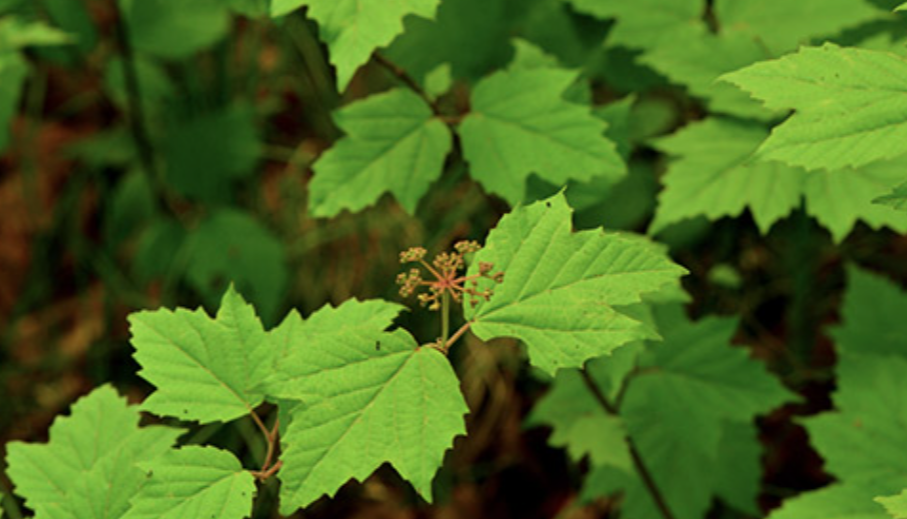
The leaves are the plant’s most distinctive feature. They are opposite, 2 to 5 inches long, and nearly as wide, with 3 pointed lobes and coarsely toothed edges. The overall shape is almost identical to a red maple leaf. The upper surface is medium green, and the underside is softly hairy. Under a hand lens, the underside also shows tiny dark dots, which are glandular spots found in this viburnum but not in maples.
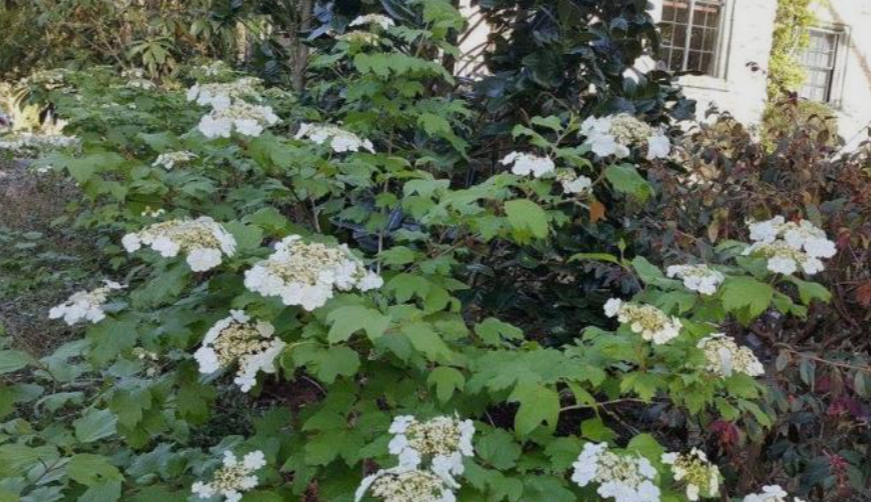
The flowers open in May and June in flat-topped clusters 1 to 3 inches across, often held on slender stalks above the leaves. The Purdue University Arboretum describes them as small white flowers in flat clusters about 3 inches wide in spring. Unlike the showier cranberrybush viburnums, the clusters lack a ring of large sterile flowers. Each small creamy-white flower has long stamens that give the clusters a soft, fuzzy look.
The fruit ripens in late summer and early fall as small, round to oval berries about ⅓ inch across. They turn from green to red and then to a deep purple-black, and they often stay on the plant well into winter. The shrub itself usually reaches 3 to 6 feet tall and 2 to 4 feet wide, with a slender, open, sparsely branched habit. Over time it spreads into a loose colony of upright stems.
Mapleleaf Viburnum vs. Maple Seedlings and Cranberrybush
The shrub is most often confused with young maple trees. Both have opposite, 3-lobed leaves, but there are clear differences. Mapleleaf viburnum grows as a multi-stemmed shrub, often in a colony, while maple seedlings have a single main stem. The viburnum’s leaves are softly hairy underneath with tiny dark dots. In late spring it bears flat clusters of creamy flowers, followed by dark fruit, while maples produce winged seeds.
It is also confused with the American cranberrybush viburnum, which has similar 3-lobed leaves. American cranberrybush is a much larger shrub, usually 8 to 12 feet tall, with lacecap clusters ringed by large white sterile flowers and bright red fruit. It grows best in moist, sunny sites. Mapleleaf viburnum stays small, lacks the showy sterile flowers, bears dark purple-black fruit, and prefers dry shade. Knowing these differences helps gardeners choose the right shrub for the right site.
Remarkable Fall Color
Fall is when mapleleaf viburnum truly stands out. Most shrubs turn red, orange, or yellow. This one often develops an unusual range of soft pastel tones, including rose pink, mauve, pale purple, magenta, and creamy pink, sometimes on the same plant. The colors are especially striking in shaded woodlands, where they glow against the darker browns and golds of the forest floor.
The color varies from plant to plant and year to year. Colonies may show anything from deep reddish-purple to pale pinkish-cream. Shrubs growing in partial sun usually color more intensely than those in deep shade. Because the fall color is so unusual, many native-plant gardeners grow mapleleaf viburnum mainly for its autumn display, placing it where its pastel foliage can be seen from paths and windows.
Landscape Uses
Mapleleaf viburnum is one of the best native shrubs for dry shade beneath large trees. The Cornell University woody plants database describes it as extremely shade tolerant and a great understory plant that suckers and colonizes, but notes that it does not tolerate full sun. That makes it ideal for wooded lots, shady foundation beds on the north side of homes, and the ground beneath mature oaks and maples, where lawn grass and most flowering shrubs fail.
Its small size and colonizing habit make it useful for naturalized woodland plantings, shady slopes, and stabilizing soil on banks beneath trees. It pairs well with other shade-tolerant natives such as ferns, wild ginger, woodland phlox, and spicebush. Purdue University also notes that it tolerates the toxins released by black walnut trees, so it is one of the few shrubs that can be planted near black walnuts.
Wildlife Value
Mapleleaf viburnum is a high-value native plant for wildlife. Its spring flowers attract native bees, small butterflies, and many flies and beetles that feed on the nectar and pollen. The University of Tennessee notes that it has very high wildlife value and serves as larval food for the spring azure butterfly. It also hosts the caterpillars of many native moths, which in turn provide food for woodland songbirds raising their young.
The fruit is eaten by many birds, including thrushes, robins, cedar waxwings, bluebirds, and ruffed grouse. Small mammals such as chipmunks and squirrels eat it too. Because the fruit often stays on the shrub into winter, it is an important late-season food source in woodland habitats. The dense, low colonies give ground-nesting birds and small mammals shelter and cover.
Growing Considerations
Mapleleaf viburnum is hardy from Zone 3 or 4 through Zone 8, so it suits most of the eastern and central United States. Unlike most viburnums, it performs best in partial to full shade. In full sun its leaves may scorch, especially in hot, dry summers. It grows best in well-drained, slightly acidic soil rich in organic matter, but it tolerates rocky, sandy, and dry soils once established.
Plant it in spring or fall, and water it regularly during its first growing season while its roots establish. Once established, it handles drought very well and rarely needs supplemental watering, even beneath large trees. A 2 to 3 inch layer of shredded leaves or wood mulch over the root zone mimics its natural woodland habitat and helps hold soil moisture.
Mapleleaf viburnum needs very little pruning. Remove dead or damaged stems as needed, and thin the oldest stems at the base every few years to encourage fresh growth. If needed, prune right after flowering to avoid removing next year’s flower buds. Because it spreads by underground runners, allow room for the colony to expand, or remove unwanted suckers to keep it contained.
Also Read: Different Types of Viburnum
Pests and Problems
Mapleleaf viburnum has few serious problems in most of its range. The major exception is the viburnum leaf beetle, which is highly destructive to this species in regions where the beetle has become established. Larvae feed on young leaves in spring, and adults feed again in summer, often reducing the leaves to skeletons. Repeated heavy damage over several years can kill shrubs and threatens wild populations in the Northeast and Great Lakes region.
Gardeners in areas where the beetle is present should check twigs every winter for rows of small, capped egg sites along the undersides of young stems. Prune out and destroy infested twigs before the eggs hatch in spring. Occasional powdery mildew or leaf spots may appear in humid, crowded conditions, but these rarely cause lasting harm. Deer may browse young plants in some areas. Outside the beetle’s range, mapleleaf viburnum is generally a long-lived, low-maintenance shrub.
Sources
University of Maryland Extension, “Mapleleaf Viburnum”
Purdue University Arboretum, “Mapleleaf Viburnum”
Cornell University Woody Plants Database, “Maple-leaved Viburnum”
University of Tennessee, Tennessee Yards and Neighborhoods, “Mapleleaf Viburnum”