Downy Arrowwood Viburnum: The Small, Drought-Tough Native Shrub of Dry Rocky Woods
Downy arrowwood viburnum is one of the smallest and toughest native viburnums of eastern North America. It grows naturally on dry, rocky hillsides, bluffs, and open woodlands where few flowering shrubs survive. It produces flat clusters of white flowers in late spring, dark blue-black fruit for birds in late summer, and leaves that turn shades of red, purple, and gold in autumn. Its leaves have soft, velvety hairs on the underside, which give the shrub its common name.
Although less familiar than its larger cousin, southern arrowwood, downy arrowwood fills a valuable niche in native landscapes. It stays compact, handles drought far better than most viburnums, and supports a wide range of native insects and birds. This guide covers its history and naming, how to identify it and tell it apart from similar viburnums, and how to grow it in dry, sunny, or partly shaded sites.
Botanical Classification
Downy arrowwood viburnum is a deciduous, multi-stemmed shrub in the viburnum genus, a group of roughly 150 to 175 species of shrubs and small trees found mostly in the Northern Hemisphere. Like other viburnums, it has been placed in several plant families over the years. Older references list the honeysuckle family, others the moschatel family, and current systems give viburnums their own family. It is also known as Rafinesque viburnum and, in parts of the Midwest, Missouri viburnum.
It belongs to the arrowwood group of North American viburnums, whose straight young stems were historically used for arrow shafts. Botanists have described several regional forms that differ in how hairy their leaves are. Some older references even treated the smoother-leaved plants as a separate species. Its botanical name is spelled 2 different ways in different references, a small quirk that often confuses gardeners searching for information.
Brief History and Naming
Downy arrowwood was formally described in 1820 and named in honor of Constantine Samuel Rafinesque. He was one of the most colorful and eccentric naturalists in early American history. Born in 1783 near Constantinople to a French father and a German mother, Rafinesque traveled widely across the young United States. He described thousands of plants and animals, many of them from the Ohio Valley and Appalachian region where this shrub grows. Though often dismissed by his contemporaries, he is now recognized as an important pioneer of American natural history.
Like other arrowwoods, downy arrowwood was used by Native peoples, whose straight stems made good arrow shafts and small tools. Settlers and later naturalists noted its abundance on dry, rocky ground, particularly on limestone and other mineral-rich soils. Downy arrowwood has rarely been a common nursery plant. Interest in it has grown in recent decades as native-plant gardening and habitat restoration have become more popular.
Native Range and Habitat
Downy arrowwood is native to a wide area of eastern North America. Its range stretches from southern Quebec and Ontario west to Manitoba, and south through New England, the Great Lakes region, and the Appalachians. It reaches as far south as Georgia, Kentucky, and Arkansas. It is especially common in the Midwest and the Appalachian highlands but is uncommon at the edges of its range, and in some northeastern states it is listed as rare.
In the wild, it grows in dry to moderately moist woodlands, on rocky slopes and bluffs, along woodland edges, and in open, rocky glades. It often grows in thin, rocky soils over limestone and other mineral-rich bedrock. Unlike many viburnums, which prefer moist ground, downy arrowwood is adapted to dry conditions and often grows in sites that receive considerable sun and summer drought.
Identifying Characteristics
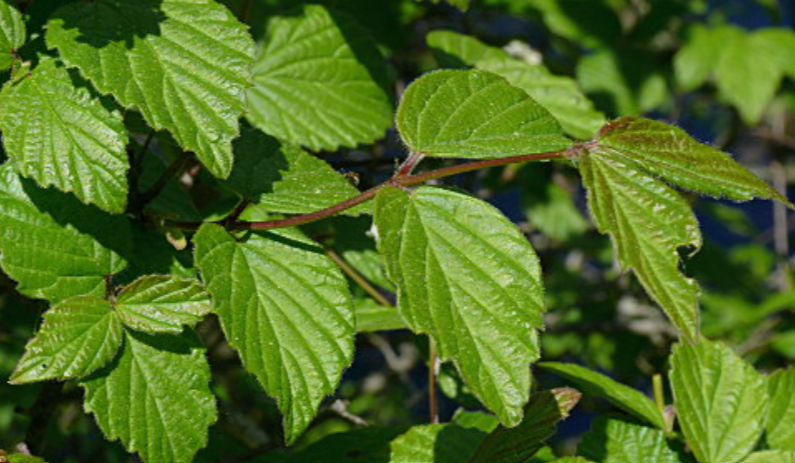
The leaves are the best way to recognize downy arrowwood. They are opposite, oval to egg-shaped, and noticeably small, typically 1½ to 3 inches long. The University of Tennessee notes that they are about half the size of the leaves of southern arrowwood. Each leaf has coarse teeth along the edge and a rounded or slightly heart-shaped base. The underside is covered with soft, downy hairs that make it feel velvety.
One of the most useful identification features is the leaf stalk. On downy arrowwood, the stalks are very short, often only a fraction of an inch, so the leaves appear to sit almost directly on the stem. Many plants also have tiny, thread-like appendages at the base of the leaf stalks. In autumn the leaves turn yellow, orange, red, or deep reddish-purple, often with several colors on the same plant.
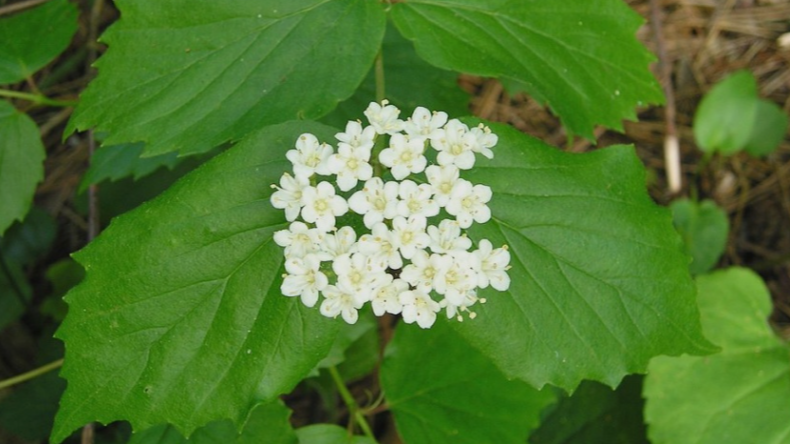
The flowers open in May and June in flat-topped clusters 1 to 3 inches across, made of many small white flowers with prominent stamens. NC State Extension describes downy arrowwood as a heavy bloomer, with showy clusters of white flowers followed by purple, berry-like fruit that attracts wildlife. The fruit ripens in late summer to dark blue-black or purple-black, about ⅓ inch across, each with a flattened seed. Mature plants usually reach 3 to 8 feet tall, sometimes taller, with a rounded, multi-stemmed habit.
Downy Arrowwood vs. Southern Arrowwood
Downy arrowwood is most often confused with southern arrowwood, a larger and more common native viburnum. The 2 species share similar coarsely toothed leaves, white flower clusters, and blue-black fruit. Downy arrowwood is noticeably smaller in nearly every way. Its leaves are smaller and more rounded, its leaf stalks are much shorter, and the shrub itself usually stays smaller and more compact.
Habitat offers another clue. Southern arrowwood typically grows in moist to wet sites, such as stream banks, swamp edges, and low woods. Downy arrowwood favors dry, rocky woods and hillsides. That difference makes downy arrowwood a better choice for dry, sunny gardens and difficult rocky sites, while southern arrowwood suits wetter areas such as rain gardens and pond edges.
Landscape Uses
Downy arrowwood’s compact size and drought tolerance make it well suited to small gardens, native plant borders, and naturalized landscapes. It works well in foundation plantings where larger viburnums would outgrow the space. It is also useful for dry slopes and banks where its suckering roots help hold the soil, and in pollinator and wildlife gardens. It can be grown as a single specimen or massed to form an informal low hedge or thicket.
Because it grows naturally on dry, rocky, often limestone-based soils, downy arrowwood is an excellent choice for difficult sites. Those include rocky outcrops, thin soils, and areas beneath open-canopied trees where competition for water is strong. Its fall color and fruit make it attractive in naturalistic plantings with native grasses, asters, goldenrods, and other woodland-edge plants.
Also Read: Different Types of Viburnum Shrubs
Wildlife Value
Downy arrowwood offers excellent value for wildlife. Its late-spring flowers attract native bees, butterflies, and many small flies and beetles that feed on the nectar and pollen. Like other native viburnums, it serves as a host plant for the spring azure butterfly and for many native moths, whose caterpillars feed nesting songbirds in spring and early summer.
The dark fruit is eaten by many songbirds, including thrushes, catbirds, robins, and bluebirds. Ruffed grouse, wild turkeys, and squirrels also eat it. The dense, suckering stems provide cover and nesting sites for small birds and other wildlife. As a native plant adapted to dry woodland edges, downy arrowwood is a strong choice for habitat restoration and wildlife plantings on dry upland sites.
Growing Considerations
Downy arrowwood is hardy from Zone 3 through Zone 8, so it suits most of the eastern and central United States and southern Canada. It grows best in full sun to partial shade. Plants in fuller sun flower and fruit more heavily and develop better fall color, while those in shade grow more open and set less fruit. It tolerates a wide range of soils, but it performs especially well in well-drained, rocky, or loamy soils, including slightly alkaline soils over limestone.
Plant downy arrowwood in spring or fall, and water regularly during its first growing season while the roots establish. Once established, it is notably drought tolerant and rarely needs supplemental watering except during extended droughts. Mulch spread 2 to 3 inches deep conserves moisture and keeps the soil cool. Avoid heavy fertilizing, which can produce weak, leggy growth.
Downy arrowwood needs little pruning. Remove dead or damaged stems as needed, and thin a few of the oldest stems at the base every few years to keep the plant vigorous and dense. Prune right after flowering to avoid removing next year’s flower buds. Because the plant spreads slowly by suckers, remove unwanted shoots to keep it in bounds, or allow it to form a loose colony in naturalized areas.
Fruit Production and Cross-Pollination
Like many native viburnums, downy arrowwood sets the heaviest fruit when 2 or more genetically different plants grow near each other. A single plant may produce only a light crop. For the best fruit display and wildlife benefit, plant downy arrowwood in groups of 3 or more, ideally from seed-grown or different nursery sources so the plants can cross-pollinate.
The fruit ripens in late summer and early fall and is usually eaten by birds within a few weeks. Because of this, the fruit display is often brief, but its value to migrating and resident birds is high. The berries are not considered a food crop for people and should be treated as wildlife food.
Pests and Problems
Downy arrowwood is generally a hardy, low-maintenance shrub with few serious problems in its native range. In regions where the viburnum leaf beetle has become established, it can be fed on by both larvae and adults, which skeletonize the leaves in spring and summer. It is generally less heavily damaged than southern arrowwood, but gardeners should still check twigs in winter for rows of small, capped egg sites and prune out infested twigs before the eggs hatch.
Other problems are usually minor. Powdery mildew and leaf spots may appear in humid or crowded sites, especially in shade, and aphids may cluster on new spring growth. Deer may browse young plants in some areas. Choosing a sunny or lightly shaded site with good drainage and air circulation prevents most issues, and well-sited downy arrowwood can thrive for decades with little care.
Sources
NC State Extension Gardener Plant Toolbox, “Downy Arrowwood”
University of Tennessee, Tennessee Yards and Neighborhoods, “Downy Arrowwood”
Oregon State University Landscape Plants, “Downy Arrowwood Viburnum”
University of Minnesota Bell Museum, Minnesota Biodiversity Atlas, “Downy Arrowwood”