Leatherleaf Viburnum: The Bold, Wrinkled-Leaf Evergreen That Shrugs Off Shade and Deer
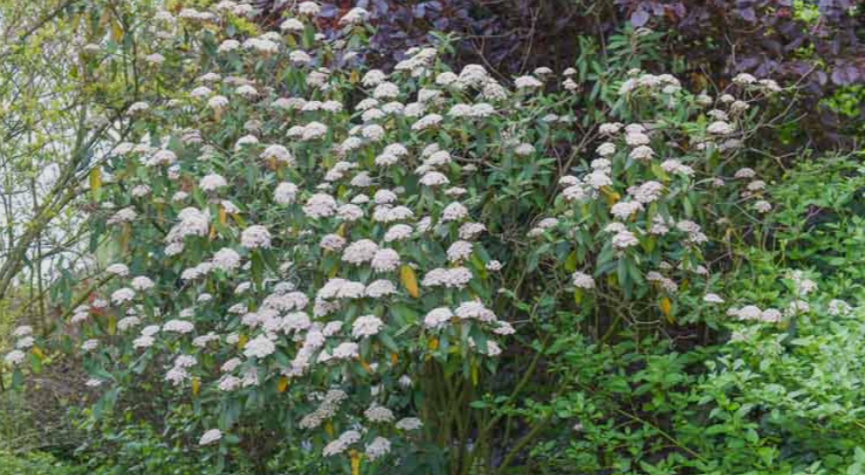
Leatherleaf viburnum is one of the most distinctive evergreen shrubs that can survive northern winters. Its long, narrow leaves are deeply wrinkled, dark green above, and covered with dense, soft felt underneath. The result is a coarse, bold texture unlike almost any other hardy shrub. In late spring it carries broad clusters of creamy white flowers, and in some years it follows them with red berries that ripen to glossy black. With age it grows into a large, imposing screen, often reaching 10 to 15 feet tall.
Leatherleaf viburnum is also one of the most practical problem-solvers in the viburnum family. It grows well in shade, is seldom browsed by deer, resists the viburnum leaf beetle better than most of its relatives, and stays green through winter in much of its range. It also has quirks that surprise new owners: drooping winter leaves, flower buds that sit exposed all winter, and fuzzy leaves that can irritate skin. This guide explains all of them and how to grow the shrub well.
Botanical Classification
Leatherleaf viburnum is a large, broadleaf evergreen to semi-evergreen shrub in the viburnum genus, a group of roughly 150 to 175 species of shrubs and small trees found mostly in the Northern Hemisphere. Like other viburnums, it has been placed in several plant families over the years. Older references list the honeysuckle family, others the moschatel family, and current systems give viburnums their own family. Its botanical name means “wrinkled leaf,” describing the deeply furrowed foliage that defines the plant.
It belongs to a group of viburnums with “naked” winter buds. That means its buds are not protected by scales and instead are covered in thick, fuzzy hairs. Its closest relative in gardens is the wayfaring tree, a European viburnum with similar felted leaves and flat flower clusters. The 2 species have been crossed to create several popular hybrids that combine leatherleaf’s bold foliage with improved hardiness and neater growth.
Brief History
Leatherleaf viburnum is native to the mountains of central and western China. The University of Connecticut Plant Database notes that it is native to central and western China and hardy to Zone 5. It forms a large, evergreen, multi-stemmed shrub reaching 10 to 15 feet tall or taller. In the wild it grows in forests, thickets, and along mountain valleys, where its thick, hairy leaves help it cope with cold winters and humid summers.
The shrub reached Western gardens at the very beginning of the 20th century. It came through the English plant hunter Ernest Wilson, who collected it in China around 1900 for the famous Veitch nursery. It quickly earned a place in British and American gardens as one of the few large-leaved evergreens hardy enough for cold climates. Later in the century, American breeders crossed it with the wayfaring tree to produce hybrids that are now widely planted in parks, campuses, and commercial landscapes.
Identifying Characteristics
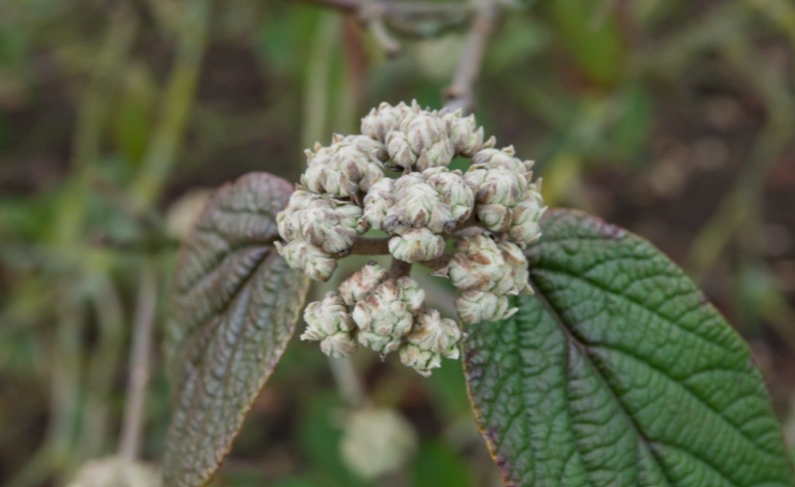
The leaves are the plant’s signature feature. They are opposite, long, and narrow, typically 3 to 7 inches long and 1 to 2½ inches wide, with smooth or very finely toothed edges. The upper surface is dark, slightly glossy green and deeply wrinkled by a network of sunken veins. The underside is covered with a dense mat of grayish to yellowish-brown hairs that feel like felt. Young stems are also thickly coated in the same tan fuzz.
In cold weather, the leaves behave much like rhododendron leaves. As temperatures drop below freezing, they droop and curl downward, then flatten out again as the weather warms. This is a normal way of reducing moisture loss and cold injury, not a sign of a dying plant. In the coldest parts of its range, the shrub may lose many of its leaves in a harsh winter, behaving as a semi-evergreen.
The flower buds form in late summer and fall and remain exposed all winter as fuzzy, tan clusters at the branch tips, adding winter interest. In May they open into broad, flat-topped clusters 4 to 8 inches across of small, creamy to yellowish-white flowers. Some people find the scent mildly unpleasant. The fruit ripens in late summer and fall, turning from green to bright red and finally to glossy black, often with several colors in one cluster. Heavy fruiting usually requires 2 or more genetically different plants growing nearby to cross-pollinate.
Also Read: Different Types of Viburnum Varieties
Leatherleaf Viburnum Hybrids
Several of the most widely planted evergreen viburnums in North America are hybrids between leatherleaf viburnum and the wayfaring tree. They are often grouped under the name lantanaphyllum viburnum. ‘Alleghany’, released by the U.S. National Arboretum in the 1950s, is the best known. It has dark, leathery leaves that are less wrinkled than those of leatherleaf, a dense rounded habit, heavy flowering, and good resistance to leaf spot. ‘Willowwood’ is another popular hybrid, with arching branches and a tendency to bloom again lightly in fall.
Prague viburnum is a separate hybrid raised in Prague, Czech Republic, in the mid-20th century. Leatherleaf viburnum is one of its parents. It has narrower, glossier, smoother leaves that are less coarse than leatherleaf’s, and it forms a neat, dense evergreen shrub. Gardeners who like the look of leatherleaf but want a finer, tidier texture often choose Prague viburnum or one of the lantanaphyllum hybrids instead. True leatherleaf cultivars are few, and most plants sold are the straight species.
Landscape Uses
Leatherleaf viburnum’s large size and evergreen leaves make it an excellent screen for blocking views, softening buildings, and creating privacy along property lines. It works well as a background plant in large shrub borders, where its coarse texture contrasts with finer-leaved shrubs and perennials. Planted in groups or as an informal hedge, it forms a dense, tall barrier that stays green through most winters.
The shrub is especially valuable in shady sites. It grows well beneath tall deciduous trees, along the north and east sides of buildings, and in woodland gardens where few other evergreens thrive. Its bold foliage pairs well with ferns, hostas, hellebores, rhododendrons, and other shade-tolerant plants. Because deer seldom eat it, leatherleaf viburnum is often used in suburban and rural landscapes where deer browsing limits shrub choices.
A Word of Caution About the Fuzzy Leaves
The dense hairs covering leatherleaf viburnum’s leaves, stems, and buds are made up of tiny, star-shaped hairs. They can detach easily, especially during pruning or when handling the plant in dry weather. For some people, the loose hairs irritate the skin, eyes, nose, or throat, causing itching, sneezing, or coughing. Gardeners with sensitive skin or respiratory allergies should wear gloves, long sleeves, and eye protection when working with the shrub.
The same hairs help protect the plant. They discourage many insects and deer, reduce water loss in winter, and help shield the leaves from cold and drying winds. Most gardeners find the shrub easy to live with, as long as they take simple precautions during heavy pruning.
Growing Considerations
Leatherleaf viburnum is hardy from Zone 5 through Zone 8, and the hybrids and protected plantings extend its range into colder parts of Zone 5. It grows best in partial shade to full shade, especially where it is sheltered from strong winter sun and wind. In exposed, sunny sites, the leaves often scorch, brown, or drop in winter, and they may yellow in hot, dry summers. A spot on the north or east side of a building, or beneath tall trees, gives the best results.
The shrub prefers moist, fertile, well-drained soil rich in organic matter, slightly acidic to neutral, though it tolerates clay and moderately alkaline soils. Shelter from wind is important. Its large leaves are easily torn and dried out by strong winter winds. Plant it in spring or early fall, and water regularly through the first growing season. A 2 to 3 inch layer of mulch keeps the roots cool and moist and protects them in winter.
Leatherleaf viburnum grows at a moderate pace and rarely needs heavy pruning. Prune right after flowering in late spring to shape the plant or remove dead or damaged branches. Do not prune in late summer or fall, which removes the exposed flower buds for the next year. Overgrown or leggy shrubs can be renewed by cutting a few of the oldest stems to the ground every few years, or by cutting the entire plant back hard in late winter. It resprouts vigorously.
Pests and Problems
Leatherleaf viburnum is one of the more pest-resistant viburnums. Its thick, hairy leaves make it relatively unattractive to the viburnum leaf beetle, which devastates arrowwood, cranberrybush, and many other viburnums in the Northeast. It is also seldom bothered by deer. Occasional problems include leaf spots in wet weather, scale insects on stems, and aphids on soft new growth, but these rarely cause serious damage.
Most of the problems gardeners see are environmental rather than pest-related. Winter leaf scorch, browning, and leaf drop result from exposure to sun and wind, especially when the ground is frozen and the roots cannot replace lost moisture. Poorly drained soils can lead to root rot. Choosing a sheltered, shaded site with good drainage, and watering deeply in fall before the ground freezes, prevents most issues.
Sources
University of Connecticut Plant Database, “Leatherleaf Viburnum”
Virginia Cooperative Extension, Virginia Tech, “Leatherleaf Viburnum”
NC State Extension Gardener Plant Toolbox, “Leatherleaf Viburnum”
Purdue University Arboretum, “Leatherleaf Viburnum”
Cornell University Woody Plants Database, “Leatherleaf Viburnum”