Laurustinus Viburnum: The Ancient Mediterranean Evergreen with Winter Flowers and Metallic Blue Berries
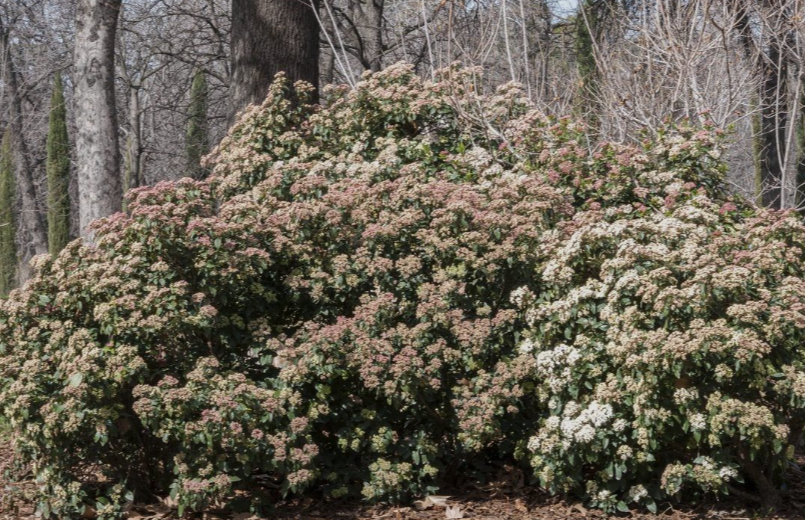
Laurustinus viburnum is one of the oldest cultivated ornamental shrubs in the Western world. It has been grown in European gardens for centuries, and its name goes back to Roman times. It is also one of the most useful evergreen shrubs for mild-winter climates. Its glossy, dark green leaves stay attractive all year. From late fall through early spring, when few other plants are in bloom, it carries clusters of pink buds and white flowers at the same time. Then come its most remarkable feature: berries in a shimmering, metallic blue that scientists only recently managed to explain.
Laurustinus is tough, adaptable, and easy to grow. It thrives in coastal gardens, tolerates salt spray, handles shade and drought, and can be shaped into anything from a loose screen to a formal hedge or small tree. This guide covers its ancient history, the science behind its unusual fruit color, how to choose among its many cultivars, and how to grow it well, along with a few cautions that matter in some parts of North America.
Botanical Classification
Laurustinus is a broadleaf evergreen shrub in the viburnum genus, a group of roughly 150 to 175 species of shrubs and small trees found mostly in the Northern Hemisphere. Like other viburnums, it has been placed in several plant families over the years. Older references list the honeysuckle family, others the moschatel family, and current systems give viburnums their own family. UC Master Gardeners of Marin County explain that the name “laurustinus” combines Latin words meaning “laurel-like tinus,” a reference to evergreen foliage that resembles bay laurel.
The species varies somewhat across its range, and botanists recognize distinct island forms. One grows in the Canary Islands and another in the Azores, each with slightly different leaves and growth habits. Most garden plants derive from the mainland Mediterranean form. Among landscape viburnums, laurustinus stands out as one of the few evergreen species that flowers mainly in winter. That trait makes it especially valuable in mild climates.
Brief History
Laurustinus has one of the longest documented garden histories of any viburnum. In classical times it was already known by its Latin name, tinus, and Roman writers including Pliny mentioned the shrub. In its native Mediterranean region, it grows in woodland understories, shrublands, and shady, moist ravines, from southern Europe across to North Africa. It has long been planted around villas, monasteries, and courtyards there.
The shrub reached northern European gardens early. Oregon State University notes that it has been cultivated in England for some 500 years. It was a favorite of Tudor and later Victorian gardeners, who valued its winter flowers and evergreen leaves in an otherwise bleak season. In North America, it became popular in California, the Pacific Northwest, and the coastal South. There it is now one of the most commonly planted evergreen screening shrubs.
Identifying Characteristics
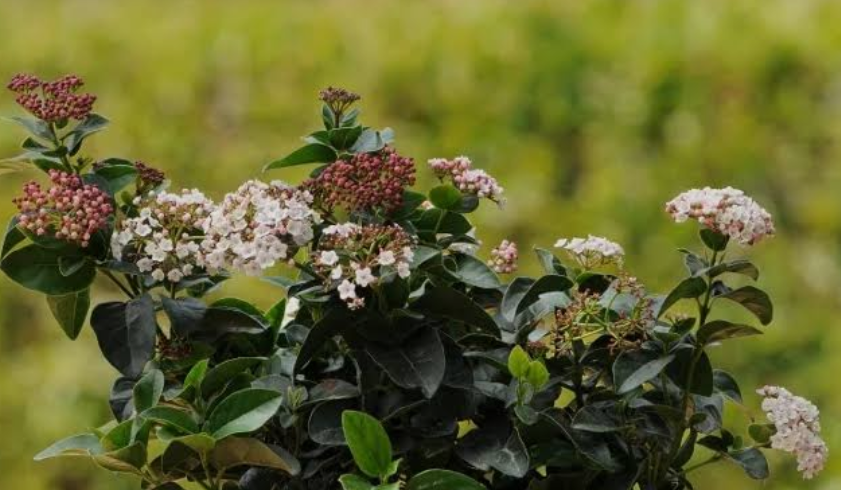
The leaves are oval to elliptical, typically 2 to 4 inches long, with a thick, leathery texture and a glossy, dark green upper surface. Their edges are smooth and often slightly rolled under. The undersides are paler and carry small tufts of hair where the veins meet. Those tufts form tiny shelters called domatia, which house beneficial predatory mites. New stems often emerge a deep wine-red, contrasting with the dark foliage, and mature shrubs stay densely leafy right down to the ground.
The flowers appear in flat-topped clusters about 2 to 4 inches across. The buds are pink to rosy-red and open into small, white, starry flowers. Because the buds open gradually over many weeks, a single shrub usually shows pink buds and white flowers together, giving it a soft two-toned look. The bloom season is long. In mild climates, flowering typically runs from late fall through early spring. The flowers have a light, pleasant fragrance and are visited by bees and other pollinators on warm winter days.
The fruit follows in late spring and summer. It is a small, oval, one-seeded berry about ¼ inch long. As it ripens, it turns a striking metallic blue and eventually matures to purple-black. The shrub typically grows 6 to 12 feet tall and up to 10 feet wide, with an upright, rounded, dense habit. Older plants can be trained into multi-trunked small trees.
Also Read: Different Types of Viburnum Shrubs
The Science of the Metallic Blue Berries
The shimmering blue of laurustinus fruit has puzzled botanists for a long time. Most blue fruits get their color from pigments, but laurustinus fruit does not rely mainly on pigment for its brilliant metallic sheen. A 2020 scientific study found that the color comes from tiny, layered globules of fat in the fruit’s skin. These structures scatter and reflect light, producing what scientists call structural color.
Structural color is common in bird feathers, butterfly wings, and beetle shells, but it is extremely rare in plants. That makes laurustinus one of the few garden plants with fruit colored this way. Researchers believe the shiny blue may make the fruit more visible to birds, which eat the berries and spread the seeds. For gardeners, it means the berries catch light and seem to glow in a way few other fruits do.
Popular Cultivars
Laurustinus comes in many cultivars that differ in size, flower color, and leaf type. ‘Spring Bouquet’, also sold as ‘Compactum’, is one of the most widely planted in North America. Oregon State University notes that it grows 3 to 5 feet tall with an equal spread. UC Marin Master Gardeners describe it as having slightly smaller, darker green leaves and recommend it for hedges. ‘Eve Price’ is a classic compact British selection with smaller leaves, very dense growth, and deep carmine-pink buds. It is one of the most floriferous forms available.
‘Gwenllian’ is another compact cultivar with especially pink buds and a heavy crop of blue fruit. ‘French White’ is a vigorous, upright form grown for its large clusters of pure white flowers. ‘Robustum’ has coarser, rougher leaves and less pink in the flowers. UC Marin Master Gardeners note that it is more resistant to mildew and makes an excellent small, narrow tree. Gardeners who want variegated foliage can choose ‘Bewley’s Variegated’, with cream-edged leaves, or ‘Lisa Rosa’, whose leaves are edged in cream, yellow, and pink, as NC State Extension notes.
Landscape Uses
Laurustinus is one of the most versatile evergreen shrubs for mild climates. Its dense foliage reaches the ground, which makes it excellent for privacy screens, windbreaks, and hedges, whether clipped formally or left loose and informal. It can be shaped into topiary or trained into a small, multi-trunked tree for patios, courtyards, and narrow spaces. Compact cultivars such as ‘Spring Bouquet’ and ‘Eve Price’ work well in foundation plantings and mixed borders.
The shrub is especially valuable near the coast. Oregon State University notes that it can withstand considerable shade and salt spray. UC Marin Master Gardeners add that it is tolerant of deer, drought, and salt. That makes it one of the best evergreen shrubs for seaside gardens, windswept sites, shaded urban yards, and low-water landscapes. Its winter flowers also make it a natural centerpiece for winter-interest gardens, alongside hellebores, camellias, and winter-blooming bulbs.
A Caution for West Coast Gardeners
Laurustinus’s adaptability has a downside in some regions. Birds eat the berries and spread the seeds, and in parts of California and Oregon the shrub has been reported escaping from gardens and growing in natural areas. Gardeners in those regions should check local invasive-plant guidance before planting and consider native or non-spreading alternatives near wild lands. In other areas, including Florida, the University of Florida lists the shrub as not known to be invasive.
The fruit is not considered edible for people. In folk medicine it was historically used as a purgative, and eating the berries can upset the stomach. Gardeners with small children or pets should treat the blue berries as ornamental only.
Growing Considerations
Laurustinus is best suited to Zones 8 through 10, and it is often grown in protected sites in Zone 7b. It is generally hardy to around 14°F (−10°C), but colder temperatures can damage leaves, flower buds, and stems. In colder areas, plant it in a sheltered spot protected from harsh winter winds, and choose hardier selections where available.
The shrub grows well in full sun to partial shade. In hot, dry summer climates it prefers some afternoon shade, which keeps the foliage greener and reduces stress. It tolerates a wide range of soils, including clay, loam, and sand, and grows in acidic to slightly alkaline conditions, as long as drainage is good. Waterlogged soils can lead to root rot, so avoid low, soggy spots.
Plant laurustinus in fall or spring, and water regularly during its first growing season. Once established, it tolerates moderate drought well, though it looks best with occasional deep watering during long dry spells. A 2 to 3 inch layer of mulch helps keep the soil cool and moist. For the best winter display, do major pruning right after flowering ends in spring. Formal hedges can be lightly sheared in early summer, which keeps them dense while preserving many of the next season’s flower buds.
Pests and Problems
Laurustinus is generally a low-maintenance shrub, and in many areas it has few serious pests. The University of Florida notes that no serious pests are normally seen on the plant. Problems can still occur. Powdery mildew is the most common, especially in coastal fog or shaded, crowded sites. Choosing mildew-resistant cultivars such as ‘Robustum’ and spacing plants for good air circulation reduce the risk.
Aphids sometimes attack new spring shoots, and spider mites and thrips may appear in hot, dry conditions. Scale insects occasionally build up on stems and leaves, producing sticky honeydew and sooty mold. In Europe, the viburnum whitefly and viburnum leaf beetle are common pests, and the viburnum leaf beetle has spread into parts of North America. Root rot can develop in poorly drained soils. Healthy, well-sited plants in good conditions often thrive for decades.
Sources
UC Master Gardeners of Marin County, “Viburnum tinus: A Hard-Working, Versatile, Evergreen Shrub”
Oregon State University Landscape Plants, “Laurustinus”
NC State Extension Gardener Plant Toolbox, “Viburnum tinus”
University of Florida IFAS, “Viburnum tinus: Laurestinus Viburnum” Fact Sheet