Judd Viburnum: The Arnold Arboretum Hybrid That Quietly Replaced Koreanspice
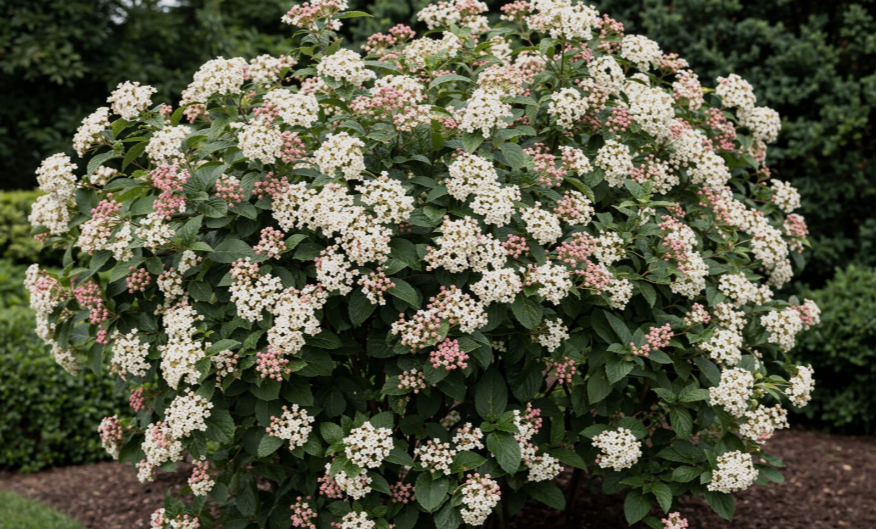
Judd viburnum is a fragrant spring-flowering shrub that offers almost everything gardeners love about Koreanspice viburnum, with fewer of its problems. Each spring, its rosy-pink buds open into rounded clusters of white flowers with a sweet, spicy scent of cloves and carnations. The shrub grows into a full, rounded mound about 6 to 8 feet tall and wide, with dark blue-green leaves that often turn wine-red to purple in autumn. It is hardy, adaptable, and more disease resistant than its famous parent, so many horticulturists consider it one of the best fragrant viburnums for home gardens.
Judd viburnum is far less well known than Koreanspice, even though it has been grown for more than a century. It was raised in 1920 at one of America’s most important botanical institutions. Since then it has steadily earned the respect of nursery growers, landscape designers, and extension horticulturists. This guide covers its history, how it compares with similar fragrant viburnums, and how to grow it for the strongest spring scent.
Botanical Classification
Judd viburnum is a deciduous, multi-stemmed shrub in the viburnum genus, a group of roughly 150 to 175 species of shrubs and small trees found mostly in the Northern Hemisphere. Like other viburnums, it has been placed in several plant families over the years. Older references list the honeysuckle family, others the moschatel family, and current systems give viburnums their own family. Gardeners may see any of these on plant tags and in extension publications.
It is traditionally described as a hybrid between 2 Asian viburnums. According to Purdue University, the parents are Koreanspice viburnum and Bitchiu viburnum, a closely related, more open-growing shrub from Japan named for the old Bitchū region. Recent botanical work adds a twist. Some authorities now treat Bitchiu viburnum as a variety of Koreanspice rather than a separate species. Under that view, Judd viburnum is technically a selection of Koreanspice rather than a true cross between 2 species. For gardeners, nothing changes, but it explains why the plant appears under slightly different names in different references.
Brief History
Judd viburnum was created in 1920 at the Arnold Arboretum of Harvard University in Boston. Oregon State University records that William H. Judd, the arboretum’s propagator, made the cross. Judd spent decades raising new plants at the arboretum, which was then one of the world’s leading centers for introducing Asian trees and shrubs to Western gardens. The hybrid was formally named in his honor in 1935.
For much of the 20th century, Judd viburnum lived in the shadow of Koreanspice viburnum and the English-bred Burkwood viburnum, both of which were more aggressively promoted by nurseries. Over time, however, growers noticed that Judd viburnum was more reliable. It was less prone to disease and grew into a fuller, better-shaped shrub. Iowa State University Extension notes that the Judd hybrid has largely replaced Koreanspice viburnum in the trade, though both remain good choices where available.
Identifying Characteristics
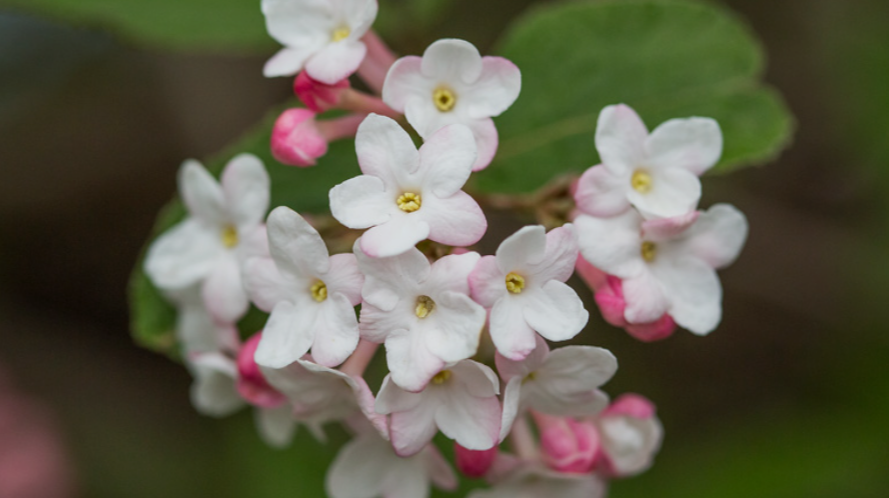
The flowers are the main attraction. In April and early May, deep pink to reddish buds form at the tips of the branches and open into rounded, semi-snowball clusters about 2½ to 3½ inches across. Each cluster holds dozens of small, tubular white flowers, often with a soft pink blush in the early stages. Because the buds open over several days, the clusters often look pink and white at the same time. That two-toned effect is one of the shrub’s most charming features.
The fragrance is very similar to that of Koreanspice viburnum: rich, sweet, and spicy, with notes of clove, carnation, and spice cake. On warm, calm days the scent carries well beyond the shrub, often reaching across a patio or small garden. The flower clusters are slightly looser and more open than those of Koreanspice, but just as fragrant.
The leaves are opposite, oval, and 1½ to 3½ inches long, with irregular teeth along the edges. They are dark green to blue-green, slightly hairy, and somewhat leathery, without the high gloss of Burkwood viburnum leaves. In autumn the foliage often turns red, burgundy, or wine-purple, though fall color varies from year to year. Small oval fruit forms in late summer and ripens from red to black. It is usually sparse but still eaten by birds.
Judd vs. Koreanspice vs. Burkwood Viburnum
These 3 fragrant viburnums are closely related and often confused. Koreanspice viburnum is the oldest and most famous of the group. It has the most intense fragrance, but it is more prone to bacterial leaf spot and often grows lopsided or open. Its leaves are dull, gray-green, and softly hairy on both sides. It is usually the least heat tolerant of the three.
Burkwood viburnum, a cross between Koreanspice and an evergreen Chinese viburnum, has glossy, dark green leaves that may stay on the shrub through winter in mild climates. It handles heat better than Koreanspice and grows taller and more upright, but its fragrance is usually a little lighter. Judd viburnum falls between the two. It has fragrance close to Koreanspice, better disease resistance, and a fuller, more rounded shape that tends to fill out right to the ground. For many northern and midwestern gardeners, it is the most dependable all-around choice of the three.
Landscape Uses
Judd viburnum’s fragrance makes placement especially important. Plant it near entrances, walkways, patios, decks, and windows that are opened in spring, where the scent can be enjoyed every day it blooms. A single shrub positioned upwind of a seating area can perfume a whole corner of the garden. Its moderate size and naturally rounded shape make it well suited to foundation plantings, mixed shrub borders, and cottage gardens.
Because Judd viburnum tends to keep its leaves and branches all the way to the ground, it often does not need shorter plants in front to hide bare stems. That makes it useful as a stand-alone specimen or for informal low hedges and screens. Planted in groups of 3 or as a loose row, it forms a dense, fragrant barrier that stays attractive from spring through fall. It also pairs well with spring bulbs and early perennials, which bloom at the same time.
Wildlife Value
The fragrant spring flowers attract a wide range of early-season pollinators, including native bees, honeybees, butterflies, and many flies and beetles. Because Judd viburnum blooms in early spring, it provides valuable nectar and pollen at a time of year when relatively few shrubs are in flower. Pollinator activity usually peaks on warm, sunny days, when the fragrance is also strongest.
The fruit is not abundant, but birds eat it as it ripens in late summer, and the dense branching offers cover for small songbirds. Like its Asian parents, Judd viburnum supports far fewer native caterpillars than native North American viburnums such as arrowwood or blackhaw. Gardeners who want maximum wildlife value often plant Judd viburnum close to the house for fragrance and use native viburnums farther out on the property.
Growing Considerations
Judd viburnum is generally hardy from Zone 4 through Zone 8, though some references rate it more conservatively to Zone 5. It grows best in full sun to partial shade. Plants in full sun flower most heavily and keep the densest form, while afternoon shade helps protect the leaves in hot southern summers. It handles heat better than Koreanspice viburnum, but it still prefers temperate climates to the hot, humid Deep South.
The shrub prefers moist, fertile, well-drained soil, slightly acidic to neutral, though it tolerates a wide range of soil types. Utah State University notes that once established, it is drought tolerant and adapts to many soils. Plant it in spring or early fall, and water deeply and consistently through its first growing season. A 2 to 3 inch layer of mulch over the root zone keeps the soil cool and evenly moist.
Prune Judd viburnum immediately after flowering, since next spring’s buds form during summer and later pruning removes them. Because of its naturally rounded habit, it rarely needs more than light shaping and removal of dead or crossing branches. Every few years, older plants can be renewed by cutting a few of the oldest stems to the ground. If your plant was grafted, watch for suckers from the rootstock that look different from the main shrub, and remove them promptly.
Pests and Problems
Disease resistance is one of Judd viburnum’s biggest advantages over Koreanspice viburnum. Purdue University and Cornell University both note that it has better resistance to bacterial leaf spot, a disease that frequently disfigures Koreanspice plants in wet seasons. Powdery mildew may appear occasionally in humid summers, especially on shaded or crowded plants. Good air circulation and watering at the base help keep the leaves healthy.
Aphids sometimes cluster on new spring growth but rarely cause lasting damage. As with other viburnums, crown borers can attack the lower stems of stressed or damaged plants, causing wilting and dieback, so avoid wounding the base with mowers or string trimmers. Judd viburnum is generally less troubled by the viburnum leaf beetle than arrowwood and the cranberrybush viburnums, and deer usually leave it alone. Grown in the right site, it is a long-lived, low-maintenance shrub.
Sources
Purdue University Arboretum, “Judd Viburnum”
Oregon State University Landscape Plants, “Judd Viburnum”
Iowa State University Extension and Outreach, “Viburnums for Iowa” (RG 705)
Utah State University Extension, Varga Arboretum, “Judd Viburnum”