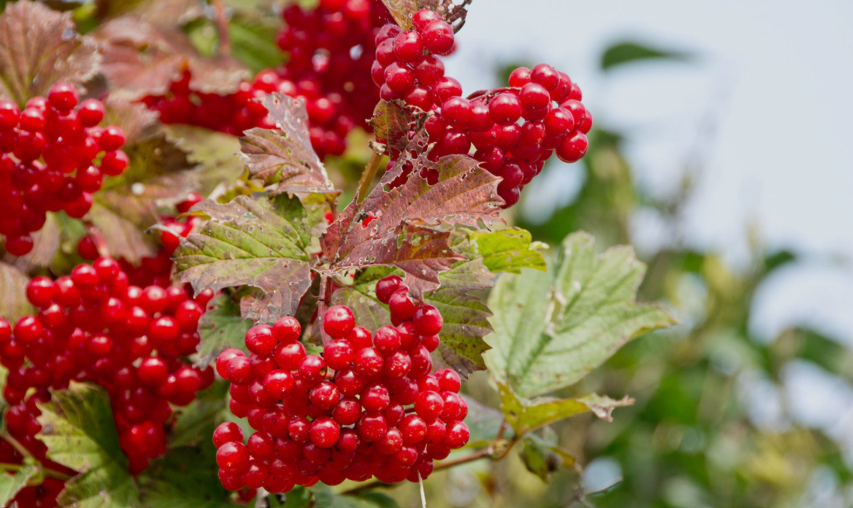
European cranberrybush viburnum is a large, fast-growing deciduous shrub that has decorated European gardens for at least 500 years. It also gave American gardeners one of their most nostalgic plants, the old-fashioned snowball bush. In late spring it bears flat, lace-like clusters of white flowers. In autumn its maple-shaped leaves turn red and purple, and it carries heavy clusters of translucent scarlet berries that can hang on the branches through winter. Its toughness and generous display made it a fixture of farmyards, cemeteries, and suburban hedges long before native-plant gardening became popular.
It is also one of the more complicated shrubs a North American gardener can choose. It has escaped cultivation across much of the northern United States and Canada, and several states now list it as invasive. It also looks almost exactly like the native American cranberrybush, so the two are often confused in the wild and at the nursery. This guide covers the plant’s history, appearance, best cultivars, and growing needs, and helps you decide whether it belongs in your landscape.
Botanical Classification
European cranberrybush is a multi-stemmed, deciduous shrub in the viburnum genus, a group of roughly 150 to 175 species of shrubs and small trees spread across the Northern Hemisphere. Like its relatives, it has been moved between plant families as botanists have revised their classifications. It has been placed in the honeysuckle family, then the moschatel family, and most recently in its own viburnum family. Garden references, nursery tags, and extension publications still use all three.
The species is the centerpiece of a small, closely related group. The native American cranberrybush is now often classified as a North American variety of this European species, and a third, Asian form, Sargent viburnum, is treated the same way. Oregon State University notes that the European plant is native to Europe, including Britain, as well as northern Africa and northern Asia. Because the European and American forms can interbreed, scientists also watch for hybrids where the introduced shrub has spread into native habitat.
Brief History
The plant’s oldest and most romantic common name is guelder rose. It refers to Gelderland, a province in the Netherlands where the sterile snowball form is believed to have been cultivated in early European gardens. The shrub is not a rose at all. The name came from the full, rose-like clusters of the snowball form. Over the centuries it collected many folk names in Britain and Europe, including water elder, whitten tree, and snowball tree, reflecting its fondness for damp ground and its showy blooms.
The shrub has deep cultural roots in Eastern Europe. In Ukraine it is known as kalyna and is one of the country’s most cherished national symbols. It appears in folk songs, poetry, embroidery, and wedding traditions, and is often associated with beauty, love, and the homeland. The bitter red berries were traditionally preserved, cooked with honey, or used in folk remedies, and the bark was valued for easing cramps.
The University of Arkansas Cooperative Extension notes that the snowball form has been grown in gardens since at least the middle of the 16th century and reached the United States in colonial times. Nurseries have produced it continuously ever since. For generations it was easier to find and propagate than the native American cranberrybush, which is why so many older American landscapes contain the European plant rather than the native one.
Identifying Characteristics
The leaves are opposite and 3-lobed, coarsely toothed, and typically 2 to 4 inches long, giving them a strong resemblance to maple leaves. They are bright to dark green in summer and turn yellow-red to reddish-purple in autumn, though fall color is inconsistent from year to year. The leaf stalk has small, disk-like glands just below the leaf blade. On the European plant these glands are usually flat or slightly concave, which is one of the few reliable ways to tell it apart from the native American shrub, whose glands tend to be raised and rounded.
In the wild-type plant, the flowers open in May as flat-topped clusters about 2 to 4 inches across. Each cluster has an outer ring of large, showy white flowers that are sterile. These surround a center of tiny fertile flowers with yellow anthers, which produce the fruit. This lacecap arrangement is delicate and elegant, especially when the shrub is in full bloom. The snowball forms have only sterile flowers, packed into round, ball-shaped clusters.
The fruit ripens in late summer and early fall as hanging clusters of glossy, translucent red berries about ¼ inch wide, each holding a single flattened seed. Birds tend to leave them alone until late winter, so the fruit often stays on the branches for months. It gradually shrivels into red “raisins” against the bare twigs. Older shrubs reach about 8 to 12 feet tall and wide, with upright, arching stems that sucker from the base and can form dense thickets.
Popular Cultivars
Most gardeners first meet this species through ‘Roseum’, the classic European snowball viburnum. Its fertile flowers have been replaced by large, round clusters of sterile white blooms that cover the plant in May. They sometimes take on a faint pink tint as they fade, which explains the somewhat misleading cultivar name. Because the flowers are sterile, ‘Roseum’ produces no fruit. That limits its wildlife value but also means it does not spread by seed.
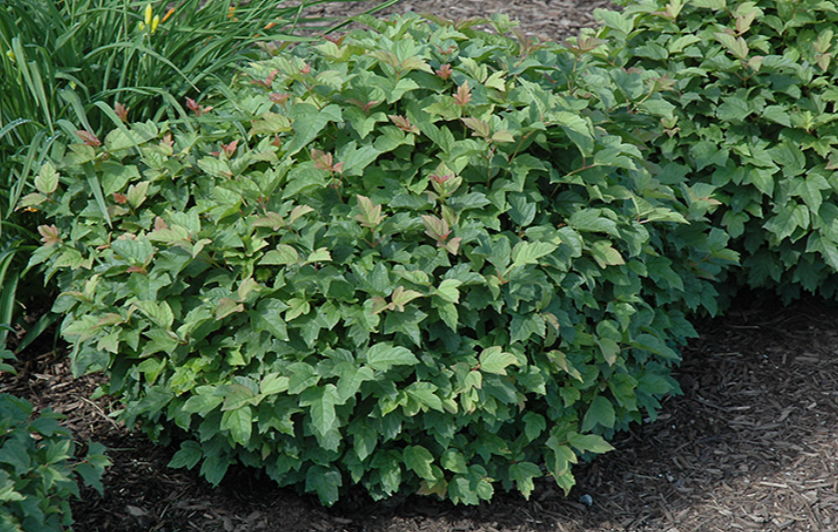
Several smaller selections suit modern yards better than the full-sized species. Virginia Tech describes ‘Compactum’ as a dense form about half the size of the species, reaching around 6 feet tall with good fall color. ‘Nanum’ is a true dwarf, usually staying 2 feet tall and somewhat wider, and it rarely flowers or fruits. It is grown mainly as a low hedge or groundcover. ‘Xanthocarpum’ stands out for its golden-yellow, translucent fruit, a striking change from the usual red that works well in mixed borders.
Also Read: Major Types of Viburnum Shrubs
Edibility and Toxicity
The European berries are often lumped together with the edible fruit of the native American cranberrybush, but the two are very different in flavor. European cranberrybush fruit is intensely bitter and astringent. Most people who taste it raw find it unpleasant, and jelly made from it is often called inedible. Eating large amounts of raw fruit can upset the stomach, so the berries should not be treated as a casual snack, especially by children.
In Eastern Europe, the berries are traditionally used only after cooking, freezing, or long storage. These steps reduce the bitterness and make them suitable for preserves, teas, and honey-sweetened mixtures. Even so, gardeners in North America who want a shrub for homemade jelly are much better served by the native American cranberrybush or one of its fruiting cultivars. Anyone foraging wild shrubs should identify the plant carefully first, since the two species often grow side by side.
Landscape Uses
European cranberrybush is one of the most adaptable shrubs in cultivation. It tolerates wet to dry soil, acidic to alkaline pH, full sun to partial shade, and winters down to Zone 3. It also handles heat better than the native American cranberrybush, growing well into Zone 8. That makes it useful for informal hedges, privacy screens, and shrub borders, especially in difficult sites where fussier plants fail.
The snowball forms remain popular for cottage gardens, heritage landscapes, and anyone restoring a historic garden, where their old-fashioned blooms match the period. The compact and dwarf cultivars work in foundation beds and smaller yards. The full-sized species is best kept for large, informal spaces, because older plants grow broad and sprawling and need regular renewal pruning to stay tidy.
Should You Plant It?
The European cranberrybush’s adaptability has a downside. Birds eat the fruit of the fertile forms and drop the seeds in woodlands, wetlands, and stream corridors far from where the shrub was planted. Escaped populations now grow wild from the Atlantic coast to Washington state and south to Missouri and Virginia. Several states, including Wisconsin, Pennsylvania, and New Jersey, include it on invasive species lists. In those areas it competes with native shrubs and can crowd the understory of damp forests.
The risk depends on what you plant and where. Fruitless snowball forms such as ‘Roseum’ do not spread by seed and carry far less risk, and ‘Nanum’ rarely fruits. Fruiting forms planted near natural areas are a greater concern. Gardeners who want the look of a cranberrybush with the wildlife benefits and none of the invasive risk can choose the native American cranberrybush instead. It looks nearly identical and supports far more native insects and birds.
Growing Considerations
European cranberrybush grows best in full sun to partial shade, with at least 6 hours of direct sun for the heaviest flowering and fruiting. It does well in moist, fertile soil but adapts to clay, sand, wet sites, and moderately dry ground once established. Plant it in spring or early fall, water deeply through the first growing season, and spread 2 to 3 inches of mulch over the root zone to hold moisture and suppress weeds.
Established shrubs need little care beyond pruning. Since flower buds form during the summer for the following spring, prune right after flowering to avoid cutting off next year’s blooms. Renewal pruning is the best way to keep older plants vigorous: every few years, remove about one third of the oldest, thickest stems at ground level. Remove suckers that wander beyond the planting area to keep the shrub from forming an unwanted thicket.
Pests and Problems
The most common problem on European cranberrybush, especially the snowball forms, is the snowball aphid. UMass Amherst lists both the species and ‘Roseum’ among the aphid’s preferred hosts. Its feeding tightly curls and distorts new leaves within about 3 weeks of bud break. Control works best very early in spring, when the leaves are about 2 inches long, because the aphids become protected inside curled foliage soon afterward.
The viburnum leaf beetle is a second serious threat. This beetle is native to Europe and was first recorded in North America in 1947. It strongly prefers this species, and its larvae can strip shrubs to skeletal leaves each spring. Repeated defoliation over several seasons can kill even large plants. Inspect twigs each winter for rows of small, capped egg sites and prune out infested wood before the eggs hatch. Powdery mildew and leaf spot also appear occasionally, especially in humid, crowded plantings with poor air circulation.
Sources
Oregon State University Landscape Plants, “European Cranberrybush Viburnum”
University of Arkansas Cooperative Extension, “Plant of the Week: Viburnum, Snowball”
Virginia Cooperative Extension, Virginia Tech, “European Cranberrybush Viburnum (Guelder Rose)”
UMass Amherst Landscape, Nursery and Urban Forestry Program, “Snowball Aphid”