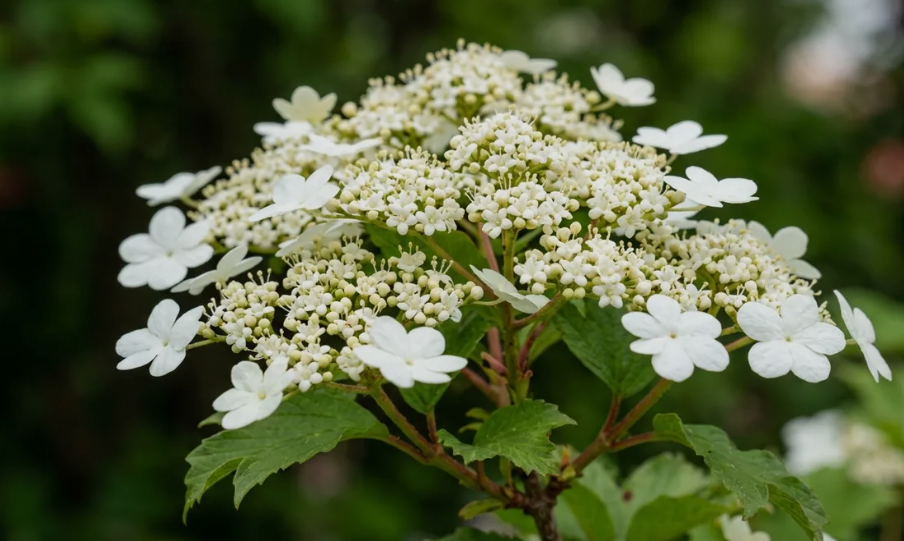
American cranberrybush viburnum is a cold-hardy native shrub. It brightens northern landscapes with lacy white spring flowers, maple-shaped leaves, and glossy scarlet fruit that often hangs on the bare branches well into winter. Despite the name and the uncanny resemblance of its berries, it has nothing to do with the bog cranberries sold in grocery stores. The name was given by early settlers, who saw clusters of tart red fruit and used them much as they used true cranberries, cooking them into sauces and jellies to get through long northern winters.
Few native shrubs offer as many seasons of interest or as much practical value. The plant grows 8 to 12 feet tall and wide. It survives winters as cold as Zone 2, feeds birds during the leanest months of the year, and produces fruit that people can eat. It also has a nearly identical European relative that is sold widely and has escaped into the wild in parts of North America. Learning to tell the two apart is one of the most useful skills a native-plant gardener can have, and this guide explains exactly how.
Botanical Classification
American cranberrybush is a deciduous, multi-stemmed shrub in the viburnum genus, a group of about 150 to 175 species found mostly in the Northern Hemisphere. Like other viburnums, it has been moved between plant families as botanists have revised their classifications. Older field guides put it in the honeysuckle family, newer references in the moschatel family, and current systems give viburnums their own family. Gardeners comparing plant tags, catalogs, and extension fact sheets will often find all three.
Its relationship to the European cranberrybush is still debated. Some botanists treat the American plant as its own species. Others list it as a North American variety of the European shrub, because the two look so alike and can interbreed. The University of Maine lists it as a variety of the European species and records common names including highbush cranberry and cranberry viburnum. Whichever system a reference follows, the native plant is genetically and ecologically distinct enough that conservation groups encourage planting it instead of its imported cousin.
Brief History
Long before European settlement, Indigenous peoples across the northern woodlands gathered the fruit of this shrub. The berries are sour and musky when raw but become much more palatable after a hard frost. They were cooked, dried, or mixed with other foods, and the bark was steeped for medicinal teas. That bark use gave the shrub another old common name, crampbark, because it was traditionally used to relieve muscle cramps.
European settlers quickly adopted the fruit as a cranberry substitute, especially in regions far from coastal bogs. In the early 20th century, plant explorers began selecting wild shrubs with larger, better-flavored fruit, and several of those selections are still sold today. Ornamental interest grew more slowly, because the European cranberrybush was easier to propagate and dominated the nursery trade for decades. The native-plant movement of recent years has brought the American shrub back into favor, especially across the northern Plains, the Great Lakes, and New England.
Native Range and Habitat
American cranberrybush grows naturally across a broad band of northern North America. North Dakota State University describes its range as stretching from New Brunswick to British Columbia and south through New York, the Great Lakes, and South Dakota. It is absent from most of the southern United States, because it struggles with long hot summers. Isolated populations also occur in the Pacific Northwest and some northern Rocky Mountain states.
In the wild, the shrub favors moist and even soggy ground. It grows in swampy woods, along lake margins and streambanks, in bogs and thickets, and in low spots where water collects. That preference for moisture makes it one of the best native shrubs for the wet corners of a landscape that defeat many other ornamentals. It handles some drier soil once established but never reaches its full size or fruit load in droughty sites.
Identifying Characteristics
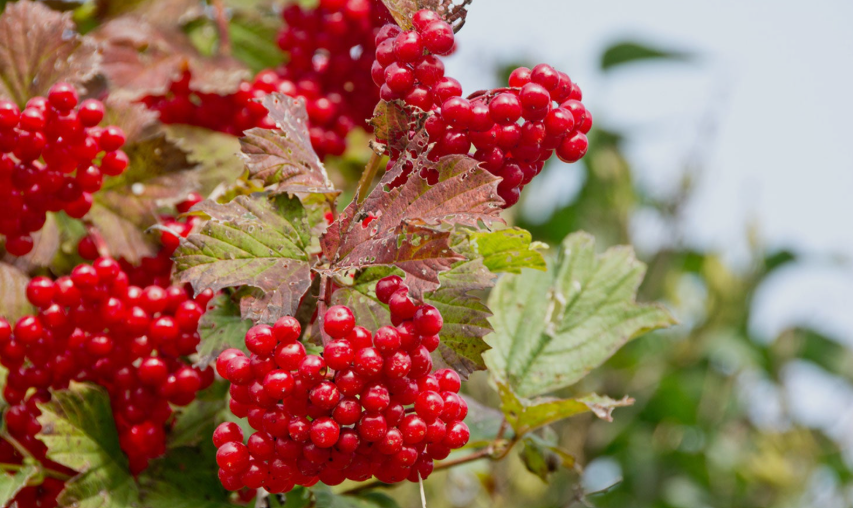
The leaves are the first clue that this is no ordinary viburnum. Each opposite leaf has 3 pointed lobes and coarse teeth, so it looks far more like a maple leaf than the oval leaves of most viburnums. The leaves are usually 2 to 5 inches long and dark green in summer. They turn yellow, red, or reddish-purple in autumn, though the fall color varies a lot from plant to plant and year to year.
The flowers open in late May and June as flat clusters 3 to 5 inches across, in what gardeners call a lacecap arrangement. The center of each cluster is packed with small fertile flowers that produce fruit. A ring of much larger, showy white flowers around the edge are sterile and exist only to attract pollinators. The effect is delicate and eye-catching, and it sets this shrub apart from native viburnums such as arrowwood and nannyberry, whose clusters lack the showy outer ring.
The fruit ripens in late summer to early fall as drooping clusters of round, translucent berries about ⅓ to ½ inch across. They turn a bright, glossy red and contain a single flat seed. The fruit usually stays on the branches through winter, since birds tend to eat it late in the season after more palatable foods are gone. The persistent red clusters against snow are among the most striking winter sights in northern gardens.
Telling It Apart from European Cranberrybush
The American and European cranberrybushes are so alike in leaf, flower, and fruit that even experienced gardeners confuse them. The most reliable way to tell them apart is to look at the leaf stalk just below the leaf blade, where both shrubs have small glands. On the American shrub, these glands are usually raised, with a rounded or domed top, and sit on short stalks. On the European shrub, they are flatter or concave on top, sitting more like small cups directly against the leaf stalk.
Taste offers a second clue for those willing to try. Fruit of the American shrub is tart but edible and widely used for jelly. Fruit of the European shrub is noticeably bitter and generally considered unpleasant. Buying from a reputable native-plant nursery and checking the plant name on the label is the simplest way to be sure you are getting the native. This matters because the European shrub has naturalized in woodlands across parts of the Northeast and Midwest, where it competes with native vegetation.
Also Read: Different Types of Viburnum Shrubs
Popular Cultivars
Several selections make American cranberrybush easier to fit into home landscapes. ‘Bailey Compact’ is one of the most widely planted, staying around 5 to 6 feet tall and wide, with dependable deep red fall color. ‘Compactum’, often sold as the dwarf American cranberrybush, reaches a similar size and flowers and fruits heavily on a smaller frame. Both suit foundation plantings and small yards where the full-sized species would grow too large.
Gardeners who want to harvest fruit often choose ‘Wentworth’, ‘Hahs’, or ‘Andrews’. All 3 were selected from wild plants in the early 20th century for larger, better-flavored berries. ‘Redwing’ is valued for its reddish new spring growth and strong fruit set. These named cultivars are less common in garden centers than their European counterparts, so mail-order native nurseries are often the most reliable source.
Edible Uses
The fruit of American cranberrybush is edible and has been used for food for centuries. Raw berries are very sour, with a musky smell that many first-time foragers find off-putting. The smell fades during cooking, and adding orange or lemon peel helps cover any remaining odor. Many harvesters wait until after the first hard frost, which softens the fruit and slightly mellows its sharp acidity.
The berries are naturally high in pectin, so they make a clear, ruby-red jelly that often sets without commercial pectin. They are also cooked into sauces for game and poultry, syrups, fruit leathers, and homemade wines. Because each berry holds a large flat seed, the fruit is almost always cooked and strained rather than eaten whole. Anyone foraging wild shrubs should first confirm they have the American plant, since the bitter European berries can make an unpleasant and inedible jelly.
Landscape Uses
American cranberrybush is one of the most attractive native shrubs for informal hedges, screens, and wildlife borders. Its upright, rounded growth fills space quickly, and its dense branching provides privacy from late spring through fall. Planted 6 to 8 feet apart, a row of shrubs forms a tall, flowering screen within a few seasons. The compact cultivars work well in mixed borders and along foundations.
The shrub’s tolerance for wet soil makes it valuable in rain gardens, along pond and stream edges, and in low areas that stay damp after storms. It also works well along woodland edges, where it softens the transition between lawn and trees. For year-round impact, plant it where its winter fruit can be seen from a window or walkway. The red clusters stand out most against snow or an evergreen backdrop.
Wildlife Value
The flowers attract a wide range of native bees, flies, and beetles in late spring, and the foliage supports the caterpillars of several native moths and butterflies. Because the fruit is less appealing than many others when it first ripens, birds tend to leave it on the branches until late winter. That timing makes the shrub an important emergency food source in February and March, when other fruits are long gone.
Cedar waxwings, robins, grosbeaks, bluebirds, and ruffed grouse are among the birds that eat the fruit. Small mammals such as squirrels and chipmunks feed on fallen berries. The dense, multi-stemmed growth gives songbirds shelter from predators and harsh weather, along with good nesting sites. Deer will browse young shoots, so newly planted shrubs may need protection in areas with heavy deer pressure.
Growing Considerations
American cranberrybush is hardy from Zone 2 through Zone 7, which makes it one of the most cold-tolerant viburnums available. Virginia Tech notes that it performs best in Zones 2 to 6 and often suffers in the summer heat of Zone 7. It flowers and fruits most heavily in full sun with at least 6 hours of direct light each day. It tolerates partial shade but produces fewer berries there.
The shrub prefers moist, fertile, well-drained to poorly drained soil and is not fussy about pH. Plant it in spring or early fall, and water deeply and consistently through the first full growing season. A 2 to 3 inch layer of mulch keeps the soil cool and moist. Fruit production usually begins a few years after planting and reaches full yield around the fourth or fifth year. Pruning, when needed, should happen right after flowering, since next year’s flower buds form during summer. Removing a few of the oldest stems at the base every few years keeps the shrub vigorous and productive.
Pests and Problems
The most serious threat to American cranberrybush is the viburnum leaf beetle, an invasive insect from Europe that feeds only on viburnums. The University of Connecticut plant database, like many northeastern sources, lists this shrub among the viburnums the beetle damages most. Larvae chew young leaves in spring until only the veins remain, and adults feed again in summer. Several years of heavy infestation can kill even large, established shrubs.
Gardeners in areas where the beetle is established should check the shrubs every winter for rows of small, capped egg sites along the undersides of young twigs. Pruning out and destroying infested twigs before spring hatch is one of the most effective controls. Aphids sometimes curl new leaves in spring, and powdery mildew or leaf spot may appear in humid, crowded sites. Good air circulation and full sun reduce most foliage diseases. Outside the beetle’s range, American cranberrybush is generally a long-lived and low-maintenance shrub.
Sources
North Dakota State University Extension, “American Cranberrybush”
University of Maine Cooperative Extension, “American Cranberrybush”
Virginia Cooperative Extension, Virginia Tech, “European Cranberrybush Viburnum (Guelder Rose)”
University of Connecticut Plant Database, “American Cranberrybush Viburnum”