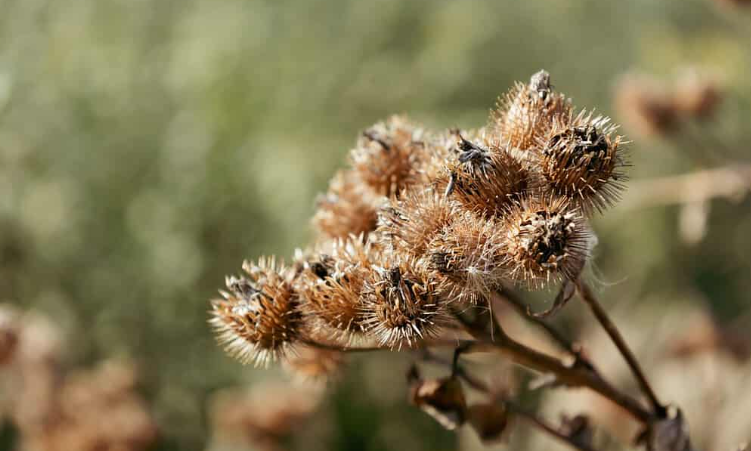
Shrubs with stickers can be some of the most useful plants in a landscape. Their thorns, prickles, or spines can create an effective living barrier around property lines, discourage browsing animals, and provide nesting cover for birds. Many are also attractive ornamental plants, producing colorful flowers, berries, fall foliage, or evergreen leaves.
The term “sticker” is commonly used for several different types of sharp plant structures. Roses and blackberries technically have prickles, while barberries have spines and hawthorns have true woody thorns. The difference is botanical, but from a gardener’s perspective, all can make an unpleasant surprise when a bare arm or leg meets the plant.
The shrubs below range from compact barberries to large firethorns and sprawling blackberry plants. Some are native to North America, while others originated in Europe, Asia, Africa, or South America and are now widely cultivated. Hardiness zones and mature dimensions are approximate because cultivars and growing conditions can significantly affect size.
1. Japanese Barberry (Berberis thunbergii)
Japanese barberry is a compact, densely branched shrub recognized by its sharp spines, small leaves, and often colorful foliage. Typical plants grow about 3 to 6 feet tall, with arching branches carrying spines about 1/2 inch long. Depending on the cultivar, foliage may be green, yellow, orange, burgundy, or reddish purple.
The species is native to Japan and has been introduced widely elsewhere, including much of the eastern United States. It tolerates a wide range of conditions and can grow in sun or partial shade. However, this adaptability has also made Japanese barberry invasive in parts of the United States. Japanese barberry identification and management information
2. Firethorn (Pyracantha coccinea)
Firethorn is one of the most striking thorny shrubs for warm-climate landscapes. It develops stiff, thorny branches and can reach approximately 6 to 15 feet tall, often with a similar spread. White flowers appear in spring or early summer, followed by masses of orange, red, or yellow berries that can remain on the plant into winter.
Native to parts of southern Europe and western Asia, firethorn is now widely grown as an ornamental shrub. It can be trained against fences and walls, planted as a hedge, or allowed to develop naturally. It performs best in full sun for heavy flowering and fruit production and can tolerate somewhat dry conditions once established. Firethorn growing information and landscape uses
3. Rugosa Rose (Rosa rugosa)
Rugosa rose is a particularly tough thorny shrub that forms dense, spreading growth. Mature plants commonly reach about 4 to 6 feet tall and can spread several feet wide. The stems are covered with numerous prickles, making the plant effective as a barrier or informal hedge.
This rose is native to coastal areas of eastern Asia, including parts of Japan, China, and Korea. It tolerates salt, wind, and relatively poor soils better than many ornamental roses, which is why it has traditionally been used in coastal landscapes. It produces fragrant pink, white, or reddish flowers followed by large red-orange rose hips.
4. Blackberry (Rubus spp.)
Blackberries are technically woody shrubs or shrub-like cane plants rather than conventional upright landscape shrubs. Depending on the type, their thorny canes may trail along the ground, grow upright, or arch outward. Trailing cultivars can produce new canes reaching 15 feet long, while erect varieties remain much more compact.
Blackberries grow naturally across large parts of North America, Europe, and Asia, depending on the species. Cultivated types are grown extensively for fruit, particularly in regions with suitable summer temperatures. There are thorny and thornless cultivars, with thornless selections often preferred for home gardens. Blackberry and raspberry growing guide
5. Raspberry (Rubus idaeus and related species)
Raspberries are another group of thorny cane-forming shrubs. Most cultivated raspberry plants reach roughly 3 to 6 feet tall, although vigorous canes can grow considerably longer before being supported or pruned. The stems may carry numerous small prickles that can easily catch clothing and skin.
Red raspberries are native across parts of Europe and northern Asia, while North American raspberry species and cultivars are also widely grown. Depending on the cultivar, raspberries may fruit on first-year canes, second-year canes, or both. Under suitable conditions, raspberry plants can begin producing meaningful crops about 2 years after planting and may remain productive for approximately 8 to 10 years. Raspberry and blackberry production information
6. Gooseberry (Ribes uva-crispa and related species)
Gooseberry is a compact fruiting shrub with an unmistakable defense system: sharp spines occur along the stems, particularly near the base of leaf clusters. Most cultivated plants remain around 3 to 5 feet tall, making them considerably smaller than many thorny barrier shrubs.
Gooseberries originated in Europe and western Asia, while several related Ribes species are native to North America. They are particularly useful in cooler climates because they can tolerate conditions that are unsuitable for many warm-season fruit crops. Some gooseberries can also produce fruit in partial or light shade, although good air circulation and adequate sunlight generally improve performance.
7. Hawthorn (Crataegus spp.)
Hawthorns are best known as small trees, but several species can grow as large, multistemmed shrubs. Their branches carry woody thorns that commonly measure 1 to 3 inches long, depending on the species. They also produce clusters of white or pink flowers followed by small red or orange fruits.
There are more than 380 species in the genus Crataegus, giving gardeners an enormous range of forms to choose from. Hawthorns occur naturally across North America, Europe, and Asia, with many species adapted to temperate climates. They can provide flowers for pollinators and persistent fruit for wildlife, although their thorns require careful placement around paths and play areas. Hawthorn species, characteristics, and landscape information
8. Bougainvillea (Bougainvillea spp.)
Bougainvillea is usually described as a woody vine, but it can be trained into a large, sprawling shrub and is frequently used as a thorny landscape barrier. Depending on the species and climate, plants can reach approximately 15 to 40 feet tall and wide when given room to climb.
Native to South America, bougainvillea thrives in hot, sunny climates and is particularly well suited to USDA Zones 9b through 11. Its long, curved thorns help the plant climb through surrounding vegetation or structures. The spectacular pink, purple, red, orange, or white displays are actually colorful bracts surrounding small true flowers. Bougainvillea growing requirements and dimensions
9. Woods Rose (Rosa woodsii)
Woods rose is a North American native shrub that usually reaches about 2 to 5 feet tall and often forms dense thickets. Its stems carry straight or curved prickles, giving the plant a naturally protective structure.
It occurs across much of western and central North America, particularly in open woodland, grassland edges, stream corridors, and other naturally disturbed habitats. Pink to dark rose-colored flowers appear from spring into summer, followed by orange-red rose hips that can remain on the plant through winter. This combination makes woods rose valuable for both wildlife habitat and native plant landscaping. Woods rose profile and growth characteristics
10. Cockspur Hawthorn (Crataegus crus-galli)
Cockspur hawthorn is a particularly formidable thorny shrub or small tree. Its branches can carry thorns measuring approximately 1 1/2 to 3 inches long, although thornless cultivars are also available. Mature plants can reach roughly 20 to 35 feet tall, so they need considerably more space than a compact barberry.
The species is native to eastern North America, with a natural range extending from parts of the Northeast south toward Texas. It produces white flowers in spring, followed by small red fruits, while the foliage can develop attractive orange-red color in autumn. Its dense, thorny branches can provide excellent wildlife cover, but placement away from high-traffic areas is important. Cockspur hawthorn details and landscape characteristics
11. Scarlet Firethorn (Pyracantha coccinea)
Scarlet firethorn deserves special mention because it is one of the most commonly cultivated firethorns and is particularly useful as a defensive hedge. The branches are stiff and thorny, while the shrub can grow to approximately 6 to 15 feet tall and spread to a similar width if left unpruned.
Its evergreen or semi-evergreen foliage gives it year-round structure in warm climates. In spring and early summer, small white flowers cover the branches, followed by clusters of bright berries that can persist through winter. Cultivars differ in berry color, including orange-red and yellow. The dense growth can also provide shelter and food for birds.
12. Oregon Grape (Mahonia aquifolium)
Oregon grape is an evergreen North American shrub with stiff, leathery leaves whose edges are sharply spiny. Mature plants commonly reach approximately 3 to 6 feet tall, although their size and habit vary with conditions and cultivar.
Native to the Pacific Northwest and parts of western North America, Oregon grape is particularly well adapted to woodland edges, dry shade, and other challenging sites. Its yellow flowers appear in clusters in late winter or spring, followed by blue-purple berries. The glossy foliage can turn reddish or bronze during colder weather, giving the plant ornamental value even outside its flowering season.
Quick Comparison: 12 Shrubs With Stickers
| Shrub | Typical size | Main sharp feature | Flowers or fruit | General growing range |
|---|---|---|---|---|
| Japanese barberry | 3–6 ft | Spines | Red berries | Much of temperate U.S. |
| Firethorn | 6–15 ft | Thorns | Red, orange, or yellow berries | Warmer temperate regions |
| Rugosa rose | 4–6 ft | Prickles | Rose hips | Temperate/coastal areas |
| Blackberry | 3–15 ft+ canes | Prickles | Black fruit | Much of U.S. |
| Raspberry | 3–6 ft | Prickles | Red, black, yellow, or purple fruit | Cool to temperate regions |
| Gooseberry | 3–5 ft | Spines | Edible berries | Cool temperate regions |
| Hawthorn | 10–35+ ft | Thorns | Red/orange fruits | Temperate regions |
| Bougainvillea | 15–40 ft | Thorns | Colorful bracts | USDA Zones 9b–11 |
| Woods rose | 2–5 ft | Prickles | Rose hips | Western/central North America |
| Cockspur hawthorn | 20–35 ft | 1.5–3 in thorns | Red fruit | Eastern North America |
| Scarlet firethorn | 6–15 ft | Thorns | Persistent berries | Warmer temperate regions |
| Oregon grape | 3–6 ft | Spiny leaves | Blue-purple berries | Western North America |
Why Grow Shrubs With Stickers?
The biggest advantage is natural protection. A dense thorny shrub can make an effective boundary without the visual harshness of a fence or wall. Firethorn, barberry, roses, and some hawthorns can form dense barriers that are difficult for people and animals to pass through.
Thorny shrubs can also have substantial wildlife value. Their branches provide nesting and hiding places, while berries and rose hips can provide food. However, not every thorny shrub is appropriate for every property. Plants with sharp branches should generally be kept away from sidewalks, children’s play areas, patios, and frequently used garden paths.
Best Thorny Shrubs for a Security Hedge
For a defensive hedge, firethorn, rugosa rose, blackberry, Japanese barberry, and some hawthorns are among the more obvious choices. Firethorn has the additional advantage of evergreen or semi-evergreen foliage in suitable climates, while rugosa rose can tolerate exposed coastal conditions.
For smaller spaces, Japanese barberry and gooseberry are easier to manage because they remain much shorter. However, check local regulations and invasive-plant lists before planting Japanese barberry. Its ability to spread and establish outside cultivation has caused concern in many parts of the eastern United States.
Best Thorny Shrubs for Wildlife
Native roses and hawthorns can be particularly valuable in wildlife-oriented gardens. Woods rose provides flowers, hips, and dense cover, while hawthorns provide spring flowers and persistent fruit.
Blackberries and raspberries can serve a dual purpose by providing wildlife habitat while also producing edible fruit. Their vigorous canes, however, need regular management if you want them confined to a particular part of the garden.
Things to Consider Before Planting
A thorny shrub should be planted with its mature size and location in mind. A plant that looks harmless when purchased in a small container can become a dense, wide barrier within a few growing seasons. Blackberry canes, for example, can become extremely long, while firethorn and bougainvillea can eventually occupy a large area.
Also consider maintenance. Pruning a thorny plant is more difficult than pruning a smooth-stemmed shrub, so protective gloves, long sleeves, and appropriate tools are worthwhile. If a shrub is intended for a hedge, pruning it while young can be easier than trying to reshape an established, tangled plant.
Finally, remember that “thorny” does not automatically mean “low maintenance.” Some species spread aggressively, while others require regular pruning to remain attractive. The best choice is one whose mature size, climate requirements, growth habit, and level of defensiveness match the location.
Key Takeaways
Shrubs with stickers can be beautiful, practical, and surprisingly useful. From the colorful berries of firethorn and the flowers of rugosa rose to the edible fruit of blackberries and raspberries, these plants offer much more than simple protection.
For a compact thorny shrub, Japanese barberry or gooseberry can be useful where appropriate. For a larger barrier, firethorn, rugosa rose, or blackberry may be better choices. In native-plant landscapes, woods rose, hawthorn, and Oregon grape can combine sharp defenses with flowers, fruit, and wildlife value. The key is to choose the right species for your climate and give every thorny plant enough room to grow without interfering with people, pets, or pathways.
Further References
- North Carolina State University Extension — Plant Defense: Thorns, Spines, and Prickles.
NC State Extension — Plant Defense
Excellent botanical reference explaining the differences between prickles, spines, and true thorns. It also gives examples including roses, blackberries, raspberries, barberries, hawthorns, firethorn, and honey locust. - University of Missouri Extension — Of Thorns, Spines and Prickles.
University of Missouri Extension — Of Thorns, Spines and Prickles
Useful for explaining the terminology behind sharp plant structures and identifying shrubs such as firethorn, hawthorn, and Japanese flowering quince. - Penn State Extension — Multiflora Rose: Accurate Identification.
Penn State Extension — Multiflora Rose Identification
Provides detailed identification information for multiflora rose, including its prickly canes, leaves, flowers, fruits, growth habit, and differences from raspberries and blackberries. - North Carolina State University Extension — Scarlet Firethorn (Pyracantha coccinea).
NC State Extension — Scarlet Firethorn
A useful species-level reference for firethorn, a popular thorny shrub recognized for its sharp spines, evergreen foliage, white flowers, and bright orange-red berries. - Virginia Cooperative Extension — Edible Landscape Species: Shrubs, Vines, and Groundcovers.
Virginia Cooperative Extension — Edible Landscape Species
Particularly useful for sections covering thorny raspberries and blackberries, including their growth habits, cultivars, hardiness zones, and thornless alternatives.